Same Proven Process, Organized for Continuous Output
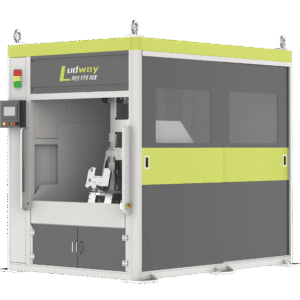
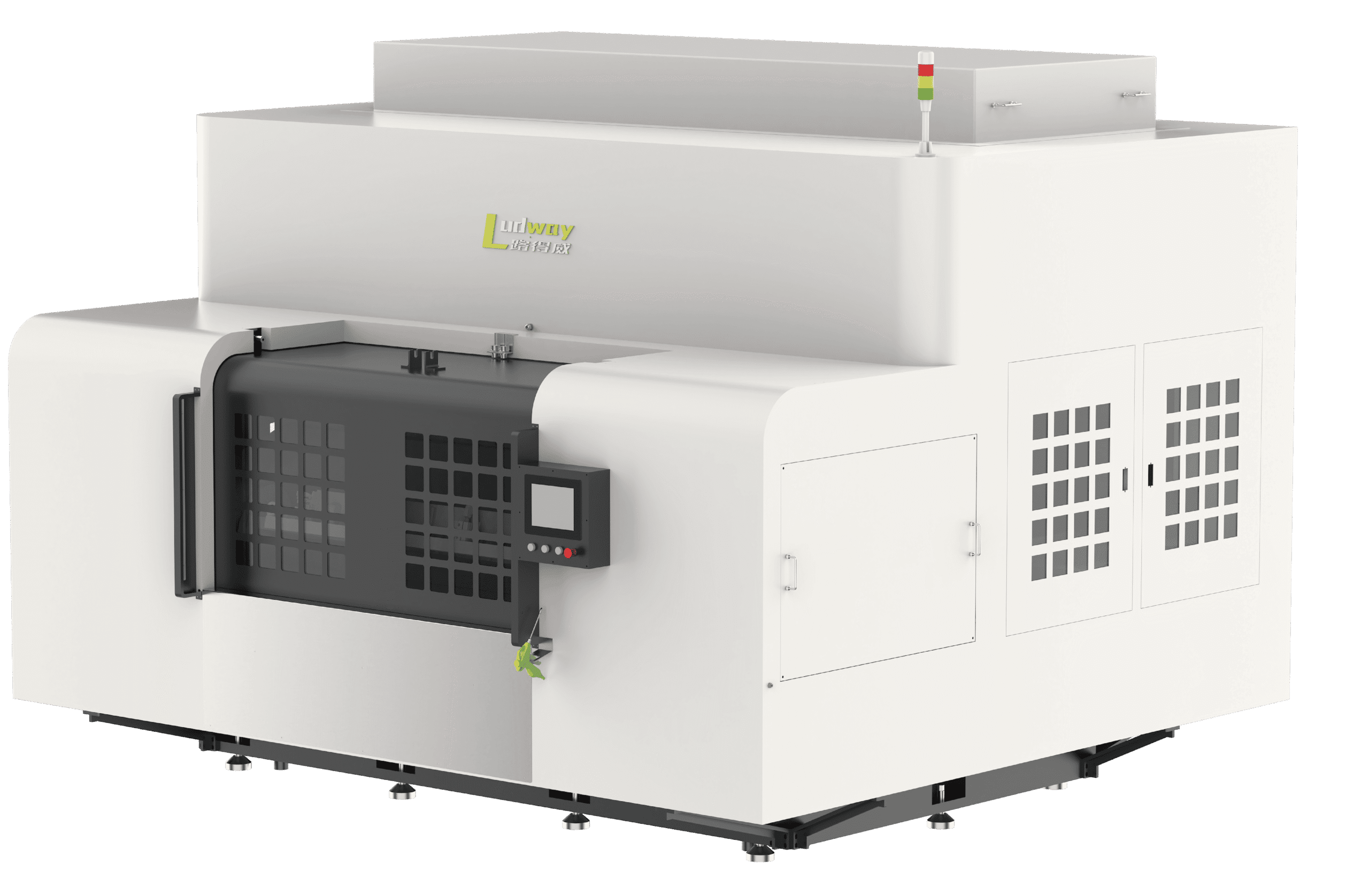
This machine is the five-axis LDW-5R platform rebuilt around one production decision: the part should never wait for a person. Where the single-station five-axis machine machines, then pauses while the casting is swapped, this version carries two independent workstations that alternate in front of the same spindle column. Cutting continues on one station while the other is loaded, so the equipment runs as a capacity machine rather than a job-shop tool.
The process envelope itself is unchanged from what makes the five-axis platform popular: X500 x Y400 x Z300 mm of travel, a 21-station tool magazine that carries the full cutter, chamfer, brush, and abrasive sequence for a casting in one program, and five-axis teach programming with stored programs per workpiece. Xindai control and servo drives run both axes and cycle logic, with optional RTCP for work on steep walls and deep pockets. What the second station adds is throughput, and what it asks in return is floor space and volume.
How the Alternating Cycle Works
Walk through one full cycle and the logic becomes concrete. The operator loads a raw casting into the fixture on station one and starts the program. The column moves to station one and begins cutting. While the spindle runs, the operator unloads the finished part from station two and loads the next raw casting there. When the program completes, the head retracts, the machine indexes to station two, and cutting resumes immediately. Handling time is absorbed into machining time instead of being added to it.
The machine grows to make room: L3450 x W1920 x H2710 mm overall against L2289 x W1898 x H2698 mm for the single-station build, roughly one more meter of length along the station axis. Two fixtures, or two part numbers, can live on the two stations simultaneously, which suits plants that run small families of related castings in parallel rather than one high-volume part.
Single Station Versus Dual Station: The Honest Comparison
| Decision Factor | Five-Axis Single Station | Five-Axis Dual Station (This Machine) |
|---|---|---|
| Steady-state cycle per part | Cutting time + loading time | Approaches cutting time only |
| Footprint (L x W) | 2289 x 1898 mm | 3450 x 1920 mm |
| Operator attention per part | Every cycle, machine waits | Every cycle, machine does not wait |
| Best-fit production | Many part numbers, short batches, frequent changeovers | Stable families at volume, two or three shifts |
| Changeover flexibility | Single fixture, fastest swaps between unrelated parts | Two stations can hold different fixtures or part numbers |
| Entry investment | Lower | Higher, offset by output per square meter |
For illustration only, since real figures depend on the part and tool path: a casting with 75 seconds of cutting and 35 seconds of handling takes 110 seconds per piece on a single station. With the handling hidden inside the cutting cycle, the dual-station machine approaches one piece per 75 seconds, close to 45 percent more output from one spindle. If your cutting time is short and handling is long, the gain is larger; if parts are heavy and slow to cut, the gain narrows. That ratio, not the brochure, should drive the choice.
Built to Run Long Shifts
Continuous operation is a waste-management problem as much as a control problem, and the machine is equipped accordingly. A wet chip removal structure separates coolant from metal chips into a hopper, so swarf from aluminum and cast iron finishing does not accumulate around the fixtures during multi-hour runs. Automatic lubrication services the motion assemblies on schedule, and the oil-cooled spindle holds its position through thermal cycles. Guards cover the moving elements, and the HMI tracks running status, output counts, alarms, and tool condition for both stations, which lets one supervisor watch several machines instead of standing at one.
Specifications
| Specifications | LDW-5R-21T-500-2 |
|---|---|
| Overall Dimensions | L3450 x W1920 x H2710 mm |
| Equipment Travel | X500 mm + Y400 mm + Z300 mm |
| Idle Speed | 32000 mm/min |
| Processing Speed | 500-8000 mm/min |
| Spindle Cooling Method | Oil Cooling |
| Air Pressure Requirement | ≥0.55 MPa |
| Tool Magazine Capacity | 21 Tools |
| Number of Control Axes | 5 |
| Station Structure | Dual independent workstations |
Note: specifications are subject to change without prior notice for product optimization; accuracy class, spindle power, and machine weight are confirmed per workpiece configuration.
Parts and Volumes That Justify the Second Station
The part profile matches the single-station five-axis machine: aluminum die castings and similar components within the travel envelope that finish inside 21 tools, including head covers, housings, brackets, and hardware castings. The volume profile is what differs. The dual-station build pays where a part family runs day after day at rates that make spindle idle time expensive, or where two related part numbers should run in parallel on one machine. Below those volumes, the single-station machine with the identical process is the more sensible buy, and saying so plainly is part of the service.
Related Guides
Before specifying, two background reads help. The robotic grinding guide covers the finishing processes these machines execute, tool by tool, on casting surfaces. The deburring machine types selection guide places single-station, dual-station, and robotic layouts side by side with the volume and tolerance boundaries of each.
Get a Takt Assessment on Your Part
Send the casting drawing, current manual or machine cycle times, and monthly volumes through the contact page. UBright will run the single-versus-dual station calculation on your numbers, propose the fixture and tool plan, and offer a proof of concept so the projected cycle is demonstrated rather than assumed.