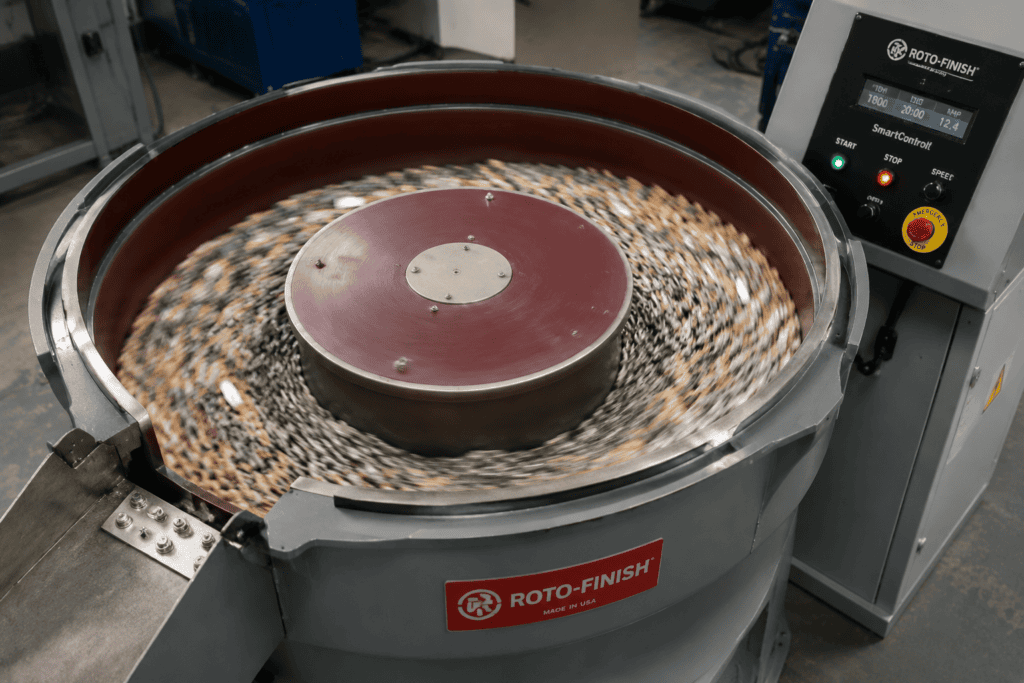
Centrifugal disc finishing is a high-energy mass finishing process in which a disc at the bottom of a stationary bowl spins at high speed, throwing media, compound, and workpieces up and outward against a fixed wall so the load climbs, stalls, and rolls back down over itself in a continuous toroidal circuit. Because the fastest media layer scrapes past the slowest one thousands of times per minute, the process removes burrs and refines edges roughly 5–10 times faster than vibratory finishing on comparable work, and some machine makers quote 10–30 times on aggressive applications. Where a vibratory bowl needs two hours and a barrel tumbler needs six, a disc finisher often closes the same job in a 10–20 minute window. That speed, applied to parts small enough to fit the bowl, is why it has become the default bulk edge process in precision hardware plants.
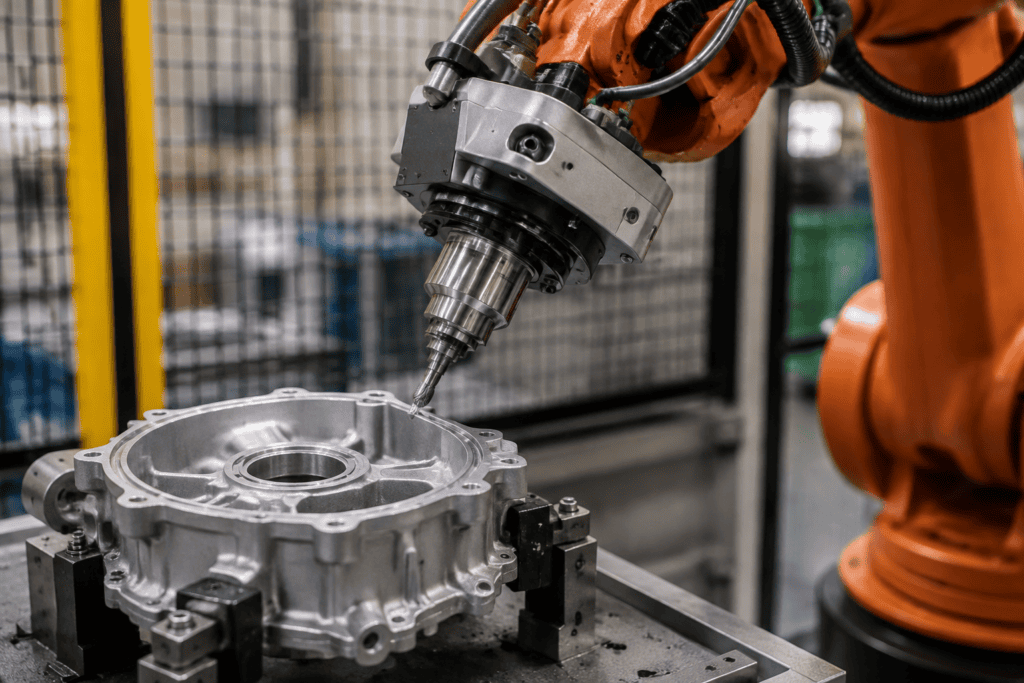
We build robotic polishing and deburring cells at UBright Solutions, and the centrifugal disc finisher is the machine we most often place in front of our own robots. It clears the bulk edge work on parts too small to fixture one at a time, at consumable costs no robot can approach. What it cannot do is everything: media-trapping geometry, contact-sensitive parts, and large work still need different equipment, and knowing those boundaries before you buy is the difference between a fast machine and an expensive shortcut.
How the Mechanics Differ From Every Other Bowl
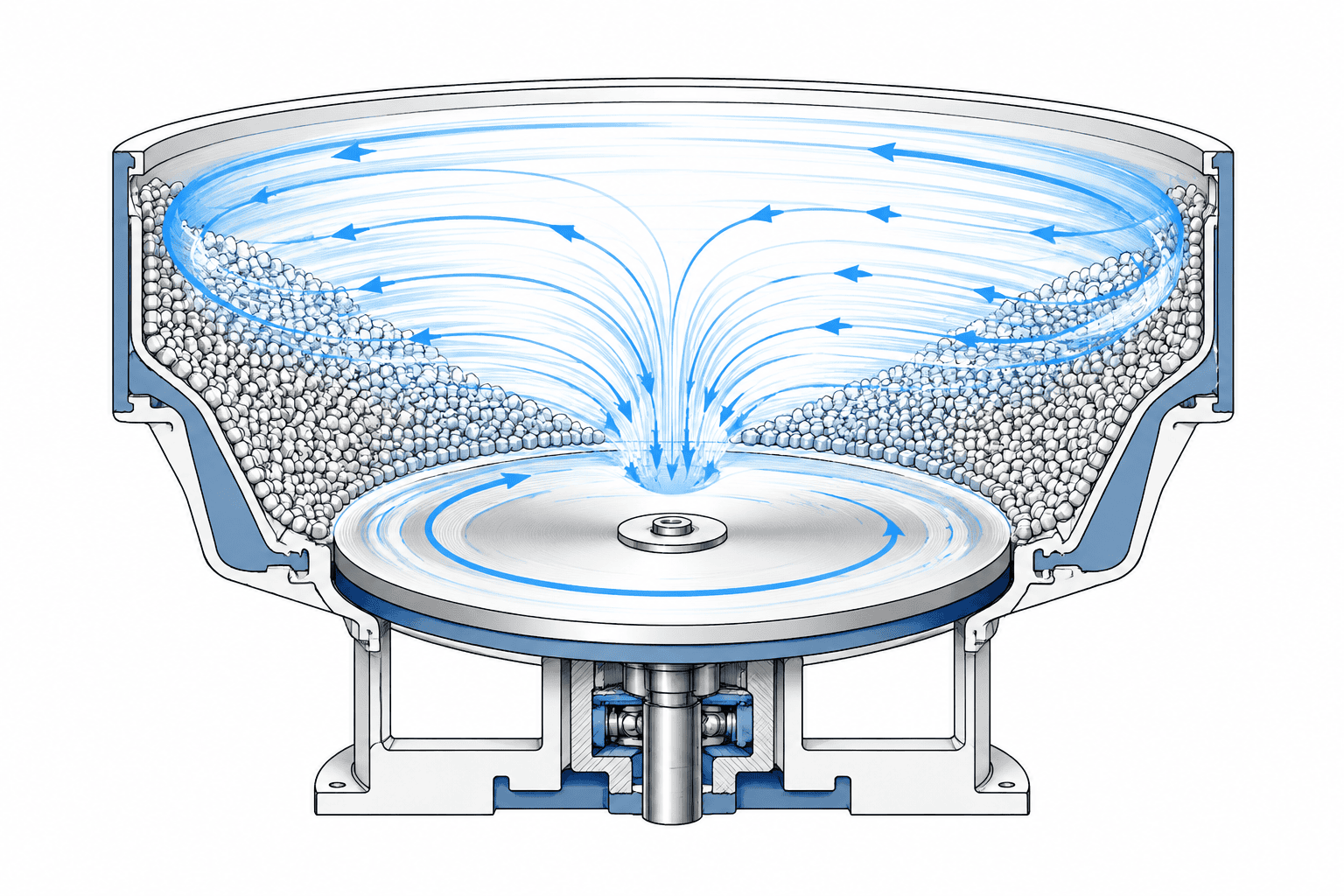
Two surfaces do all the work, and only one of them moves. The bowl—the outer wall and the lower side walls—stands still, usually lined with polyurethane to absorb impact and resist abrasive wear. The disc, a hardened plate seated into the bowl floor, rotates at a speed you control through a variable-frequency drive. Load the bowl with media, water, compound, and parts, then start the disc. It grips the bottom of the load and accelerates it outward and up the wall, where the load decelerates, loses the fight with gravity past the widest point of the bowl, and turns back inward and down toward the disc, which flings it out again. The result is a doughnut-shaped current—up the wall, over the top, down the middle—that a modern disc finisher sustains continuously and quietly. Operators describe the sound as closer to a commercial washing machine than to a vibratory bowl hammering the floor all shift.
The cutting action lives in the velocity difference between layers. Media riding the disc edge moves at rim speed; media hugging the stationary wall barely moves at all. The load shears against itself in between, and the sliding layer where most material removal happens sweeps every part through it dozens of times per minute. The contrast with the two low-energy methods is immediate. In tumble deburring, parts only see abrasive action inside the thin active layer of a collapsing cascade, a few seconds out of every barrel rotation. In vibratory finishing, the whole load turns over gently a few times per second under a micro-amplitude shake. The disc machine forces the same media through high-relative-speed contact essentially without interruption, which is the entire basis of its speed advantage.
What “High Energy” Means in Numbers
Process engineers rank mass finishing methods by how hard the media pushes against the workpiece, in multiples of gravity. A vibratory bowl working a normal recipe subjects the load to roughly 3–6g. A centrifugal disc finisher drives its sliding layer into the 10–15g band—machine-dependent, climbing further on large machines at full output. Centrifugal barrel systems, the other common high-energy method, sit higher still. The practical meaning: five to ten times the contact force, sustained almost continuously, gives five to ten times the cut rate per minute, subject to media and compound doing their share.
That energy has to go somewhere, and three consequences follow. First, heat: the load warms as it works, and long polishing cycles need flow-through compound—fresh solution in, spent solution out—to carry heat and swarf away before chemistry degrades around the 50°C mark. Second, media wear: abrasive media in a disc machine consumes itself faster per running hour than the same media in a vibratory bowl, though the shortened cycle often leaves total media consumption per batch in the same range. Third, part protection becomes an active variable. The disc speed that shears a burr off a hardened steel pin will scuff a soft aluminum cosmetic face if you let it, which is why a variable-frequency drive is not a luxury: slower for delicate work, faster for coarse deburring, the exact same settings every batch.
Machine Anatomy: Disc, Bowl, Gap, and Discharge
The category is compact; every builder follows the same recipe.
The bowl and disc. Production machines range from benchtop units with roughly 8-liter bowls and 9-inch disc diameters up to floor models in the 60–120 liter class with discs of 20–24 inches; the largest single-bowl machines on the market reach the 170-liter neighborhood. Multiple chambers multiply capacity on one frame—up to four 8-liter bowls or three 22-liter chambers on a single cabinet, so coarse and fine steps run simultaneously in one footprint.
The gap, and its adjustment. Between the spinning disc edge and the stationary wall there is a narrow running clearance. Tighten it and media pressure in the shear zone rises along with cut rate and disc wear; open it and the action softens but small parts gain room to wedge. Every serious machine gives you a mechanical way to set this—tool-free rotary adjusters on premium builds, adjustment bolts on standard ones. Some makers have made gap adjustment their headline feature, and it earns the attention: gap, disc speed, and media selection are the three levers that control the entire process.
The liner. The wall wears. Polyurethane liners are replaceable, and liner replacement cost and downtime belong in any five-year ownership calculation, not just the purchase price.
Compound and discharge. Flow-through compound systems meter liquid into the bowl and overflow dirty solution out, keeping the bath clean through long runs. Discharge is the other design fork: on standard machines you stop the disc and tip the whole tub forward over a screen so media falls back for the next batch, while automated versions add unload-and-reload systems, integrated media separators, and PLC control for unattended cycles. Power requirements run from single-phase 110–220V on benchtop models to three-phase supplies on production floor units.
Parts That Thrive in the Bowl
The machine has a size sweet spot, and it is small. Parts from a few millimeters up to roughly 15 centimeters make up the working population—below that floor there is nothing to finish, and above it the bowl physics stops cooperating. Within that envelope, the winners share one trait: they arrive in volume, carry burrs on accessible features, and tolerate rolling in a media mass.
Stamped and fine-blanked hardware was the original constituency—small brackets, contacts, washers, and shims where punch-breakout burrs need consistent edge break. Turned and milled small parts follow: screws, fittings, spacers, pins, and small machined components in steel, stainless, brass, copper, titanium, and aluminum, where a 15-minute cycle replaces an hour of bowl time or a hand-deburring station. The electronics sector runs entire product families through disc finishers—connectors, shields, buttons, clips, and structural hardware across consumer electronics manufacturing, where takt times measured in minutes do not tolerate overnight vibratory cycles. Medical and dental work and volume additive parts round out the roster; printed components benefit most of all, because the aggressive shear strips partially sintered powder and sharp surfaces in a fraction of the time gentler processes need.
The collision question deserves its own sentence rather than a footnote. Parts in a disc machine follow each other in an orderly orbital stream—they do not clink and dink the way loose parts in a barrel can—but no honest vendor will guarantee they never roll over one another. For paint-grade or mirror faces, media selection, high media-to-part ratios, and reduced disc speed manage the risk; for parts whose appearance cannot accept any random contact, the process is simply wrong—the next section covers where to go instead.
Centrifugal Disc vs. Vibratory vs. Tumbling
All three processes put loose media against parts in bulk. The differences are energy, contact character, and scale, and they decide which machine earns the floor space.
| Centrifugal disc | Vibratory | Tumbling (barrel) | |
|---|---|---|---|
| Typical deburr cycle | 3–15 minutes | 1–3 hours | 2–6 hours |
| Relative aggressiveness | High, continuous shear | Moderate, gentle micro-contact | High but intermittent |
| Part-on-part risk | Moderate (orderly flow, not zero) | Low to moderate | Moderate to high |
| Practical part size | Up to ~150 mm | Very large parts possible | Large batches of mid-size parts |
| Batch character | Small to medium, fast turnover | Medium to large | Large, slow, unattended |
| Floor environment | Quiet, compact | Noisy, needs more area | Quiet but slow |
Read the table as a routing tool rather than a scoreboard. The vibratory bowl remains the general-purpose workhorse—the only one of the three that handles genuinely large parts, and where surface refinement matters more than speed, its gentler action is an advantage; our vibratory finishing guide covers that territory in detail. The barrel tumbler wins on cost per part for big lots of collision-tolerant hardware and runs unattended overnight, a scheduling feature the other two cannot match; the tumble deburring guide explains where barrels still win. The disc machine takes the center of that map: small precision parts, short cycles, processes pinned to takt time. In plants we equip, the three frequently coexist, each fed with the part families that fit it.
Cycle Times You Can Actually Plan Around
Numbers from machine builders and from our own process work cluster tightly enough to plan around, provided you treat them as starting points rather than guarantees. Light deburring of small parts with straightforward burrs: 3–15 minutes. Edge radiusing and surface smoothing: 10–30 minutes for most geometries. Polishing toward a refined or near-mirror finish: 30–60 minutes and up, depending on the starting surface and the media doing the final work. Cleaning and descaling as their own step: often inside 5–10 minutes.
Set those against the alternatives on identical work: a vibratory bowl that deburrs in 60–120 minutes and a tumbler that needs 2–6 hours compress, in a disc machine, into that single-digit-to-low-double-digit window—hence the 5–10× factor we plan with, and the 10–30× figures quoted for aggressive ceramic-media work on hard alloys. Three variables move you inside those ranges: disc speed (more is faster and rougher), media cut (fast-cut ceramic versus gentle plastic or polishing porcelain), and the gap setting. Establish the real number by pulling samples at intervals during first articles, then freeze the recipe—over-running a disc cycle degrades edges and surfaces just as surely as over-tumbling, only faster.
The Honest Limits
Four boundaries account for nearly every misapplied disc finisher we have been asked to rescue.
Large and long parts. Past roughly 150 mm, or for parts with a long axis that cannot tumble freely, the toroidal flow cannot carry the workpiece and the wall becomes a battering ram—vibratory territory, or robotic territory for parts with geometry worth fixturing.
Very thin and delicate sections. Stampings thin enough to flex, fine springs, and delicate flanges risk bending and media peening. Some survive with softened parameters and careful media selection; a trial on samples, not a leap of faith on a production batch, is the only sane way to find out.
The gap itself. The clearance between disc and wall is a pinch point. Thin flat parts, clips, and slotted components occasionally wedge into it no matter how orderly the flow above looks—jamming the disc or marring the part. Adjustable-gap machines exist precisely for this; with wedge-prone part families, check the clearance before the first cycle, not after the first crash.
Cosmetic-critical faces. A disc finisher produces an even, uniform surface—matte or satin depending on media—which is exactly right for thousands of parts and exactly wrong for the visible show surfaces of a consumer product. The production answer in 3C hardware is a chain, not a choice: mass finishing takes down burrs and breaks edges in bulk, then force-controlled equipment refines the appearance surfaces that survived contact. Our smartphone mid-frame finishing work follows exactly that split—bulk edge work first, robotic polishing for the cosmetic arcs and R-angles no random-process machine should touch.
Buying Checks That Separate Good Machines From Cheap Ones
The purchase decision is less about brand and more about whether seven specific things are present and serviceable.
Disc speed control. Insist on a variable-frequency drive. Fixed-speed machines force every process problem to be solved with media alone—slower and less repeatable.
Gap adjustment. Ask how the disc-to-wall clearance is set and how long a change takes. Tool-free rotary systems cost more than bolts and pay for themselves the first time your process engineer tunes a new part family.
Liner quality and replacement. Confirm the liner material, its expected life in your media, the parts price, and whether your own technicians can perform the swap. This is the number-one lifetime cost that purchase-price comparisons miss.
Discharge method. Tip-the-tub discharge is standard and fine at low volume. If your takt target is minutes per batch, price the automated unload-and-separation option up front; retrofitting automation later costs more than ordering it built in.
Compound system. A flow-through system with dosing keeps long polishing cycles inside their temperature and cleanliness windows. Batch-and-drain machines make you the flow-through system.
Chamber count. Multi-chamber machines let coarse and fine steps run simultaneously in one footprint. If your parts need staged media—and most precision parts do—decide this on day one.
Sample processing. Any maker confident in the machine will run your parts and report media, compound, speed, and cycle time before you sign. Makers who skip this step are telling you whose risk the purchase is.
Where Disc Finishing Sits in the Mass Finishing Family
Zoom out and the map is tidy. All bulk finishing processes put loose media, compound, and parts in motion against each other; they differ in how hard and how often. Our mass finishing overview lays out the full selection logic; in brief, the vibratory bowl holds the general-purpose center, barrel tumbling the low-cost bulk end, centrifugal disc finishing the high-energy position for small parts and short cycles, and centrifugal barrel and drag or spindle systems the high-energy branch toward still-faster or still-more-precise work. Disc finishing is also the most approachable entry into high energy—meaningfully cheaper than centrifugal barrel equipment for comparable small-part throughput, and simpler to operate and maintain.
The machine is only half of any recipe; the media inside decides whether that energy cuts, polishes, or burnishes. Fast-cut ceramic for burrs, plastic for soft alloys, porcelain and steel for luster—the media’s shape, size, and abrasive load interacts with disc speed and gap more strongly than in any vibratory process. The deburring media guide covers that selection in depth—read it immediately after this one.
Frequently Asked Questions
How much faster is centrifugal disc finishing than vibratory finishing?
Plan around 5–10 times faster for equivalent results on small parts—our working number, and the factor we use when sizing cells. Machine makers quote up to 10–30 times on aggressive applications with fast-cut ceramic media on hard alloys. The exact ratio depends on burr size, material, media, and disc speed—sample processing on your own parts beats any published multiplier.
What size and type of parts work in a centrifugal disc finisher?
Parts from a few millimeters to roughly 15 centimeters that can tolerate rolling in a media mass: stamped hardware, turned and milled small parts, connectors and electronics components, medical and dental work, and volume additive parts. Large or long parts, very thin sections prone to flexing, and parts with cosmetic faces that cannot accept random contact belong in other processes.
Can the process reach holes, slots, and internal features?
Yes, and this is one of its strengths—the forced three-dimensional flow drives media into grooves, slots, through-holes, and recesses that a cascade in a tumbler rarely touches. The constraint is media sizing: media must be meaningfully smaller than the smallest feature you want worked, and deep blind pockets with narrow openings still see limited action because media cannot circulate freely inside them.
Is centrifugal disc finishing run wet or dry?
Wet is standard—water plus a compound that suspends swarf, keeps parts clean, and protects against corrosion. Flow-through compound systems earn their cost on any machine running cycles past a few minutes. Dry organic media such as corn cob or walnut shell has a place too, mostly as a drying and burnishing step after a wet cycle.
How much does a centrifugal disc finishing machine cost?
Small floor models start in the same budget band as production vibratory equipment, benchtop units sit below that, and fully automated multi-chamber cells with integrated separation climb toward robotic-cell pricing once unload systems and PLC control are added. Media, compound, liners, and energy are the recurring costs behind the real number. Most makers will process your samples and give budget guidance before you commit—take the offer.