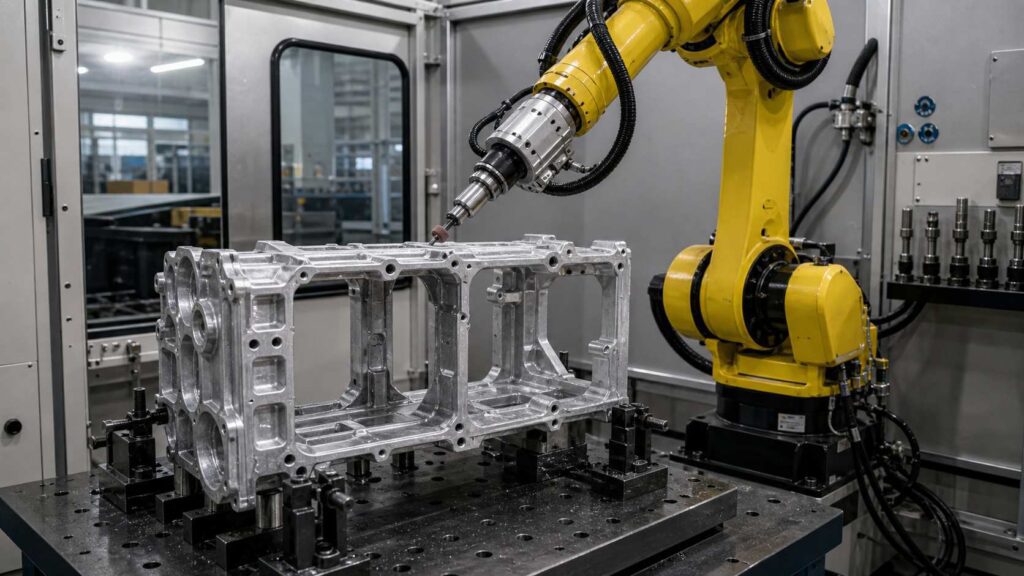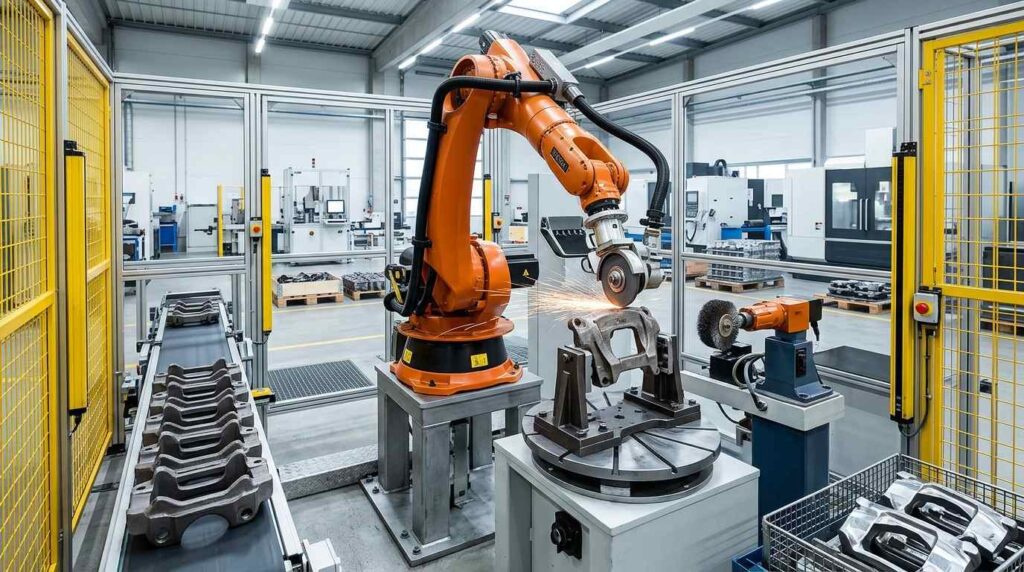
Caliper brackets are critical structural components in automotive braking systems. They are widely used in passenger vehicles, commercial vehicles and other transportation equipment where brake calipers must be mounted securely and positioned accurately. As a typical cast iron automotive part, a caliper bracket often includes multiple holes, mounting interfaces, outer contour transitions and localized edge areas that require reliable post-casting finishing.
During casting and rough machining, caliper brackets may develop burrs, flash, parting lines, sharp edges and local surface irregularities around hole edges, outer profiles and assembly-related areas. If these defects are not removed properly, they may affect handling safety, assembly accuracy, coating quality and the overall consistency of downstream production. For manufacturers handling repeated caliper bracket models in batches, manual finishing can become inefficient and difficult to standardize.
Traditional manual grinding requires workers to repeatedly process hole edges, contour transitions and selected mounting-related surfaces. Because the workpiece contains several local features rather than one long continuous path, quality often depends heavily on operator experience. A robotic grinding solution provides a more controlled and repeatable method for finishing cast iron caliper brackets while reducing heavy manual grinding work.
This solution is designed for cast iron caliper brackets with typical dimensions around 440 × 140 × 160 mm. It focuses on robotic grinding, hole-edge deburring, contour smoothing and finishing preparation on assembly-related non-critical areas before coating, assembly or shipment.
What is a Caliper Bracket?
A caliper bracket is a support and positioning component used in a disc brake system. It connects the brake caliper to the steering knuckle, axle or suspension-side structure and helps maintain the correct relationship between the brake caliper and brake disc. The bracket must provide reliable strength and dimensional stability because it works under repeated braking loads and vibration.
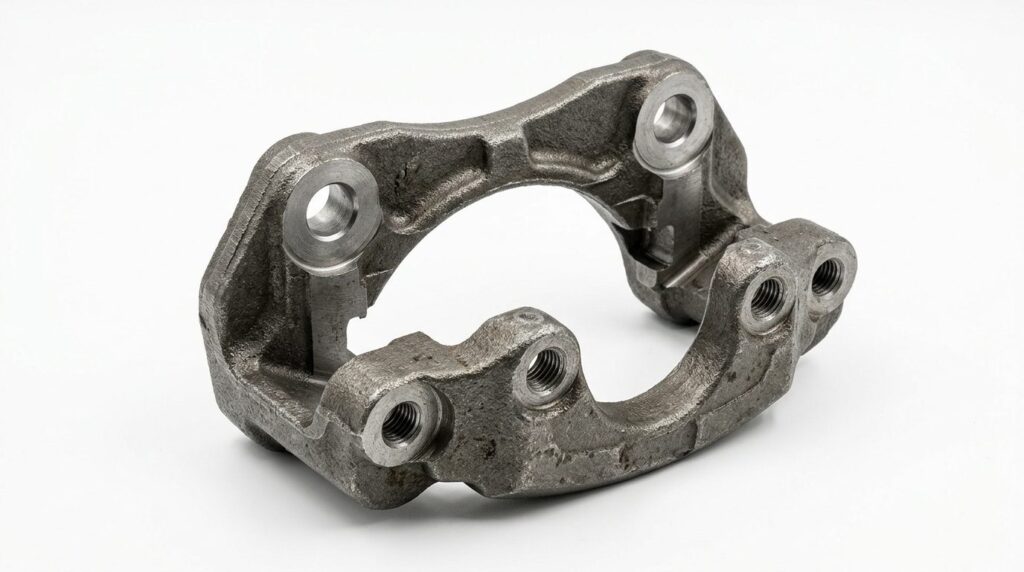
Cast iron is commonly used for caliper brackets because it offers good rigidity, castability and cost efficiency. Depending on the vehicle platform, the bracket may include bolt holes, guide pin holes, structural ribs, mounting arms and several local transitions between thick and thin sections. These structural features create burr-prone edges and local surface irregularities after casting or rough machining.
Although the final function of a caliper bracket depends on dimensional accuracy in key interfaces, the casting still requires finishing in non-critical areas. Common finishing targets include hole-edge burrs, sharp outer edges, contour transitions and selected assembly-related surfaces that need better handling quality or coating preparation.
| Objet | Détails |
|---|---|
| Nom de la pièce | Caliper Bracket |
| Taille standard | 440 × 140 × 160 mm |
| Matériau | Cast Iron |
| Processus principal | Rectification robotisée |
| Processus assistés | Deburring, Edge Rounding, Surface Finishing |
| Principaux domaines d'activité | Hole edges, outer contour, local transitions, assembly-related non-critical areas |
| Industry | Automobile et véhicules électriques |
| But décisif | Remove burrs, flash, sharp edges and local surface irregularities |
Nothing on a caliper bracket gets polished for show. Edge quality, clean holes and smooth contours — repeated identically across a batch — are the whole job.
Typical Applications of Caliper Brackets
Caliper brackets are mainly used in braking systems for automotive and transportation equipment. Their structure and size may vary, but the functional role remains similar.
| Domaine d'application | Typical Use |
|---|---|
| Passenger Vehicles | Brake caliper mounting support |
| Commercial Vehicles | Heavy-duty brake bracket structures |
| New Energy Vehicles | EV brake system support components |
| Specialty Vehicles | Brake assemblies for custom vehicle platforms |
| Off-Road Vehicles | Braking support structures for harsh-duty applications |
| Transport Equipment | Disc brake support components in related systems |
In these applications, burrs around holes, contour edges or mounting-related areas may affect assembly, handling safety, coating quality and the consistency of downstream operations.
Pain Point Analysis of Caliper Bracket Finishing
One of the main challenges in caliper bracket finishing is the number of local feature areas. The workpiece may have multiple holes, recesses, curved transitions and mounting contours, each of which may require different tool access and processing angles. This makes manual grinding highly dependent on worker skill.
Another challenge is hole-edge deburring. Burrs around machined or cast holes can affect assembly quality, fastener installation and handling safety. Manual deburring can be inconsistent, especially when multiple holes must be processed repeatedly across large production volumes.
A third challenge is contour consistency. The outer profile and transition zones of the caliper bracket may have flash or sharp edges after casting. If these areas are not ground evenly, the final part may show inconsistent edge quality or unstable coating preparation.
The fourth challenge is maintaining process control around assembly-related surfaces. Some areas need finishing for burr removal and handling improvement, but functional surfaces must be protected according to process requirements. This requires more precise path control than manual grinding usually offers.
| Problème courant | Domaine spécifique | Impact |
|---|---|---|
| Burrs on Hole Edges | Bolt holes, guide holes, local openings | Affects assembly and fastener installation |
| Casting Flash | Outer contour and parting line zones | Reduces edge quality and appearance consistency |
| Arêtes vives | Contour transitions and local corners | Creates handling and safety risks |
| Local Surface Irregularity | Non-critical assembly-related areas | Affects coating preparation and visual consistency |
| Variation manuelle | Repeated hole and contour processing | Causes unstable quality between operators |
| Dust and Repetitive Labor | Opération de meulage | Increases labor burden and workshop dust exposure |
Compared with manual finishing, robotic grinding provides better repeatability for localized multi-point processing. The robot can access defined hole edges, contours and target areas with consistent paths and tool orientation.
| Élément de comparaison | Meulage manuel | Rectification robotisée |
|---|---|---|
| Hole Edge Deburring | Depends on operator consistency | Repeatable processing of defined hole edges |
| Contour Grinding | Quality varies by angle and force | Stable programmed contour finishing |
| Protection des surfaces | Hard to control manually | Defined target zones and protected areas |
| Intensité de main-d'œuvre | Repetitive local grinding workload | Reduces manual finishing burden |
| Production en série | Difficult to standardize fully | Suitable for repeated automotive parts |
| Process Repeatability | Operator-dependent | Les programmes peuvent être enregistrés et réutilisés |
For caliper bracket manufacturers, robotic grinding helps standardize burr removal and contour finishing while reducing the variability of manual processing.
Robotic Grinding Process for Caliper Brackets
A robotic grinding cell for caliper brackets can be configured according to workpiece size, hole layout, contour complexity and production volume. The system usually includes a six-axis robot, dedicated fixture, abrasive grinding tool, flexible deburring tool, optional small grinding spindle, dust extraction system and safety enclosure.
Because caliper brackets contain multiple localized processing areas, the robot path is usually divided into defined feature groups such as hole edges, outer contours, transition corners and selected assembly-related zones.
| Étape | Processus | Objectif | Outil / Système |
|---|---|---|---|
| 1 | Chargement et positionnement | Secure the caliper bracket accurately | Dispositif de fixation spécifique |
| 2 | Sélection des programmes | Select the correct finishing path | IHM / Programme de robot |
| 3 | Hole Edge Deburring | Remove burrs from bolt holes and openings | Outil d'ébavurage flexible |
| 4 | Rectification des contours extérieurs | Smooth outer profile and remove flash | Outil de meulage abrasif |
| 5 | Transition Area Finishing | Process local corners and geometry changes | Small grinding head |
| 6 | Assembly-Related Area Cleaning | Improve selected non-critical surface consistency | Grinding wheel or abrasive tool |
| 7 | Contrôle qualité | Check burr removal, contour quality and protected zones | Inspection manuelle ou visuelle |
| 8 | Déchargement et nettoyage | Enlevez la poussière et transférez la pièce | Nettoyage à l'air comprimé / par aspiration |
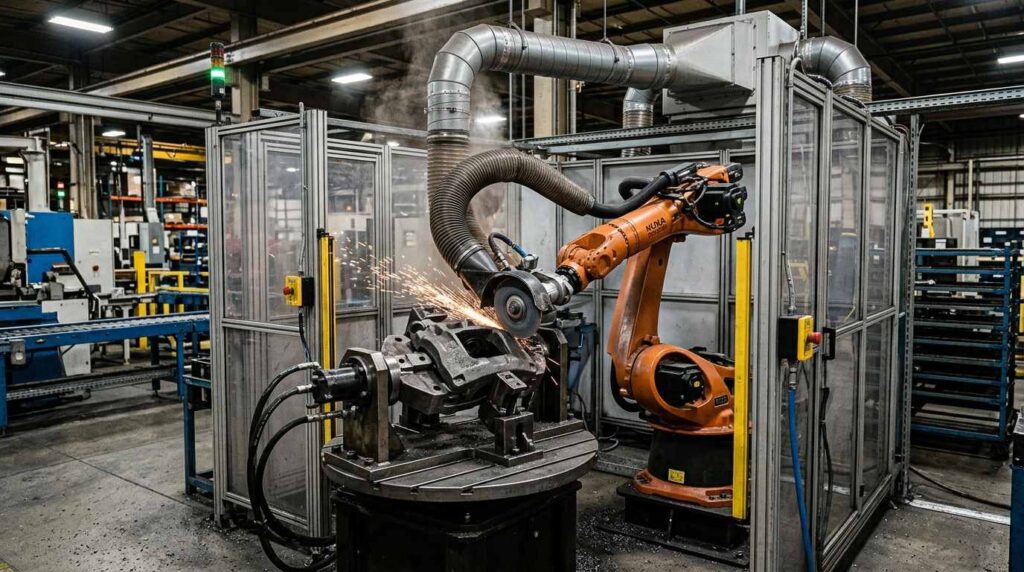
Étape 1 : Chargement et positionnement
The caliper bracket is placed into a dedicated fixture. Accurate positioning is important because the robot must process specific holes, contour edges and local transitions without affecting protected functional surfaces.
For batch production, the fixture can be designed for quick loading and repeatable orientation. This helps maintain stable robotic access to all target areas.
Étape 2 : Choix du programme
The operator selects the appropriate finishing program based on the caliper bracket model. Different brake platforms may use different hole patterns, bracket shapes or contour structures, so separate programs are usually needed.
For mixed-model production, fixture recognition or recipe-based program management can be added.
Step 3: Hole Edge Deburring
The robot first processes the burr-prone hole edges. These may include mounting holes, guide holes and local openings. Burrs around these areas can create problems during assembly and should be removed consistently.
A flexible deburring tool or precision abrasive tool is used to smooth the edges without excessive removal of surrounding material.
Étape 4 : Rectification des contours extérieurs
After hole deburring, the robot processes the outer contour of the caliper bracket. This step removes flash, smooths the external profile and improves handling safety.
Because contour geometry may include curves, arms and transition sections, the robot follows a predefined path with stable orientation and contact control.
Step 5: Transition Area Finishing
Local transition zones and corners often accumulate flash or sharp edges after casting. These areas may be difficult to reach consistently by hand.
The robot can use a smaller grinding head or localized abrasive tool to finish these features more precisely.
Step 6: Assembly-Related Area Cleaning
Selected non-critical assembly-related surfaces may need additional light grinding or cleaning to improve surface consistency, remove residual local defects or prepare for coating.
This step should be controlled carefully so that only defined target areas are treated.
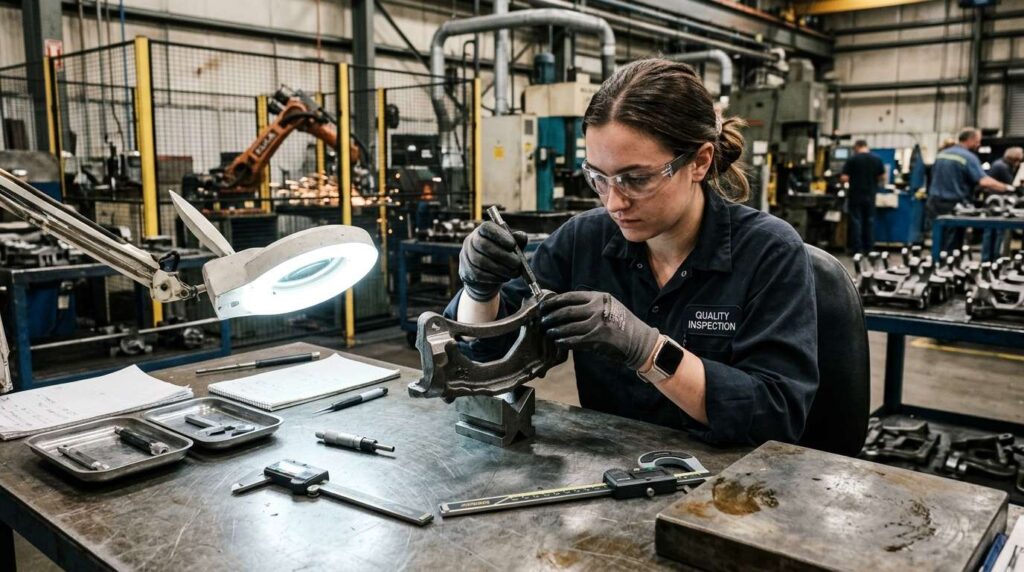
Étape 7 : Contrôle qualité
After grinding, the caliper bracket is inspected for hole-edge deburring quality, contour smoothness, local burr removal and correct protection of designated surfaces. Inspection may be manual or visually assisted depending on the required automation level.
Étape 8 : Déchargement et nettoyage
The finished part is removed from the fixture, and grinding dust or residue is blown off, vacuumed or brushed away. The bracket can then move to coating, assembly, packaging or the next production step.
Difficultés d'usinage et solutions
Caliper brackets are not large castings, but they are challenging because they combine several localized finishing tasks in one part. The robotic solution must provide accurate access to holes, contours and transition zones while maintaining process control.
| Défi | Cause | Solution robotique |
|---|---|---|
| Burrs Around Holes | Cast or machined openings leave edge burrs | Dedicated hole-edge deburring path |
| Flash on Outer Profile | Parting lines and contour edges retain flash | Programmed contour grinding |
| Complex Local Transitions | Multiple corners and geometry changes need angle adjustment | Small grinding head and optimized tool orientation |
| Assembly Surface Protection | Some areas require treatment while others must be preserved | Defined target zones and accurate fixturing |
| Repetitive Multi-Point Processing | Many local features must be finished on every part | Repeatable robotic sequence with saved programs |
Difficulty 1: Hole Edge Burrs Affect Assembly Quality
Caliper brackets often include several holes used for mounting or guiding. Burrs around these holes can interfere with bolt insertion, fastener seating or assembly handling.
The solution is a dedicated robotic deburring path for each target hole, giving repeatable burr removal across the whole batch. The tooling principles behind this approach are explained in our primer on what robotic deburring is.
Difficulty 2: Outer Contour Flash Reduces Edge Consistency
The outer contour may include parting line flash, sharp profile edges or uneven transitions. Manual grinding may leave inconsistent results depending on tool angle and worker experience.
The solution is to use programmed contour grinding with stable tool orientation. The robot can process the same profile repeatedly and improve overall edge consistency.
Difficulty 3: Local Corners and Transitions Are Hard to Reach
The bracket may contain recessed areas, local corners and shape transitions that are difficult to finish evenly by hand. These areas are often missed or over-ground in manual processing.
The solution is to use a smaller grinding head and optimized robot approach angles. This allows the system to reach localized features more reliably.
Difficulty 4: Functional Areas Must Be Protected
Certain surfaces or interfaces on the caliper bracket may require protection and should not be ground unnecessarily. Manual control of these boundaries is often inconsistent.
The solution is to use precise fixturing and clearly defined robot paths. Only the designated holes, contours and non-critical target areas are treated.
Difficulty 5: Repetitive Local Finishing Increases Labor Burden
Even though the part is not large, repeated processing of multiple holes and contour features creates fatigue over time in manual production.
The solution is to let the robot handle the repeated finishing sequence. This reduces labor intensity and makes batch production more stable.
Application Scenario
Scenario Background
Consider a plant casting caliper brackets in automotive braking volumes. Hole-edge deburring and contour grinding consistency are the sticking points, and the repetitive manual finishing behind them does not scale with batch production.
Défis techniques
Several burr-prone holes, local contour transitions and selected assembly-related areas all demand controlled finishing. Manual deburring drifts between operators — especially around hole edges and tight corners — and the consistency has to come without touching protected functional surfaces.
Grinding dust and the labor burden of hitting many small features on every part complete the picture.
Solution
The matching UBRIGHT SOLUTIONS cell combines a six-axis industrial robot, a dedicated fixture, a flexible deburring tool, an abrasive grinding tool and enclosed dust extraction.
The sequence opens on the defined hole edges, then shifts to the outer contour and local transitions for flash removal and edge smoothing. Selected non-critical assembly areas are cleaned last, following the programmed path. Repeatable fixture positioning keeps every feature within stable tool reach.
| Objet | Configuration |
|---|---|
| Pièce à usiner | Cast Iron Caliper Bracket |
| Taille standard | 440 × 140 × 160 mm |
| Processus principal | Rectification robotisée |
| Processus assisté | Hole Edge Deburring and Edge Rounding |
| Robot | Robot industriel à six axes |
| Outillage | Flexible Deburring Tool, Abrasive Grinding Tool |
| Calendrier | Dedicated Caliper Bracket Fixture |
| Lutte contre la poussière | Cellule fermée avec système de dépoussiérage |
| Demande | Hole-edge deburring, contour grinding, local finishing |
Expected Results
In this configuration the expected gains are steadier hole-edge deburring and more repeatable contours. The robot absorbs the manual finishing workload and standardizes local feature processing across repeated bracket models.
Dust stays inside the enclosure instead of the workshop, and validated finishing paths live on as reusable robot programs for recurring part types.
| Zone de résultats | Expected Improvement |
|---|---|
| Hole Deburring Consistency | More stable burr removal around target holes |
| Qualité des contours | More repeatable edge and profile finishing |
| Réduction des effectifs | Reduced repetitive local grinding workload |
| Process Stability | Reusable robot programs for repeat bracket models |
| Protection des surfaces | Better control of target and protected areas |
| Lutte contre la poussière | Cleaner finishing environment with dust extraction |
FAQ
Q1: Why is robotic grinding suitable for caliper brackets?
Robotic grinding is suitable because caliper brackets contain multiple localized features such as holes, contour edges and transitions that need repeatable finishing. The robot can process these defined areas consistently in batch production.
Q2: What areas of a caliper bracket are typically processed?
Typical processing areas include hole edges, outer contours, local corners, transition zones and selected assembly-related non-critical surfaces that require burr removal or smoothing.
Q3: Can robotic grinding remove burrs from hole edges?
Yes. Robotic grinding is well suited for hole-edge deburring when the target holes and access paths are clearly defined. Flexible deburring tools can remove burrs consistently without excessive material removal.
Q4: Does the robot process the whole bracket surface?
Not necessarily. In most cases, only defined target areas are processed, such as holes, contours and selected non-critical surfaces. Functional surfaces should be protected according to process requirements.
Q5: Can one robotic cell process different caliper bracket models?
Yes. Different models can be processed if suitable fixtures and robot programs are prepared. Recipe management and fixture recognition can help with mixed production. For a wider comparison of machine formats, see our deburring machine types guide.
Q6: How does robotic grinding improve contour consistency?
The robot follows a predefined path with stable orientation and repeatable tool contact. This provides more consistent contour finishing than manual grinding, which often varies by operator.
Q7: Is polishing required for caliper brackets?
In most cases, no. The main requirement is grinding, deburring and edge smoothing rather than decorative polishing. The focus is on assembly readiness and consistent finishing quality.
Q8: Can the system include dust extraction?
Yes. Dust extraction is strongly recommended for cast iron grinding. The robotic cell can include an enclosure, local suction and filtration equipment to improve the workshop environment.
Conclusion
Caliper brackets are important automotive cast iron components that require reliable finishing on hole edges, outer contours and local transition areas. Burrs, flash, sharp edges and local surface defects can affect assembly consistency, handling safety and downstream finishing quality if they are not removed properly.
A robotic grinding solution helps caliper bracket manufacturers improve hole-edge deburring consistency, reduce repetitive manual labor and build a more stable finishing process for batch production. With dedicated fixtures, controlled tool paths and integrated dust extraction, robotic finishing is well suited to repeated caliper bracket production. For the larger disc casting in the same brake system, see the brake disc robotic grinding solution.
If your caliper bracket production still relies on manual hole deburring, contour grinding or local edge finishing, Nous contacter for a customized robotic solution. More brake and chassis castings are documented under Automobile et véhicules électriques, and machine options are listed under Equipement.