What This Five-Axis Platform Is Built For
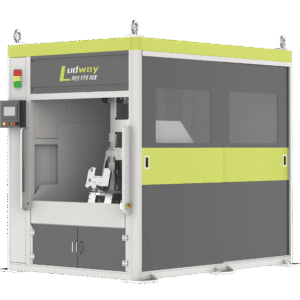
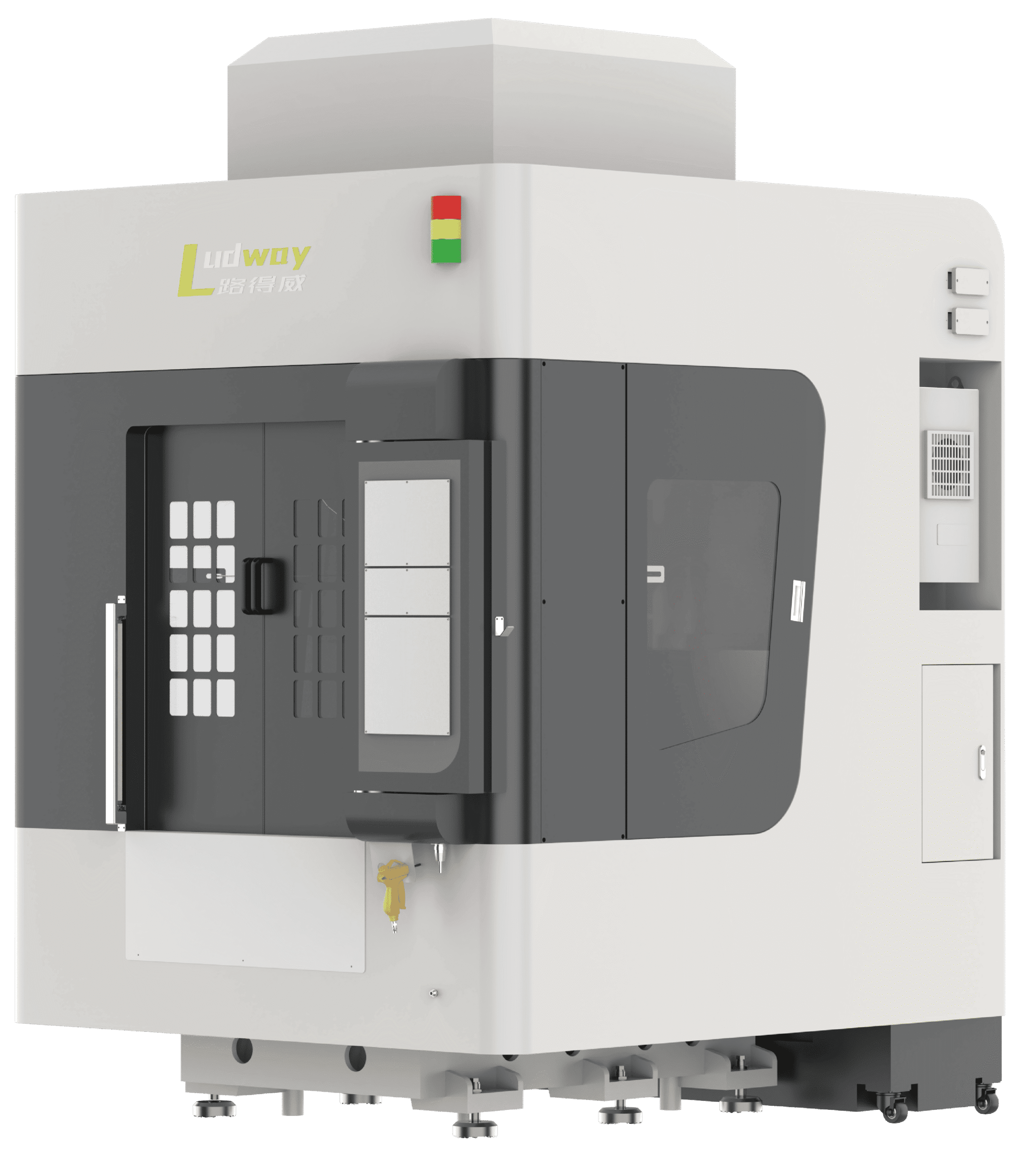
The LDW-5R-21T-500 is a machine-tool-type five-axis deburring and finishing center with a single loading station. Its job is to take small and medium aluminum die castings out of the hand-deburring lane: parting-line flash, gate stubs, bore chamfers, and mating-surface cleanup all run in one clamping, under numerically controlled feed rates instead of operator skill.
Five simultaneous axes are the reason this configuration exists. Cylinder head covers, oil pans, and transmission housings carry burrs across curved walls, around bosses, and inside pockets where a three-axis tool approach either cannot reach or leaves steps on the surface. With two rotary axes tilting the spindle head, the cutting edge keeps a consistent contact angle along the whole contour, so a finishing pass that follows a casting draft line does not dig in at the transitions.
Machine Structure and Working Method
Structurally the machine follows machining-center practice rather than robot practice: a fixed worktable carries the fixture, and a traveling column delivers the spindle along X, Y, and Z, with the rotary axes integrated in the spindle head. Overall footprint is L2289 x W1898 x H2698 mm, which places it in the same floor-space class as a compact VMC and keeps it viable for cells where one operator services several machines.
The 21-station tool magazine is the other half of the concept. A typical casting needs heavy flash milling cutters, chamfer tools for bore mouths, and abrasive or brushing heads for surface finishing. All of them live in the magazine at once, so the machine changes tools internally instead of waiting for an operator to re-equip between process steps. First-article setup runs through five-axis teach programming: the operator walks the tool along the part once, the path is stored, and every subsequent batch recalls the program by workpiece number.
Loading and unloading happen at the single station, which means the spindle stands still while the part is swapped. For job shops running many part numbers in short batches, that idle window is rarely the bottleneck and the single-station layout keeps the investment and footprint low. If your volumes grow to where loading time hurts output, the same platform exists in a dual-station build; see the notes at the end of this page.
The spindle is oil-cooled, which holds thermal stability through long cycles. The HMI reports running status, production counts, fault alarms, and tool condition in real time, so a supervisor can see tool wear trends before surface quality drifts.
LDW-5R-21T-500 Specifications
| Specifications | LDW-5R-21T-500 |
|---|---|
| Overall Dimensions | L2289 x W1898 x H2698 mm |
| Equipment Travel | X500 mm + Y400 mm + Z300 mm |
| Idle Speed | 32000 mm/min |
| Processing Speed | 500-8000 mm/min |
| Spindle Cooling Method | Oil Cooling |
| Air Pressure Requirement | ≥0.55 MPa |
| Tool Magazine Capacity | 21 Tools |
| Number of Control Axes | 5 |
Note: specifications are subject to change without prior notice for product optimization; accuracy class, spindle power, drive configuration, and machine weight are confirmed per workpiece configuration.
Typical Process Capability
- Parting-line and gate-area deburring: controlled feed from 500 to 8000 mm/min covers the spread from heavy flash removal at high feed to fine contour passes at low feed.
- Bore and edge chamfering: programmable chamfer paths on hole mouths, slot edges, and machined references, repeatable batch to batch.
- Surface finishing: milling and abrasive tools from the magazine handle cosmetic-surface preparation and mating-face cleanup in the same program.
- Optional RTCP: rotational tool center point control keeps the tool tip on its programmed path while the head reorients, which matters for steep walls and deep pockets where attitude changes are constant.
Processing accuracy class, spindle power, drive configuration, and machine weight are configuration-dependent and are confirmed against the workpiece during technical review; send the part drawing and required tolerances, and the engineering team will match the build sheet. As a orientation point, the six-axis machines in the same product family are specified at ±0.02 mm/300 mm, and the five-axis platform targets the same class of finishing work with one fewer controlled axis.
Which Parts Fit This Machine
The practical envelope is defined by the X500 x Y400 x Z300 mm travel and by parts that finish within 21 tools. Successful applications cluster around:
- Aluminum die-cast housings and covers in the automotive powertrain and EV sector: cylinder head covers, oil pan assemblies, transmission and reducer housings.
- Plumbing and hardware castings where parting lines meet cosmetic surfaces.
- Structural brackets and 3C-electronics parts that need chamfers plus a defined edge condition.
- Any mid-volume family of castings where manual deburring is inconsistent and a robot cell is more machine than the geometry requires.
If the part is larger than the travel envelope, the six-axis LDW-6R series extends to X900 mm. If the geometry is highly complex but tolerances are moderate, a robot-held-tool cell may be the lighter option. Both comparisons are worked through in the selection guides linked below.
Reading Before You Specify
Two in-depth guides cover the decisions around this machine. Types of Deburring Machines: Complete Selection Guide compares machine-tool-type, six-axis, and robotic approaches across part size, tolerance, and volume. What Is Robotic Deburring? walks through the process fundamentals, tooling choices, and what automation realistically removes from cycle time.
For teams whose volumes are climbing: the same five-axis platform is available as the 5-axis dual-station deburring equipment, where a second station hides loading time inside machining time. Reading this page against that one is the fastest way to decide whether single or dual stations match your takt targets.
Discuss Your Part With an Engineer
Send the casting drawing, the burr locations that matter, and your monthly volumes through the contact page. UBright reviews the geometry, proposes a process and tool list for the 21-station magazine, and can run a proof of concept on sample parts before any commitment on the machine.