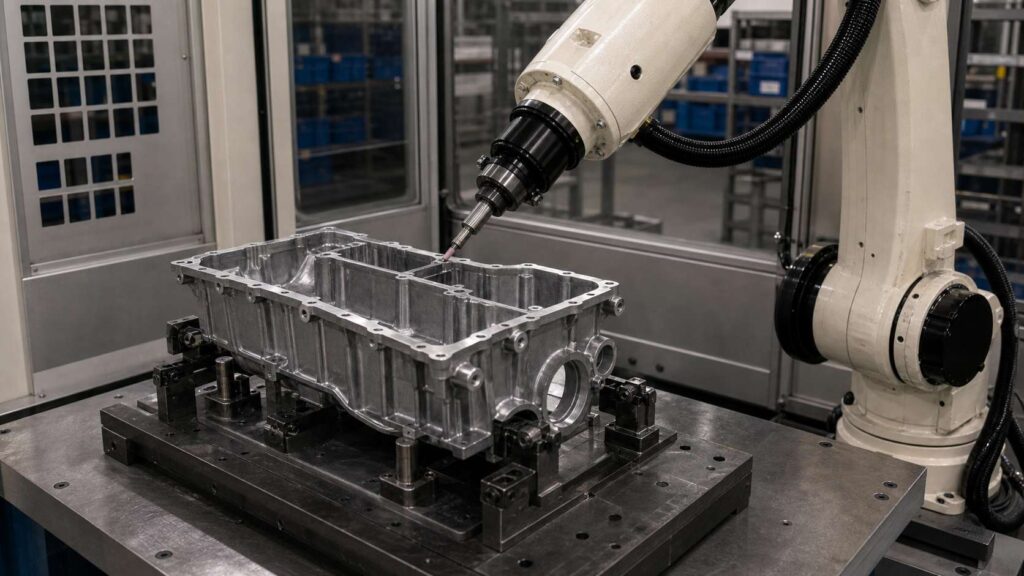
Cast iron mid-axle reduction housings are heavy axle and drivetrain castings used to support internal reduction components, protect transmission structures and provide mounting interfaces for axle assemblies. Based on the sample workpiece, this part has a large cavity opening, thick cast walls, a central bore area, wide base sections and several reinforced transition zones, which makes post-casting grinding more demanding than ordinary housing cleanup.
This robotic grinding solution is designed for cast iron mid-axle reduction housing workpieces with typical dimensions around 760 × 610 × 420 mm. It focuses on removing parting lines, gate residues, burrs and local contour defects from heavy cast sections while protecting bore-related areas, mounting faces and fitting interfaces.
What Is a Mid-Axle Reduction Housing?
A mid-axle reduction housing is a cast structural housing used in axle and drivetrain systems. It provides the main enclosure and support structure for reduction-related components, while also forming the installation base for later machining, assembly and sealing operations. The sample part shown here is a heavy cast housing with a large upper opening, deep internal cavity, central bore area, thick outer wall and base mounting structure.

After casting, this type of housing often has parting lines along the outer walls, gate-cut residues on heavy sections, burrs around cavity openings and rough transitions near bore or base areas. The main finishing requirement is not decorative polishing, but controlled robotic grinding and deburring for casting cleanup, with careful protection of fitting surfaces and bore-related interfaces.
| Артикул | Подробности |
|---|---|
| Название заготовки | Cast Iron Mid-Axle Reduction Housing |
| Китайское название | 中桥减壳 / 中桥减速壳 |
| Типовой размер | 760 × 610 × 420 mm |
| Материал | Чугун |
| Основной процесс | Роботизированная шлифовка |
| Процессы с поддержкой | Deburring, Edge Rounding, Gate Residue Removal |
| Основные направления деятельности | Opening edges, outer contours, bore boundaries, base transitions, parting lines, gate areas |
| Охраняемые территории | Mounting faces, fitting interfaces, precision bores |
| Финальный гол | Remove parting lines, gate residues and burrs while improving contour consistency |
Typical Finishing Challenges of Cast Iron Mid-Axle Reduction Housings
Mid-axle reduction housings are difficult to finish because the workpiece combines heavy wall thickness, a large cavity opening, irregular outer contours and functional interfaces in one casting. The robot must remove heavy casting defects from approved areas while avoiding damage to surfaces that will be used for fitting, machining or assembly.
The main challenge is the difference between heavy-removal zones and protected functional zones. Gate-cut areas and parting lines may require stronger grinding, while bore-related areas, mounting faces and fitting interfaces require controlled access and clear no-grind boundaries.
| Распространенная проблема | Конкретная область | Воздействие |
|---|---|---|
| Parting Lines | Outer walls, opening edges and base transitions | Reduces casting surface consistency |
| Остатки на воротах | Gate-cut sections and thick contour areas | Requires heavier material removal |
| Острые края | Cavity opening, bore boundary and base corners | Создает риски, связанные с обращением и сборкой |
| Остаточные заусенцы | Local corners, wall transitions and cut areas | Приводит к нестабильному качеству отделки |
| Ручное изменение | Long contour seams and repeated cleanup areas | Приводит к несогласованности результатов между операторами |
| Чувствительные функциональные области | Mounting faces, fitting surfaces and bore interfaces | Риск повреждения при ручной шлифовке |
Robotic Grinding Process for Mid-Axle Reduction Housings
A robotic grinding cell for mid-axle reduction housings should be designed around three points: heavy-part positioning, grinding-area accessibility and protected-surface control. Because the workpiece is large and has a deep cavity structure, the fixture must support the housing securely while keeping the opening edge, outer contour, gate-cut areas and bore boundary accessible to the robot.

For housings around 760 × 610 × 420 mm, the process usually includes workpiece positioning, program selection, protected-area confirmation, outer contour grinding, gate-residue removal, local transition finishing, inspection and unloading.
| Шаг | Процесс | Назначение | Инструмент / Система |
|---|---|---|---|
| 1 | Загрузка и позиционирование | Secure the heavy housing for stable grinding access | Специализированное приспособление |
| 2 | Выбор программы | Match the correct housing model and tool path | Программа для интерфейса человека-машины / робота |
| 3 | Подтверждение статуса охраняемой территории | Определить зоны, в которых запрещено шлифование, и защищенные границы раздела | Логика работы оборудования / Настройка программы |
| 4 | Outer Contour Grinding | Remove parting lines and contour defects | Абразивный шлифовальный инструмент |
| 5 | Удаление остатков с ворот | Clean gate-cut areas and thick residual sections | Grinding wheel / Stock-removal tool |
| 6 | Local Transition Finishing | Process opening edges, bore boundaries and base transitions | Малая шлифовальная головка / Гибкий инструмент |
| 7 | Контроль качества | Check grinding quality and protected areas | Ручной или визуальный осмотр |
| 8 | Разгрузка и очистка | Remove dust and transfer the housing | Продувка воздухом / Вакуумная очистка |
Шаг 1: Загрузка и размещение
The mid-axle reduction housing is placed into a dedicated fixture that supports the casting from stable base and side-wall areas. Because the housing has a large cavity opening and uneven mass distribution, accurate positioning is important for keeping the robot path consistent and preventing vibration during heavy grinding.
The fixture should leave the opening edge, parting-line sections, gate-cut areas and bore boundary accessible to the robot. At the same time, it should help protect mounting faces and fitting interfaces from accidental tool contact.
Шаг 2: Выбор программы
After the housing is fixed, the operator selects the corresponding robot program through the HMI. If several similar axle housing or reduction housing models are processed in the same line, each model can have its own saved path, tool sequence and protected-zone setting.
This step reduces operator dependence and makes repeated batches more stable. Once the process is verified, the robot can repeat the same grinding sequence for parting lines, gate areas and opening-edge cleanup with consistent tool movement.
Шаг 3: Подтверждение охраняемой территории
Before grinding starts, the system confirms which areas can be processed and which areas must remain untouched. For this type of housing, mounting faces, bore-related interfaces and fitting surfaces should be defined as protected zones.
These no-grind zones can be controlled through robot path limits, fixture positioning or physical shielding. This is important because the workpiece needs both heavy casting cleanup and functional-surface protection in the same robotic cycle.
Step 4: Outer Contour Grinding
The robot first processes the main outer contour of the housing, including outer walls, opening perimeter, base edges and long parting-line areas. This step removes visible flash, seam marks and local contour irregularities left from the casting process.
For heavy cast housings, contour grinding should be stable but not excessive. The goal is to clean the casting profile and improve surface consistency without removing unnecessary material from structural walls or protected fitting regions.
Step 5: Gate Residue Removal
Gate-cut areas usually require stronger material removal than normal edge deburring. On a heavy casting like a mid-axle reduction housing, gate residues may be thick, uneven and located close to wall transitions or base sections.
The robot can use a stock-removal grinding wheel or heavy-duty abrasive tool for these areas. The tool path should focus only on approved gate-removal zones, so nearby bore interfaces, mounting regions and transition surfaces remain protected.
Step 6: Local Transition Finishing
After the heavier removal steps, the robot processes local transition areas such as opening edges, bore boundaries, wall intersections and base corners. These areas often retain small burrs or rough edges because the geometry changes quickly and manual access is unstable.
A smaller grinding head or compliant finishing tool is suitable for this step. It allows the robot to clean localized defects without over-grinding adjacent surfaces or changing the intended housing geometry.
Шаг 7: Контроль качества
After grinding, the housing is inspected for parting-line removal, gate-residue cleanup, burr removal and protected-surface condition. Key inspection points include the large opening edge, gate-cut areas, outer wall seams, bore boundary and mounting-related surfaces.
Inspection can be manual or visually assisted depending on the production requirement. The main goal is to confirm that heavy casting defects have been removed while functional interfaces remain undamaged.

Шаг 8: Разгрузка и очистка
The finished housing is removed from the fixture and cleaned by air blowing, vacuum suction or brushing. Cast iron dust and loose particles can remain in the cavity opening, base corners and local transition areas, so cleaning is important before machining, coating or assembly.
For batch production, unloading and cleaning can be integrated with a turntable, conveyor or lifting system. This reduces non-processing time and makes the robotic grinding cell more suitable for repeated heavy housing production.
Проблемы при механической обработке и их решения
| Задача | Причина | Роботизированное решение |
|---|---|---|
| Long Parting Lines | Large cast housing creates long contour seams | Programmed contour grinding path |
| Heavy Gate Residues | Gate-cut sections contain thick residual stock | Dedicated stock-removal tool and local grinding routine |
| Opening and Bore Edge Burrs | Large opening and bore regions retain edge defects | Controlled local edge-finishing paths |
| Функциональная защита поверхностей | Mounting and fitting faces must not be damaged | Защищенные зоны, исключенные из траекторий шлифования |
| Heavy-Part Manual Labor | Housing size and weight increase operator workload | Специализированное приспособление и повторяемость роботизированных операций |
Difficulty 1: Long Parting Lines on Heavy Housing Contours
The workpiece has thick outer walls and a large perimeter, so parting lines can remain along long contour sections after casting. Manual removal is repetitive and often depends heavily on operator experience.
The solution is to use a programmed contour-grinding path that follows the housing geometry in a stable sequence. This allows the robot to remove seam defects more consistently across repeated batches.
Difficulty 2: Gate Residues Require Stronger Cleanup
Gate-cut areas on heavy cast housings usually contain thicker residual stock than ordinary flash. If these areas are manually ground, the result may vary from part to part, especially near wall transitions and base sections.
The solution is to separate gate cleanup from normal deburring. A stronger stock-removal tool can be used for gate areas, while smaller tools handle edge and transition finishing afterward.
Difficulty 3: Opening and Bore Boundaries Need Controlled Edge Treatment
The large cavity opening and bore boundary may contain burrs, sharp edges and local irregularities. These areas are close to functional geometry, so they require more careful path control than broad outer-wall grinding.
The solution is to define these boundaries as dedicated finishing zones. The robot can process them with controlled tool angles and limited contact pressure to improve edge quality while protecting nearby interfaces.
Difficulty 4: Mounting and Fitting Areas Must Be Protected
The housing includes surfaces used for later machining, fitting or assembly. Random manual grinding near these areas can damage the geometry and affect downstream process reliability.
The solution is to define mounting faces and bore-related areas as no-grind zones. The robot path should only cover approved cleanup areas, while fixture design helps protect critical interfaces during processing.
Пример из производственной практики
История клиента
An axle component manufacturer produces cast iron mid-axle reduction housings for drivetrain and axle-system applications. Before automation, operators manually removed parting lines, gate residues and burrs from the housing after casting.
As production volume increased, manual grinding became a bottleneck. The customer wanted a more stable process for repeated housing batches, especially around long parting-line sections, gate-cut areas and large opening edges.
Технические проблемы
The housing had a large cavity opening, thick outer walls, base transition areas and bore-related interfaces. Manual workers needed to perform both heavy stock removal and local edge cleanup on the same part, which made the process tiring and inconsistent.
Another challenge was functional-surface protection. Some fitting faces and bore-related areas had to remain untouched, while nearby gate residues and parting-line defects still needed to be removed. This required a process that could clearly separate grinding zones from protected zones.
Решение
A robotic grinding cell was configured with a six-axis industrial robot, a dedicated reduction-housing fixture, a heavy stock-removal grinding tool, a flexible finishing tool and an enclosed dust collection system. The process was divided into three main operations: outer contour grinding, gate-residue removal and local edge finishing.
For this housing size, fixture rigidity and robot access were critical. The fixture supported the casting from stable base and side-wall locations while keeping the opening edge, gate-cut areas and bore boundary accessible. The robot program excluded protected interfaces and focused grinding only on approved cleanup zones.
| Артикул | Конфигурация |
|---|---|
| Заготовка | Cast Iron Mid-Axle Reduction Housing |
| Типовой размер | 760 × 610 × 420 mm |
| Основной процесс | Роботизированная шлифовка |
| Процесс с поддержкой | Deburring, Edge Rounding, Gate Residue Removal |
| Робот | Шестиосевой промышленный робот |
| Инструментарий | Abrasive Grinding Tool, Stock-Removal Tool, Compliant Finishing Tool |
| Расписание | Dedicated Reduction Housing Support Fixture |
| Стратегия защиты | Protected fitting interfaces and bore-related areas |
| Борьба с запыленностью | Камера с закрытой конструкцией и системой пылеудаления |
Результаты внедрения
The robotic cell took over repetitive grinding work on long parting lines, gate-cut sections and opening-edge burrs. Operators mainly handled loading, unloading, inspection and tool maintenance, which reduced direct manual grinding intensity and made repeated housing batches more stable.
The enclosed cell also improved dust control during cast iron grinding. Instead of open manual grinding around the housing, dust and particles were collected inside the workstation, helping create a cleaner and more controlled finishing area.
| Область результатов | Улучшение |
|---|---|
| Качество контура | More stable parting-line removal on outer walls |
| Gate Cleanup | Better consistency in thick residual-stock removal |
| Качество кромок | Improved finishing around opening and bore boundaries |
| Сокращение трудозатрат | Reduced repetitive heavy manual grinding workload |
| Стабильность производства | Saved programs for repeated housing batches |
| Условия проведения семинара | Cleaner finishing area with enclosed dust collection |
Отзывы клиентов
The customer reported that the robotic grinding cell made heavy housing cleanup more stable and reduced the manual effort required for parting-line and gate-residue removal. Operators could focus more on part handling, inspection and tool monitoring instead of continuous heavy grinding.
Информация, необходимая для подготовки предложения по роботизированной шлифовке
To recommend a suitable robotic grinding cell for your mid-axle reduction housing, we usually need the part drawing, material, casting weight, photos of parting lines and gate residues, required grinding areas, protected surfaces, current manual grinding cycle time and annual production volume.
These details help our engineering team evaluate fixture design, robot reach, tool selection, dust collection layout and process feasibility. For heavy housing castings, it is especially important to identify which areas require stock removal and which interfaces must be protected during robotic grinding.
ЧАСТО ЗАДАВАЕМЫЕ ВОПРОСЫ
Q1: Is this workpiece a general housing or an axle-related reduction housing?
Based on the sample image and dimensions, this workpiece is better treated as a mid-axle reduction housing used in axle and drivetrain systems rather than a general-purpose thin-wall housing.
Q2: Why is robotic grinding suitable for this housing?
Because the workpiece has long parting lines, thick gate residues, large opening edges and heavy contour transitions that are difficult to process consistently by hand. Robotic grinding improves repeatability and reduces manual finishing workload.
Q3: What areas can the robot process on this reduction housing?
The robot can process outer contours, parting lines, gate-cut regions, opening edges, bore boundaries and local transition areas while avoiding protected fitting and mounting interfaces.
Q4: Does this housing require polishing?
In most cases, no mirror polishing is required. The main requirement is grinding, deburring and gate-residue cleanup for better contour quality and process consistency.
Q5: How are fitting and bore areas protected during grinding?
Fitting faces, bore interfaces and mounting-related areas can be defined as protected zones through program limits, fixture support or temporary shielding.
Q6: Can one robotic cell handle similar axle housing castings?
Yes. If the product family is similar, separate programs and suitable fixtures can allow one robotic cell to process multiple related heavy housing castings.
Заключение
Cast iron mid-axle reduction housings have heavy outer contours, large cavity openings, long parting-line areas and gate-cut sections, making manual grinding difficult to standardize. A robotic grinding solution helps manufacturers remove parting lines, clean gate residues and improve finishing consistency while protecting bore-related and fitting interfaces.
If your mid-axle reduction housing production still relies on manual parting-line cleanup, gate removal or local contour grinding, Свяжитесь с нами для создания индивидуального роботизированного решения. Вы также можете ознакомиться с нашими Автомобили и электромобили приложения и Оборудование чтобы узнать больше о наших роботизированных системах отделки.