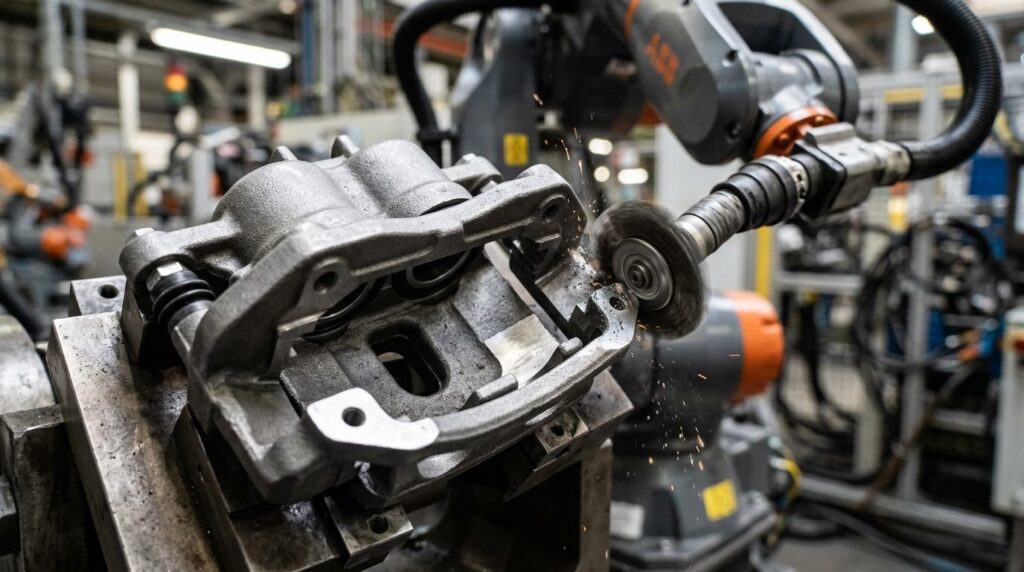
Brake calipers are important components in automotive and commercial vehicle braking systems. They are used to house and support braking elements while maintaining reliable fit, motion and force transfer in the brake assembly. As a typical cast metal workpiece, a brake caliper usually has complex outer contours, recessed areas, mounting edges, openings, transition corners and multiple assembly-related surfaces. During casting and machining, common finishing problems include casting flash, parting lines, burrs in recessed areas, sharp assembly edges and local surface irregularities.
Traditional manual grinding is time-consuming and difficult to standardize, especially when operators need to process complex contours, window openings, edge transitions and mounting areas repeatedly. Different operators may apply different pressure and tool angles, which can lead to unstable finishing quality and over-grinding risks. This robotic grinding solution is designed for cast brake calipers with typical dimensions around 420 × 300 × 170 mm, focusing on complex contour deburring, assembly edge rounding, local flash removal and surface finishing before coating, assembly or final inspection.
What is a Brake Caliper?
A brake caliper is a structural and functional component used in a disc brake system. It supports brake pads and works together with the brake disc and hydraulic or pneumatic actuation system to generate braking force. Depending on vehicle type, brake calipers are used in passenger vehicles, commercial vehicles, trucks, trailers and other transportation equipment.

Brake calipers are often manufactured as cast metal components because casting can efficiently form complex geometries, internal support sections and mounting features. After casting, the workpiece usually undergoes machining to create critical contact surfaces, holes, bores and assembly interfaces. Even after machining, however, the caliper still requires finishing operations to remove casting flash, burrs, sharp edges and local surface defects.
The finishing quality of a brake caliper directly affects assembly consistency, coating adhesion, handling safety and final product appearance. Burrs in mounting areas may interfere with assembly. Sharp edges on external contours may create safety risks during handling. Residual flash in recessed or narrow transition areas may reduce quality consistency. Therefore, robotic grinding is suitable for improving finishing quality on this type of complex cast component.
| Item | Details |
|---|---|
| Workpiece Name | Brake Caliper |
| Chinese Name | 卡钳 |
| Typical Size | 420 × 300 × 170 mm |
| Material | Cast Iron / Cast Steel / Cast Metal |
| Main Process | Robotic Grinding |
| Assisted Processes | Deburring, Edge Rounding, Surface Finishing |
| Main Processing Areas | Complex outer contours, recessed areas, window openings, assembly edges, parting lines, local transition corners |
| Finishing Goal | Remove casting flash, burrs and sharp assembly edges on complex caliper structures |
For this type of workpiece, the main requirement is not decorative polishing. The key task is to remove casting defects, smooth assembly edges, deburr complex contours and improve consistency before coating or assembly. That is why robotic grinding is the most suitable core process for this solution.
Typical Applications of Brake Calipers
Brake calipers are used in braking systems where consistent structural quality and assembly precision are required. Depending on design, the caliper may be used in passenger vehicles, light commercial vehicles, trucks, trailers or specialized transport equipment.
| Application Area | Typical Function |
|---|---|
| Passenger Vehicles | Support brake pad installation and disc brake operation |
| Commercial Vehicles | Provide durable brake structure under repeated use |
| Trucks | Support heavy-duty braking assemblies |
| Trailers | Used in braking systems requiring reliable mounting accuracy |
| Buses | Applied in durable and frequently operated brake systems |
| Special Vehicles | Used in transport or industrial vehicle brake assemblies |
For these applications, burrs, sharp edges and local flash are not only appearance problems. They may also affect assembly consistency, coating quality, handling safety and inspection results. A controlled robotic grinding process helps manufacturers achieve more repeatable finishing quality on complex brake caliper castings.
Pain Point Analysis of Brake Caliper Finishing
Brake calipers present several finishing challenges. The first challenge is the complex geometry. Unlike simple round or flat castings, a brake caliper often includes bridges, recessed sections, side openings, internal corners and mounting surfaces. Manual grinding on these irregular contours is difficult to keep uniform.
The second challenge is assembly edge quality. Calipers usually have multiple mounting-related edges, opening edges and functional transitions. If these edges are too sharp or contain burrs, they may affect assembly fit, handling safety or downstream processing.
The third challenge is accessibility. Some burr-prone areas are located in recessed windows, narrow corner transitions or partially enclosed contours. These areas are difficult for manual tools to process consistently, especially in repeated batch production.
The fourth challenge is labor intensity and quality variation. Manual grinding requires workers to repeatedly change tool angle and body position around a complex workpiece. This creates fatigue, unstable quality and over-grinding risk.
| Common Problem | Specific Area | Impact |
|---|---|---|
| Casting Flash | Parting lines, contour edges, window openings | Affects appearance and assembly preparation |
| Burrs | Recessed areas, internal corners, openings | May interfere with fit and handling |
| Sharp Assembly Edges | Mounting edges, contour transitions | Creates handling safety risks |
| Surface Irregularity | Visible cast surfaces and local transitions | Reduces coating and finishing consistency |
| Manual Variation | Complex contours and local edges | Causes unstable finishing quality |
| Cast Grinding Dust | Grinding operation | Affects workshop environment and operator comfort |
Compared with manual grinding, robotic grinding provides a more controlled and repeatable process. The robot can follow programmed paths across irregular contours and process repeated edge locations in sequence.
| Comparison Item | Manual Grinding | Robotic Grinding |
|---|---|---|
| Complex Contour Processing | Depends on operator skill | Repeatable programmed path |
| Edge Rounding Consistency | Easy to vary between operators | Stable contact and repeatable results |
| Recessed Area Deburring | Hard to reach consistently | Tool path can target local areas |
| Labor Intensity | High manual workload | Reduces repetitive grinding tasks |
| Process Consistency | Difficult to standardize | Programs can be saved and reused |
| Batch Production | Limited by worker capacity | Suitable for repeated caliper models |
For brake caliper manufacturers, robotic grinding can transform complex and repetitive manual finishing into a more standardized process. It helps improve edge consistency, reduce missed burrs and support stable batch production.
Robotic Grinding Process for Brake Calipers
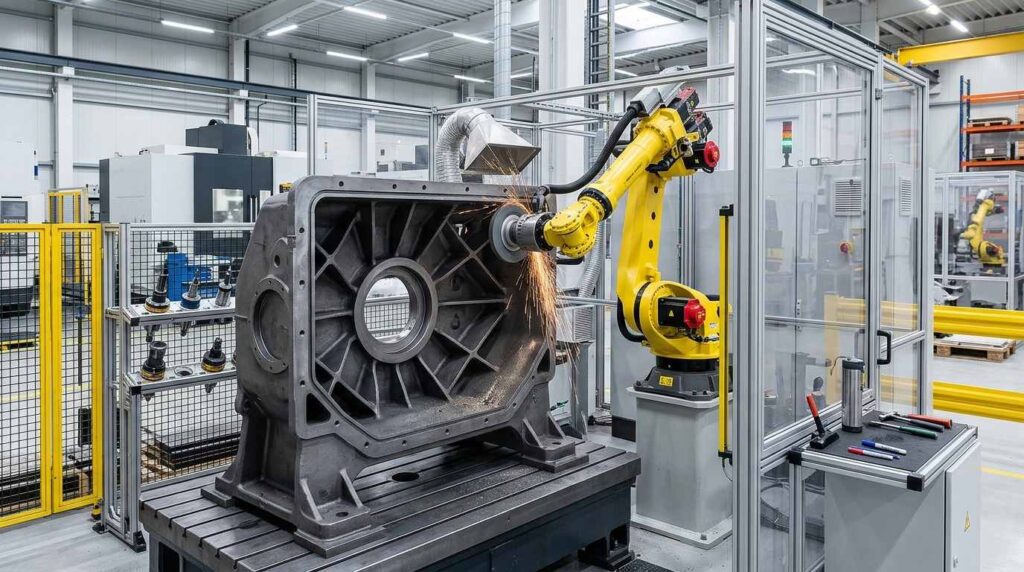
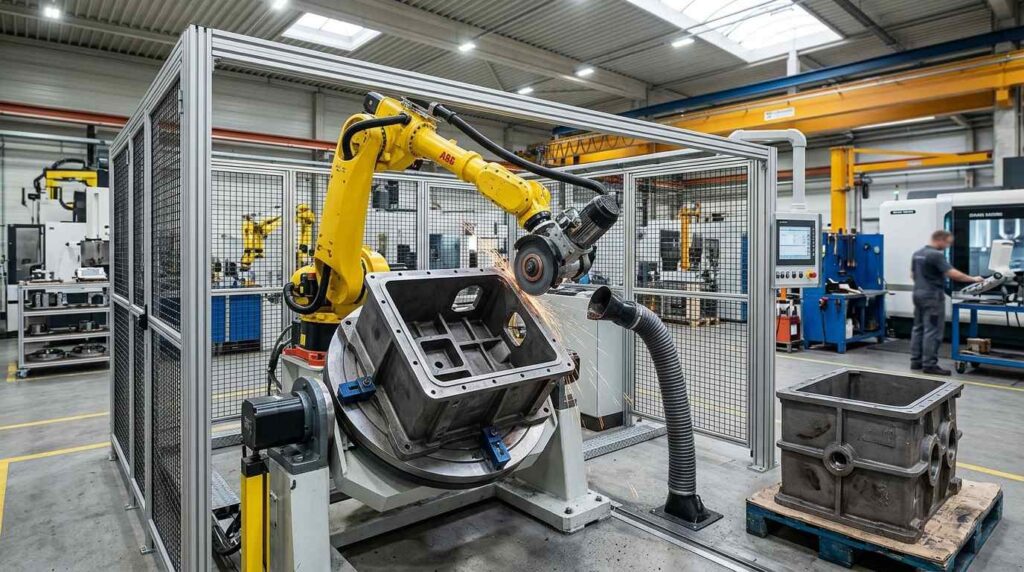
A robotic grinding cell for brake calipers can be configured according to workpiece size, material, burr condition, contour complexity and production volume. The system usually includes a six-axis industrial robot, dedicated fixture, abrasive grinding tool, flexible deburring tool, force-control or compliant mechanism, dust collection system and safety enclosure.

Because brake calipers contain multiple irregular contours and localized burr areas, robot path planning is especially important. The system must process outer contours, recessed sections, window openings and mounting edges while protecting critical machined surfaces.
| Step | Process | Purpose | Tool / System |
|---|---|---|---|
| 1 | Loading and Positioning | Secure the brake caliper accurately | Dedicated fixture |
| 2 | Program Selection | Select the correct caliper model | HMI / robot program |
| 3 | Outer Contour Grinding | Remove flash on major contour edges | Abrasive grinding tool |
| 4 | Recessed Area Deburring | Remove burrs from internal or recessed contours | Flexible deburring tool |
| 5 | Assembly Edge Rounding | Smooth sharp edges on mounting and opening areas | Rotary deburring tool / compliant tool |
| 6 | Local Surface Finishing | Improve local surface consistency | Abrasive belt or flexible grinding head |
| 7 | Quality Inspection | Check burr removal and edge condition | Manual or visual inspection |
| 8 | Unloading and Cleaning | Remove dust and transfer the part | Air blow / vacuum cleaning |
Step 1: Loading and Positioning
The brake caliper is placed into a dedicated fixture. The fixture should position the workpiece according to key reference points and ensure stable access to contour edges, openings and mounting areas.
For repeated production, the fixture can be designed for quick positioning and stable clamping. If multiple caliper models are produced, model-specific fixtures or quick-change fixture solutions can be used.
Step 2: Program Selection
The operator selects the corresponding robot program according to the brake caliper model. Each model can have different robot paths, tool parameters and protected zones depending on contour shape and burr locations.
For higher automation requirements, barcode scanning, fixture recognition or visual positioning can be added to confirm the correct workpiece model.
Step 3: Outer Contour Grinding
The robot first processes the major contour edges of the brake caliper. These areas often contain casting flash, parting lines and sharp edges. The robot follows the programmed path and removes unwanted material with an abrasive grinding tool.
Stable tool contact is important for this step. Force-controlled grinding helps maintain consistency and reduces the risk of removing too much material from functional regions.
Step 4: Recessed Area Deburring
After processing the main contour, the robot moves to recessed sections, inner contour areas and local openings where burrs often remain. These areas are more difficult for manual grinding because access is limited.
The system can use a flexible deburring tool or smaller grinding head to reach these local features. Proper path design helps ensure that repeated burr areas are processed consistently.
Step 5: Assembly Edge Rounding
Brake calipers have multiple assembly-related edges that require smoothing and edge rounding. These include mounting edges, opening edges and transition corners. The purpose of this step is not heavy grinding, but controlled burr removal and safe edge conditioning.
The robot uses a deburring or compliant grinding tool to round sharp edges without damaging nearby precision features.
Step 6: Local Surface Finishing
After burr removal and edge conditioning, the robot can process selected visible cast surfaces or local transition areas to improve surface uniformity. This is especially useful before coating or painting.
The process does not aim for decorative polishing. Instead, it improves the consistency of local surfaces and removes small visual defects.
Step 7: Quality Inspection
After grinding, the brake caliper is inspected for burr removal, edge condition, local surface consistency and over-grinding. Key inspection areas include contour edges, recessed corners, mounting edges, openings and transition surfaces.

Inspection can be carried out manually, with gauges or with visual assistance depending on the customer’s quality standard.
Step 8: Unloading and Cleaning
The finished brake caliper is removed from the fixture. Dust and grinding residues can be cleaned by air blowing, vacuum suction or brushing. The part can then move to coating, assembly, packaging or the next production stage.
For larger production lines, the grinding cell can be integrated with conveyors, automatic loading and centralized dust collection.
Machining Difficulties and Solutions
Brake calipers are more demanding than simple castings because they combine complex contours, recessed structures and multiple assembly edges. The robotic system must be designed for path accessibility, controlled edge rounding, fixture stability and functional surface protection.
| Challenge | Cause | Robotic Solution |
|---|---|---|
| Complex Contour Accessibility | Irregular geometry and local recesses | Use multi-angle robot paths and flexible tools |
| Recessed Burr Areas | Burrs remain inside openings and corners | Target local features with smaller deburring tools |
| Assembly Edge Sharpness | Multiple mounting and opening edges require smoothing | Use controlled edge rounding paths |
| Functional Surface Protection | Some machined or contact areas must be preserved | Define protected zones and optimized tool paths |
| Dust Generation | Cast grinding creates fine particles | Use enclosed cell with dust extraction |
Difficulty 1: Processing Complex External and Internal Contours
Brake calipers have bridges, cutouts, contour transitions and asymmetric features. Manual grinding of these areas is slow and difficult to standardize.
The solution is to use programmed multi-angle robot paths. A six-axis robot can approach different contour sections with stable orientation and repeat the same motion across batches.
Difficulty 2: Reaching Recessed Burr Areas
Burrs often remain in recessed openings, narrow corners or internal contour transitions. Manual operators may miss these areas or process them unevenly.
The solution is to use flexible deburring tools or smaller grinding heads that can access localized features. The robot can approach these areas from predefined angles and repeat the same sequence for every part.
Difficulty 3: Maintaining Consistent Edge Rounding
Brake caliper assembly edges often need controlled rounding rather than heavy material removal. Too little processing leaves sharp edges, while too much processing may damage geometry.
The solution is to use compliant tools and defined edge-conditioning paths. This helps maintain consistent edge quality without over-grinding.
Difficulty 4: Protecting Functional Surfaces
Some brake caliper areas may be machined or dimension-critical, including mounting surfaces, contact faces or bore-related areas. These must not be damaged during grinding.
The solution is to define protected zones in the robot program and use accurate fixturing. Tool paths should avoid critical surfaces, and lower contact force can be used near sensitive regions.
Difficulty 5: Controlling Grinding Dust
Grinding cast metal calipers generates fine dust and particles. Manual grinding exposes workers directly to the dust source and creates a harsher environment.
The solution is to use an enclosed robotic grinding cell with integrated dust collection. Local suction, protective covers and filtration systems help improve cleanliness and operator safety.
Manufacturing Case
Customer Background
An automotive brake component manufacturer produces cast brake calipers for commercial vehicle and transportation applications. The workpieces have complex external contours, internal window openings, mounting edges and local recessed structures. Before automation, workers manually removed casting flash, burrs and sharp edges after casting and machining.
As production volume increased, manual finishing became a bottleneck. The customer wanted to improve contour deburring consistency, reduce missed burrs in recessed areas and lower repetitive manual grinding workload.
Technical Challenges
The brake caliper had multiple burr-prone areas, including outer contour edges, internal window openings, local recessed corners and mounting-related edges. Manual workers needed to constantly change tool angle and body position, which caused unstable finishing quality.
Another challenge was protecting functional surfaces. Some areas had to remain dimensionally accurate after machining, so the robotic system needed to remove burrs and sharp edges without affecting critical assembly geometry. Dust control was also important because manual grinding created an uncomfortable environment.
Solution
UBRIGHT SOLUTIONS designed a robotic grinding cell for cast brake calipers. The system used a six-axis industrial robot, dedicated caliper fixture, abrasive grinding tool, flexible deburring tool and enclosed dust collection system.
The robot first processed the major contour edges and parting line areas, then removed burrs from recessed openings and local corners. Controlled edge rounding paths were applied to mounting edges and assembly-related transitions. Protected zones were defined in the program to avoid damage to critical machined features.
| Item | Configuration |
|---|---|
| Workpiece | Cast Brake Caliper |
| Typical Size | 420 × 300 × 170 mm |
| Main Process | Robotic Grinding |
| Assisted Process | Deburring, Edge Rounding, Surface Finishing |
| Robot | Six-Axis Industrial Robot |
| Tooling | Abrasive Grinding Tool, Flexible Deburring Tool |
| Fixture | Dedicated Brake Caliper Fixture |
| Dust Control | Enclosed Cell with Dust Collection |
| Application | Complex Contour Deburring, Edge Rounding, Flash Removal |
Implementation Results
After implementation, the customer achieved more stable finishing quality on complex contours and assembly edges. The robot could repeatedly process contour edges, recessed areas and mounting transitions according to the saved program.
The robotic grinding cell reduced heavy manual grinding workload and improved process standardization. The enclosed cell also improved dust control and workshop cleanliness.
| Result Area | Improvement |
|---|---|
| Contour Deburring Consistency | More stable processing on complex outer contours |
| Recessed Area Quality | Fewer missed burrs in openings and local corners |
| Edge Rounding Quality | More uniform assembly edge condition |
| Labor Reduction | Reduced repetitive manual grinding workload |
| Production Stability | Reusable robot programs for repeated caliper models |
| Dust Control | Enclosed cell improved workshop cleanliness |
Customer Feedback
“The robotic grinding system helped us standardize the finishing process for cast brake calipers. It improved contour consistency and reduced missed burrs in recessed areas while lowering manual grinding workload.”
FAQ
Q1: Why is robotic grinding suitable for brake calipers?
Robotic grinding is suitable for brake calipers because they have complex contours, recessed structures and multiple assembly edges that require consistent finishing. The robot can follow programmed paths and process the same areas repeatedly, making it suitable for batch production.
Q2: What defects can robotic grinding remove from brake calipers?
The system can remove casting flash, parting lines, burrs, sharp edges and local surface irregularities. The most common processing areas include contour edges, recessed openings, mounting edges, transition corners and visible cast surfaces.
Q3: Can the robot process recessed or partially enclosed areas?
Yes. With suitable path planning and flexible deburring tools, the robot can process many recessed or partially enclosed areas. The final accessibility depends on the geometry of the caliper and tool selection.
Q4: Does a brake caliper need polishing?
In most cases, brake calipers do not require decorative mirror polishing. The main requirement is grinding, deburring, edge rounding and local surface preparation before coating or assembly.
Q5: How does the robot avoid damaging functional surfaces?
The robot program can define protected zones and limit tool contact in precision areas. Proper fixturing, accurate positioning and controlled grinding force help protect critical surfaces and maintain dimensional consistency.
Q6: Can one robotic grinding cell process different brake caliper models?
Yes. A robotic grinding cell can process different caliper models if the fixtures and programs are designed properly. For similar product families, quick-change fixtures and saved programs can reduce changeover time.
Q7: What tools are used for brake caliper robotic grinding?
Common tools include abrasive grinding wheels, belt tools, flexible deburring heads, rotary deburring tools and compliant grinding tools. The final tool selection depends on contour accessibility, burr size and finishing requirements.
Q8: Is dust collection necessary for brake caliper grinding?
Yes. Dust collection is strongly recommended. Grinding cast metal calipers produces fine particles, so the robotic cell should include an enclosure, suction ports, dust collection pipes and filtration equipment.
Conclusion
Brake calipers are complex cast components that require reliable finishing on outer contours, recessed openings, mounting edges and local transition corners. Casting flash, burrs, sharp assembly edges and local surface irregularities can affect assembly consistency, handling safety, coating quality and final inspection results if they are not removed properly.
A robotic grinding solution helps brake caliper manufacturers improve complex contour deburring, assembly edge rounding and local surface consistency in batch production. With dedicated fixtures, controlled tool paths, flexible deburring tools and integrated dust extraction, robotic finishing is well suited to repeated production of cast brake calipers.
If your brake caliper production still relies on manual contour deburring, recessed area grinding or assembly edge finishing, Contact Us for a customized robotic solution. You can also explore our Automotive Parts applications and Equipment to learn more about our robotic finishing systems.