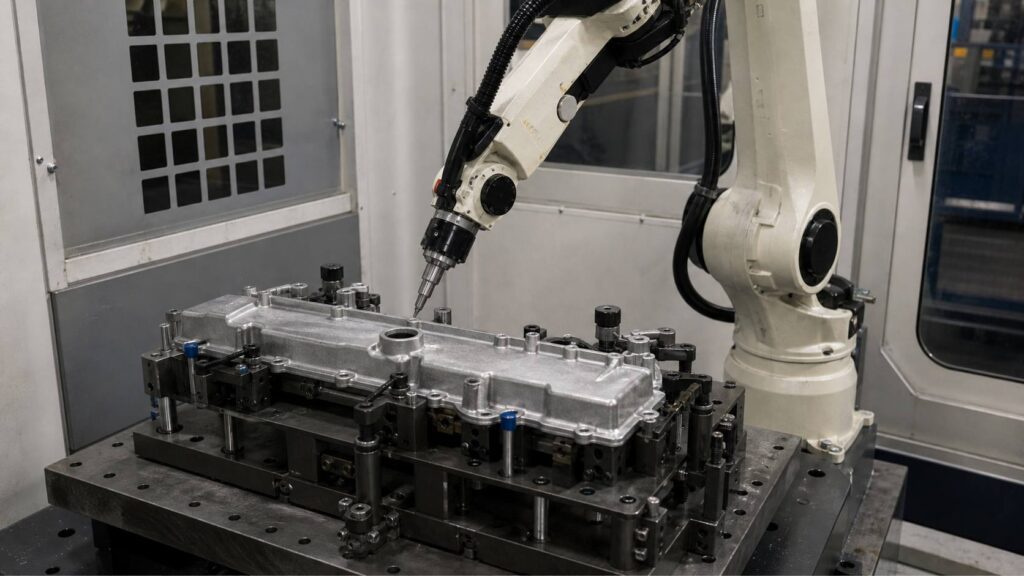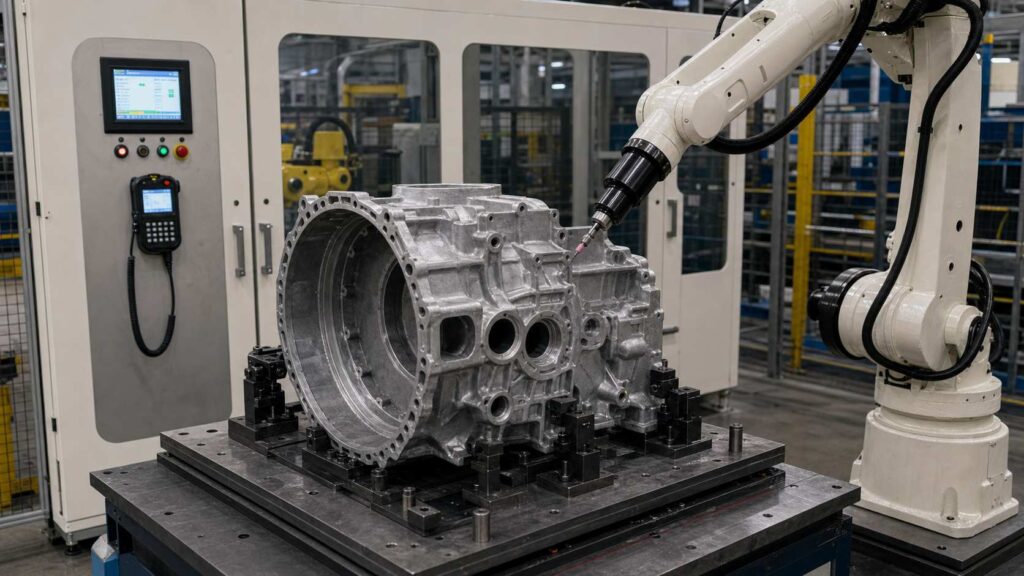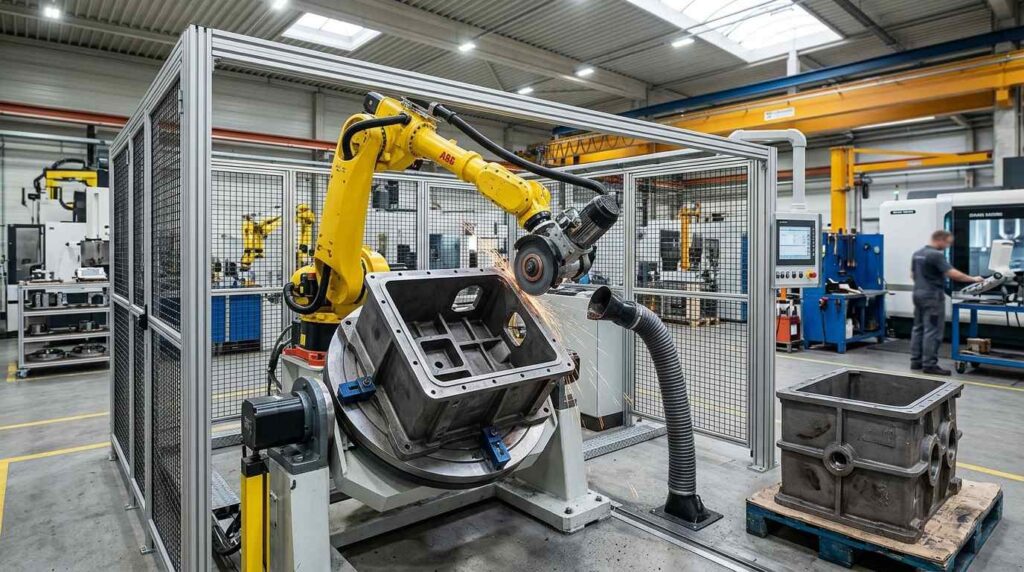
Gearbox housings are cast structural components used in reducers, gear transmission systems, industrial machinery, automation equipment and vehicle-related drivetrain assemblies. The part typically has a box-shaped cast structure with an internal cavity, large circular opening, top window, base feet, outer contours and multiple edge areas that require reliable post-casting finishing.
During casting and rough machining, gearbox housings may develop parting lines, casting flash, burrs, sharp edges and inner cavity defects around the housing opening, internal ribs, outer profile, base feet and mounting-related areas. Manual grinding of this type of housing is difficult because both external and internal areas must be processed. A robotic grinding solution provides a more repeatable method for parting line grinding, inner cavity burr removal and housing edge finishing before coating, machining or assembly.
What is a Gearbox Housing?
A gearbox housing is the main structural shell used to support and protect gears, shafts, bearings and lubrication systems inside a reducer or transmission unit. It must provide rigidity, accurate mounting support and protection for internal mechanical components. In many industrial applications, gearbox housings are made from cast iron because of its strength, vibration damping, castability and cost efficiency.

A housing of this type has a compact box-like structure with a large front circular opening, an upper window, thick side walls and base feet. These features are common in reducer housing and gearbox casing designs. They improve strength and assembly function, but they also create many burr-prone areas after casting, especially around internal cavities, openings, parting lines and edge transitions.
| Item | Details |
|---|---|
| Workpiece Name | Gearbox Housing |
| Typical Size | 420 × 400 × 480 mm |
| Material | Cast Iron / Cast Steel |
| Main Process | Robotic Grinding |
| Assisted Processes | Deburring, Inner Cavity Cleaning, Edge Finishing |
| Main Processing Areas | Parting lines, inner cavity, housing openings, base feet, outer contours |
| Industry | General Metal / Industrial Machinery |
| Finishing Goal | Remove parting lines, casting flash, burrs and sharp edges |
A gearbox housing needs cleaning, not shine. The work is parting lines, cavity burrs and edge preparation — done to a standard that coating, machining and assembly can rely on.
Typical Applications of Gearbox Housings
Gearbox housings are widely used in mechanical transmission systems where gears, shafts and bearings must be protected and accurately supported. Their application can vary by equipment type, but the finishing requirements are usually similar.
| Application Area | Typical Use |
|---|---|
| Industrial Gear Reducers | Main housing for gear and shaft assemblies |
| Automation Equipment | Transmission housing for motion systems |
| Heavy Machinery | Reducer casing for power transmission units |
| Material Handling Systems | Gearbox housing for conveyors and lifting equipment |
| Agricultural Machinery | Cast housing for transmission and drive systems |
| Vehicle-Related Drivetrain Systems | Gear or reducer housing in mechanical assemblies |
In these applications, burrs, parting lines and sharp edges can affect coating quality, assembly efficiency, sealing area cleanliness and operator handling safety. Stable robotic grinding helps improve consistency before the housing enters machining, coating or assembly.
Pain Point Analysis of Gearbox Housing Finishing
Gearbox housing finishing is challenging because the part combines external contours with internal cavity features. Workers must remove parting lines on the outside while also cleaning burrs around internal openings, ribs and cavity edges. Some areas are visible and easy to reach, while others are recessed and difficult to process by hand.
Another challenge is surface protection. Gearbox housings often include assembly-related areas, machined interfaces, bearing seats, mounting surfaces or sealing-related zones. These areas must be protected from over-grinding. Robotic grinding can define target zones and protected zones more clearly than manual finishing.
| Common Problem | Specific Area | Impact |
|---|---|---|
| Parting Lines | Outer housing profile and side walls | Affects coating and appearance consistency |
| Inner Cavity Burrs | Internal ribs, openings and cavity edges | May affect assembly and cleaning quality |
| Casting Flash | Housing edges, windows and base feet | Reduces finishing consistency |
| Sharp Edges | Large openings, top window and outer contour | Creates handling and coating risks |
| Manual Variation | Internal and external housing areas | Causes unstable finishing quality |
| Cast Iron Dust | Grinding and deburring operation | Affects workshop cleanliness and operator comfort |
Compared with manual grinding, robotic grinding provides better repeatability for both external parting line removal and internal cavity deburring. The robot can process defined edges, openings and burr-prone areas in a stable sequence.
| Comparison Item | Manual Grinding | Robotic Grinding |
|---|---|---|
| Parting Line Grinding | Depends on worker force and experience | Repeatable programmed grinding path |
| Inner Cavity Deburring | Difficult to reach consistently | Defined tool access for internal areas |
| Opening Edge Finishing | Quality varies by operator | Controlled edge finishing path |
| Surface Protection | Hard to control manually | Defined target and protected zones |
| Batch Production | Difficult to keep consistent | Programs can be saved and reused |
| Dust Exposure | Operators work close to grinding dust | Can be integrated with dust extraction |
For gearbox housing manufacturers, robotic grinding helps reduce manual variation and makes casting finishing more stable for repeated production.
Robotic Grinding Process for Gearbox Housings
A robotic grinding cell for gearbox housings can be configured according to housing structure, burr locations, casting variation and production volume. The system usually includes a six-axis industrial robot, dedicated housing fixture, abrasive grinding tool, flexible deburring tool, small grinding head, optional force-control system, dust extraction system and safety enclosure.
The process focuses on removing parting lines, cleaning burrs from inner cavities, finishing opening edges and preparing the housing for coating, machining or assembly.
| Step | Process | Purpose | Tool / System |
|---|---|---|---|
| 1 | Loading and Positioning | Secure the gearbox housing accurately | Dedicated housing fixture |
| 2 | Program Selection | Select the correct finishing path | HMI / Robot program |
| 3 | Parting Line Grinding | Remove raised parting lines from outer surfaces | Abrasive grinding tool |
| 4 | Opening Edge Deburring | Smooth large circular and top window edges | Flexible deburring tool |
| 5 | Inner Cavity Burr Cleaning | Remove burrs from internal ribs and cavity edges | Small grinding head |
| 6 | Base and Contour Finishing | Process base feet and outer contour transitions | Compliant abrasive tool |
| 7 | Quality Inspection | Check burr removal and protected surfaces | Manual or visual inspection |
| 8 | Unloading and Cleaning | Remove dust and transfer the part | Air blow / vacuum cleaning |
Step 1: Loading and Positioning
The gearbox housing is placed into a dedicated fixture. Because the part has a box-shaped structure and multiple openings, the fixture must hold the housing securely while leaving access to the outer profile, front opening, upper window, base feet and internal cavity.
Stable positioning is important for repeatable robotic grinding. For batch production, quick locating blocks or positioning pins can help reduce loading time and improve fixture accuracy.
Step 2: Program Selection
The operator selects the correct robot program according to the gearbox housing model. Different housing designs may have different opening positions, parting line locations, cavity structures and base shapes.
For mixed production, barcode scanning, fixture recognition or recipe management can be used to reduce program selection errors.
Step 3: Parting Line Grinding
The robot first processes the outer parting line areas. These raised lines are commonly found along the casting mold separation zones and outer contours. If they are not removed properly, they may affect coating quality and final appearance.
An abrasive grinding tool follows the programmed path to remove the parting line and smooth the surrounding surface. For thicker flash or uneven casting defects, multiple passes can be used.
Step 4: Opening Edge Deburring
After the outer parting lines are processed, the robot moves to the large circular opening, top window and other housing openings. These areas often have sharp edges or local burrs after casting and machining.
A flexible deburring tool can smooth the opening edges while reducing the risk of damaging important surfaces. This improves handling safety and assembly readiness.
Step 5: Inner Cavity Burr Cleaning
The inner cavity is one of the most important finishing areas for gearbox housings. Burrs inside the housing may remain around ribs, internal corners, window edges and cavity transitions. These burrs can affect cleaning, assembly and internal component installation.

The robot uses a small grinding head or flexible abrasive tool to process accessible internal burr-prone areas. Tool path planning is important because the robot must reach inside the housing without touching protected functional surfaces.
Step 6: Base and Contour Finishing
The robot then processes the base feet, outer corner transitions and local edges on the housing body. These areas may contain casting flash, sharp edges or local roughness.
Consistent edge finishing improves handling safety and prepares the housing for coating. It also reduces manual rework before machining or assembly.
Step 7: Quality Inspection
After grinding, the gearbox housing is inspected for parting line removal, inner cavity burr cleaning, opening edge quality and surface protection. Key inspection areas include the front circular opening, top window, inner cavity, base feet, outer contour and parting line zones.
Inspection can be performed manually or with visual assistance depending on production requirements.
Step 8: Unloading and Cleaning
The finished gearbox housing is removed from the fixture. Blowing, vacuuming or brushing clears the remaining dust. The part can then move to machining, coating, assembly, packaging or final inspection.
Machining Difficulties and Solutions
Gearbox housings are difficult to finish because they combine outer surface grinding, opening edge deburring and inner cavity cleaning in one workpiece. A good robotic solution must provide stable positioning, proper tool access and clear protection for functional surfaces.
| Challenge | Cause | Robotic Solution |
|---|---|---|
| Outer Parting Lines | Casting mold separation creates raised lines | Programmed parting line grinding path |
| Inner Cavity Burrs | Internal ribs and recessed areas are hard to reach manually | Small tool with defined internal access path |
| Opening Edge Burrs | Large windows and circular openings retain sharp edges | Flexible deburring tool for opening edges |
| Surface Protection | Machined or sealing-related areas must not be over-ground | Dedicated fixture and protected process zones |
| Casting Variation | Flash and burr size may vary between batches | Compliant grinding or force control |
Difficulty 1: Parting Lines Require Stable Grinding
Gearbox housings often have visible parting lines along side walls, corners and outer profiles. Manual grinding can leave uneven marks or incomplete removal if the operator changes pressure or angle.
The solution is to use a programmed robotic grinding path. The robot follows the same parting line area on every housing and provides more stable finishing consistency.
Difficulty 2: Inner Cavity Burrs Are Difficult to Reach
The internal cavity may include ribs, corners and recessed features. These areas are difficult for workers to access with handheld tools, and burrs are easy to miss.
The solution is to use a small grinding head or flexible deburring tool with a defined internal access path. The robot can process reachable cavity edges in a controlled sequence. The underlying tooling concepts are introduced in what robotic deburring is.
Difficulty 3: Opening Edges Need Consistent Deburring
Large circular openings and top windows often have sharp edges or burrs. These edges may affect handling safety, assembly or coating quality.
The solution is to use flexible deburring tools and controlled tool paths around opening edges. This helps create more uniform edge quality than manual deburring.
Difficulty 4: Functional Surfaces Must Be Protected
Gearbox housings may include machined interfaces, bearing-related areas, sealing surfaces or mounting positions. These areas should not be over-ground during burr removal.
The solution is to use accurate fixturing and clearly defined robot paths. Only target burr-prone areas are processed, while protected surfaces are avoided.
Difficulty 5: Casting Variation Requires Flexible Processing
Casting flash and burr thickness may vary between batches. A fully rigid grinding path may not always provide stable contact.
The solution is to use compliant grinding tools or force-controlled processing. This allows the robot to adapt to small casting variations while maintaining consistent finishing quality.
Application Scenario
Scenario Background
In this scenario an industrial machinery supplier casts gearbox housings for reducer and transmission assemblies. Large openings, internal cavities, base feet and outer parting lines all wait for finishing before coating, machining and assembly.
Manual grinding handles parting lines and opening burrs at small scale, but standardization breaks down as housing volumes grow.
Technical Challenges
Visible parting lines trace the outer profile, and burrs ring the large opening, the top window and the inner cavity edges. Some internal zones barely admit a hand tool, and finish quality varies with the operator.
Functional surfaces stay off-limits to the tools, burr removal must still tighten up, and cast iron dust burdens the finishing area.
Solution
For this part, a UBRIGHT SOLUTIONS cell pairs a six-axis industrial robot with a dedicated housing fixture, an abrasive grinding tool, a flexible deburring tool, a small grinding head and dust extraction.
Outer parting lines first, then the circular opening, top window and inner cavity zones in sequence. The fixture anchors repeatable positioning, and the program draws the line between target and protected areas.
| Item | Configuration |
|---|---|
| Workpiece | Cast Iron Gearbox Housing |
| Typical Size | 420 × 400 × 480 mm |
| Main Process | Robotic Grinding |
| Assisted Process | Inner Cavity Deburring and Edge Finishing |
| Robot | Six-Axis Industrial Robot |
| Tooling | Abrasive Grinding Tool, Flexible Deburring Tool, Small Grinding Head |
| Fixture | Dedicated Gearbox Housing Fixture |
| Dust Control | Enclosed Cell with Dust Collection |
| Application | Parting line grinding, opening deburring, inner cavity cleaning |
Expected Results
Expected outcome: steadier parting line removal and cleaner openings and cavity edges, with the robot — not a rotating roster of operators — holding process consistency across repeated housing models.
Enclosure-based dust control plus saved programs turn the pre-coating, pre-machining finishing step into a standardized routine.
| Result Area | Expected Improvement |
|---|---|
| Parting Line Removal | More consistent grinding on outer housing profiles |
| Inner Cavity Cleaning | Fewer missed burrs inside accessible cavity areas |
| Opening Edge Quality | More stable deburring around large windows and circular openings |
| Labor Reduction | Reduced repetitive manual grinding workload |
| Surface Protection | Better control of target and protected areas |
| Dust Control | Cleaner finishing environment with extraction system |
FAQ
Q1: Why is robotic grinding suitable for gearbox housings?
Robotic grinding is suitable because gearbox housings have parting lines, internal cavity burrs, opening edges and outer contours that require repeatable finishing. The robot can process these areas with stable paths and reduce variation caused by manual grinding.
Q2: What areas of a gearbox housing are typically processed?
Common processing areas include outer parting lines, large circular openings, top windows, inner cavity edges, base feet, outer contours and local transition zones. The exact process depends on the housing structure and quality requirements.
Q3: Can robotic grinding clean burrs inside the housing cavity?
Yes. With suitable tool selection and path planning, the robot can clean accessible burrs inside the cavity. Small grinding heads and flexible deburring tools are often used for internal edges and recessed areas.
Q4: Can the robot remove parting lines from cast gearbox housings?
Yes. Robotic grinding can remove raised parting lines from outer housing surfaces and side profiles. For thicker flash, multiple grinding passes can be used.
Q5: How does the robot protect functional surfaces?
The system uses accurate fixturing and predefined robot paths. Only target burr-prone areas are processed, while sealing surfaces, machined interfaces or bearing-related areas can be protected according to the process plan.
Q6: Can one robotic cell process different gearbox housing models?
Yes. Different models can be processed if suitable fixtures and robot programs are prepared. For similar housing families, quick-change fixtures and recipe management can reduce changeover time. Machine formats for this duty are compared in our deburring machine types guide.
Q7: Is polishing required for gearbox housings?
In most cases, no. Gearbox housings usually require grinding, deburring and surface preparation rather than decorative polishing. The focus is on removing parting lines, burrs and sharp edges before coating, machining or assembly.
Q8: Can the system include dust extraction?
Yes. Dust extraction is recommended for cast iron or cast steel grinding. The robotic cell can include an enclosure, local suction and filtration equipment to improve workshop cleanliness.
Conclusion
Gearbox housings are cast structural components that require reliable finishing on parting lines, openings, inner cavities, base feet and outer contours. Casting flash, burrs and sharp edges can affect coating quality, handling safety, machining preparation and assembly consistency if they are not removed properly.
A robotic grinding solution helps gearbox housing manufacturers improve parting line removal, inner cavity burr cleaning and opening edge finishing in batch production. With dedicated fixtures, controlled tool paths and integrated dust extraction, robotic finishing is well suited to repeated production of cast gearbox housings. For a smaller cavity casting from the same machinery world, see the sewing machine casing grinding solution.
If your gearbox housing production still relies on manual parting line grinding, inner cavity deburring or opening edge finishing, Contact Us for a customized robotic solution. The wider industrial-casting portfolio is under General Metal, and the machines behind it under Equipment.