Search “deburring machine for sale” and you will get four very different kinds of sellers: machine builders selling new equipment, automation integrators selling engineered cells, used equipment dealers reselling trade-ins, and auction houses liquidating entire shops. All four are legitimate channels. They differ in price, lead time, risk and the kind of buyer they serve, and picking the wrong channel for your parts wastes more money than picking the wrong brand.
The short version: a new batch machine from a builder runs roughly $5,000–$50,000, a wide-belt sheet metal deburring machine runs $15,000–$300,000+ depending on working width and stations, and a custom robotic deburring cell runs $80,000–$300,000+ because it includes engineering, fixtures and process development, not just hardware. Used equipment sells at roughly 40–60% of new price, and auction lots can go lower—with the caveats explained below.
| Channel | Typical Price Band | Best For |
|---|---|---|
| New, direct from builder | $5,000–$300,000+ | Known part families, standard machine classes |
| Automation integrator | $80,000–$300,000+ | Complex 3D parts, mixed families, labor replacement |
| Used equipment dealer | 30–60% of new | Budget-capped buyers with in-house maintenance |
| Auction / liquidation | Lowest, plus 5–18% premium | Experienced buyers who can inspect and move fast |
This guide walks through all four channels honestly, including the two where we compete.

Five Questions to Answer Before You Shop
Every deburring machine for sale, new or used, was designed around a process window. Your job before contacting any seller is to know your window. Five questions settle it.
1. What kind of burr are you removing? A punched or laser-cut sheet edge, a machined crosshole intersection and a cast parting line are three different problems that happen to share a name. Burr thickness drives everything: disc brushes handle thin rolled burrs, heavy slag from plasma or oxyfuel cutting needs dedicated slag-removal stations, and internal intersection burrs need crosshole tools, thermal or electrochemical processes. Our deburring machine types guide maps each machine class to the burr geometry it was built for.
2. What are the parts? Material, size range, weight and the features that must not be touched. A 2 mm aluminum bracket and a 40 kg cast gearbox housing never share a machine. Write down your smallest and largest part, your materials and your protected features—sealing faces, threads, bearing bores. Any seller who does not ask for this list is guessing at your quote.
3. What is the cycle time target? Parts per hour or parts per shift, and whether the machine runs alongside one operator or lights-out. Throughput decides machine class, automation level and whether one machine or two belong in the cell. A machine sized for 200 parts an hour processing 40 parts a day is capital sitting idle.
4. What is the realistic budget band? Not the machine price—the landed, running cost: machine, tooling, installation, extraction, freight, first-year consumables and spare parts. Buyers who budget only the headline price routinely discover the rest later.
5. Who maintains it? A shop with two maintenance techs can rescue a 1998 wet-deck machine from an auction. A shop with no maintenance staff cannot, and a used machine becomes a production stoppage with a serial number. If your maintenance bench is thin, warranty, documentation and vendor support move from nice-to-have to deciding factors.
If questions 1–2 point you toward robots rather than standard machines, read what robotic deburring actually involves before comparing cells—the process logic explains most of the price differences between integrators.
Buying New Direct From a Machine Builder
This is the classic route: you identify the machine class from your part profile, contact the builder or its regional dealer, and buy a catalog machine with a warranty.
How to find builders. Trade shows remain the highest-signal channel—FABTECH for sheet metal equipment, IMTS for machine-tool-class systems—and industry directories plus manufacturer sites fill the gap.
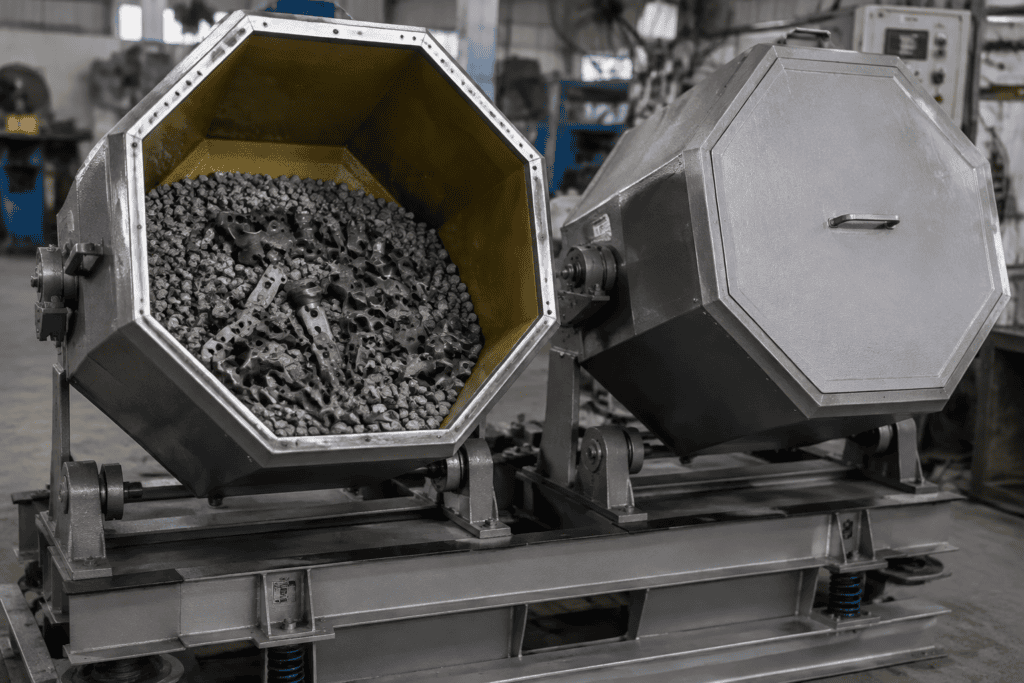
Price band. Entry batch equipment—tumblers, vibratory bowls, small centrifugal finishers—sits at $5,000–$50,000. Wide-belt sheet metal machines scale with working width and station count from about $15,000 to $300,000+. Within one builder’s line, the jump from a single-head machine to a multi-station line with slag removal, deburring and edge rounding typically doubles or triples the price.
Risks. Catalog machines are engineered for a market, not for your parts. If your burrs sit outside the machine’s window—too heavy, too deep, on the wrong face—the warranty does not cover disappointment. Second risk: service radius. A cheap machine from a builder with no regional technician turns every fault into a multi-day wait for a flown-in engineer or a parts shipment.
Best for. Shops with standard part families—laser-cut sheet, punched parts, machined components in the machine’s rated size range—who want warranty, documentation and spare parts availability. Browse our full equipment line to see how this class of offering is structured.
Buying Through an Automation Integrator
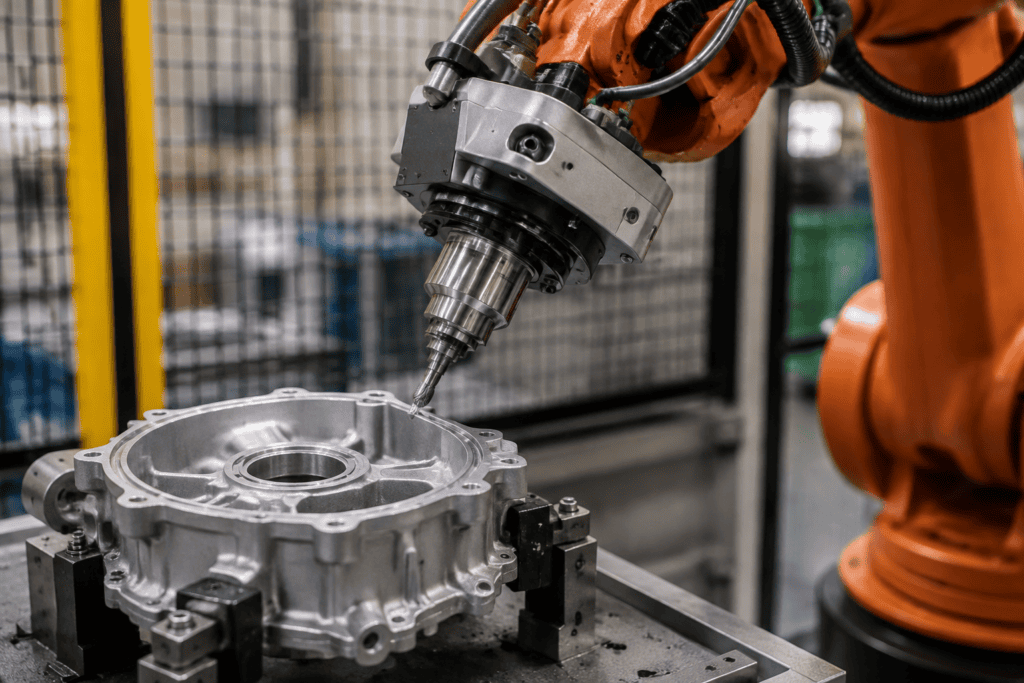
An integrator does not sell you a machine from a catalog. They take your parts, design a cell around them—robot, end effector, fixtures, tooling, programming, safety—and deliver a running process, rather than shipping you a catalog machine to integrate yourself.
How to find integrators. Referrals from shops running similar parts, robot brand partner lists (integrators certified by the major robot manufacturers are published), and process-specific case studies. The portfolio tells you more than the brochure: an integrator with twelve cells running on parts like yours is a different risk than one proposing to learn on your project.
Price band. $80,000–$300,000+ for an engineered cell. The spread is not the robot—a capable six-axis robot is a small fraction of the cell cost. It is fixtures, tool changers, spindles, guarding, programming, vision or probing, and the process development that makes the cell produce good parts on day one. Cells built on platforms like our 6-axis deburring equipment sit in this band.
Risks. Integrator capability varies enormously, and the contract structure matters: fixed-price turnkey versus cost-plus engineering, what the FAT covers, how many process iterations are included. The honest risk is buying a demo-quality program that needs six months of in-house tuning to hold tolerance—ask every candidate integrator how they prevent exactly that.
Best for. Complex three-dimensional parts, high-mix production, castings and machined components where hand deburring is the status quo, and any shop buying labor replacement rather than a machine. The economics of this channel are covered properly in our deburring automation ROI guide—the short version is that the recoverable pools are labor, quality escapes and throughput, and a cell pays back when those pools are real, not hypothetical.
Used Equipment Dealers
Used dealers sell trade-ins, refurbished machines and surplus stock with at least a level of inspection, often a short warranty, and the ability to see the machine under power.
How to find them. The established directories—Surplus Record and MachineTools.com—list dealer inventory by category, and most dealers maintain their own stock pages. Dealers specializing in sheet metal fabricating equipment routinely carry used wide-belt deburring machines from the major brands.
Price band. Typically 30–60% of the equivalent new price, driven by age, condition and whether the machine has been refurbished. A ten-year-old wide-belt machine in running condition commonly lands at 35–50% of new; a fully rebuilt one with new conveyor, bearings and controls can approach 70%.
Risks. Condition opacity is the business model’s core problem: hours of use, belt wear and crash history are hard to verify. Consumables and spare parts for discontinued models can be scarce—check that brushes, belts and contact rollers are still cataloged before you buy the machine. And you rarely get to run your parts, so the fit between the machine and your burrs rests on your own analysis.
Best for. Buyers with a hard budget cap, in-house maintenance capability, and parts that fit a well-understood machine class. The full decision logic—including when used is the wrong economy—is laid out in used vs new deburring equipment.
Industrial Auctions and Liquidations
Auctions sell everything from single machines to entire plants, online or on-site. Bid on Equipment and GovPlanet run continuous online inventory; firms like Hilco Industrial handle full liquidations.
Price band. The lowest of any channel—sometimes 20–30% of new for solid machines—and then the buyer’s premium adds 5–18% on top of the hammer price, plus loading, freight and rigging which are always your responsibility.
Risks. Nearly everything. Machines sell as-is, where-is, often without manuals, tooling or power available for inspection. Removal deadlines are strict and storage fees after them are punishing. You are betting your money on a visual inspection and your maintenance team’s ability to fix whatever is wrong. Auction buyers who do well are experienced, know the exact machine model they want, inspect in person and have rigging arranged before bidding.
Best for. Shops with strong maintenance teams, buyers replacing an identical machine who want a parts donor, and anyone whose budget makes a calculated gamble rational. If you have never bought at auction, buy your first machine from a dealer instead; the price difference is tuition.
What a New Deburring Machine Actually Costs
For robotic cells specifically, the robotic polishing machine price guide dissects what drives the number.
Price bands by machine class, gathered from builder catalogs and quoted projects:
| Machine Class | Typical New Price | What Moves the Price |
|---|---|---|
| Batch / mass finishing (vibratory, tumbling, centrifugal) | $5,000–$50,000 | Bowl size, drive power, separation, media handling |
| Wide-belt sheet metal deburring | $15,000–$300,000+ | Working width, station count, wet/dry, slag removal |
| Thermal energy (TEM) | $150,000–$400,000+ | Chamber size, gas handling, automation |
| High-pressure water | $200,000–$500,000+ | Pressure class, filtration, drying |
| Robotic deburring cell | $80,000–$300,000+ | Part complexity, fixtures, stations, engineering |
Three notes on reading this table. First, the sheet metal band is wide because working width is almost linear in price: a compact 300 mm machine and a 1,500 mm wide twelve-station line are different products sharing a category. Second, TEM and high-pressure water look expensive per machine but amortize across entire part batches in one shot—their cost per part can undercut everything else at volume. Third, robotic cells price on engineering as much as iron, which is why two cells with identical robots can differ by $100,000: one was programmed, the other was developed.
For the full machine-class landscape behind these numbers, the types guide is the reference.
What to Prepare Before You Request a Quote
Want to know what happens after you hit send? Our turnkey project process guide walks through every stage from inquiry to on-site commissioning.
The single biggest accelerator of an accurate quote—and the single biggest filter on seller quality—is what you send. A serious seller asks for the same three things every time.
Part drawings. PDFs or STEP files for the parts to be processed, with the edges or features requiring deburring marked if it is not obvious. Drawings let the seller assess geometry, access, tolerances and protected features before proposing a machine class. A quote built from “we deburr some steel parts, maybe 200 mm” is a guess with a number on it.
Sample parts. Actual parts, especially representative worst-case burr conditions. For engineered cells this is non-negotiable: any integrator worth the name wants to run your parts before quoting a cycle time, because promised-but-untested cycle times are where cell projects go wrong. Send the worst burrs you produce, not the clean ones.
Target cycle time and context. Parts per hour, shift pattern, what happens upstream and downstream, and the current cost of the operation if you know it—manual bench hours, scrap or rework rates, cleanliness or edge-quality specifications the process must meet. This lets a good seller size the machine correctly—and often tell you a smaller machine will do the job.
Sellers who quote from an email exchange alone are telling you how they will treat you after the deposit.
Buying Mistakes That Cost More Than the Machine
Four recur across every channel.
Mistake 1: Buying a model instead of a process match. The listing says “wide-belt deburring machine, 1,100 mm, excellent condition”—and says nothing about whether your burrs, materials and part sizes sit inside its process window. Buyers anchor on brand and price because those are comparable, and skip the process fit because it requires work. A $40,000 machine that cannot remove your burr is more expensive than a $90,000 one that can, because you still own the problem.
Mistake 2: Ordering without a trial run. On new engineered cells this means sample processing before contract signature or at FAT; on used machines it means seeing it cut under power. Skipping the trial to save a week of schedule is the most reliable way to spend six months commissioning. Machines that are never proven on your parts arrive as hypotheses.
Mistake 3: Ignoring consumables and lifetime cost. Brushes, belts, media, contact rollers and coolant are the operating cost of deburring, and they are recurring. A machine consuming $8,000 a year in brushes and media costs another machine’s price every few years. Ask every seller for consumable part numbers, expected life at your duty cycle and annual cost estimate—then verify that the consumables are actually orderable in your region. Discontinued consumables turn cheap used machines into lawn ornaments.
Mistake 4: Budgeting the machine and forgetting the cell. Power supply, air, extraction or dust collection, water treatment for wet processes, foundation or leveling, rigging and freight. These add 15–30% to the headline price for standard machines and can add more for a robotic cell that needs guarding, safety circuits and integration with your line. Budget them on day one or discover them on delivery day.
Buying From China: Audit, FAT and Pre-Shipment Inspection
A growing share of deburring machines sold globally are built in China, including ours. The price advantage is real—often 30–50% below comparable Western-built equipment—and so is the variance between suppliers, which ranges from world-class factories to workshops with a good website. We sell from Nanjing, and this section is the advice we would give you about evaluating any Chinese supplier, including us.
Audit the factory before you pay. Visit in person if the order justifies it; otherwise commission a third-party audit—SGS, Bureau Veritas and TÜV all offer factory assessment reports at modest cost relative to any machine purchase. You are verifying that the factory exists at the claimed scale, that the machines on the floor match the brochure, and that there is a real engineering department behind the proposals.
Make the FAT meaningful. Factory Acceptance Test before shipment is your strongest protection on engineered equipment. Insist that it runs your parts, not the supplier’s demo parts, against the agreed cycle time and quality criteria, and that the test protocol is written into the contract. A FAT on unfamiliar parts proves the machine runs; a FAT on your parts proves the process works. Attend in person or by video with recorded evidence—travel cost is a fraction of one commissioning dispute.
Commission a pre-shipment inspection. After packing and before the container leaves, a third-party inspector verifies the machine against the contract—model, serial, accessories, tooling, documentation—and the packing quality: export-grade crates, rust prevention, moisture protection, correct marking. Photograph the loaded container. Insurance claims for transit damage succeed or fail on this evidence.
Structure the payment. The standard pattern is a deposit of 30% with order and 70% against shipping documents after FAT; larger orders sometimes run through a letter of credit. Any supplier demanding 100% upfront is not a supplier, whatever their price.
None of this is specific to China—the same discipline serves any cross-border machine purchase. The difference is that in a market with wider price spread, verification discipline is what separates the bargains from the write-offs. Send your drawings and sample parts through our contact page and we will tell you plainly whether our equipment fits your parts—including when it does not.
Send Us Your Part Drawings
If you have read this far, you already know what we will ask for: part drawings, sample parts, target cycle time and your current process. Send them to UBright Solutions and our engineers will respond with a proposed machine or cell configuration, a realistic cycle estimate and a price band—not a generic catalog quote, but an assessment of your actual parts. Start on the contact page, or review the full product line first if you are still mapping machine classes to your work.
FAQ
Q1: How much does a deburring machine cost?
Batch finishing equipment runs $5,000–$50,000 new; wide-belt sheet metal machines run $15,000–$300,000+ with working width and station count as the main drivers; robotic cells run $80,000–$300,000+ including engineering and fixtures. Used machines sell at 40–60% of new price, and auction purchases land lower but carry buyer’s premiums and as-is risk.
Q2: Where is the best place to buy a deburring machine?
Direct from a builder for standard part families, from an automation integrator for complex or high-mix parts, from a used dealer when budget is capped and you have maintenance support, and at auction only if you can inspect in person and absorb the risk.
Q3: Should I buy a used or new deburring machine?
Used wins when the machine class fits your parts well, you have maintenance capability and consumables remain available; new wins when your parts need process development, warranty coverage matters or the used market has nothing in your class. The comparison is worked through in used vs new deburring equipment.
Q4: What is the lead time on a new machine?
Standard catalog machines from active builders typically ship in 8–16 weeks. Engineered robotic cells take 8–20 weeks from order through design, build, programming and FAT, longer when fixtures are complex or your parts need iterative process development. Used equipment ships as soon as logistics allow—usually two to four weeks.
Q5: How do I start the buying process?
Answer the five questions above—burr type, parts, cycle target, budget band, maintenance capability—then send drawings and sample parts to two or three sellers in your chosen channel. Compare what they ask, not just what they quote: the seller who studies your parts before pricing is the one who will still answer the phone after installation.