Surface finishing processes are the secondary operations that change a metal part’s surface after primary manufacturing—removing burrs and flash, smoothing or roughening the topology, cleaning and preparing it for coating. Deburring, grinding, mass finishing, and polishing all belong to the family. This guide maps the territory and shows where your parts fit.
Milling, stamping, die casting, and welding build shape; they also leave burrs, flash, scale, and witness marks on every workpiece. Everything that happens to the surface afterward—everything buyers judge when they run a fingernail over an edge—falls under surface finishing. On this site you will find more than a dozen dedicated guides to individual processes. This page is the map that connects them, written for the person standing in front of a pallet of unfinished parts and a budget line that says “solve this.”

What Are Surface Finishing Processes?
A surface finishing process is any operation that deliberately alters the surface of a workpiece—its geometry at the micro level, its texture, its cleanliness, or its chemistry—without changing the bulk form. The intent separates it from machining: a milling cutter creates a feature, while a finishing operation makes that feature usable, saleable, or paintable.
The scope is wider than most buyers assume. At the aggressive end sits stock removal: grinding gate stubs off castings, cutting weld beads flush, knocking 0.3 mm burrs off stamped edges. In the middle sit smoothing operations that step roughness down in stages, from a belt-sanded Ra 1.2 µm to a buffed Ra 0.05 µm. At the fine end sit preparation steps—cleaning, deoxidizing, activation—that exist only to make a downstream coating or bond hold. A decorative chrome layer on a rough substrate looks and performs like a failure; metal surface finishing is where that outcome gets decided, before the plating line ever sees the part.
One vocabulary note, because it causes real confusion in procurement: “surface finish” is the result, “surface finishing” is the process family. A drawing calls out a surface finish (Ra 0.8 µm, 32 µin); the shop chooses among surface finishing processes to hit it. We use the terms that way throughout.
The Three Families: Classifying Processes by Purpose
Process directories—coatings here, mechanical abrasives there, laser treatments in a third column—describe the market, but they do not help you buy. A classification that maps to equipment decisions sorts surface finish types by what the process is there to accomplish.
Removal processes take material off. Deburring, grinding, deflashing, descaling, and weld dressing belong here. The measurable outcome is negative: burr thickness reduced from 0.1–0.4 mm to zero, parting-line flash gone, oxide layer stripped. Removal is the entry point because unfinished edges are a safety problem, an assembly problem, and a quality-escape problem all at once.
Refinement processes improve what remains. Polishing, buffing, burnishing, and the finishing stages of mass finishing lower Ra, remove directional marks, and build the reflective or satin appearance customers pay for. Removal decides whether a part is safe; refinement decides whether it looks like a premium product.
Preparation processes make the surface ready for the next operation. Industrial cleaning, degreasing, descaling in its manufacturing sense—removing mill scale and heat-treat oxide from steel, not consumer appliances—and pre-coating prep sit here. Blasting a steel weldment to Sa 2.5 before painting is preparation. So is the fine matte finish specified ahead of structural adhesive, because bond strength tracks surface energy and roughness more than most bonding specs admit.
One boundary worth drawing explicitly: electroplating, anodizing, powder coating, and thermal spray are often listed as surface finishing processes. Mechanically they belong downstream—they add layers rather than prepare surfaces—and the coating shop will specify the incoming condition your parts must meet. This guide covers everything up to that handoff. The three families above overlap in practice; a vibratory bowl can deburr (removal) and burnish (refinement) in one cycle. That overlap is exactly why selection starts from the part, not from a machine catalog.
From Part to Machine: A Selection Framework
For parts where the spec is an edge radius rather than a surface number, the edge rounding guide maps three process routes; the hydraulic manifold case shows internal crosshole deburring end to end.
Four questions, asked in order, will route almost any workpiece to the right equipment class.
Question one: what is the material? Aluminum and copper alloys cut fast and smear under dull abrasives. Stainless steel work-hardens and demands sharper media at lower pressure. Hardened tool steel, Inconel, and thermal-spray coatings grind slowly and destroy cheap tooling. Material sets the abrasive family, the wheel speeds, and—through wear rates—a large share of your running cost.
Question two: what defect are you removing? Exit burrs from milling run 0.05–0.2 mm. Stamped slivers hug the blanked contour. Die-cast flash at the parting line can exceed 1 mm. Heat-treat scale and laser discoloration are area defects rather than edge defects. Each defect type implies a tool: a file follows an edge, a flap wheel covers an area, and a blast nozzle reaches neither precisely but both cheaply.
Question three: what must the surface look like when you are done? Ra 3.2 µm satisfies most machined functional faces. Ra 0.8 µm is the usual pre-plate condition. Decorative sanitary or automotive brightwork targets Ra 0.1–0.4 µm, and decorative mirror work toward Ra 0.05 µm adds a buffing stage and real cost. Specify a number; “smooth” means something different to every department.
Question four: what volume and takt? One hundred parts a month of ten different designs lives in a very different machine from 5,000 identical castings a day. Volume decides payback, and variety decides flexibility.
The answers collapse into four equipment routes. Batch finishing equipment (vibratory bowls, barrels, centrifugal disc machines) handles small and mid-size parts in bulk. Robotic cells grind, deburr, and polish large or geometrically complex parts with programmed paths. Dedicated machines—sheet deburring lines, flat-surface polishers, wheel and tube polishers—win when part geometry is fixed across thousands of units. And outsourcing wins honestly during ramp-up or when utilization cannot justify capital. The full taxonomy, with sizes and typical prices, is in our deburring machine types guide.
Removal: Deburring, Grinding, and Deflashing
Three precision-boundary questions come up constantly in this family: deburring vs grinding when a part carries both flash and stock, lapping vs polishing when flatness itself is the spec, and honing vs polishing for bore-versus-outside-surface work.
Removal is where most surface finishing projects start, and burrs are why. A burr is a thin ridge of work-hardened material left where a cutting tool exited, a die sheared through, or a mold parted—harder than the parent metal, sharp enough to cut gloves, and positioned exactly where hands and assembly tools go. Secondary problems follow: burrs break off inside hydraulic components, jam stamping progressions, and crack under cyclic load.
Robotic deburring applies a programmed path with controlled force, so edge quality stops depending on which operator is on shift. A force-controlled spindle or wrist keeps contact pressure constant as the tool wears and as castings vary within tolerance, holding edge break within a few hundredths of a millimeter across a whole production run. The economics are strongest on parts too big for a bowl and too varied for a dedicated fixture—our robotic deburring primer covers force control, tooling, and cell layout.
Robotic grinding is removal at higher stakes. Feed stubs and parting lines on castings, weld beads that must blend flush, forgings with flash to dress: here the machine removes grams, not slivers, and stiffness of the robot and the spindle becomes the limiting factor. Pass strategy, wheel selection, and dressing routines make the difference between a stable process and one that scrambles for tolerance every shift—the robotic grinding guide works through them.
Deflashing deserves its own branch because the material, not the geometry, drives it. Cryogenic deflashing tumbling parts at liquid-nitrogen temperatures (−196 °C) embrittles thin flash on rubber and plastic parts and on zinc or aluminum die castings, so media impact shatters the flash cleanly while the thicker section stays tough. Cycle times run 5–15 minutes with no part-specific tooling, which is why it dominates for small, complex polymer components. The cryogenic deflashing guide details what the process can and cannot reach.
Mass Finishing: Batch Processing at Scale
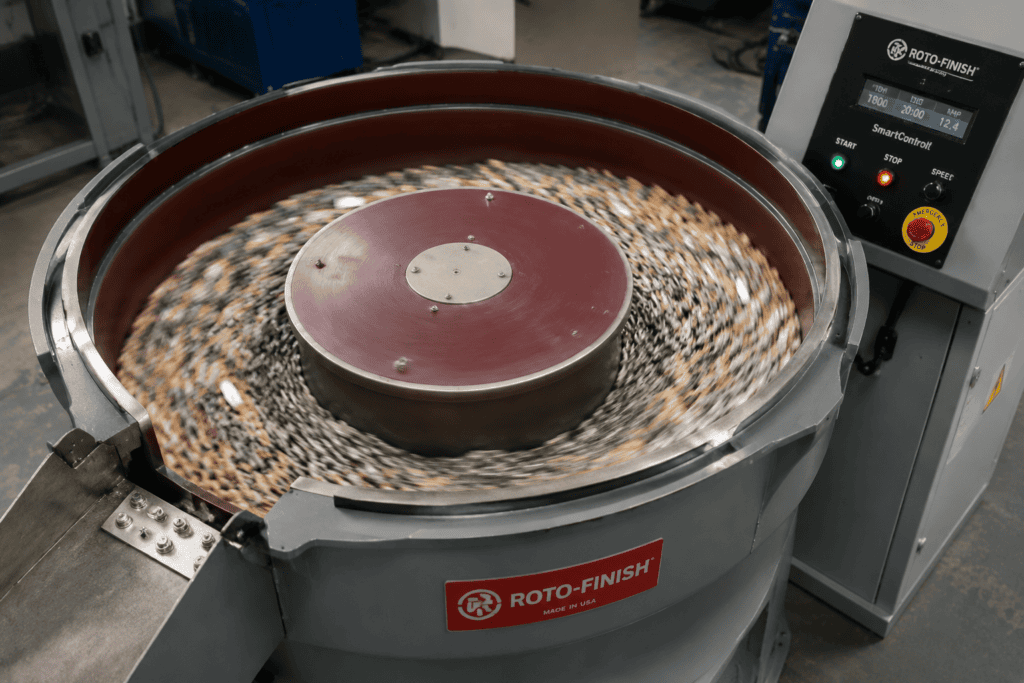
When parts are small enough to tumble and numerous enough to count in thousands, the entire selection question can collapse into one sentence: put them in a bowl with media and compound. Mass finishing deburrs, radiuses, cleans, burnishes, and polishes whole batches simultaneously—vibratory bowls for the broad middle of the market, barrels for the finest pre-plate finishes, centrifugal disc machines when cycle time matters most, and magnetic polishers for tiny, delicate components.
The statistical argument beats every alternative at volume. Inside the media bed, contact between abrasive and part is random but repeated millions of times, so variation averages out; a batch emerges more uniform than eight hours of hand work could produce. One operator runs several machines, and per-part finishing cost lands at fractions of a cent. The boundary is just as clear: mass finishing cannot direct work at one edge, hold a radius only on the slot, or protect a critical face. When the drawing says “here, not everywhere,” you are back to robotics.
Every mass finishing process is really a media and compound decision wearing a machine costume—ceramic for cutting, plastic for gentle action on softer alloys, steel for burnishing, with cycle times from 10 minutes in high-energy machines to 6 hours in slow barrels. The complete family comparison, including equipment sizing and media selection, is consolidated in the mass finishing guide.
Sheet Metal and Flat-Surface Lines
Sheet metal finishing is its own discipline because the parts are thin, large, and floppy, and because the defects arrive as full-area problems: burrs along every sheared and punched edge, slag on plasma-cut contours, coil marks and handling scratches across the face. A robot arm with a grinder treats these one at a time; the sheet treats them all at once.
Passing a blank or fabricated panel through a wet brush-deburring machine does both faces and both edges in one feed—top and bottom brushes contact simultaneously, edge rounding runs 0.1–0.5 mm, and throughput scales linearly with line speed. Dry abrasive versions handle simpler edge work at lower cost. The decision factors—brush type, throughput classes, and when wet processing pays for itself—are laid out in the sheet metal deburring machine guide.
Flat-surface polishing covers the other half of the family: panels, plates, strips, and fabricated surfaces that need a uniform finish—brushed, satin, or mirror—across the whole face rather than just clean edges. Oscillating-bed and throughfeed machines hold Ra across areas no handheld tool can keep consistent, which matters for stainless architectural panels, appliance fronts, and food-equipment surfaces where the eye catches every discontinuity. The flat surface polishing machine guide covers machine configurations and achievable finishes.
Refinement: Polishing and Buffing
Refinement is where surface finishing stops being a cost center and starts being part of the product. Sanitary fittings, cutlery, faucet bodies, medical devices, automotive brightwork—in these categories the buyer sees the surface and nothing else, and the difference between Ra 0.3 µm and Ra 0.08 µm is the difference between two price tiers.
Robotic polishing reproduces the motions of a skilled polisher—compound, buffing wheel, contact angle, dwell—with none of the variability. Consistency is the entire value proposition: the 400th part of the shift matches the 1st, smoke breaks and skill gaps disappear, and the aggressive dust that makes manual polishing a health problem gets captured at the cell instead of in lungs. Machine configurations, wheel and compound selection, and what robotic polishing realistically achieves on different alloys are covered in the robotic polishing machine guide.
Geometry still narrows the choice. Wheels, hubs, and other rotationally symmetric parts finish more efficiently on dedicated wheel polishing machines, where the part spins against a programmed buffing head; long stock—tube, bar, and shafts—belongs on throughfeed polishers that handle lengths no robot reach can cover. For wheel applications specifically, the wheel polishing machine guide compares single-station and multi-station configurations.
Media and Consumables: The Hidden Variable
First-time buyers budget for the machine and discover the media. Abrasive media, compounds, wheels, belts, and brushes are consumables that keep consuming long after the capital invoice is paid, and in high-volume mass finishing they routinely dominate total cost of ownership. A vibratory bowl running three shifts eats ceramic media by the hundred-kilogram order; a grinding cell consumes wheels, discs, and dressing tools on a schedule that tooling suppliers track more closely than you will.
Selection is a science of matches. Media must cut the workpiece faster than it wears itself, must reach the geometry (triangle media enters slots; cylinders roll off edges), and must separate cleanly from parts at discharge. Compound chemistry controls glazing, corrosion, and part brightness in wet processes. Getting the combination wrong shows up as 2× longer cycles or stained parts weeks after commissioning. The deburring media guide maps media families, shapes, and wear economics—the single highest-leverage reading for anyone pricing a batch system.
Surface Roughness (Ra) Ranges by Process
Ra—centerline average roughness—is the common currency of surface specification, and knowing the realistic range of each process prevents paying for refinement a machine cannot deliver or specifying mirror finish where nobody will see it. The table below consolidates typical achievable ranges for metal surface finishing; treat them as planning bands, with exact results depending on material, media grade, and cycle time.
| Processus | Typical Ra range (µm) | Primary role |
|---|---|---|
| As-cast / flame-cut surface | 6.3–25 | Starting condition |
| As-machined (milled, turned) | 0.8–6.3 | Starting condition |
| Abrasive blasting | 0.8–6.3 | Cleaning, roughening, preparation |
| Robotic grinding | 0.8–3.2 | Stock removal, blending |
| Belt sanding | 0.4–1.6 | Intermediate smoothing |
| Vibratory finishing | 0.2–0.8 | Batch deburr, general finish |
| Barrel tumbling (fine media) | 0.1–0.4 | Pre-plate refinement |
| Robotic polishing | 0.05–0.4 | Controlled fine finish |
| Electropolishing | 0.05–0.3 | Chemical smoothing, passivation |
| Buffing | 0.025–0.1 | Decorative bright finish |
| Lapping / fine honing | 0.012–0.05 | Precision sealing surfaces |
Three cautions from practice. First, Ra alone underspecifies a surface: two finishes at the same Ra can look completely different depending on lay direction (the dominant scratch pattern), so decorative specs should reference a sample plate, not just a number. Second, Rz sometimes matters more than Ra—sealing and fatigue applications respond to peak-to-valley depth, which aggressive processes can leave high even at acceptable Ra. Third, measure your own incoming parts before budgeting; the actual roughness of as-received castings or sheet determines how many finishing stages you need, and supplier claims age poorly.
Industry Applications and the Integrator Decision
Different industries answer the selection framework in different, repeatable ways. In EV and general automotive manufacturing, battery tray welds, motor housings, and structural castings drive demand for robotic grinding and deburring cells that trace every part—our automotive and EV surface finishing page collects those applications. Hardware and plumbing specifiers route faucet and fitting production toward mass finishing plus robotic polishing for the visible faces. Medical device manufacturers pay for the process control, validation documentation, and repeatability that robotic cells provide, since a polishing recipe that cannot be reproduced exactly is a batch that fails audit. Aerospace leans on robotic grinding and polishing for blades, vanes, and structural components where every gram and every micron is contractual.
That leaves the make-or-buy decision at the center of most projects, and it comes down to two honest questions. Can a standard machine hit your spec? When your parts match a machine’s native geometry—sheet through a deburring line, wheels through a wheel polisher, small hardware through a vibratory bowl—standard equipment with modest fixturing does the job at the lowest cost and fastest delivery. When does an integrator earn the fee? Multi-part families on one cell, tight force-control requirements, in-line inspection, automated part handling, or process development from scratch—these are the projects where application engineering, not the iron, determines success.
Either way, insist on a sample-part trial before the purchase order. Every serious supplier runs one; a process proven on your parts, with your burrs, is worth more than any catalog claim. For the financial side—labor displacement, cycle-time gains, payback windows that typically land between 12 and 36 months for automation against manual finishing—the deburring automation ROI guide works through the arithmetic line by line.
Frequently Asked Questions
What is the difference between surface finishing and surface finish? Surface finishing is the process family—deburring, grinding, mass finishing, polishing, cleaning. Surface finish is the measurable result, usually specified as Ra in micrometers or microinches. A drawing specifies a surface finish; manufacturing chooses among surface finishing processes to achieve it.
Which surface finishing process gives the smoothest surface? Lapping and fine honing reach Ra 0.012–0.05 µm on precision sealing faces. For decorative and most industrial work, buffing (Ra 0.025–0.1 µm) is the practical ceiling, usually applied after robotic polishing has already brought the surface to Ra 0.05–0.4 µm. Electropolishing reaches Ra 0.05–0.3 µm while adding passivation on stainless.
Should I choose mass finishing or robotic finishing? Choose mass finishing when parts are small, robust, and produced in batches from hundreds upward, and when uniform all-over treatment is acceptable. Choose robotic cells when parts are large, when work must be directed at specific edges or faces, or when a documented, repeatable process path is required. Many plants run both: a vibratory bowl for general deburring, a robot for the faces that matter.
Can one machine handle both deburring and polishing? Robotic cells can, by changing tools and programs between operations—a gripper swaps from a carbide burr to a buffing wheel within the same cycle. Multi-stage mass finishing systems do it with sequenced media loads. Dedicated single-purpose machines generally cannot, and should not be asked to.
How much does an automated surface finishing system cost? Bench-top and small batch machines start around $5,000–20,000; production vibratory and sheet-deburring equipment spans roughly $30,000–150,000; full robotic grinding and polishing cells, including spindles, tooling, safety, and integration, typically run $80,000–300,000+ depending on payload, force control, and in-line measurement. Payback against manual finishing commonly lands in 12–36 months.