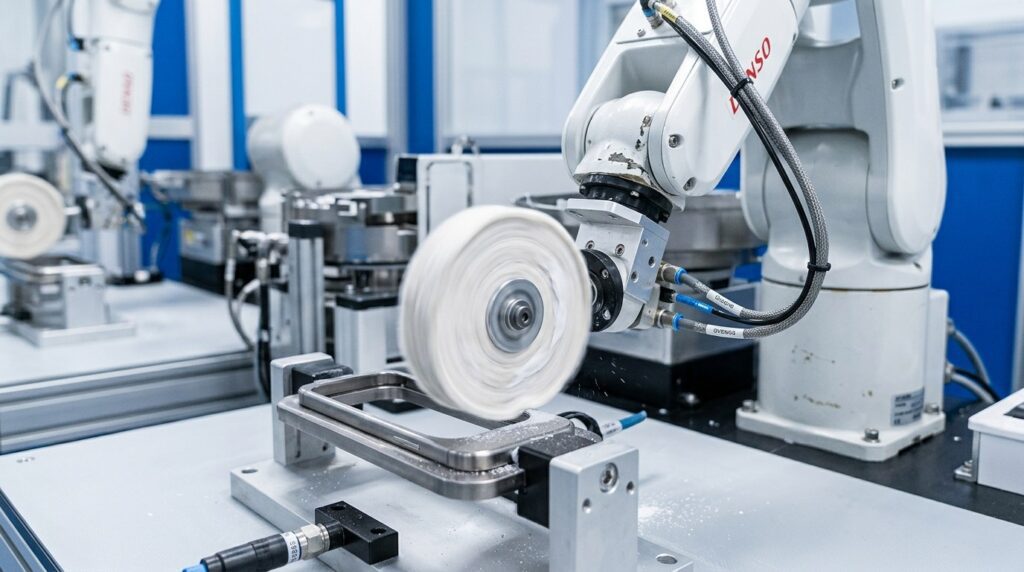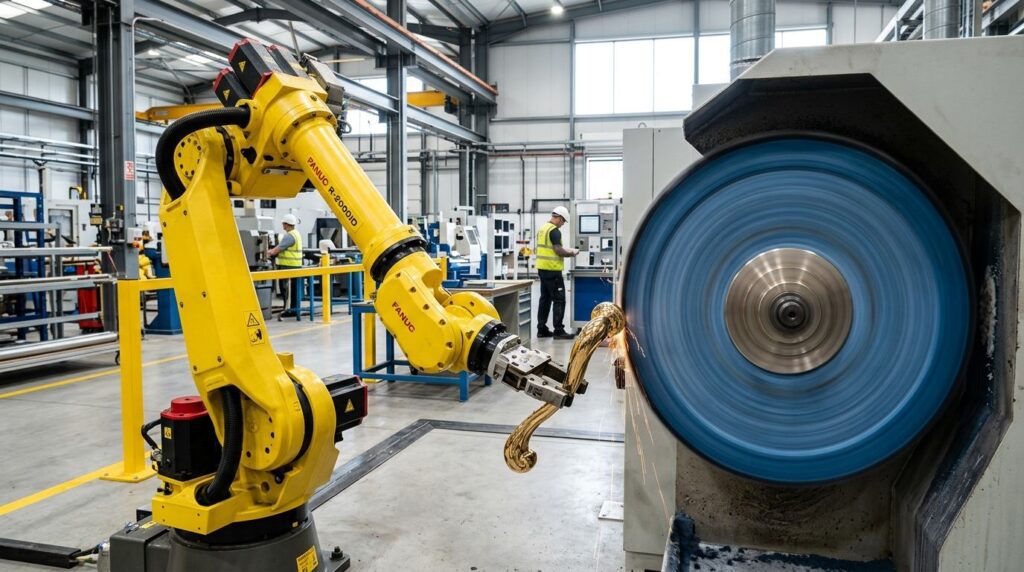
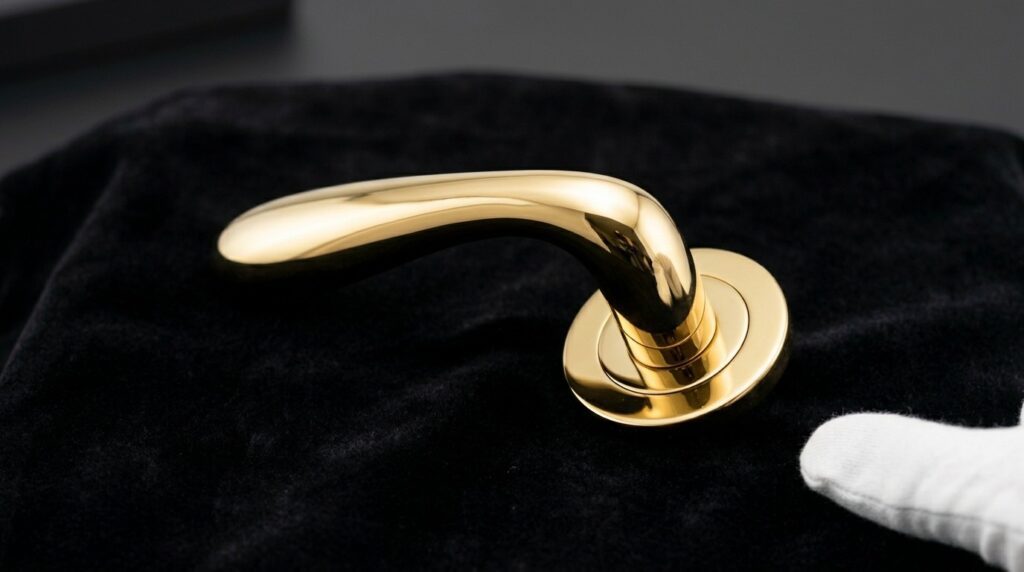
На премиальном рынке сантехника и оборудование, Ручки и тяги - это не просто функциональные элементы, это произведения искусства. Будь то минималистичный обтекаемый дизайн или замысловатые бионические формы, очарование роскошных ручек заключается в их непрерывных и совершенных переходах 3D-кривизны.
To hold the designer’s arc across thousands of repetitions, hardware brands have moved to an automated роботизированная полировка architecture—a heavy-duty robot carrying the workpiece against floor-mounted multi-station equipment—to reach the curve consistency that manual shops promise but rarely deliver.
Что такое элитные дверные ручки?
Роскошные ручки обычно изготавливаются с помощью Горячая ковка латуни или Литье по выплавляемым моделям из нержавеющей стали. По сравнению со стандартным литьем под давлением, эти материалы более плотные и жесткие, что также означает, что необработанные поверхности после обработки чрезвычайно твердые и имеют сложную текстуру.
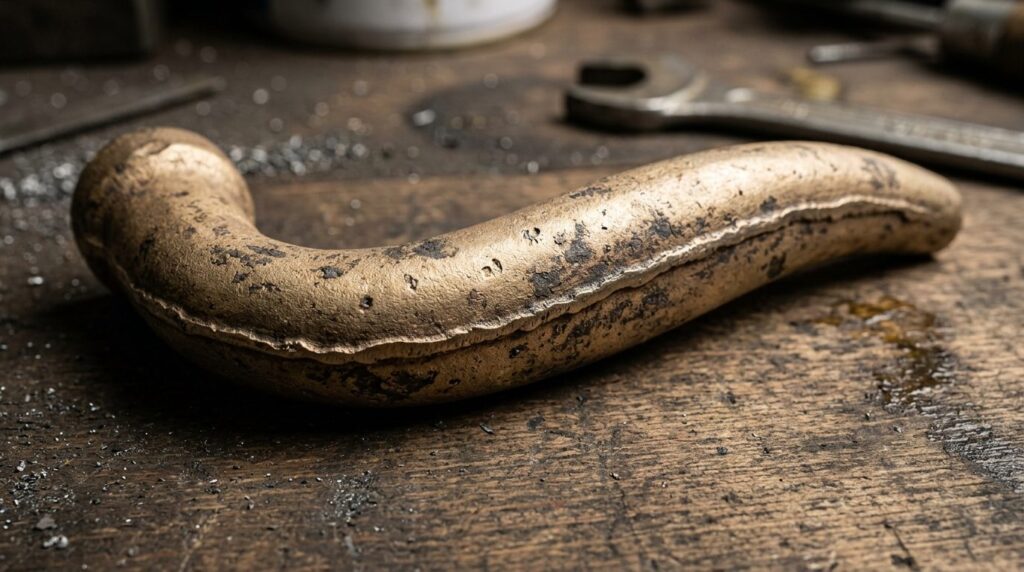
“Убийца кривых” традиционной ручной полировки
Ручки класса люкс имеют множество вогнутых/выпуклых поверхностей и крошечные R-углы, что создает значительные трудности для ручного труда:
- “Плоские пятна” на кривых: Когда рабочие вручную вращают рукоятку против шлифовальной ленты, неравномерная мощность усилия легко создает крошечные плоские пятна на закругленных поверхностях, что приводит к поломке отражений.
- R-угловое искажение: Корень или изгиб (R-угол) рукояти - это визуальная точка фокуса. Ручная шлифовка легко приводит к тому, что эти углы “разваливаются” или округляются, разрушая эстетический замысел.
- Сильные физические нагрузки: Полировка массивных латунных ручек требует огромного давления вниз. Падение давления, вызванное усталостью, является отраслевой нормой в ручных мастерских.
Технические параметры для автоматизации роскошных дверных ручек
| Stage | Recommended Tooling & Setting | Примечания |
| Удаление вспышки | Лента с крупнозернистой абразивной крошкой | Быстро стирает линии ковки, не повреждая профиль |
| Наложение 3D-профилей | Гибкое контактное колесо / нейлоновая щетка | Подстраивается под сложные 3D-траектории для унификации текстуры поверхности |
| Зеркальная полировка | Колесо из сизаля высокой плотности / тонкой ткани | Paired with premium wax for deep metal luster |
| Диапазон постоянных усилий | ±1N (высокочастотная адаптация) | Действует как “гибкая рука”, защищая нежные R-уголки |
| Повторяемость траектории | ≤ 0,03 мм | Keeps every handle’s arc true to the CAD model |
Почему элитные дверные ручки должны использовать архитектуру “робот - держатель - деталь”?
For geometry this complex, the cell is arranged the other way round from a machine-tool: the 6-axis robot cradles the handle the way a craftsman’s hands would, and carries it to a row of floor-mounted belt machines and buffing stations that never move. Every axis of articulation lives on the part side, which is precisely what free-form handles need.
This arrangement earns its keep in three concrete ways:
- Полная свобода движений: A 6-axis wrist rotates through 360 degrees, so a stationary belt or cloth wheel can be swept along every U-bend and S-curve without re-clamping the handle.
- Fine-Resolution Force Sensing: The curve is the product, so pressure gets treated accordingly. The robot senses small changes in polishing load and eases off as it approaches an R-corner or edge, removing imperfections while leaving the designed geometry untouched.
- Multi-Station Integration: One grip takes the handle through flash removal, blending and buffing at consecutive stations. No second setup means no re-datuming, so coordinates stay consistent through the whole cycle.
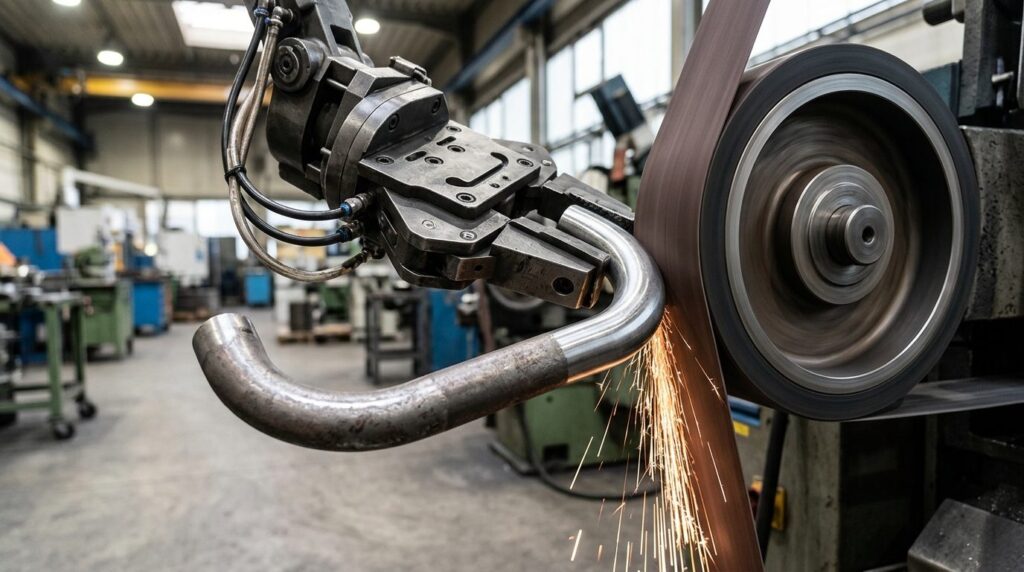
Автоматизированный рабочий процесс шлифовки и полировки
| Шаг | Station | Инструментарий | Результат |
| 01 | Сверхпрочный точный захват | Робот + литой захват на заказ | Тяжелые рукоятки не смещаются при трении на высоких скоростях |
| 02 | Удаление линии ковки | Напольный станок для тяжелых ремней | Быстро разглаживает линии пробора, восстанавливая первоначальный профиль |
| 03 | Смешивание сложных кривых | Плавающий контактный колесный ремень | Приспосабливается к поверхностям свободной формы, удаляя макроскопическую рябь |
| 04 | Базовая зеркальная полировка | Многостанционный шлифовальный центр Auto-Wax | Благодаря использованию градиентных дисков из сизаля/ткани достигается четкая зеркальная поверхность. |
| 05 | Автоматическая разгрузка и контроль качества | Переход к лазерной маркировке/ультразвуковой | Ожидает последующего нанесения PVD или глянцевого покрытия |
Workholding for Free-Form Brass Handles
A solid brass handle offers almost nothing to clamp: no flat reference face, a heavy body, and 360 degrees of cosmetic surface. The fixturing answer is to grip where the customer will never look. Mounting threads at the base, the internal bore, or the spindle recess become the locating features; a pneumatic expanding mandrel or a form-matched cradle picks up those features and leaves the entire visible surface exposed to the wheels.
- Anti-rotation without marking: torque from high-speed buffing is real on heavy handles, so drivers engage splines or flats inside the bore—not the polished shank.
- Thermal discipline: brass conducts buffing heat straight into the fixture; gripper materials and exchange rhythms are chosen so wax does not bake onto the part or the tooling.
- One datum end to end: the same bore that locates the handle for polishing also locates it at final inspection, so geometric checks are not fighting a fixture shift.
Gripper design also decides changeover economics. Because handle families share section sizes more than they share silhouettes, one gripper body with interchangeable insert sets usually covers a brand’s whole catalog; a new handle geometry then means an insert, not a new fixture build. That is what keeps small-batch custom programs profitable on the same cell that runs volume staples.
Consumables and Process Windows for Brass
Brass forgings arrive hard-skinned with parting lines, and they finish as mirror product—so the abrasive ladder has to be long and the final cuts light. A workable sequence moves from coarse belts that erase forging lines, through flexible contact wheels and nylon that fair the free-form surfaces, to sisal with cutting compound and finally soft cotton with finishing compound for color. Each stage exists to remove the previous stage’s scratch pattern, nothing more.
- Pressure discipline: brass is softer than it looks; the process window favors moderate force at healthy surface speed rather than heavy pressure, which smears instead of cuts and heats the part.
- Compound choice: cutting compound on sisal for stock removal, finishing compound on cotton for luster—mixing the two is a common cause of hazy finishes.
- R-corner tooling: small-diameter wheels reach into handle roots where full-size wheels cannot; the robot schedules them as a separate station rather than forcing one wheel to do both jobs. Machine formats for this work are compared in our robotic polishing machine guide.
Path Planning, Takt Time and Consistency Verification
Path generation for handles is a normal-following exercise: the tool must meet the surface at a controlled angle and sweep along the curvature, decelerating into tight R-zones and accelerating on open shanks—look-ahead speed control is what prevents dwell burns at the transition points. Because the handle never leaves the gripper between stations, the path executed at the buffing wheel is registered to exactly the same coordinate frame as the belt passes before it.
On takt, a single robot walking four to five fixed stations suits most handle programs; where volumes are higher, two robots share the station row and alternate parts, roughly halving cycle time without doubling the machine count. Starvation is avoided by letting the loading side of the cell run asynchronously.
Verification closes the loop: gloss-meter sampling across the batch, zebra-light reflection checks for curve continuity, and a sealed golden sample from the first approved batch as the visual reference for every shift. The same inspection discipline applies across general metal polishing programs; for the flat-panel counterpart in door hardware, see our smart door lock panel polishing solution.
Application Scenario: Curved Solid Brass Handles
One typical project involves a hardware plant serving the RV and private-estate market, where polished brass handles are specification items rather than accessories.
- Вызов: On a solid brass S-shaped handle, manual first-pass rates were stuck at unprofitable levels—uneven curve transitions broke the reflection after plating, and rework could not keep up.
- The Outcome: Under the robot-holding, force-controlled cell, the machine repeats a master-level path with pressure that never tires. First-pass yield recovered to consistently high levels, unit processing cost fell substantially, and the delivery disruptions that followed labor turnover stopped.
Часто задаваемые вопросы о полировке роскошных ручек
Вопрос 1: Конструкции рукояток значительно отличаются друг от друга. Сложно ли программировать роботов?
A: Programming is handled by 3D Offline Programming (OLP) software, not by teach-pendant walking. Import the CAD model and the system reads surface normals and plans the paths itself; even heavily stylized handles typically go from model to running program within half a day.
Вопрос 2: При полировке латунных ручек выделяется значительное количество тепла от трения. Влияет ли это на работу робота?
A: No. The cell combines temperature-resistant gripper materials with path rules that keep the tool moving—no dwelling—so friction heat never pools in one spot. That protects both the equipment and the brass surface against thermal discoloration.
Заключение
The value of a luxury handle is that one continuous curved reflection. An automated architecture of heavy-duty 6-axis robots carrying workpieces against high-power floor-mounted equipment is the most dependable route to complex 3D polishing at scale: it takes people off the physically punishing work and gives series products the consistency once reserved for hand-finished custom pieces.
Uneven curves and collapsed R-corners are geometry problems, not people problems—and geometry is exactly what a robot repeats without deviation. Bring your handle designs for a high-end hardware automation assessment: связаться с нами.