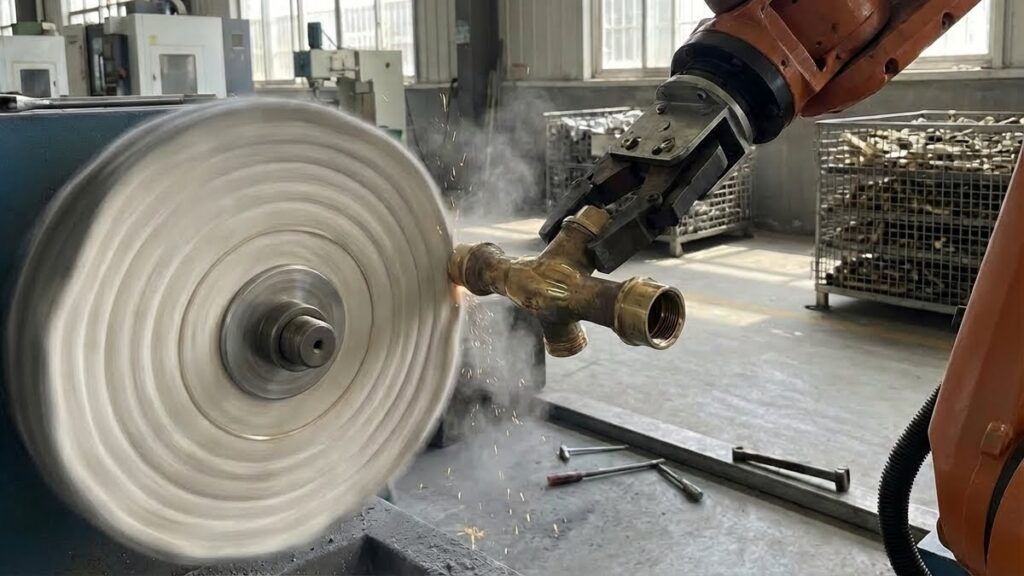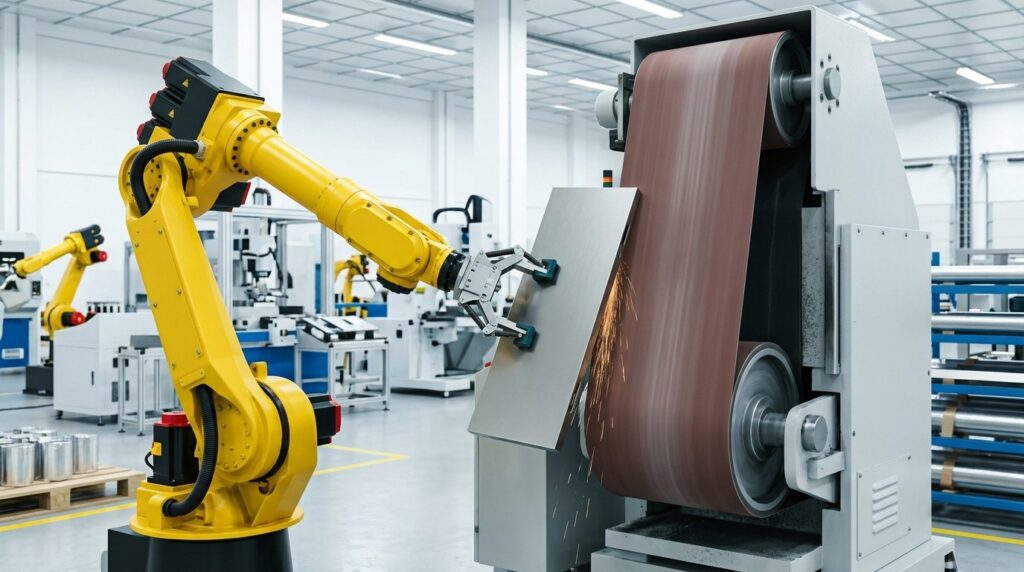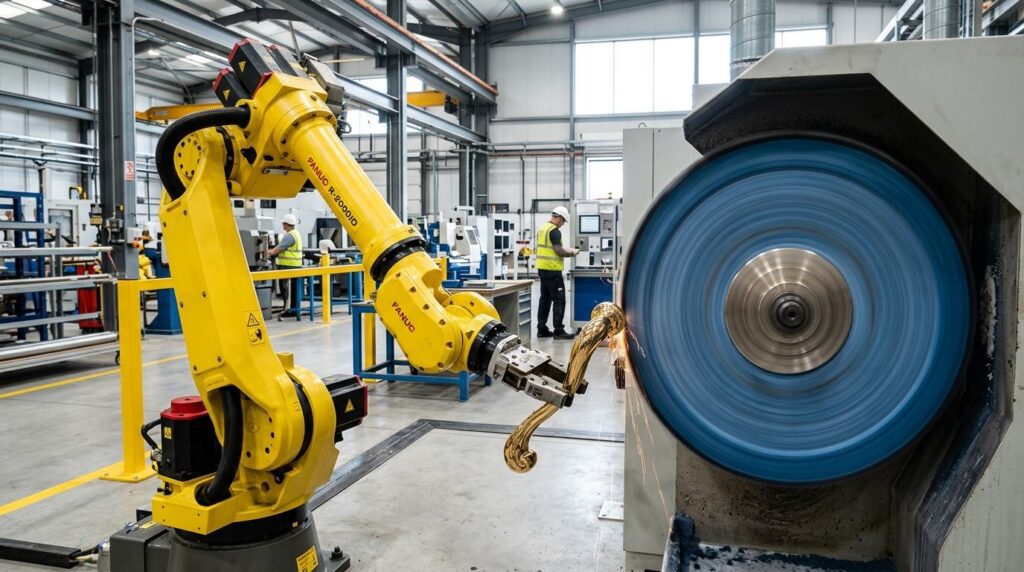
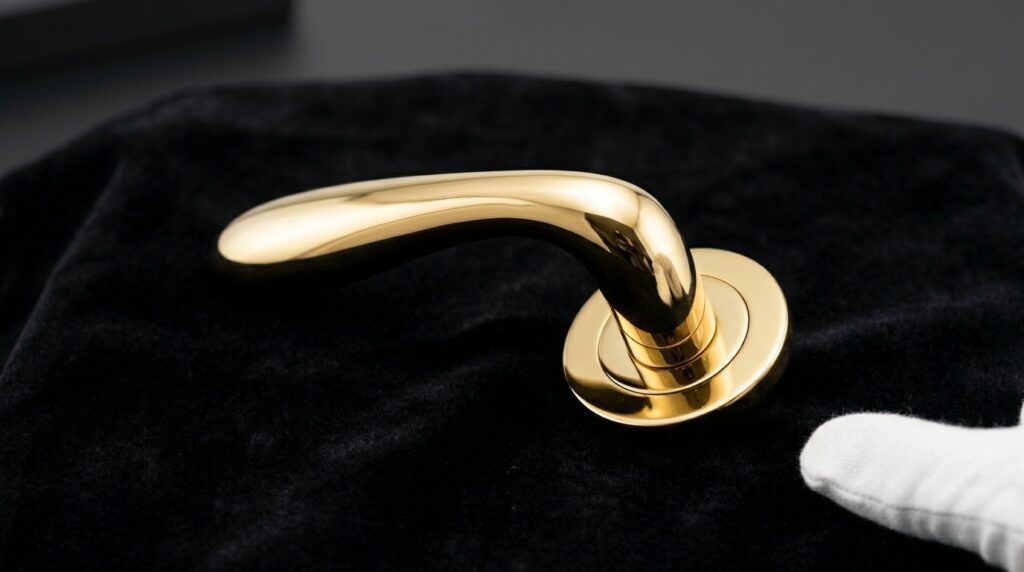
というプレミアム市場では 配管・金物, ハンドルや引手は単なる機能部品ではなく、芸術品です。ミニマルな流線型のデザインであれ、複雑なバイオニックシェイプであれ、高級ハンドルの魅力は、その連続的で完璧な3D曲率の変化にあります。.
To hold the designer’s arc across thousands of repetitions, hardware brands have moved to an automated ロボット研磨 architecture—a heavy-duty robot carrying the workpiece against floor-mounted multi-station equipment—to reach the curve consistency that manual shops promise but rarely deliver.
高級ドアハンドルとは?
高級ハンドルは通常、以下の方法で製造される。 真鍮熱間鍛造 または ステンレス鋼インベストメント鋳造. .標準的なダイカストと比較して、これらの材料は高密度で強靭であるため、機械加工後の未加工の表面は非常に硬く、複雑なテクスチャーを特徴とする。.
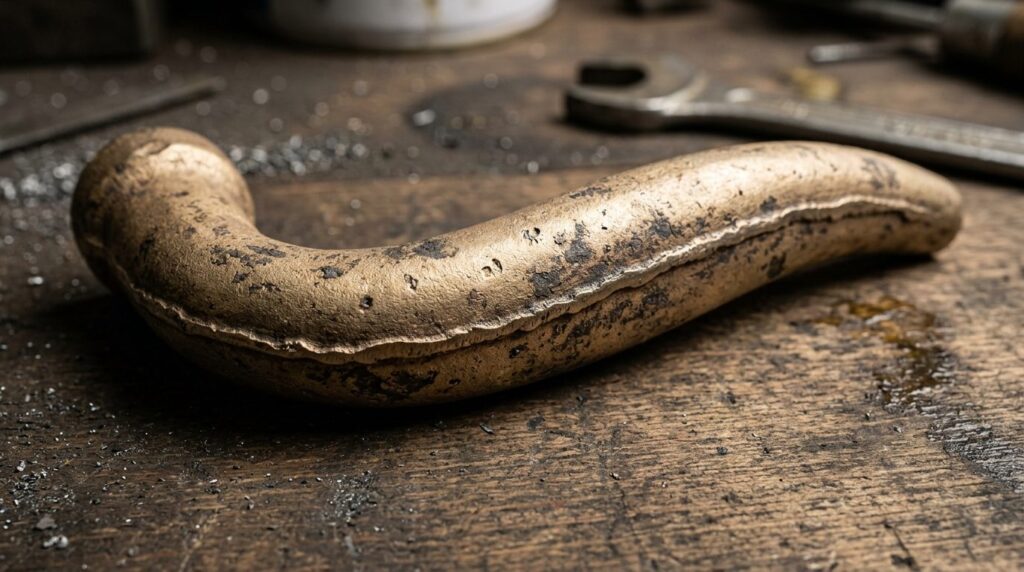
伝統的な手動研磨の「カーブキラー
ラグジュアリーなハンドルは、凹凸の多い表面や小さなRコーナーが特徴で、手作業には大きな困難を伴う:
- “「カーブの ”フラット・スポット:サンディングベルトに対して作業者が手動でハンドルを回転させると、力の出力が一定しないため、丸みを帯びた表面に小さな平らな斑点ができやすく、反射の破損につながります。.
- Rコーナーディストーション:ハンドルの根元や曲がり(Rコーナー)は、視覚的なフォーカルポイントです。手作業で研磨すると、この角が簡単に「つぶれ」たり丸みを帯びたりして、美的意図が損なわれてしまう。.
- 極度の肉体的緊張:ソリッドブラスのハンドルを磨くには、非常に大きな下向きの圧力が必要です。疲労による歩留まりの低下は、手作業店では業界の常識です。.
高級ドアハンドルオートメーションの技術的パラメータ
| Stage | Recommended Tooling & Setting | 備考 |
| フラッシュ除去 | 粗骨材ベルト | プロファイルを傷つけることなく、鍛造ラインを素早く消去。 |
| 3Dプロファイル・ブレンディング | フレキシブル・コンタクト・ホイール/ナイロン・ブラシ | 複雑な3Dパスに適合し、表面の質感を統一する |
| 究極の鏡面磨き | 高密度サイザル麻/ファインクロスホイール | Paired with premium wax for deep metal luster |
| 一定力範囲 | ±1N (高周波数アダプティブ) | デリケートなRコーナーを保護する “フレキシブルアーム ”のように機能する |
| パスの再現性 | ≤ 0.03 mm | Keeps every handle’s arc true to the CAD model |
なぜ高級ドアハンドルは「ロボット・ホールディング・ワークピース」構造を採用しなければならないのか?
For geometry this complex, the cell is arranged the other way round from a machine-tool: the 6-axis robot cradles the handle the way a craftsman’s hands would, and carries it to a row of floor-mounted belt machines and buffing stations that never move. Every axis of articulation lives on the part side, which is precisely what free-form handles need.
This arrangement earns its keep in three concrete ways:
- 自由自在な動き: A 6-axis wrist rotates through 360 degrees, so a stationary belt or cloth wheel can be swept along every U-bend and S-curve without re-clamping the handle.
- Fine-Resolution Force Sensing: The curve is the product, so pressure gets treated accordingly. The robot senses small changes in polishing load and eases off as it approaches an R-corner or edge, removing imperfections while leaving the designed geometry untouched.
- Multi-Station Integration: One grip takes the handle through flash removal, blending and buffing at consecutive stations. No second setup means no re-datuming, so coordinates stay consistent through the whole cycle.
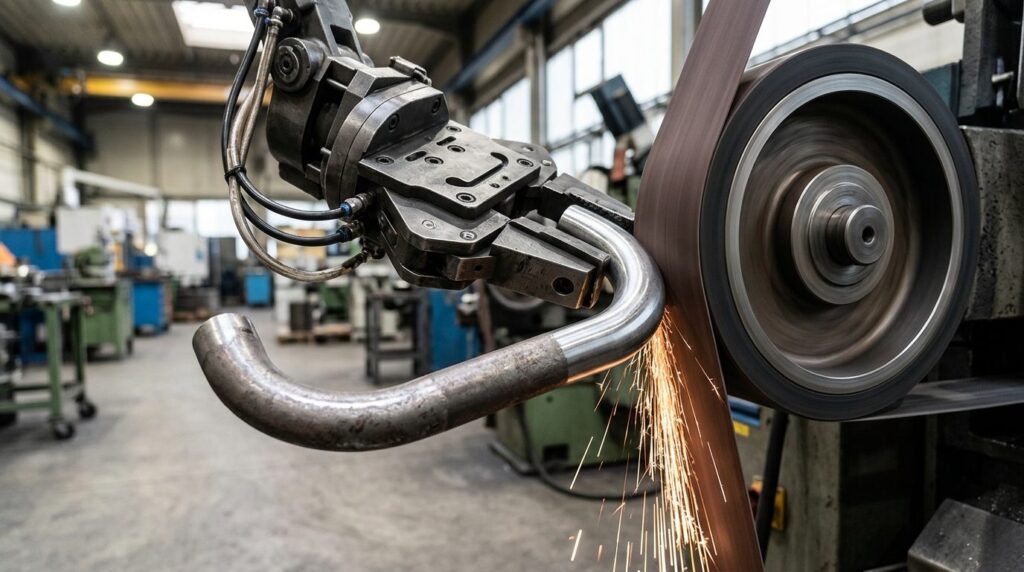
自動化された研削・研磨工程のワークフロー
| ステップ | Station | 工具 | 結果 |
| 01 | 頑丈で正確なグリップ | ロボット+カスタム成形グリッパー | 重いハンドルが高速摩擦でずれないようにする。 |
| 02 | 鍛造ラインの除去 | 床置き重ベルトマシン | パーティングラインを素早く平らにし、元の輪郭を復元します。 |
| 03 | 複雑なカーブのブレンド | フローティング・コンタクト・ホイール・ベルト | 自由曲面に適合し、マクロな波紋を消す |
| 04 | ベース・ミラー・バフ | オートワックス マルチステーション バフセンター | グレードの高いサイザル麻/布製ホイールを使用し、クリアな鏡面仕上げを実現 |
| 05 | オートアンローディング&QA | レーザーマーキング/超音波マーキングへの移行 | 後続のPVDまたは光沢めっきフローを待つ |
Workholding for Free-Form Brass Handles
A solid brass handle offers almost nothing to clamp: no flat reference face, a heavy body, and 360 degrees of cosmetic surface. The fixturing answer is to grip where the customer will never look. Mounting threads at the base, the internal bore, or the spindle recess become the locating features; a pneumatic expanding mandrel or a form-matched cradle picks up those features and leaves the entire visible surface exposed to the wheels.
- Anti-rotation without marking: torque from high-speed buffing is real on heavy handles, so drivers engage splines or flats inside the bore—not the polished shank.
- Thermal discipline: brass conducts buffing heat straight into the fixture; gripper materials and exchange rhythms are chosen so wax does not bake onto the part or the tooling.
- One datum end to end: the same bore that locates the handle for polishing also locates it at final inspection, so geometric checks are not fighting a fixture shift.
Gripper design also decides changeover economics. Because handle families share section sizes more than they share silhouettes, one gripper body with interchangeable insert sets usually covers a brand’s whole catalog; a new handle geometry then means an insert, not a new fixture build. That is what keeps small-batch custom programs profitable on the same cell that runs volume staples.
Consumables and Process Windows for Brass
Brass forgings arrive hard-skinned with parting lines, and they finish as mirror product—so the abrasive ladder has to be long and the final cuts light. A workable sequence moves from coarse belts that erase forging lines, through flexible contact wheels and nylon that fair the free-form surfaces, to sisal with cutting compound and finally soft cotton with finishing compound for color. Each stage exists to remove the previous stage’s scratch pattern, nothing more.
- Pressure discipline: brass is softer than it looks; the process window favors moderate force at healthy surface speed rather than heavy pressure, which smears instead of cuts and heats the part.
- Compound choice: cutting compound on sisal for stock removal, finishing compound on cotton for luster—mixing the two is a common cause of hazy finishes.
- R-corner tooling: small-diameter wheels reach into handle roots where full-size wheels cannot; the robot schedules them as a separate station rather than forcing one wheel to do both jobs. Machine formats for this work are compared in our robotic polishing machine guide.
Path Planning, Takt Time and Consistency Verification
Path generation for handles is a normal-following exercise: the tool must meet the surface at a controlled angle and sweep along the curvature, decelerating into tight R-zones and accelerating on open shanks—look-ahead speed control is what prevents dwell burns at the transition points. Because the handle never leaves the gripper between stations, the path executed at the buffing wheel is registered to exactly the same coordinate frame as the belt passes before it.
On takt, a single robot walking four to five fixed stations suits most handle programs; where volumes are higher, two robots share the station row and alternate parts, roughly halving cycle time without doubling the machine count. Starvation is avoided by letting the loading side of the cell run asynchronously.
Verification closes the loop: gloss-meter sampling across the batch, zebra-light reflection checks for curve continuity, and a sealed golden sample from the first approved batch as the visual reference for every shift. The same inspection discipline applies across general metal polishing programs; for the flat-panel counterpart in door hardware, see our smart door lock panel polishing solution.
Application Scenario: Curved Solid Brass Handles
One typical project involves a hardware plant serving the RV and private-estate market, where polished brass handles are specification items rather than accessories.
- 挑戦: On a solid brass S-shaped handle, manual first-pass rates were stuck at unprofitable levels—uneven curve transitions broke the reflection after plating, and rework could not keep up.
- The Outcome: Under the robot-holding, force-controlled cell, the machine repeats a master-level path with pressure that never tires. First-pass yield recovered to consistently high levels, unit processing cost fell substantially, and the delivery disruptions that followed labor turnover stopped.
高級ハンドル研磨のよくある質問
Q1:ハンドルのデザインは千差万別です。ロボットプログラミングは難しいですか?
A: Programming is handled by 3D Offline Programming (OLP) software, not by teach-pendant walking. Import the CAD model and the system reads surface normals and plans the paths itself; even heavily stylized handles typically go from model to running program within half a day.
Q2: 真鍮のハンドルを磨くと、かなりの摩擦熱が発生します。ロボットに影響はありますか?
A: No. The cell combines temperature-resistant gripper materials with path rules that keep the tool moving—no dwelling—so friction heat never pools in one spot. That protects both the equipment and the brass surface against thermal discoloration.
結論
The value of a luxury handle is that one continuous curved reflection. An automated architecture of heavy-duty 6-axis robots carrying workpieces against high-power floor-mounted equipment is the most dependable route to complex 3D polishing at scale: it takes people off the physically punishing work and gives series products the consistency once reserved for hand-finished custom pieces.
Uneven curves and collapsed R-corners are geometry problems, not people problems—and geometry is exactly what a robot repeats without deviation. Bring your handle designs for a high-end hardware automation assessment: お問い合わせ.