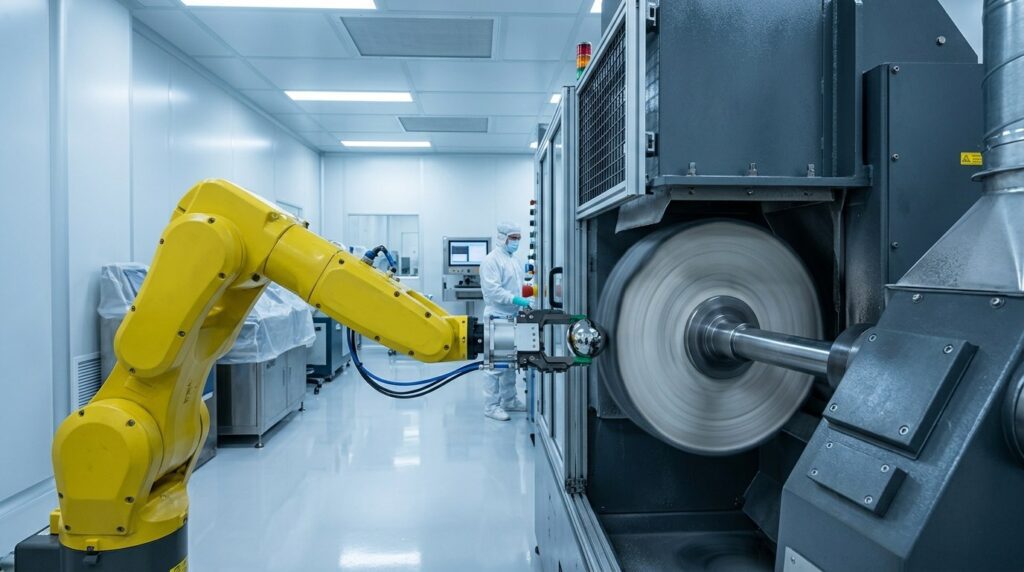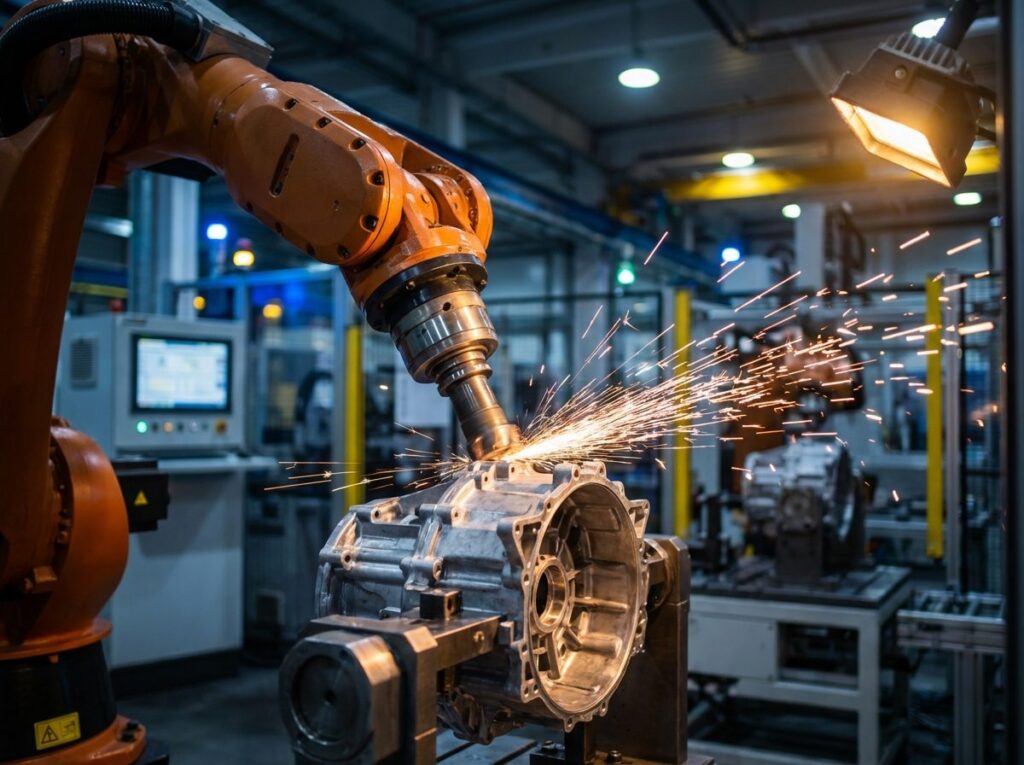
プレミアム 配管・金物 市場において、床排水溝はもはや単なる機能的な排水アクセサリーではなく、モダンなシャワーデザインの中核をなす美的要素となっています。高価なドレインパネルには、非常に洗練されたサテン仕上げや完璧な鏡面仕上げが要求され、そのエッジは絶対に安全で滑らかな手触りでなければなりません。.
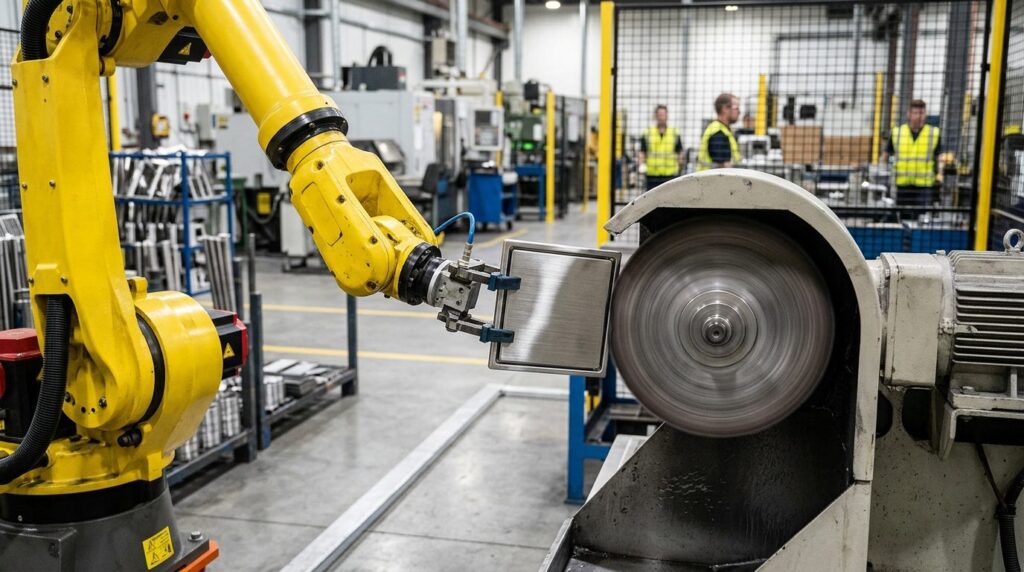
大量生産において厳格な化粧品基準を維持するために、頑丈な産業用ロボットを使用し、床に設置されたワイドベルト仕上げ機に対してパネルを保持する。 ロボット研磨-足切りの危険性」を排除し、表面の質感を統一するために、トップクラスの配管OEMの標準的な構成となっている。.
高級床排水パネルとは?
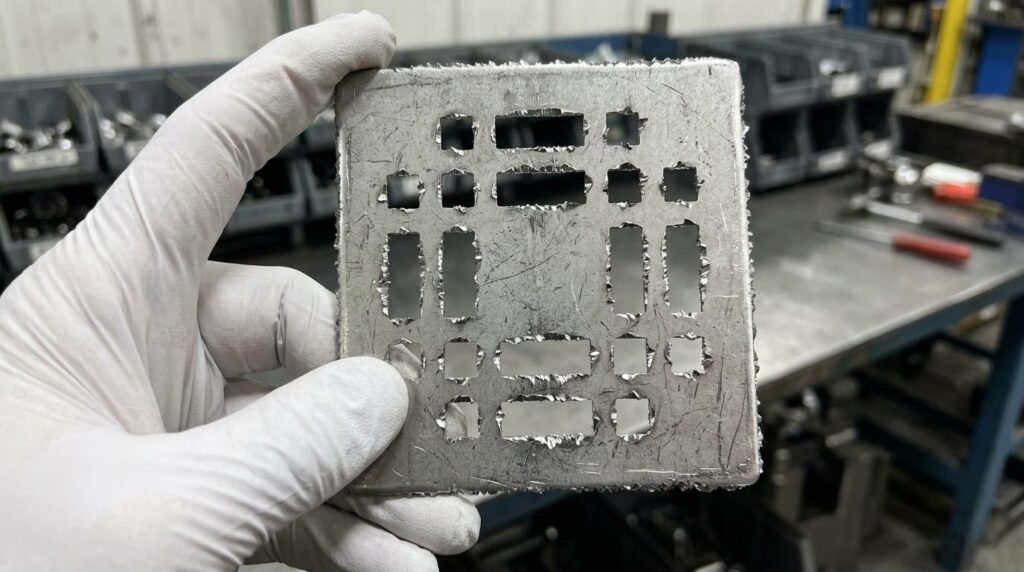
プレミアム・インビジブル・フロア・ドレイン、リニア・ドレイン、または複雑な彫刻が施されたグリッド・ドレインは通常、304ステンレス鋼からプレス加工で、または高品質の真鍮から精密鋳造とCNC機械加工で製造されます。製造ラインから出荷されたばかりの未加工の部品には、粗い表面やプレス傷が見られます。最も重要なのは、外側のエッジとグリッドのカットアウトに極めて鋭い微細なバリが残っていることです。.
手作業による仕上げの致命的な欠陥
床の排水溝表面を仕上げる場合、従来の手作業では物理的に克服できないボトルネックに直面する:
- フットカット」の危険性(鋭利なエッジ):配管製品は人の皮膚に直接触れます。手作業によるバリ取りでは、死角が見逃されたり、面取りが不均一になったりすることが多い。鋭利なエッジのR付けが不十分だと、シャワーを浴びている消費者の足を簡単に切りつけ、深刻な顧客クレームやブランド危機を引き起こしかねません。.
- 曲がったブラッシング・グレイン:高級排水溝には、絶対に平行でまっすぐな起毛テクスチャーが要求されます。作業員が手作業でパネルをサンディングベルトに押し付けると、微小なヨー偏差や手の震えによって起毛ラインが斜めになったり十字になったりし、工業デザインの美観を大きく損ないます。.
- グリッド・ディストーション:複雑な幾何学模様のグリッドが刻まれたフェースプレートでは、手作業による不均等な圧力が、繊細なグリッドの骨格の変形や崩壊を引き起こしやすい。.
床排水自動化の技術的パラメータ
| 項目 | パラメータ範囲 | 備考 |
| フラット・エリア・ブラッシング | ワイドナイロンフラップホイール/ファインベルト | Holds straight feed; grain runs parallel within spec |
| セーフエッジ バリ取り | フレキシブルコンタクトホイール / 研磨材 | 360° flash removal for a safe radiused edge |
| マイクロバリ取り | 専用SiCブラシディスク | グリッドの切り込みに浸透し、残留スタンプフラッシュを一掃 |
| ロボットによる把持方法 | マトリックス真空/強力マグネット治具 | Keeps flat panels from distorting under cutting force |
| コンスタント・フォース・プレシジョン | ±1N (Adaptive) | Protects ultra-thin faceplates against burn-through or heat discoloration |
なぜフロア・ドレンは「ロボット・ホールディング・ワークピース」構造を採用しなければならないのか?
For broad, thin faceplates, the productive layout keeps the heavy machinery still and gives the robot the part: a 6-axis robot carries the drain panel on a vacuum or magnetic gripper and presents it to floor-mounted wide brushing machines and deburring centers. Straightness then comes from the machine, not the operator.
For drain production specifically, this layout pays off in three places:
- Linear Trajectory Lock: The arm behaves like a rigid rail, holding its line without yaw as it feeds the panel across the wide brushing wheel at constant speed. Brushed grain therefore runs straight on every drain off the line, not just the ones a fresh worker handled.
- Uniform Edge Radiusing: For deburring, the robot tilts the panel to a fixed 45° and sweeps it evenly along the floor-mounted chamfering belt. Because the pose is programmed, straight edges and rounded corners receive the same radiused treatment—removing the foot-cutting hazard at its source.
- Gentle Constant-Pressure Contact: A spindle force sensor governs brushing pressure, holding it light and steady across the whole pass so gloss stays uniform from the panel center to its edges.
自動化された研削とバリ取りプロセスのワークフロー
| ステップ | Operation | 設備・消耗品 | 結果 |
| 01 | ビジョンロケーション&ソフトグリップ | ロボット+吸引マトリックス | Non-destructive grip on thin plates, establishing the work coordinate frame |
| 02 | プロファイル・エッジ放射加工 | 床置きフローティング・コンタクト・ベルト | 周囲を正確にトレースし、スタンプのバリを除去して安全なRコーナーを形成します。 |
| 03 | ディープ・グリッド・カットアウト・クリーニング | 床置き遊星ブラシセンター | SiCブラシがグリッドを貫通し、微細な閃光を一掃する |
| 04 | フラット・フェースプレート・ブラッシング | ワイドナイロンブラッシングマシン | Straight linear feed covers stamping scratches, forming premium metal grain |
| 05 | 自動荷降ろしと検査 | 梱包/クリーニングに移す | Avoids secondary scratches during handover |
Fixturing Thin Drain Panels Without Distortion
Drain faceplates are stamped from sheet typically under two millimeters thick, which makes them obedient to every force applied—clamping, brushing, even their own weight if held at an edge. Fixturing is therefore a stiffness problem: the panel needs full-area support while both faces and all edges stay accessible to the tooling.
- Matrix vacuum holding: an array of suction cups on a backing plate supports the face across its width, so brushing pressure meets a backed panel rather than a suspended one. This is the default for stainless faceplates.
- Conformal magnetic jigs: where part geometry or coating rules out vacuum, magnetic form jigs back the plate and let the robot re-grip for second-face work.
- Datum discipline: brushing must run parallel to the visible long edge of the drain, so that edge—not the stamping blank outline—is the datum the program references.
Edge work introduces one more constraint: an unsupported rim will chatter under a deburring belt and leave a wavy edge. Cells solve this with edge-support inserts in the fixture or by scheduling edge passes while the panel is still fully backed.
Brushing and Deburring Media Selection
Media choice is visible in the final product—grit and material decide how the brushed texture reads. Non-woven nylon wheels and fine belts in the mid-grit range produce the even, directional grain expected on premium drains; coarser media leaves a brighter but rougher line, finer media a softer, satin line. The choice is a design decision agreed with the customer, then frozen into the program. For process vocabulary, our overview of what is robotic deburring covers the edge-treatment side of the cell.
- Grain direction: single-pass, single-direction feed gives the cleanest line; back-and-forth passes cross the grain and read as sloppy under hotel lighting.
- Edge media: flexible contact wheels or abrasive belts take the perimeter down to a uniform radius; fixed-angle passes are what keep the radius consistent part to part.
- Cutout media: planetary brushes with SiC bristles reach into grid slots where wheels cannot, sweeping stamping flash out of the corners.
Equipment formats for these two jobs—wide-face finishing and edge deburring—differ enough that they are usually separate machines in the cell row; the trade-offs are laid out in our deburring machine types guide.
Inline Edge-Safety and Grain Quality Checks
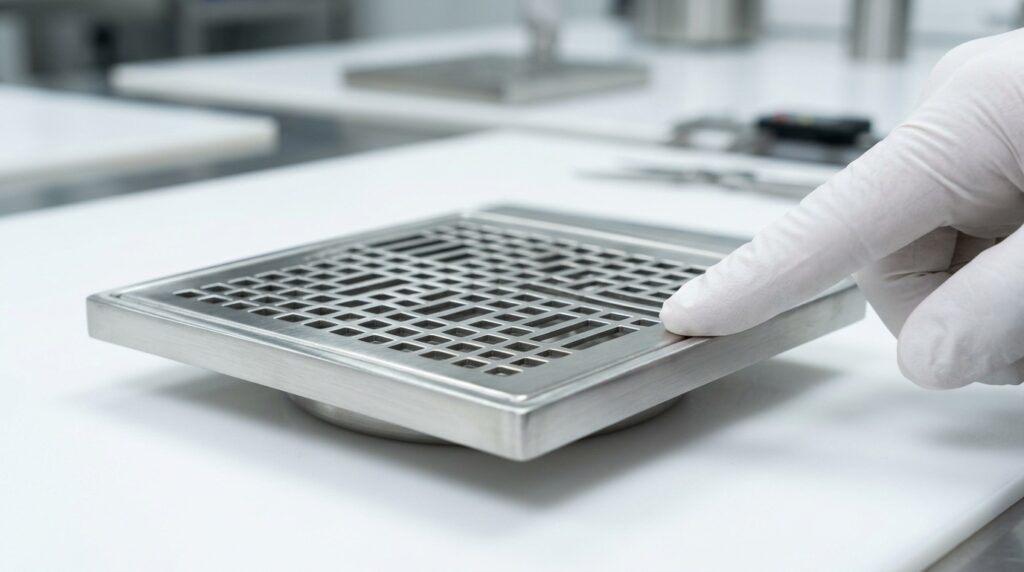
Because a drain is a barefoot-adjacent product, edge safety is checked as a release gate, not an afterthought. Operators run a tactile pass—gloved finger around the full perimeter—backed by magnified visual sampling at cutout mouths, the two spots where missed burrs hide. Any part flagged at the station is re-run through the edge program rather than reworked by hand at a bench.
Grain quality is checked under directional light: straightness, uniformity and freedom from cross-hatching are assessed in seconds against a boundary sample. Gloss or roughness instrumentation samples the batch statistically. Results feed the same quality record the robot cycle data goes into, which is what plumbing OEM audits ask to see. For the thicker-walled stainless counterpart in kitchenware, see our stainless steel sink polishing solution.
Application Scenario: Linear and Invisible Drain Panels
Consider an East China plumbing OEM running linear and invisible drain programs for hotel and residential brands—representative of the tier where brushing quality decides whether the program stays in-house.
- Before: On linear invisible drains, manual brushing scrap ran high—crooked grain above all—and sharp-edge complaints arrived with painful regularity.
- After: With the robot holding the workpiece against the floor-mounted brushing center, brushing grain runs straight along the full 600 mm length of the linear drains, and edge radiusing executes uniformly under OLP control. Edge-related complaints stop, first-pass cosmetic yield settles at consistently high levels, and manual rework shrinks to a trickle.
よくあるご質問
Q1:床ドレンパネルは非常に薄いものが多い(1.5mm~2mm程度)。研磨時にパネルを押すと、ロボットが反ってしまいませんか?
A: No. The cell uses large-area matrix vacuum suction or conformal magnetic jigs, which avoid hard clamping at the edges and back up the thin plate across its full area. With active force control keeping cutting force light and even, stress deformation of the faceplate is effectively designed out.
Q2: 顧客によってカスタマイズされるグリッドパターンは千差万別です。バリ取りプログラムは常に書き換える必要がありますか?
A: No constant rewriting is needed. Deburring trajectories are produced by 3D Offline Programming (OLP): the engineer imports the CAD model of the new pattern, and the software finds every hole and contour edge and generates the trajectory from it. Changeovers stay agile enough for the high-mix, low-volume reality of premium customization.
結論
In premium floor drain production, straight brushed texture and safe edge feel are what the brand is judged on. An automated architecture—a heavy-duty 6-axis robot holding the workpiece against floor-mounted wide belts and brushing centers—removes the crooked grain and missed edges that manual labor cannot help producing, and holds yield at the level serialized plumbing production requires.
Edge-safety complaints and inconsistent brushing grain trace back to the same root cause: the human hand. A robotic brushing and deburring cell takes that hand out of the process—お問い合わせ for a plumbing hardware automation assessment.