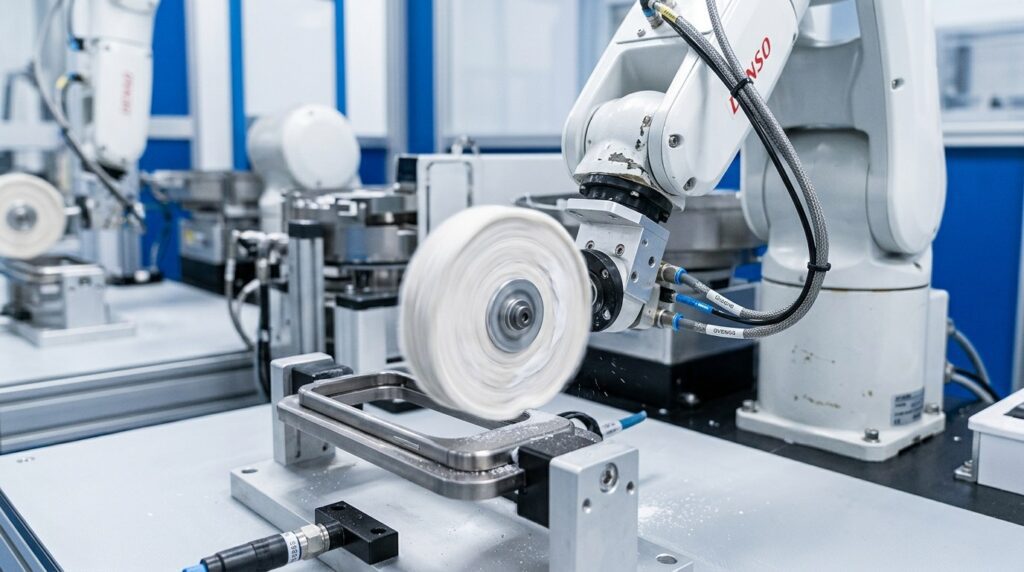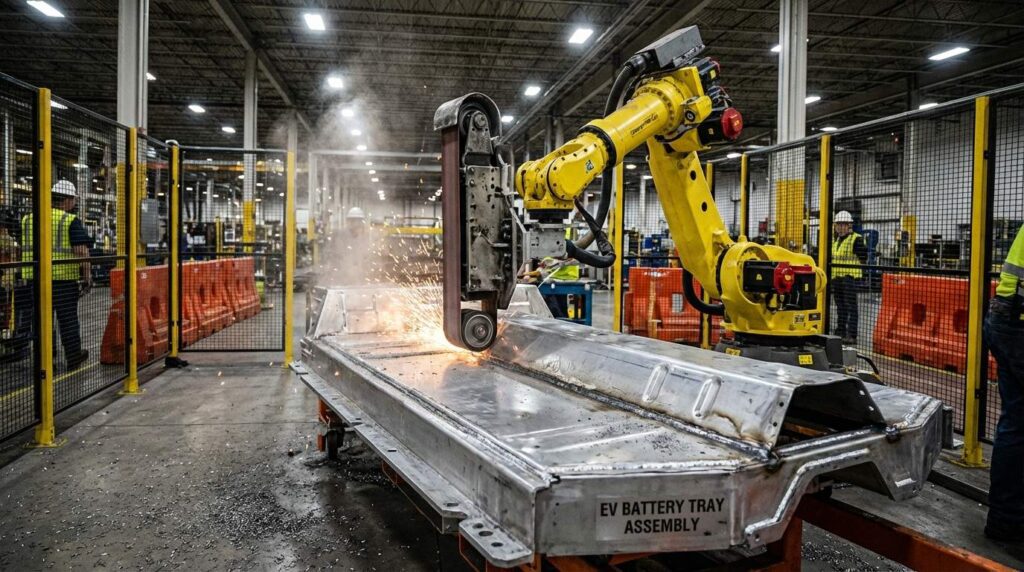
Trong gói cao cấp thiết bị vệ sinh và đồ kim khí Trên thị trường hiện nay, các loại cống thoát nước sàn không còn chỉ là những phụ kiện thoát nước đơn thuần; chúng đã trở thành những yếu tố thẩm mỹ cốt lõi trong thiết kế phòng tắm hiện đại. Các tấm cống thoát nước cao cấp đòi hỏi bề mặt được chải xước cực kỳ tinh tế hoặc hiệu ứng gương hoàn hảo, và điều quan trọng nhất là các mép của chúng phải hoàn toàn an toàn và mịn màng khi chạm vào.
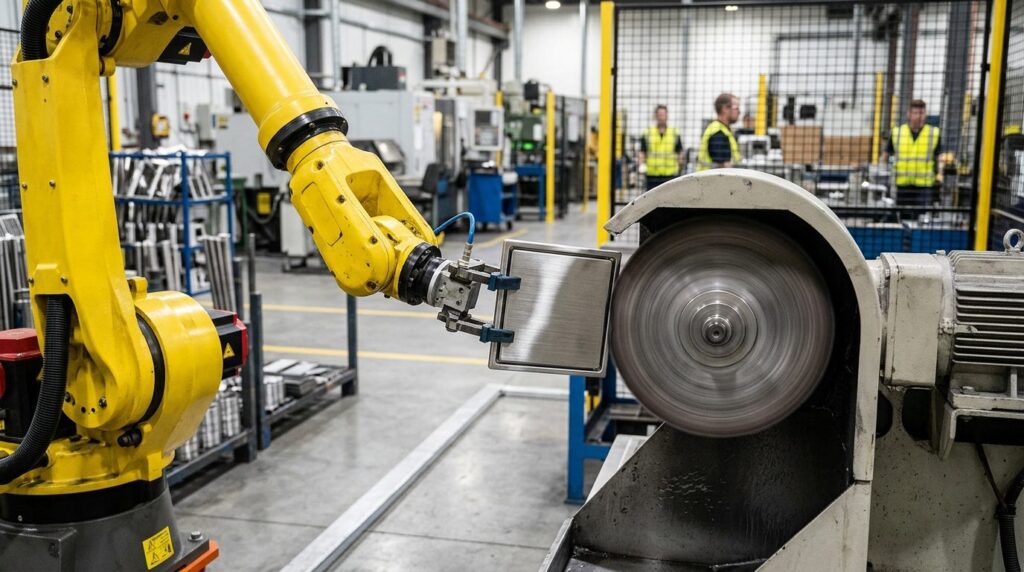
Để duy trì các tiêu chuẩn thẩm mỹ nghiêm ngặt trong sản xuất hàng loạt, người ta sử dụng các robot công nghiệp hạng nặng để giữ các tấm ván áp sát vào máy hoàn thiện băng tải rộng lắp đặt trên sàn — một quy trình được gọi là đánh bóng bằng robot—đã trở thành cấu hình tiêu chuẩn cho các nhà sản xuất thiết bị vệ sinh hàng đầu nhằm loại bỏ “nguy cơ bị cắt chân” và thống nhất kết cấu bề mặt.
Bảng thoát nước sàn cao cấp là gì?
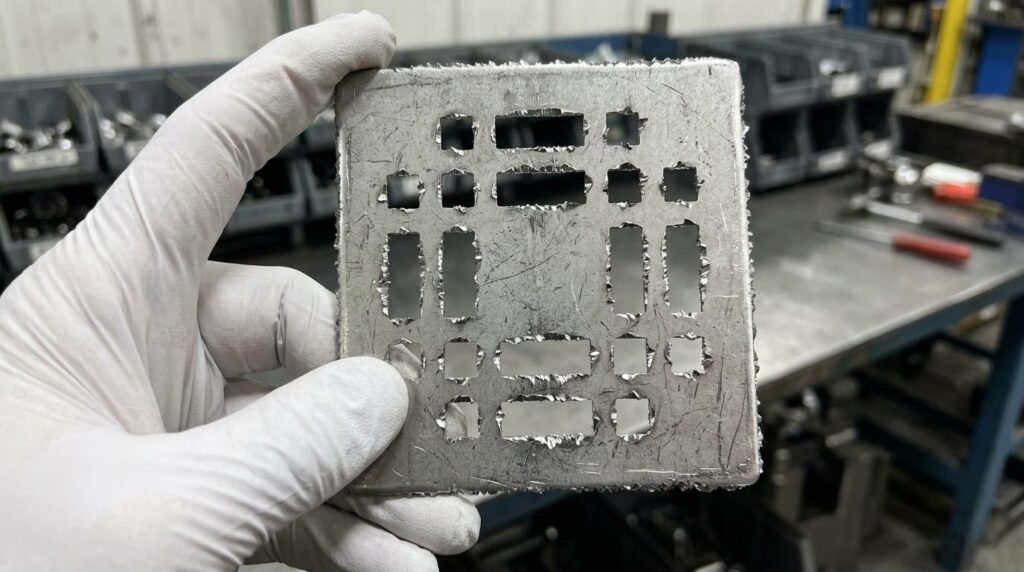
Các loại cống sàn ẩn cao cấp, cống tuyến tính hoặc cống lưới chạm khắc tinh xảo thường được sản xuất từ thép không gỉ 304 thông qua quy trình dập khuôn, hoặc từ đồng thau chất lượng cao thông qua đúc chính xác và gia công CNC. Ngay khi vừa ra khỏi dây chuyền sản xuất, các chi tiết thô thường có bề mặt nhám và vết xước do dập khuôn. Điều quan trọng nhất là các mép ngoài và các khe cắt trên lưới vẫn còn những vết gờ vi mô cực kỳ sắc nhọn.
Những nhược điểm nghiêm trọng của quá trình hoàn thiện thủ công
Khi thi công bề mặt cống thoát nước sàn, phương pháp thủ công truyền thống gặp phải những khó khăn về mặt thể lực không thể khắc phục:
- Nguy cơ “bị cắt chân” (các cạnh sắc nhọn): Các sản phẩm thiết bị vệ sinh tiếp xúc trực tiếp với da người. Việc mài nhẵn thủ công thường bỏ sót các vị trí khó tiếp cận hoặc tạo ra các góc vát không đều. Nếu các cạnh sắc nhọn không được bo tròn kỹ lưỡng, chúng có thể dễ dàng gây trầy xước chân người tiêu dùng khi tắm, dẫn đến những khiếu nại nghiêm trọng từ khách hàng và khủng hoảng thương hiệu.
- Vân gỗ cong: Các sản phẩm cống thoát nước cao cấp đòi hỏi bề mặt chải phải hoàn toàn song song và thẳng tắp. Khi công nhân dùng tay ấn tấm panel lên băng mài, những sai lệch nhỏ về góc nghiêng hoặc run tay có thể khiến các đường chải bị lệch hoặc đan chéo vào nhau, làm hỏng nghiêm trọng tính thẩm mỹ của thiết kế công nghiệp.
- Sự biến dạng lưới: Đối với các tấm mặt trước được chạm khắc theo các lưới hình học phức tạp, lực tay không đều có thể dễ dàng khiến cấu trúc lưới mỏng manh bị biến dạng hoặc sụp đổ.
Thông số kỹ thuật cho hệ thống thoát nước sàn tự động
| Mặt hàng | Phạm vi tham số | Ghi chú |
| Chải vùng phẳng | Đĩa mài nắp rộng bằng nylon / Dây đai mài mịn | Holds straight feed; grain runs parallel within spec |
| Loại bỏ ba via an toàn | Bánh xe tiếp xúc linh hoạt / Vật liệu mài mòn | 360° flash removal for a safe radiused edge |
| Cắt và mài nhám vi mô | Đĩa chổi than SiC chuyên dụng | Thâm nhập vào các khe hở trên lưới để quét sạch các mảnh vụn còn sót lại sau quá trình dập |
| Phương pháp kẹp bằng robot | Khuôn hút chân không / Khuôn từ tính mạnh | Keeps flat panels from distorting under cutting force |
| Độ chính xác lực không đổi | ±1N (Adaptive) | Protects ultra-thin faceplates against burn-through or heat discoloration |
Tại sao cống thoát nước sàn phải sử dụng kiến trúc “robot giữ phôi”?
For broad, thin faceplates, the productive layout keeps the heavy machinery still and gives the robot the part: a 6-axis robot carries the drain panel on a vacuum or magnetic gripper and presents it to floor-mounted wide brushing machines and deburring centers. Straightness then comes from the machine, not the operator.
For drain production specifically, this layout pays off in three places:
- Linear Trajectory Lock: The arm behaves like a rigid rail, holding its line without yaw as it feeds the panel across the wide brushing wheel at constant speed. Brushed grain therefore runs straight on every drain off the line, not just the ones a fresh worker handled.
- Uniform Edge Radiusing: For deburring, the robot tilts the panel to a fixed 45° and sweeps it evenly along the floor-mounted chamfering belt. Because the pose is programmed, straight edges and rounded corners receive the same radiused treatment—removing the foot-cutting hazard at its source.
- Gentle Constant-Pressure Contact: A spindle force sensor governs brushing pressure, holding it light and steady across the whole pass so gloss stays uniform from the panel center to its edges.
Quy trình làm việc tự động cho quá trình mài và loại bỏ gờ
| Bước | Operation | Thiết bị & Vật tư tiêu hao | Kết quả |
| 01 | Thiết kế Vision Location & Tay cầm mềm | Ma trận hút bụi của robot | Non-destructive grip on thin plates, establishing the work coordinate frame |
| 02 | Bo tròn cạnh | Băng tải tiếp xúc nổi lắp đặt trên sàn | Định hình chính xác đường viền, loại bỏ các gờ thừa do dập để tạo thành góc bo tròn an toàn |
| 03 | Vệ sinh khe hở lưới sâu | Trung tâm chổi quét hành tinh lắp đặt trên sàn | Lông chổi làm từ SiC thâm nhập vào các khe lưới để quét sạch các hạt bụi siêu nhỏ |
| 04 | Chải mặt phẳng | Máy chải sợi nylon khổ rộng | Straight linear feed covers stamping scratches, forming premium metal grain |
| 05 | Tự động dỡ hàng & kiểm tra | Chuyển sang khâu đóng gói/vệ sinh | Avoids secondary scratches during handover |
Fixturing Thin Drain Panels Without Distortion
Drain faceplates are stamped from sheet typically under two millimeters thick, which makes them obedient to every force applied—clamping, brushing, even their own weight if held at an edge. Fixturing is therefore a stiffness problem: the panel needs full-area support while both faces and all edges stay accessible to the tooling.
- Matrix vacuum holding: an array of suction cups on a backing plate supports the face across its width, so brushing pressure meets a backed panel rather than a suspended one. This is the default for stainless faceplates.
- Conformal magnetic jigs: where part geometry or coating rules out vacuum, magnetic form jigs back the plate and let the robot re-grip for second-face work.
- Datum discipline: brushing must run parallel to the visible long edge of the drain, so that edge—not the stamping blank outline—is the datum the program references.
Edge work introduces one more constraint: an unsupported rim will chatter under a deburring belt and leave a wavy edge. Cells solve this with edge-support inserts in the fixture or by scheduling edge passes while the panel is still fully backed.
Brushing and Deburring Media Selection
Media choice is visible in the final product—grit and material decide how the brushed texture reads. Non-woven nylon wheels and fine belts in the mid-grit range produce the even, directional grain expected on premium drains; coarser media leaves a brighter but rougher line, finer media a softer, satin line. The choice is a design decision agreed with the customer, then frozen into the program. For process vocabulary, our overview of what is robotic deburring covers the edge-treatment side of the cell.
- Grain direction: single-pass, single-direction feed gives the cleanest line; back-and-forth passes cross the grain and read as sloppy under hotel lighting.
- Edge media: flexible contact wheels or abrasive belts take the perimeter down to a uniform radius; fixed-angle passes are what keep the radius consistent part to part.
- Cutout media: planetary brushes with SiC bristles reach into grid slots where wheels cannot, sweeping stamping flash out of the corners.
Equipment formats for these two jobs—wide-face finishing and edge deburring—differ enough that they are usually separate machines in the cell row; the trade-offs are laid out in our deburring machine types guide.
Inline Edge-Safety and Grain Quality Checks
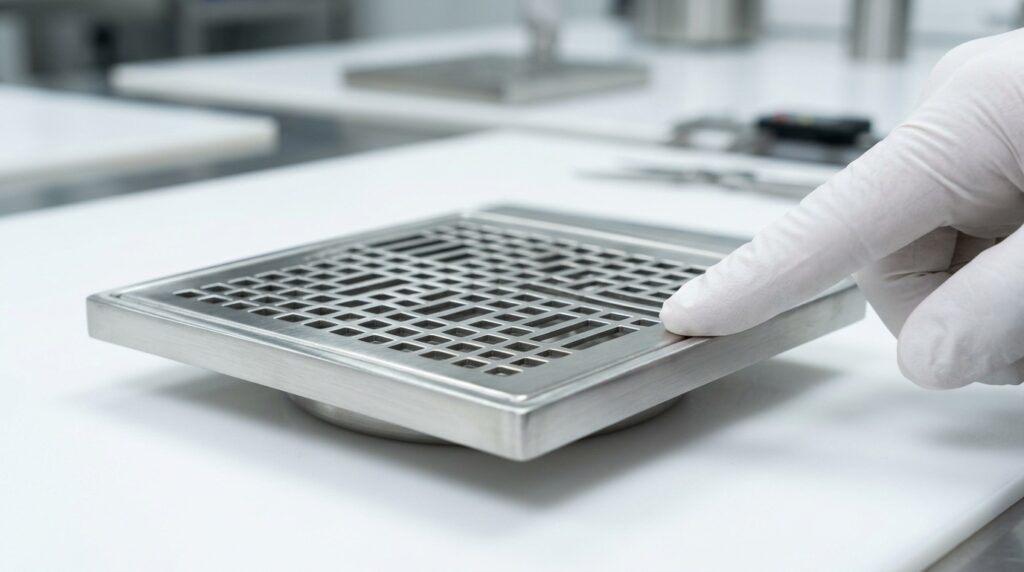
Because a drain is a barefoot-adjacent product, edge safety is checked as a release gate, not an afterthought. Operators run a tactile pass—gloved finger around the full perimeter—backed by magnified visual sampling at cutout mouths, the two spots where missed burrs hide. Any part flagged at the station is re-run through the edge program rather than reworked by hand at a bench.
Grain quality is checked under directional light: straightness, uniformity and freedom from cross-hatching are assessed in seconds against a boundary sample. Gloss or roughness instrumentation samples the batch statistically. Results feed the same quality record the robot cycle data goes into, which is what plumbing OEM audits ask to see. For the thicker-walled stainless counterpart in kitchenware, see our stainless steel sink polishing solution.
Application Scenario: Linear and Invisible Drain Panels
Consider an East China plumbing OEM running linear and invisible drain programs for hotel and residential brands—representative of the tier where brushing quality decides whether the program stays in-house.
- Before: On linear invisible drains, manual brushing scrap ran high—crooked grain above all—and sharp-edge complaints arrived with painful regularity.
- After: With the robot holding the workpiece against the floor-mounted brushing center, brushing grain runs straight along the full 600 mm length of the linear drains, and edge radiusing executes uniformly under OLP control. Edge-related complaints stop, first-pass cosmetic yield settles at consistently high levels, and manual rework shrinks to a trickle.
Câu hỏi thường gặp
Câu hỏi 1: Các tấm cống sàn thường rất mỏng (chỉ 1,5 mm – 2 mm). Liệu robot có làm cong tấm cống khi ấn vào trong quá trình mài không?
A: No. The cell uses large-area matrix vacuum suction or conformal magnetic jigs, which avoid hard clamping at the edges and back up the thin plate across its full area. With active force control keeping cutting force light and even, stress deformation of the faceplate is effectively designed out.
Câu hỏi 2: Các mẫu lưới được tùy chỉnh bởi các khách hàng khác nhau rất đa dạng. Liệu chương trình mài nhám có cần phải được viết lại liên tục không?
A: No constant rewriting is needed. Deburring trajectories are produced by 3D Offline Programming (OLP): the engineer imports the CAD model of the new pattern, and the software finds every hole and contour edge and generates the trajectory from it. Changeovers stay agile enough for the high-mix, low-volume reality of premium customization.
Kết luận
In premium floor drain production, straight brushed texture and safe edge feel are what the brand is judged on. An automated architecture—a heavy-duty 6-axis robot holding the workpiece against floor-mounted wide belts and brushing centers—removes the crooked grain and missed edges that manual labor cannot help producing, and holds yield at the level serialized plumbing production requires.
Edge-safety complaints and inconsistent brushing grain trace back to the same root cause: the human hand. A robotic brushing and deburring cell takes that hand out of the process—Liên hệ với chúng tôi for a plumbing hardware automation assessment.