Tất cả sản phẩm
UBright builds one family of automated finishing equipment and builds it in five configurations. Every machine in the lineup exists to remove the same three problems from a casting or machining operation: burrs and gate stubs left by upstream processes, inconsistent edge quality from manual deburring benches, and labor that is either unavailable or too expensive to hold a grinder all shift. What varies between the five configurations is not the purpose but the mechanics: how many axes move the tool, how many workstations feed the process, and whether the tool is carried by a machine column or a robot arm.
This page maps the whole range so you can land on the right machine in a few minutes, then go one level deeper on each product page and in the selection guides.
The Five Configurations at a Glance
| Cấu hình | Axes / Tool Carrier | Stations | Envelope | Best For |
|---|---|---|---|---|
| Five-axis deburring equipment | 5-axis machine tool | 1 | X500 x Y400 x Z300 mm | Small-mid castings, many part numbers, tight budgets |
| Six-axis deburring equipment | 6+2 axis machine tool | 1 | X500 to X900 mm, three sizes | Higher precision (±0.02 mm/300 mm), mid-size and long parts |
| Six-axis dual-station | 6+2 axis machine tool | 2 | X700 or X900 mm | Volume production where loading time must not idle the spindle |
| Five-axis dual-station | 5-axis machine tool | 2 | X500 x Y400 x Z300 mm | Continuous running of stable part families, one operator, many machines |
| Robot clamping tool type | Industrial robot + spindle | 2 or 3 | Ø1600 mm working range | Complex multi-sided geometry, centralized multi-cell deburring |
Two axes of the decision are worth naming now. The first is machine-tool versus robot: machine-tool platforms hold tighter precision and take heavier cuts; the robot cell reaches complex geometry from a wrist and enables one operator to run many cells. The second is single versus dual station: single stations cost less and suit mixed batches, dual stations hide loading time inside cutting time and pay off at stable volumes.
Five-Axis Deburring Equipment (Single Station)
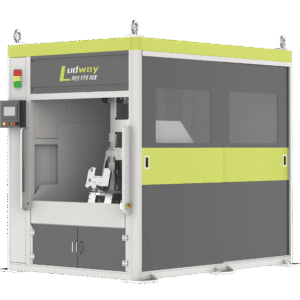
The LDW-5R-21T-500 is the entry configuration: a five-axis machining-center-style platform with a 21-station tool magazine, so a casting runs its full sequence of flash milling, chamfering, and surface finishing in one clamping. Five-axis teach programming stores a program per workpiece and recalls it by number, and the single-station layout keeps footprint and investment at the low end of the range. It is the machine for plants with many part numbers in moderate batches, where flexibility matters more than takt. See the five-axis deburring equipment page for the full specification table and process capability.
Six-Axis Deburring Equipment (Single Station)
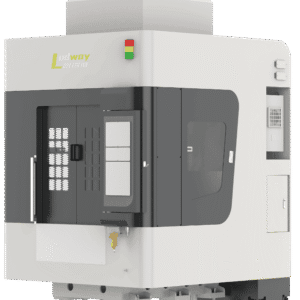
The LDW-6R series is the precision workhorse, specified at ±0.02 mm/300 mm with 6+2 axis control, a multi-angle quick-change spindle head, and the rigid cast body of a machining center. Three travels (X500, X700, X900 mm) let the machine scale with part size rather than forcing one envelope on every application. Rigid cutters and flexible abrasive tools combine in one program, which is what die-cast housings with machined datums and sealing faces usually require. See the six-axis deburring equipment page for the three-model specification table.
Six-Axis Dual-Station Deburring Equipment
Same six-axis platform and the same ±0.02 mm process, rebuilt around two alternating workstations: while one station is machined, the other is loaded, so part handling never idles the spindle. Offered as the 70-2 (X700 mm, five spindles) and the 90-2 (X900 mm, six spindles), with a wet chip hopper and full guarding for long continuous runs. This configuration earns its extra footprint wherever a stable part family runs at volumes that make every second of spindle idle time expensive. See the six-axis dual-station page, including a worked single-versus-dual station comparison.
Five-Axis Dual-Station Deburring Equipment
The five-axis platform in its continuous-output form: identical X500 x Y400 x Z300 mm envelope and 21-tool magazine as the single-station machine, with two independent workstations and roughly one extra meter of machine length. Loading time disappears into cutting time, and the machine is equipped for unattended stretches, automatic lubrication, oil-cooled spindle, wet chip removal, and an HMI that reports both stations. It suits plants running one or two stable part families day after day, or two related part numbers in parallel on one machine. See the five-axis dual-station page for the station-comparison table and takt illustration.
Robot Clamping Tool Type Deburring Equipment
The R7 series replaces the machine column with an industrial robot that carries the spindle: 3000-24000 RPM, 2.2 to 5.5 kW, tools from Φ3 to Φ13 mm, and Ø1600 mm of working range from arm articulation rather than axis travel. Precision is ±0.05 mm, which covers edge-condition and finish work comfortably, and the cell is built for centralized operations, storage bins and multi-station layouts let one operator manage five to ten units. Choose the R7-2 (two stations) or R7-3 (three stations), with Mitsubishi, KND, or Xindai control. See the robot clamping tool type page for the full configuration table.
How to Navigate the Selection
Three guides cover the decision paths behind this catalog. Types of Deburring Machines: Complete Selection Guide is the overview, machine-tool platforms against robot cells, single against dual stations, with the tolerance and volume boundaries of each. What Is Robotic Deburring? grounds the process itself: where burrs come from, what tooling removes them cleanly, and what automation changes on a shop floor. For the surface-finish side of the equipment line, the robotic polishing machine selection guide covers polishing configurations, tooling, and the requirements that separate polishing from deburring work.
If you would rather short-circuit the research: send a part drawing and monthly volumes, and the engineering team will point at the configuration and run a proof of concept before anything is quoted in steel.
Talk to an Engineer
Every configuration above can be matched to your parts and volumes through the contact page. Typical replies come within one business day, with a process proposal, tool plan, and proof-of-concept offer for sample castings.