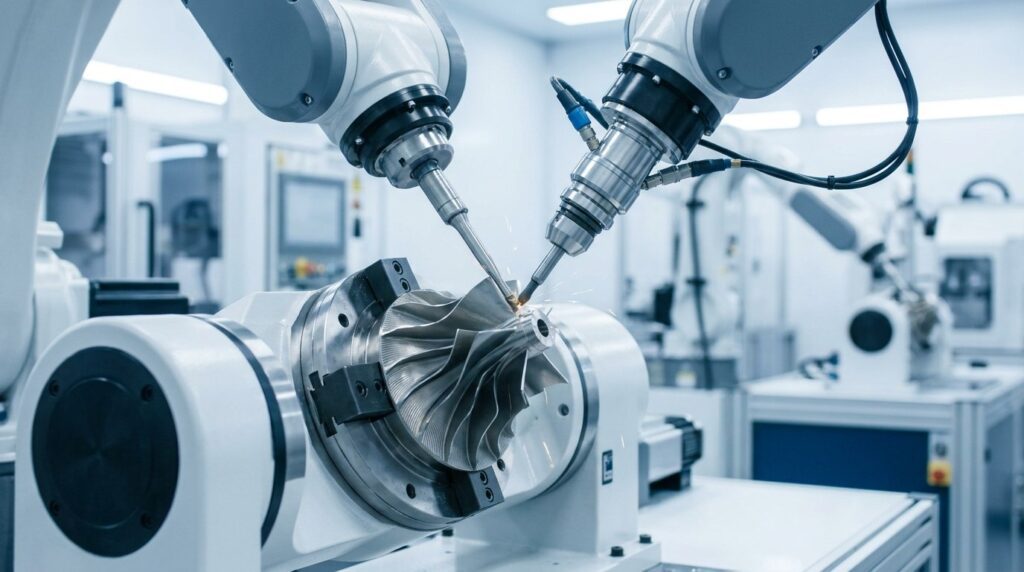
في السوق المتميز لـ السباكة والأجهزة, تعتبر المقابض والمقابض أكثر من مجرد مكونات وظيفية - إنها قطع فنية. وسواء كانت تتميز بتصاميم انسيابية بسيطة أو بأشكال بيونية معقدة، فإن سحر المقبض الفاخر يكمن في انتقالات الانحناءات ثلاثية الأبعاد المستمرة والمثالية.
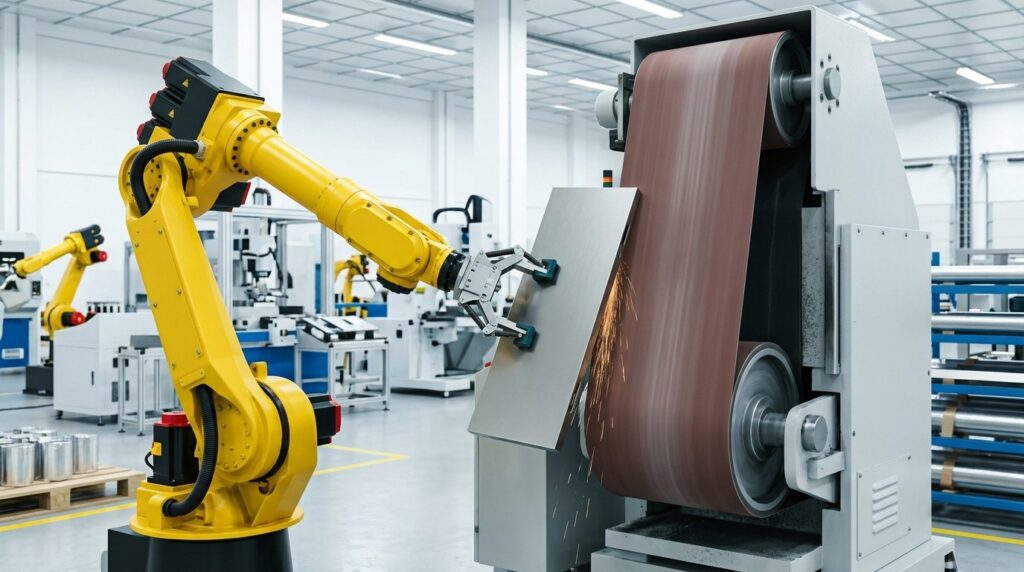
To hold the designer’s arc across thousands of repetitions, hardware brands have moved to an automated التلميع الآلي architecture—a heavy-duty robot carrying the workpiece against floor-mounted multi-station equipment—to reach the curve consistency that manual shops promise but rarely deliver.
ما هي مقابض الأبواب الفاخرة؟
عادةً ما يتم تصنيع المقابض الفاخرة عبر تشكيل النحاس النحاسي على الساخن أو سبك الفولاذ المقاوم للصدأ الاستثماري. وبالمقارنة مع القوالب المسبوكة القياسية، فإن هذه المواد أكثر كثافة وصلابة، مما يعني أيضًا أن الأسطح الخام بعد التصنيع تكون صلبة للغاية وتتميز بقوام معقد.
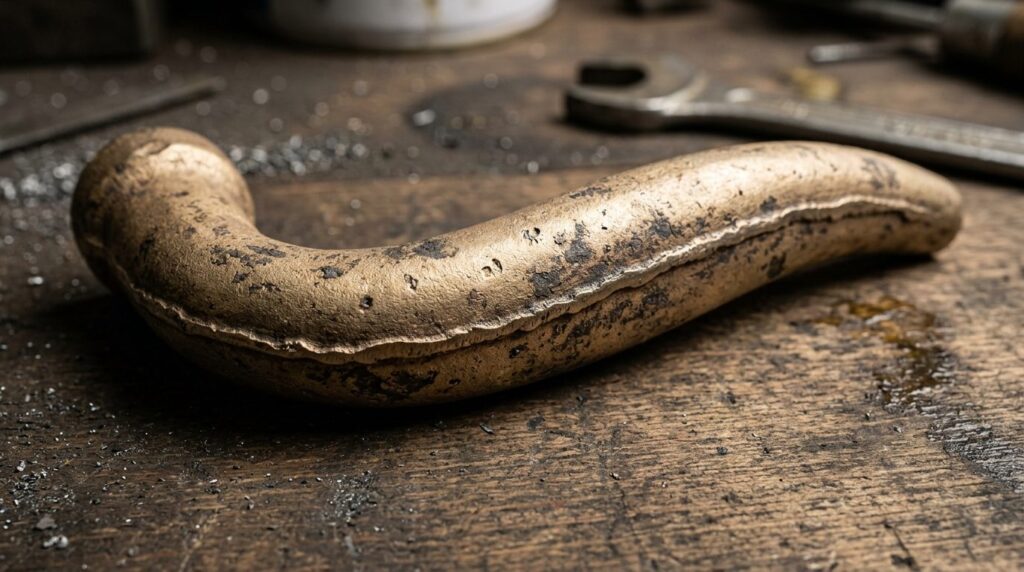
“قاتل المنحنى” للتلميع اليدوي التقليدي
تتميز المقابض الفاخرة بالعديد من الأسطح المقعرة/المحدبة والزوايا الصغيرة على شكل حرف R، مما يمثل تحديات كبيرة للعمل اليدوي:
- “البقع المسطحة” على المنحنيات: عندما يقوم العمال بتدوير مقبض يدويًا على حزام الصنفرة مقابل حزام الصنفرة، فإن ناتج القوة غير المتناسق يخلق بسهولة بقعًا مسطحة صغيرة على الأسطح المستديرة خلاف ذلك، مما يؤدي إلى انعكاسات مكسورة.
- تشويه الزاوية R- الزاوية: الجذر أو الانحناء (الزاوية R) للمقبض هو نقطة محورية بصرية. ويؤدي الطحن اليدوي بسهولة إلى “طيّ” هذه الزوايا أو تقريبها، مما يؤدي إلى تدمير الهدف الجمالي.
- الإجهاد البدني الشديد: يتطلب صقل المقابض النحاسية الصلبة ضغطًا هائلاً نحو الأسفل. إن انخفاض الإنتاجية الناجم عن الإرهاق هو قاعدة صناعية في الورش اليدوية.
المعلمات التقنية لأتمتة مقابض الأبواب الفاخرة
| Stage | Recommended Tooling & Setting | الملاحظات |
| إزالة الوميض | حزام الركام الكاشطة الخشنة الخشنة | مسح خطوط التزوير بسرعة دون الإضرار بالملف الشخصي |
| مزج الملف الشخصي ثلاثي الأبعاد | عجلة تلامس مرنة / فرشاة نايلون مرنة | يتوافق مع المسارات المعقدة ثلاثية الأبعاد لتوحيد نسيج السطح |
| ملمع المرايا المطلق | عجلة من السيزال عالي الكثافة/قماش ناعم | Paired with premium wax for deep metal luster |
| نطاق القوة الثابتة | ± 1N (متكيف عالي التردد) | يعمل مثل “الذراع المرن” لحماية الزوايا الحساسة في منطقة R |
| تكرار المسار | ≤ 0.03 مم | Keeps every handle’s arc true to the CAD model |
لماذا يجب أن تستخدم مقابض الأبواب الفاخرة بنية “الروبوت الحامل للقطعة الشغالة”؟
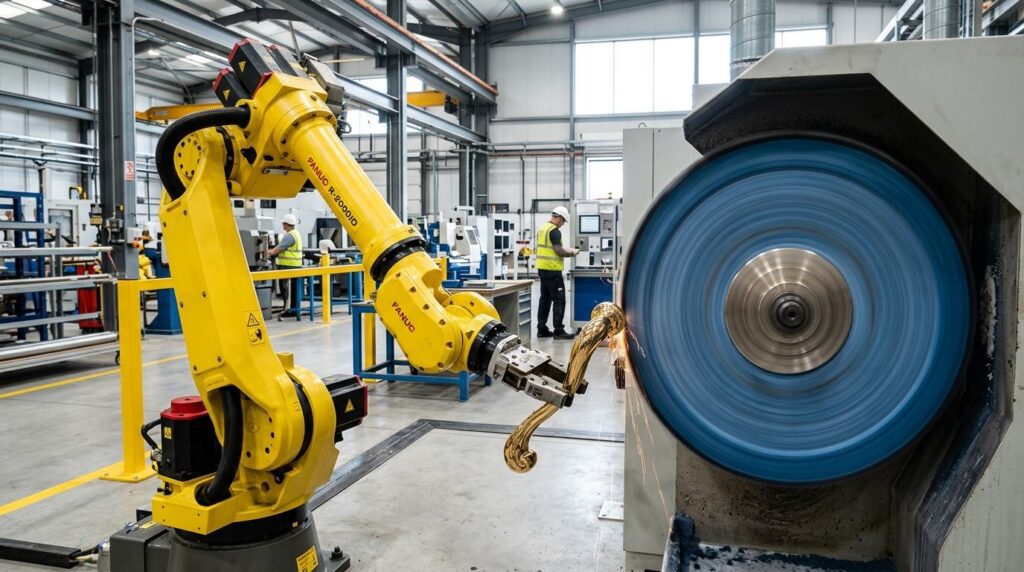
For geometry this complex, the cell is arranged the other way round from a machine-tool: the 6-axis robot cradles the handle the way a craftsman’s hands would, and carries it to a row of floor-mounted belt machines and buffing stations that never move. Every axis of articulation lives on the part side, which is precisely what free-form handles need.
This arrangement earns its keep in three concrete ways:
- حرية الحركة الكاملة: A 6-axis wrist rotates through 360 degrees, so a stationary belt or cloth wheel can be swept along every U-bend and S-curve without re-clamping the handle.
- Fine-Resolution Force Sensing: The curve is the product, so pressure gets treated accordingly. The robot senses small changes in polishing load and eases off as it approaches an R-corner or edge, removing imperfections while leaving the designed geometry untouched.
- Multi-Station Integration: One grip takes the handle through flash removal, blending and buffing at consecutive stations. No second setup means no re-datuming, so coordinates stay consistent through the whole cycle.
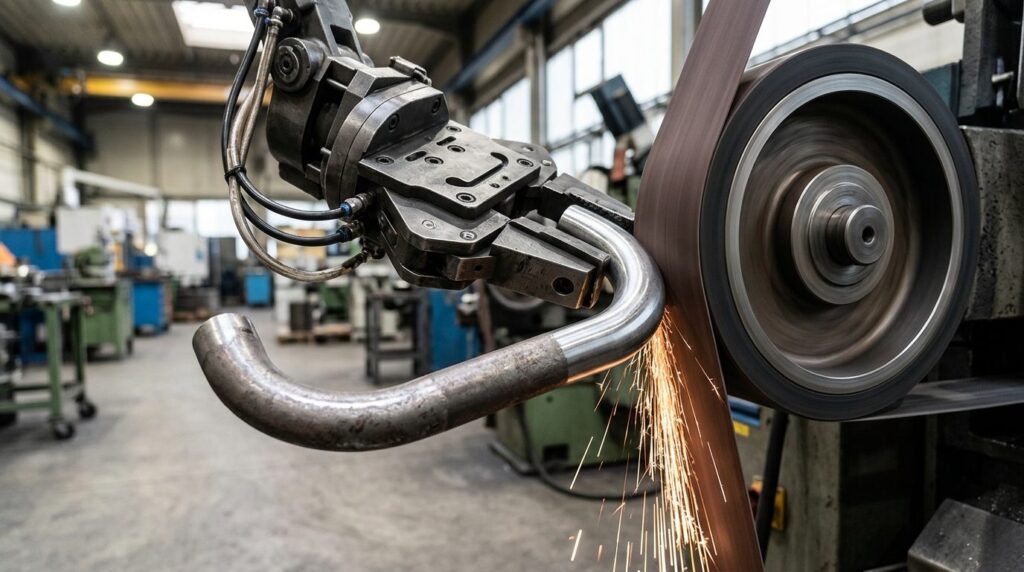
سير عمل عملية الطحن والتلميع الآلي
| الخطوة | Station | الأدوات | النتيجة |
| 01 | قبضة دقيقة للخدمة الشاقة | روبوت + قابض مصبوب حسب الطلب | يضمن عدم تحرك المقابض الثقيلة تحت الاحتكاك عالي السرعة |
| 02 | إزالة خط الحدادة | ماكينة الحزام الثقيل المثبتة على الأرض | يعمل على تسطيح خطوط التقسيم بسرعة لاستعادة المظهر الجانبي الأصلي |
| 03 | مزج المنحنيات المعقدة | حزام عجلة التلامس العائم | يتوافق مع الأسطح ذات الشكل الحر، ويمحو التموجات الكبيرة |
| 04 | تلميع المرآة الأساسية | مركز التلميع بالشمع التلقائي متعدد المحطات | تستخدم عجلات مصنوعة من السيزال/القماش المتدرج للحصول على نتائج مرآة واضحة |
| 05 | التفريغ التلقائي وضمان الجودة | التحويل إلى الوسم بالليزر/الموجات فوق الصوتية | في انتظار تدفقات الطلاء بالبي في دي أو الطلاء شديد اللمعان اللاحق |
Workholding for Free-Form Brass Handles
A solid brass handle offers almost nothing to clamp: no flat reference face, a heavy body, and 360 degrees of cosmetic surface. The fixturing answer is to grip where the customer will never look. Mounting threads at the base, the internal bore, or the spindle recess become the locating features; a pneumatic expanding mandrel or a form-matched cradle picks up those features and leaves the entire visible surface exposed to the wheels.
- Anti-rotation without marking: torque from high-speed buffing is real on heavy handles, so drivers engage splines or flats inside the bore—not the polished shank.
- Thermal discipline: brass conducts buffing heat straight into the fixture; gripper materials and exchange rhythms are chosen so wax does not bake onto the part or the tooling.
- One datum end to end: the same bore that locates the handle for polishing also locates it at final inspection, so geometric checks are not fighting a fixture shift.
Gripper design also decides changeover economics. Because handle families share section sizes more than they share silhouettes, one gripper body with interchangeable insert sets usually covers a brand’s whole catalog; a new handle geometry then means an insert, not a new fixture build. That is what keeps small-batch custom programs profitable on the same cell that runs volume staples.
Consumables and Process Windows for Brass
Brass forgings arrive hard-skinned with parting lines, and they finish as mirror product—so the abrasive ladder has to be long and the final cuts light. A workable sequence moves from coarse belts that erase forging lines, through flexible contact wheels and nylon that fair the free-form surfaces, to sisal with cutting compound and finally soft cotton with finishing compound for color. Each stage exists to remove the previous stage’s scratch pattern, nothing more.
- Pressure discipline: brass is softer than it looks; the process window favors moderate force at healthy surface speed rather than heavy pressure, which smears instead of cuts and heats the part.
- Compound choice: cutting compound on sisal for stock removal, finishing compound on cotton for luster—mixing the two is a common cause of hazy finishes.
- R-corner tooling: small-diameter wheels reach into handle roots where full-size wheels cannot; the robot schedules them as a separate station rather than forcing one wheel to do both jobs. Machine formats for this work are compared in our robotic polishing machine guide.
Path Planning, Takt Time and Consistency Verification
Path generation for handles is a normal-following exercise: the tool must meet the surface at a controlled angle and sweep along the curvature, decelerating into tight R-zones and accelerating on open shanks—look-ahead speed control is what prevents dwell burns at the transition points. Because the handle never leaves the gripper between stations, the path executed at the buffing wheel is registered to exactly the same coordinate frame as the belt passes before it.
On takt, a single robot walking four to five fixed stations suits most handle programs; where volumes are higher, two robots share the station row and alternate parts, roughly halving cycle time without doubling the machine count. Starvation is avoided by letting the loading side of the cell run asynchronously.
Verification closes the loop: gloss-meter sampling across the batch, zebra-light reflection checks for curve continuity, and a sealed golden sample from the first approved batch as the visual reference for every shift. The same inspection discipline applies across general metal polishing programs; for the flat-panel counterpart in door hardware, see our smart door lock panel polishing solution.
Application Scenario: Curved Solid Brass Handles
One typical project involves a hardware plant serving the RV and private-estate market, where polished brass handles are specification items rather than accessories.
- التحدي: On a solid brass S-shaped handle, manual first-pass rates were stuck at unprofitable levels—uneven curve transitions broke the reflection after plating, and rework could not keep up.
- The Outcome: Under the robot-holding, force-controlled cell, the machine repeats a master-level path with pressure that never tires. First-pass yield recovered to consistently high levels, unit processing cost fell substantially, and the delivery disruptions that followed labor turnover stopped.
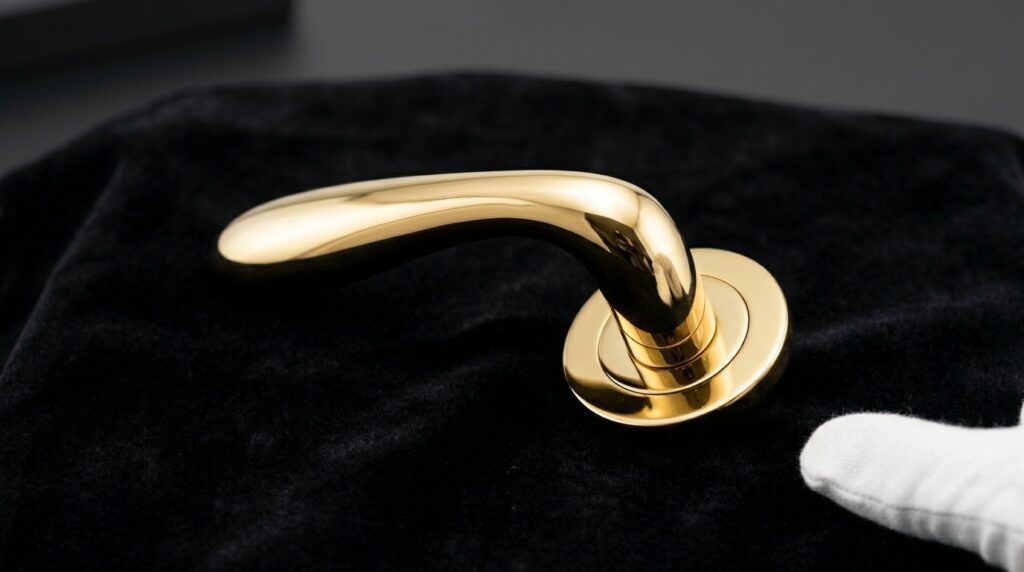
الأسئلة الشائعة حول تلميع المقابض الفاخرة
س1: تختلف تصميمات المقابض بشكل كبير. هل البرمجة الآلية صعبة؟
A: Programming is handled by 3D Offline Programming (OLP) software, not by teach-pendant walking. Import the CAD model and the system reads surface normals and plans the paths itself; even heavily stylized handles typically go from model to running program within half a day.
س2: يؤدي تلميع المقابض النحاسية إلى توليد حرارة احتكاك كبيرة. هل يؤثر ذلك على الروبوت؟
A: No. The cell combines temperature-resistant gripper materials with path rules that keep the tool moving—no dwelling—so friction heat never pools in one spot. That protects both the equipment and the brass surface against thermal discoloration.
الخاتمة
The value of a luxury handle is that one continuous curved reflection. An automated architecture of heavy-duty 6-axis robots carrying workpieces against high-power floor-mounted equipment is the most dependable route to complex 3D polishing at scale: it takes people off the physically punishing work and gives series products the consistency once reserved for hand-finished custom pieces.
Uneven curves and collapsed R-corners are geometry problems, not people problems—and geometry is exactly what a robot repeats without deviation. Bring your handle designs for a high-end hardware automation assessment: اتصل بنا.