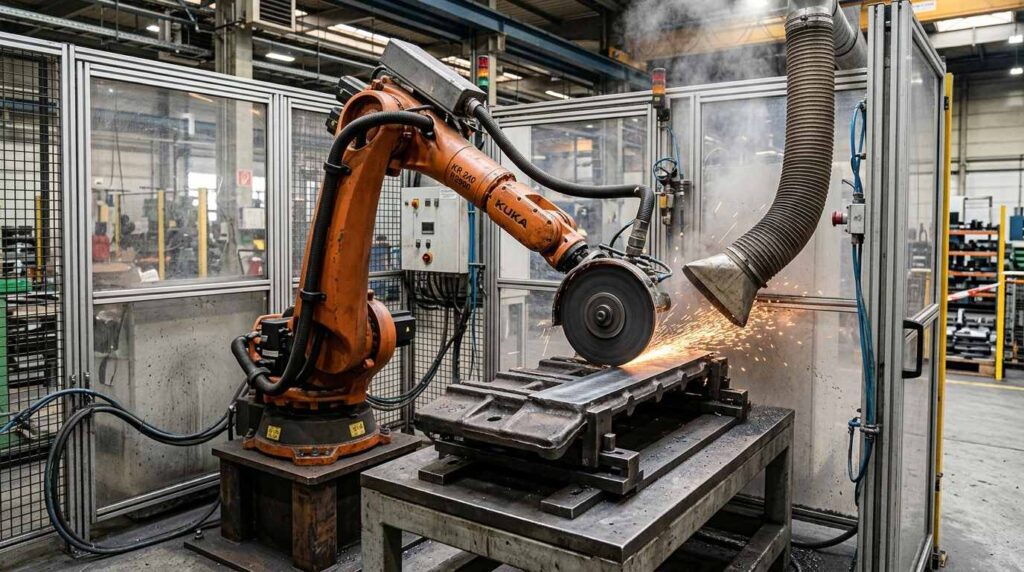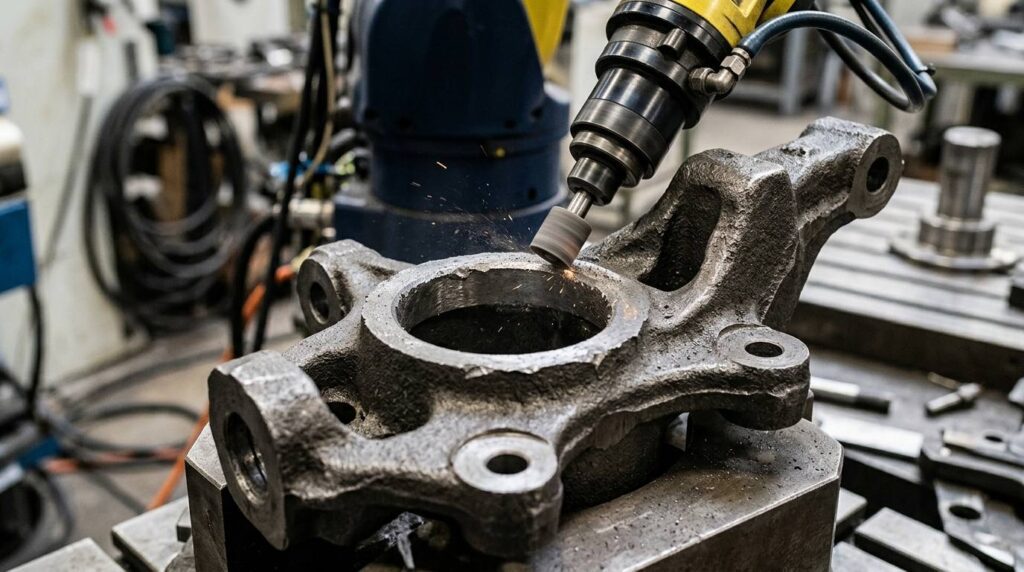
Steering knuckles are complex cast structural components used in automotive steering and suspension systems. The part typically has an irregular cast profile, multiple arms, large and small hole openings, raised mounting bosses, reinforced ribs and several assembly-related surfaces that require controlled post-casting finishing.
During casting and rough machining, steering knuckles may develop casting flash, burrs, sharp edges and parting line defects around complex contours, hole openings, bosses, rib transitions and mounting areas. Manual deburring of this type of workpiece is difficult because the part has many local features and changing tool angles. A robotic grinding solution provides a more repeatable method for complex contour deburring, hole opening treatment and assembly surface cleaning before coating or final assembly.
What is a Steering Knuckle?
A steering knuckle is an important cast component used in the steering and suspension structure of a vehicle. It connects the wheel hub, suspension links, steering linkage and braking-related components. Because it works under repeated load, vibration and impact conditions, the part must provide high strength, rigidity and accurate mounting positions.
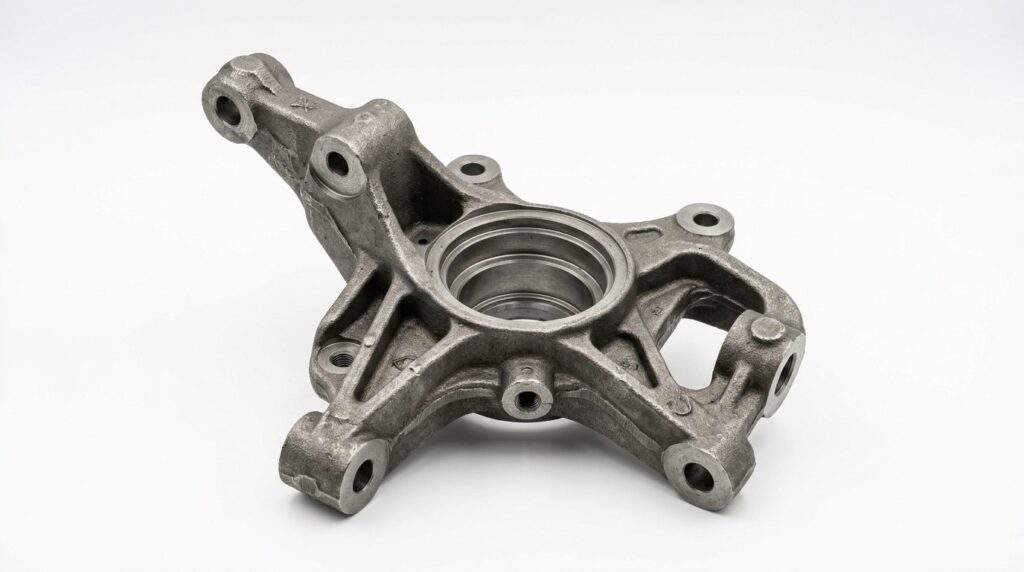
The geometry is compact but complex: several arms, circular hole openings, raised bosses, thin transitions and irregular outer contours. These features are necessary for assembly and load transfer, but they also create many burr-prone areas after casting and machining. Therefore, the finishing process must remove burrs and flash while protecting important mounting and contact surfaces.
| Артикул | Подробности |
|---|---|
| Название заготовки | Steering Knuckle |
| Типовой размер | 369 × 268 × 205 mm |
| Материал | Cast Iron / Cast Steel |
| Основной процесс | Роботизированная шлифовка |
| Процессы с поддержкой | Deburring, Hole Edge Finishing, Surface Cleaning |
| Main Processing Areas | Complex contours, hole openings, bosses, ribs, assembly-related surfaces |
| Industry | Автомобили и электромобили |
| Финальный гол | Remove burrs, casting flash, sharp edges and local surface defects |
Every operation on a steering knuckle serves function — clearing casting defects, deburring complex edges, cleaning hole openings and prepping assembly areas, all without touching functional surfaces.
Typical Applications of Steering Knuckles
Steering knuckles are mainly used in automotive steering and suspension systems. Their structure may vary depending on the vehicle platform, but they usually serve as key connection components in the wheel-side assembly.
| Application Area | Typical Use |
|---|---|
| Passenger Vehicles | Steering and suspension connection component |
| Commercial Vehicles | Heavy-duty steering support casting |
| New Energy Vehicles | EV chassis and steering system component |
| Off-Road Vehicles | Reinforced steering and suspension component |
| Engineering Vehicles | Load-bearing wheel-side steering component |
| Automotive Casting Production | Batch finishing of complex cast steering parts |
In these applications, burrs and sharp edges can affect assembly safety, coating quality, handling, fixture positioning and downstream inspection. A stable robotic grinding process helps maintain consistent finishing quality for repeated production.
Pain Point Analysis of Steering Knuckle Finishing
Steering knuckle finishing is challenging because the part has several arms, holes, bosses and irregular transition areas. Unlike simple flat castings, the robot or operator must reach many different surfaces from different angles. Manual grinding can easily miss local burrs around holes, ribs and recessed areas.
Another important challenge is assembly surface protection. Some surfaces around holes, bosses or mounting pads may be used for positioning, fastening or connection with other vehicle components. These areas must be cleaned carefully, but they should not be over-ground. Robotic grinding can define clear target zones and protected zones to improve process control.
| Распространенная проблема | Конкретная область | Воздействие |
|---|---|---|
| Вспышка при запуске | Outer contours and parting line areas | Affects coating and appearance consistency |
| Заусенцы на краях отверстий | Large holes, small holes and local openings | May affect fastener installation or assembly |
| Burrs Around Bosses | Raised mounting bosses and pad edges | Creates assembly and handling risks |
| Острые края | Arms, ribs and local transitions | May affect safety and coating quality |
| Ручное изменение | Complex contour and multi-angle areas | Приводит к нестабильному качеству отделки |
| Cast Iron Dust | Grinding and deburring operation | Affects workshop cleanliness and operator comfort |
Compared with manual finishing, robotic grinding provides better repeatability for complex contour treatment and multi-point deburring. The robot can process the same holes, bosses and contour areas in a stable sequence.
| Comparison Item | Ручное шлифование | Роботизированная шлифовка |
|---|---|---|
| Complex Contour Deburring | Depends on operator experience | Repeatable programmed tool paths |
| Hole Opening Treatment | Easy to miss internal edge burrs | Controlled hole-edge deburring |
| Boss Edge Cleaning | Quality varies by worker | Dedicated path for raised boss areas |
| Assembly Surface Protection | Hard to control manually | Defined target and protected zones |
| Batch Production | Difficult to keep consistent | Programs can be saved and reused |
| Dust Exposure | Operators work close to grinding dust | Can be integrated with dust extraction |
For steering knuckle manufacturers, robotic grinding helps reduce manual variation and improves the consistency of burr removal on complex automotive castings.
Robotic Grinding Process for Steering Knuckles
A robotic grinding cell for steering knuckles can be configured according to workpiece structure, burr locations, required finishing level and production volume. The system usually includes a six-axis industrial robot, dedicated fixture, abrasive grinding tool, flexible deburring tool, small grinding head, optional force-control system, dust extraction system and safety enclosure. Standard platforms such as our 6-axis deburring equipment cover this feature set directly.
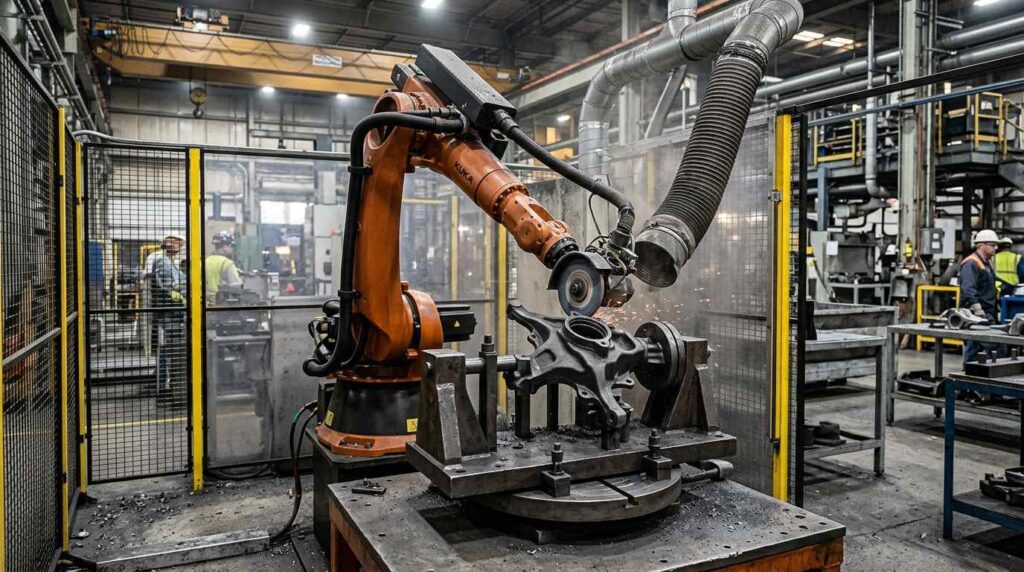
The process focuses on removing casting flash, deburring complex contours, cleaning hole openings, finishing boss edges and preparing assembly-related areas for coating or final assembly.
| Шаг | Процесс | Назначение | Инструмент / Система |
|---|---|---|---|
| 1 | Загрузка и позиционирование | Secure the steering knuckle accurately | Специализированное приспособление |
| 2 | Выбор программы | Select the correct finishing path | Программа для интерфейса человека-машины / робота |
| 3 | Outer Contour Grinding | Remove flash from irregular outer profiles | Абразивный шлифовальный инструмент |
| 4 | Hole Opening Deburring | Remove burrs around large and small holes | Small grinding head |
| 5 | Boss Edge Finishing | Smooth raised mounting boss edges | Гибкий инструмент для удаления заусенцев |
| 6 | Rib and Transition Cleaning | Process arms, ribs and recessed transitions | Compliant abrasive tool |
| 7 | Контроль качества | Проверьте удаление заусенцев и состояние защищенных поверхностей | Ручной или визуальный осмотр |
| 8 | Разгрузка и очистка | Remove dust and transfer the part | Air blow / vacuum cleaning |
Шаг 1: Загрузка и размещение
The steering knuckle is placed into a dedicated fixture. Because the workpiece has an irregular shape and multiple processing angles, accurate positioning is essential. The fixture must hold the part securely while allowing access to hole openings, outer contours, bosses and rib transitions.
For batch production, the fixture can include quick locating pins or clamping blocks to improve loading efficiency and repeatability.
Шаг 2: Выбор программы
The operator selects the correct robot program according to the steering knuckle model. Different vehicle platforms may use different hole layouts, arm lengths or boss positions, so each model should have a validated grinding program.
For mixed production, barcode scanning, fixture recognition or recipe management can be used to reduce program selection errors.
Step 3: Outer Contour Grinding
The robot first processes the irregular outer contour and parting line areas. These zones often contain casting flash, rough edges and local surface defects after casting.
An abrasive grinding tool follows the programmed profile path to remove flash and smooth the outer edges. This improves handling safety and prepares the part for coating.
Step 4: Hole Opening Deburring
Hole openings are one of the most important areas on a steering knuckle. Burrs around large holes, small holes and local openings may affect bolt insertion, bushing installation, bearing-related assembly or inspection.
The robot uses a small grinding head or deburring tool to process hole edges with controlled circular or local paths. This improves consistency compared with manual hole deburring.
Step 5: Boss Edge Finishing
Raised bosses and mounting pads often have burrs around their edges. These areas are close to assembly interfaces, so burr removal must be controlled carefully.
A flexible deburring tool can remove burrs around boss edges while reducing the risk of damaging functional surfaces. The robot path should clearly separate the target edge from protected mounting surfaces.
Step 6: Rib and Transition Cleaning
The arms, ribs and recessed transition zones of the steering knuckle may retain small burrs or sharp edges. These areas are difficult to process manually because the tool angle changes frequently.
The robot can use a compliant abrasive tool or small grinding head to process these local features in a defined sequence, reducing missed burrs and improving finishing coverage.
Шаг 7: Контроль качества
After grinding, the steering knuckle is inspected for burr removal, hole edge quality, boss edge finishing, contour consistency and protected surface condition. Key inspection points include large holes, small holes, raised bosses, arm edges, rib transitions and parting line areas.
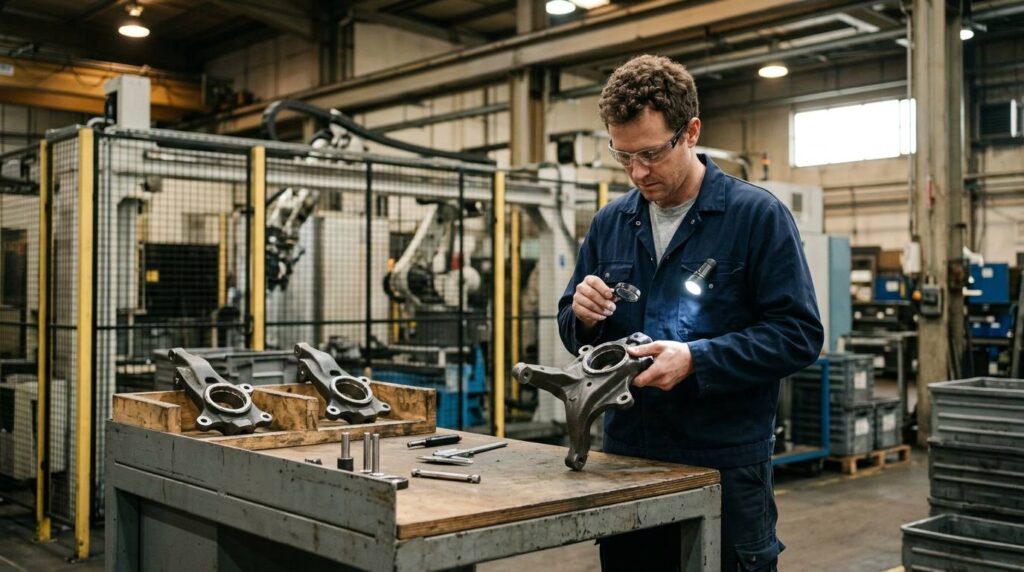
Inspection can be manual or visually assisted depending on the customer’s production and quality requirements.
Шаг 8: Разгрузка и очистка
The finished steering knuckle is removed from the fixture. An air blast, vacuum wand or brush clears dust and abrasive residue. The part can then move to coating, machining, assembly, packaging or final inspection.
Проблемы при механической обработке и их решения
Steering knuckles are difficult to finish because they combine complex geometry, multiple hole openings, raised bosses and protected assembly-related surfaces. A good robotic solution must balance burr removal efficiency with surface protection.
| Задача | Причина | Роботизированное решение |
|---|---|---|
| Complex Outer Contours | Irregular arms and curved profiles require changing tool angles | Programmed contour grinding path |
| Заусенцы на краях отверстий | Multiple openings may retain burrs after casting or machining | Small tool with controlled hole-edge path |
| Boss Edge Burrs | Raised pads create local burr-prone areas | Flexible deburring tool for boss edges |
| Recessed Transition Areas | Ribs and corners are hard to reach manually | Local finishing path with optimized robot angle |
| Защита поверхности | Assembly areas must not be over-ground | Dedicated fixture and protected process zones |
Difficulty 1: Complex Contours Require Multi-Angle Grinding
The steering knuckle has several arms, curved profiles and local shape changes. Manual workers must constantly adjust the grinding angle, which can create inconsistent results.
The solution is to use programmed robotic contour paths. The robot follows the defined edge profile and maintains stable tool orientation, improving consistency across repeated parts.
Difficulty 2: Hole Edges Require Controlled Deburring
Hole openings are critical on steering knuckles. Burrs around these areas can affect assembly, fastening or downstream inspection. Manual hole-edge deburring may vary between operators.
The solution is to use a small grinding head or deburring tool with a defined circular path. The robot can process each hole edge consistently while avoiding unnecessary surface removal.
Difficulty 3: Raised Bosses Are Easy to Over-Grind
Bosses and mounting pads need burr removal around the edges, but their functional surfaces must remain protected. Manual grinding may damage nearby assembly-related surfaces if the boundary is not controlled.
The solution is to define clear target zones around boss edges. Flexible tools and controlled robot paths help remove burrs while protecting important surfaces.
Difficulty 4: Recessed Ribs and Local Transitions Are Easy to Miss
Some burrs remain in rib transitions, corners or recessed areas. These areas are difficult for manual operators because visibility and access are limited.
The solution is to divide the workpiece into feature zones and create local robot paths for each burr-prone area. This improves coverage and reduces missed burrs. Machine-format trade-offs for this kind of multi-zone work are compared in our deburring machine types guide.
Difficulty 5: Casting Variation Requires Flexible Processing
Casting flash and burr size may vary between batches. A rigid path may not always maintain stable contact with the workpiece.
The solution is to use compliant grinding tools or force-controlled processing. This allows the robot to adapt to small casting variations while maintaining consistent finishing quality.
Application Scenario
Scenario Background
Imagine a casting plant feeding steering knuckles into vehicle steering and suspension lines. Arms, hole openings, bosses, ribs and transition areas each need deburring and surface prep before coating and assembly.
Manual grinding and deburring can hold the line at pilot volumes. At production scale the problem concentrates where access is worst — hole openings, boss edges and the complex contours in between.
Технические проблемы
Flash traces the irregular contour and burrs settle around holes of every size, bosses and rib transitions. Hand finishing demands constant tool-angle changes, and quality pays for it.
Burr removal must improve while assembly surfaces stay protected, and cast iron dust puts the finishing area under further pressure.
Решение
The application matches a UBRIGHT SOLUTIONS cell: six-axis industrial robot, dedicated fixture, abrasive grinding tool, flexible deburring tool, small grinding head and dust extraction.
Outer contour and parting lines open the cycle, then hole openings, boss edges and rib transitions follow in programmed order. Fixture repeatability plus clearly separated target and protected zones keeps the finishing consistent.
| Артикул | Конфигурация |
|---|---|
| Заготовка | Cast Steering Knuckle |
| Типовой размер | 369 × 268 × 205 mm |
| Основной процесс | Роботизированная шлифовка |
| Процесс с поддержкой | Hole Deburring and Assembly Surface Cleaning |
| Робот | Шестиосевой промышленный робот |
| Инструментарий | Abrasive Grinding Tool, Flexible Deburring Tool, Small Grinding Head |
| Расписание | Dedicated Steering Knuckle Fixture |
| Борьба с запыленностью | Камера с закрытой конструкцией и системой пылеудаления |
| Application | Contour grinding, hole opening deburring, boss edge finishing |
Expected Results
This configuration is expected to stabilize quality on the three hardest feature groups — complex contours, hole openings and boss areas — and to carry the process consistently across repeated knuckle models without the manual grinding load.
With the cell enclosed, dust control stops being a separate battle and the pre-coating finishing step gains a repeatable standard.
| Область результатов | Expected Improvement |
|---|---|
| Contour Finishing | More consistent grinding on irregular outer profiles |
| Hole Deburring | More stable burr removal around large and small holes |
| Boss Edge Quality | Improved burr removal around raised mounting areas |
| Сокращение трудозатрат | Снижение объема ручной повторяющейся шлифовальной работы |
| Защита поверхности | Better control of target and protected areas |
| Борьба с запыленностью | Cleaner finishing environment with extraction system |
ЧАСТО ЗАДАВАЕМЫЕ ВОПРОСЫ
Q1: Why is robotic grinding suitable for steering knuckles?
Robotic grinding is suitable because steering knuckles have complex contours, multiple holes, raised bosses and local transitions that require repeatable finishing. The robot can process these areas with stable paths and reduce variation caused by manual grinding.
Q2: What areas of a steering knuckle are typically processed?
Common processing areas include outer contours, parting lines, hole openings, boss edges, rib transitions and selected assembly-related surfaces. The exact process depends on the workpiece structure and quality requirements.
Q3: Can robotic grinding remove burrs around hole openings?
Yes. The robot can use a small grinding head or deburring tool to process hole openings with controlled paths. This improves consistency around large holes, small holes and local openings.
Q4: How does the robot protect assembly surfaces?
The system uses accurate fixturing and predefined robot paths. Only target burr-prone areas are processed, while protected assembly surfaces are avoided according to the process plan.
Q5: Can one robotic cell process different steering knuckle models?
Yes. Different models can be processed if suitable fixtures and robot programs are prepared. Across a knuckle family, swapping fixtures and calling up the stored recipe is all the changeover takes.
Q6: Is polishing required for steering knuckles?
In most cases, no. Steering knuckles usually require grinding, deburring and surface preparation rather than decorative polishing. The focus is on removing burrs, flash and sharp edges before coating or assembly.
Q7: Can the system include dust extraction?
Yes. Dust extraction is recommended for cast iron or cast steel grinding. The robotic cell can include an enclosure, local suction and filtration equipment to improve workshop cleanliness.
Q8: What is the main advantage of robotic grinding for steering knuckle production?
The main advantage is repeatable finishing quality. Robotic grinding helps standardize complex contour deburring, hole edge treatment and boss edge finishing in batch automotive casting production.
Заключение
Steering knuckles are complex automotive cast components that require reliable finishing on irregular contours, hole openings, raised bosses, ribs and assembly-related surfaces. Casting flash, burrs and sharp edges can affect coating quality, handling safety and assembly consistency if they are not removed properly.
A robotic grinding solution helps steering knuckle manufacturers improve complex contour deburring, hole opening treatment and boss edge finishing in batch production. With dedicated fixtures, controlled tool paths and integrated dust extraction, robotic finishing is well suited to repeated automotive casting production. For a long-path structural casting in the same chassis family, see the axle robotic grinding solution.
If your steering knuckle production still relies on manual contour grinding, hole deburring or assembly surface cleaning, Свяжитесь с нами for a customized robotic solution. Steering and chassis castings sit under Автомобили и электромобили, and the equipment line-up is in Оборудование.