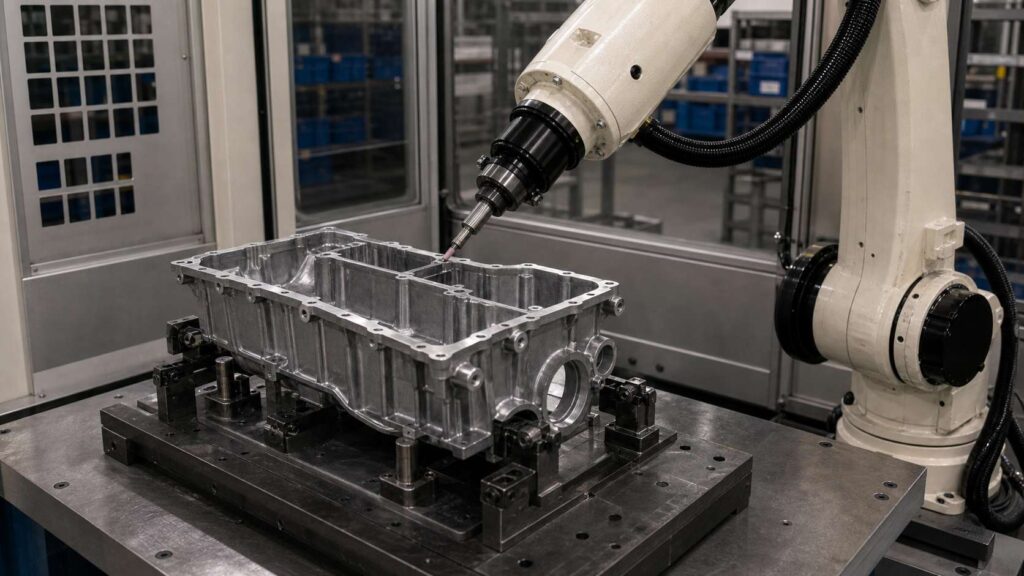
Cast iron brake backing plates are structural brake components used in braking systems where support, positioning and assembly stability are required. This part typically includes a large central opening, stepped outer contours, local bosses, mounting features and multiple edge transitions, making post-casting finishing more difficult than on simple flat castings.
This robotic grinding solution is designed for cast iron brake backing plate castings, which are typically 300–450 mm across depending on the brake design. It helps remove burrs, process hole edges, clean contour transitions and improve finishing consistency while reducing manual grinding workload.
What Is a Brake Backing Plate?
A brake backing plate is a structural brake component used to support, position or connect related brake-system parts. This workpiece is a cast iron backing-plate-type part with a central bore, stepped outer contour, local mounting features and several edge and opening areas that require post-casting cleanup.

After casting and rough machining, burrs, flash and sharp edges may remain around the central opening, outer profile, mounting edges and local transition zones. For this type of workpiece, the main finishing requirement is not decorative polishing, but robotic grinding, deburring and hole-edge treatment while protecting important fitting and mounting areas. If these process terms are new to you, our introduction to robotic deburring explains the basic categories.
| 項目 | 詳細資訊 |
|---|---|
| 工件名稱 | 鑄鐵煞車背板 |
| 典型尺寸 | Around 300–450 mm across, depending on brake design |
| 材質 | 鑄鐵 |
| 主要製程 | 機器人研磨 |
| 輔助流程 | 去毛刺、邊緣倒角、孔邊處理 |
| 主要處理區域 | 外輪廓邊緣、中央開口、孔邊界、局部凸台、分型線 |
| 保護區 | 配合面、安裝介面、精密接觸區域 |
| 完成目標 | 去除毛邊、修整邊緣並提升表面處理的一致性 |
鑄鐵煞車背板的典型表面處理挑戰
鑄鐵煞車背板的表面處理難度高於一般板狀鑄件,因為該工件將大型中央開口、階梯狀外輪廓、凸起特徵以及局部安裝區域整合於單一緊湊結構之中。鑄造完成後,開口邊緣、輪廓邊界及特徵過渡處可能殘留毛邊與飛邊。.
另一項挑戰在於加工的一致性。此類零件若採用手工研磨,往往會導致邊緣品質不均勻,特別是在階梯狀輪廓、局部凸起及凹陷過渡區域附近。若孔邊緣或配合區域附近殘留毛刺,可能會影響後續的組裝作業及零件品質。.
| 常見問題 | 特定區域 | 影響 |
|---|---|---|
| 鑄造閃光 | 外形輪廓與分型線 | 會影響外觀與邊緣的一致性 |
| 尖銳邊緣 | 開啟邊界、外緣及特徵角點 | 造成處理和組裝風險 |
| 殘留毛刺 | 孔邊緣、凸台與局部過渡 | 導致成品品質不穩定 |
| 表面不規則 | 階梯狀面與輪廓過渡 | 降低表面均勻度 |
| 手動變化 | 重複的輪廓與邊緣清理區域 | 導致不同操作員之間的品質不穩定 |
| 敏感功能區域 | 配面接口與安裝介面 | 手動研磨時可能造成的損壞風險 |
煞車背板的機器人磨削製程
針對鑄鐵煞車背板的機器人磨削單元,其設計應以輪廓可加工性、孔緣處理及穩定的夾具定位為核心。該製程必須去除外緣、開口區域及過渡區的毛邊、飛邊及局部輪廓缺陷,同時保護配合面與安裝介面。.

For castings in this size range, the process usually includes workpiece positioning, program selection, protected-area confirmation, contour grinding, hole-edge deburring, local feature finishing, inspection and unloading.
| 步驟 | 製程 | 目的 | 工具/系統 |
|---|---|---|---|
| 1 | 載入與定位 | 將背板固定好,以確保操作時穩定 | 專用夾具 |
| 2 | 計劃選擇 | 將正確的零件模型與路徑配對 | 人機介面 / 機器人程式 |
| 3 | 保護區確認 | 定義無研磨區與受保護的介面 | 賽程邏輯 / 程式設定 |
| 4 | 外輪廓磨削 | 消除閃光與輪廓不規則現象 | 研磨工具 |
| 5 | 孔邊去毛刺 | 清除中央開口及局部開口周圍的毛刺 | 靈活的去毛刺工具 |
| 6 | 局部特徵處理 | 加工邊緣、台階及內嵌過渡 | 小型研磨頭 / 柔性工具 |
| 7 | 品質檢驗 | 檢查毛刺清除情況及受保護區域 | 手動或目視檢查 |
| 8 | 卸貨與清潔 | 清除灰塵並移出工件 | 氣吹 / 真空清潔 |
步驟 1:裝載與定位
煞車背板被放置於專用的夾具中,該夾具用以支撐鑄件本體,並在磨削過程中穩定工件。由於該零件具有大型中央開口、階梯狀輪廓及局部凸起結構,因此穩定的定位對於確保機器人操作範圍與刀具路徑的一致性至關重要。.
夾具應能牢固地固定工件,同時不遮擋需要加工的外輪廓、開口邊緣或局部凸起部位。正確的定位也有助於減少振動,並提高邊緣處理的一致性。.
步驟 2:選擇計劃
With the plate located in the fixture, the operator picks the stored cycle for that plate model at the HMI. When several backing plate variants share the line, each one keeps its own cycle and fixture offset.
此步驟可提升重複性,並降低磨削路徑錯誤的風險。在批量生產中,儲存的程式能讓機器人以一致的方式處理相同的輪廓邊緣、孔邊界及局部特徵。.
步驟 3:保護區確認
在開始研磨之前,系統會確認哪些區域可以進行加工,哪些區域必須予以保護。對於此類煞車零件,配合面、安裝介面及局部精密接觸面應被視為禁止研磨區域。.
這些受保護區域可透過程式限制、夾具定位或臨時屏蔽來控制。這有助於在機器人處理附近輪廓及開口邊界時,防止意外損壞。.
步驟 4:外輪廓磨削
機器人首先對煞車背板的主外輪廓進行加工。此步驟旨在去除外輪廓及階梯狀邊緣區域上的可見毛邊、分型線殘留物及局部不平整處。.
對於鑄鐵煞車背板,輪廓磨削應保持受控且具針對性。其目標是在不改變工件預定幾何形狀的前提下,清理輪廓並改善邊緣品質。.
步驟 5:孔邊去毛刺
外輪廓加工完成後,機器人會對中央的大開口及其他局部孔邊緣進行去毛刺處理。這些區域在粗略清理後,往往仍會殘留銳利邊緣或鑄造毛刺。.
此步驟適合使用柔性去毛刺工具,因為它能夠適應圓形及不規則開口周圍不斷變化的幾何形狀。其目的是為了提升邊緣品質,並降低組裝干涉的風險。.
步驟 6:局部特徵修飾
局部凸起、抬升段、階梯狀區域及凹陷過渡區,其加工難度高於開放輪廓邊緣。由於這些特徵區域的幾何形狀變化迅速,且人工操作的穩定性較低,因此可能殘留毛刺和局部飛邊。.
該機器人可使用較小的研磨頭或柔性研磨工具,以觸及這些局部區域。透過適當的路徑規劃,可提升複雜特徵區域的表面處理一致性,並減少遺漏毛刺的情況。.
步驟 7:品質檢查
經過研磨和去毛邊處理後,需對煞車背板進行檢查,確認毛邊是否已清除、邊緣是否平滑、輪廓是否一致,以及受保護區域的狀況。主要檢查要點包括中央開口、外輪廓、局部凸台、過渡區及裝配接合面。.

Checks range from simple visual and tactile inspection to camera-based systems, depending on what the brake line requires; the constant is a clean part with every assembly-related area intact.
步驟 8:卸載與清潔
將加工完成的工件從夾具中取出,並透過氣吹、真空吸附或刷洗等方式進行清潔。鑄鐵粉塵及鬆散顆粒可能殘留於孔洞、角落及凹陷部位,因此在進入下一道工序前,進行最終清潔至關重要。.
針對大規模生產,可透過轉盤或自動化搬運系統,將卸料與清潔工序整合在一起。此舉有助於提升工作流程的連續性,並提高批次加工的效率。.
加工困難與解決方案
| 挑戰 | 原因 | 機器人解決方案 |
|---|---|---|
| 開邊毛刺 | 中央的大開口與局部孔洞會形成反覆出現的毛邊區域 | 預設的孔緣去毛刺路徑 |
| 階梯式輪廓閃光 | 分型線與輪廓變化會造成局部不規則現象 | 透過受控存取實現穩定的輪廓磨削 |
| 特色專區清理 | 頭目和隱蔽區域較難靠手動方式抵達 | 小型工具的精加工與局部路徑規劃 |
| 介面保護 | 安裝及裝配區域不得受損 | 研磨路徑中排除的受保護區域 |
| 體力勞動強度 | 反覆清理邊緣和孔洞真的很累人 | 專用夾具與可重複的機器人操作 |
難點 1:中央開口周圍的毛刺
中央的大型開口是此工件的主要加工區域之一。鑄造或粗加工後,開口周圍可能殘留毛刺與銳利邊緣,而手動清理整個開口周圍的作業,其效果往往不盡一致。.
解決方案是使用預先編程的孔緣去毛刺路徑。這能讓機器人在加工圓形邊界時,保持更穩定的接觸,並確保邊緣品質的可重複性。.
難點 2:階梯狀輪廓容易打磨得不均勻
外輪廓及階梯狀表面過渡處可能產生局部飛邊及不規則的研磨痕跡。手動加工時,往往會在暴露區域去除過多材料,卻在難以觸及的過渡處留下缺陷。.
The solution is to use stable robotic contour tracking with controlled grinding force. This improves consistency across stepped contour sections and reduces operator-dependent variation. More generally, if you are weighing a robot cell against dedicated machines for this kind of work, our deburring machine types guide compares the common formats.
難度 3:區域頭目與隱蔽的關卡要素難以抵達
凸起的凸起部位和凹陷區域比開放邊緣更難加工,因為刀具角度變化迅速且加工空間受限。這些區域在經人工清理後,往往仍會殘留毛邊。.
解決方案是使用較小的研磨工具,並採用局部精修路徑。這樣一來,不僅能提升特徵過渡區域的清理品質,同時也不會對鄰近表面造成過度的研磨。.
難點 4:功能介面必須被保護
煞車背板可能包含安裝面及與裝配相關的接合面,在研磨過程中應避免損壞這些部位。若在這些區域附近隨意進行手動研磨,可能會影響後續的組裝或零件的配合。.
解決方案是將這些區域劃定為保護區,並將機器人的行進路徑限制在經核准的加工區域內。此舉可減少意外接觸,並提升製程可靠性。.
Application Scenario
Production Context
Cast brake backing plates leave the casting line with a familiar set of defects: flash around the outer profile, burrs at the central opening, and sharp edges wherever bosses and steps change the contour. On a manual line each plate is cleaned with a hand grinder, and the areas that matter most, the bore edge and the fitting faces, are exactly the ones where a slip is most costly.
At brake-component volumes the bottleneck is rarely the grinding itself; it is holding edge quality across thousands of repetitions, and the inspection load that inconsistent edges create downstream.
Where Manual Finishing Falls Short
The central opening is the defining feature of the part, and also the hardest to deburr by hand. A manual tool naturally dwells on the easy sections of the circle and hurries past the transition to the stepped contour, so edge quality varies around the bore. Bosses and recessed steps catch burrs that are hard to see from a standing position.
The fitting faces around the mounting pattern add the second constraint: they must stay free of tool marks while burr work continues right up to their edges, which asks for a level of force control that hand grinding does not provide hour after hour.
Cell Configuration for This Part
A typical setup pairs a six-axis industrial robot with a dedicated plate fixture, an abrasive grinding tool for the outer profile and parting lines, and a flexible deburring tool programmed to travel the full bore circumference at constant pressure. Fitting faces and mounting interfaces are defined as no-grind zones in the program, and the cell runs enclosed with extraction sized for cast iron dust. The process is divided into contour cleanup, hole-edge deburring, local feature finishing and protected-area control.
| 項目 | 組態 |
|---|---|
| 工件 | 鑄鐵煞車背板 |
| 典型尺寸 | Around 300–450 mm across, depending on brake design |
| 主要製程 | 機器人研磨 |
| 輔助流程 | 去毛刺、邊緣倒角、孔邊處理 |
| 機器人 | 六軸工業機器人 |
| 模具 | 研磨工具、彈性去毛邊工具 |
| 固定裝置 | 專用煞車背板支撐夾具 |
| 保護策略 | 受保護的接頭介面與安裝區域 |
| 塵埃控制 | 帶集塵功能的密閉式機箱 |
Results of Automating This Step
The immediate change is uniform edge quality around the bore and outer profile on every plate. Repetitive grinding work leaves the operator hands, and inspection effort drops because the defect pattern no longer changes from operator to operator. Stored programs keep the process stable across part variants in the same family.
| 結果區域 | 改進 |
|---|---|
| 邊緣品質 | 在輪廓線與開口邊緣處進行更穩定的清理 |
| 去毛刺 | 在中央孔與局部孔周圍的均勻性更佳 |
| 表面一致性 | 改善階梯狀輪廓區域的表面處理 |
| 減少勞動力 | 減少重複性手動研磨的工作量 |
| 生產穩定性 | 已儲存的重複背板模型程式 |
| 研討會環境 | 配備集塵系統的更潔淨的後處理區 |
常見問題
Q1: Is this brake backing plate a thin stamped sheet part?
No. This workpiece is better treated as a cast iron brake backing plate with a stepped structure, central opening and local raised features rather than a thin stamped sheet part.
Q2: Why is robotic grinding suitable for this part?
Because the workpiece has repeated contour edges, a large central opening and local feature areas that are difficult to process consistently by hand. Programmed paths hold constant pressure around the whole opening, where hand work tends to dig into the easy stretches and hurry the rest.
Q3: What areas can the robot process on this brake backing plate?
該機器人能夠處理外輪廓、中央及局部孔邊緣、台階過渡、局部凸起以及輪廓邊界,同時避開受保護的裝配與安裝介面。.
Q4: Does this part require polishing?
Generally not. A backing plate is a functional brake component, so the requirement is burr-free, consistent edges for assembly and handling; surface brightness is not part of the spec.
Q5: How are fitting areas protected during grinding?
可透過程式限制、夾具支撐或臨時屏蔽,將接觸面與安裝介面定義為受保護區域。.
Q6: Can one robotic cell handle similar brake backing plate castings?
是的。如果產品系列相近,透過獨立的程式和合適的夾具,一個機器人工作站即可處理多種相關的鑄造煞車零件。.
總結
Cast iron brake backing plates have stepped contours, large opening edges and local feature transitions, making manual deburring and edge grinding difficult to standardize. A robotic grinding solution helps manufacturers remove burrs, smooth edges and improve finishing consistency while protecting key fitting and mounting areas. For a curved cast iron casting worked with the same process logic, see our horseshoe part robotic grinding solution.
若貴公司的煞車背板生產仍依賴手動輪廓磨削、開口邊緣去毛刺或局部特徵修整,, 聯絡我們 for a customized robotic solution. Our 汽車與電動車 applications page collects similar brake and chassis casting projects, and the 設備 catalog lists the cell hardware behind them.