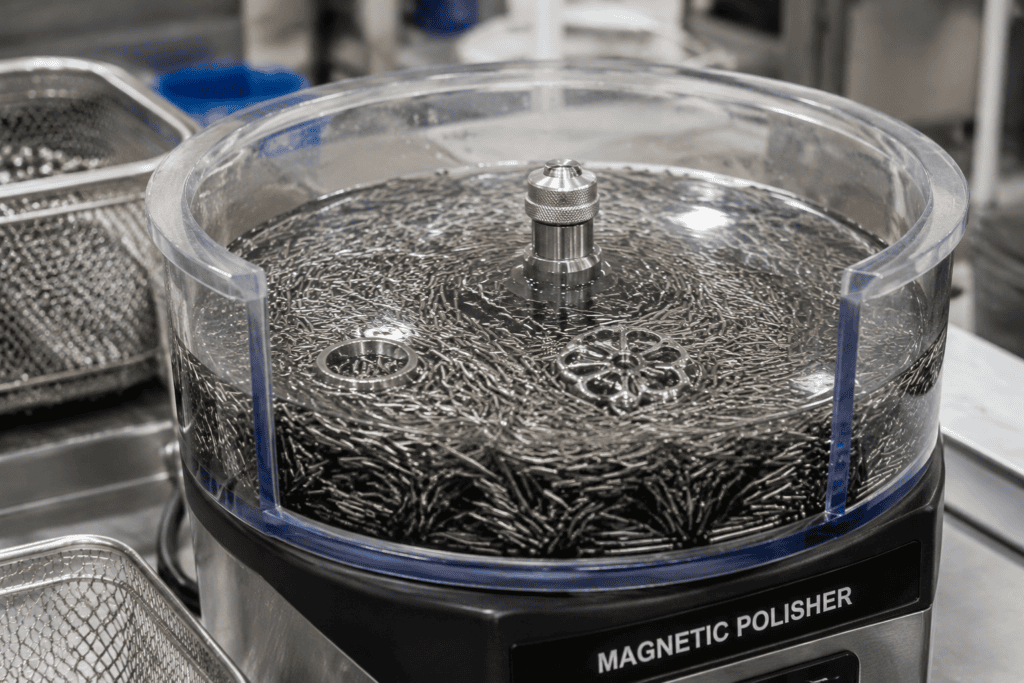
The buffing vs polishing distinction is simple to state: polishing uses bonded or graded abrasives to actually remove surface defects—tool marks, scratches, oxidation—and bring roughness down toward a target Ra. Buffing is what comes after: a soft cloth wheel carrying a wax or compounds bar that removes almost no metal and instead generates mirror gloss. Polishing changes the surface; buffing decorates it.
That one-sentence split settles most of the arguments we hear on factory floors. The rest of this article explains why the two terms get swapped so often, what each process physically does to the metal, which equipment and consumables each one demands, and how the distinction plays out when you specify a finish on a drawing or program a robot to hit it.
What Polishing Does: Abrasives That Cut
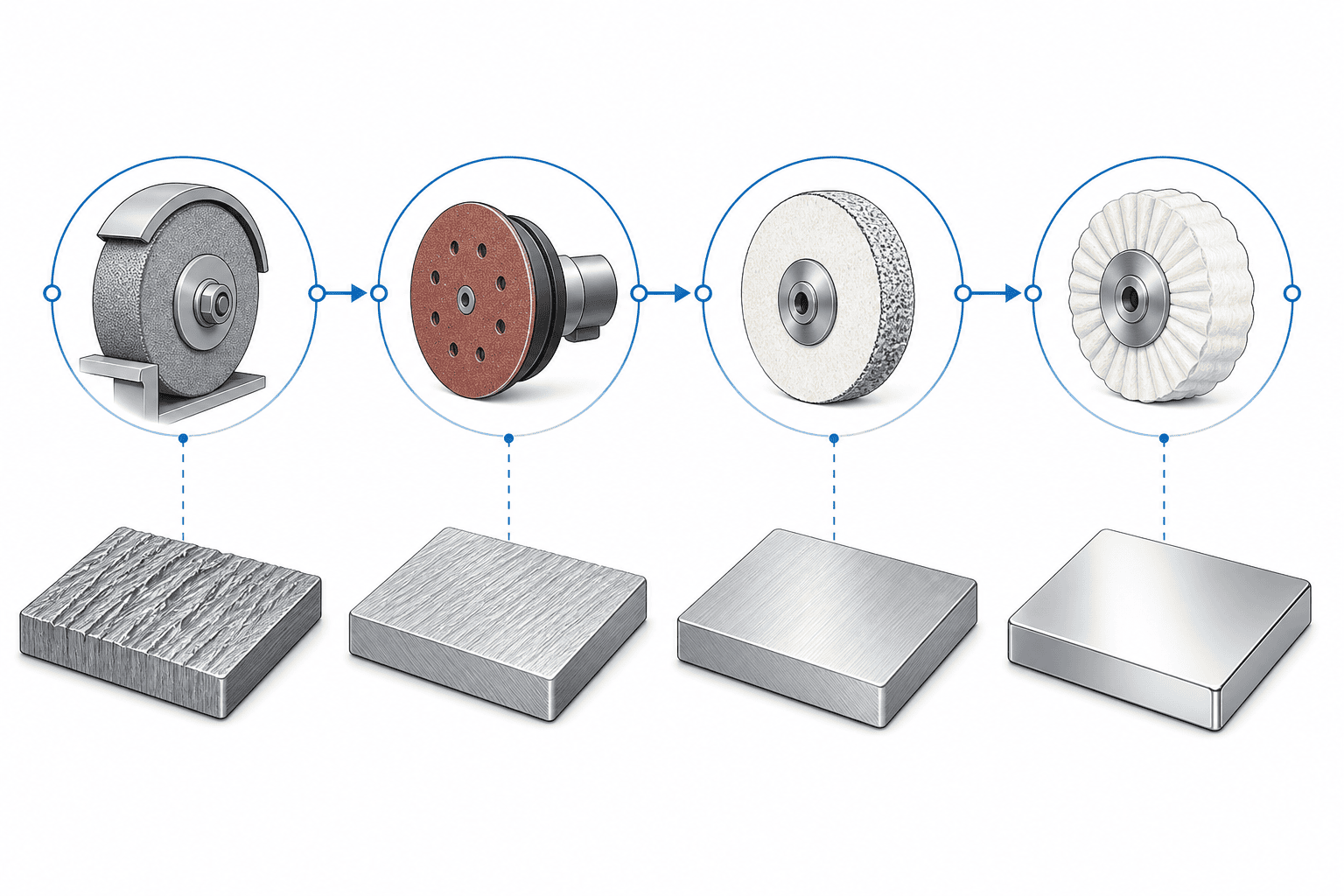
Polishing is a material-removal process. The abrasive—whether it is bonded into a wheel, coated onto a belt or disc, suspended in a paste, or loaded into a non-woven pad—shears microscopic peaks off the surface. Each pass strips a fraction of a micron, and by stepping down through progressively finer grits, the operator chases out the scratch pattern left by the previous step. Start at 240 grit to erase grinding lines, move through 400 and 800, finish at 1200 or 2000, and the surface roughness falls accordingly.
The defining trait is that polishing is measurable as stock removal and roughness reduction. A part that enters polishing at Ra 0.8 µm from a fine grinding pass can leave at Ra 0.1-0.2 µm, with every gram of that difference sitting in the filter as swarf. Shops that need to hold a dimensional tolerance or hit a Ra callout on a print are running polishing, whatever the operator at the bench happens to call it. The process also erases functional defects: die-cast pimples, machining chatter, weld discoloration, and the micro-scratches that later become corrosion initiation sites.
Polishing media stay where you put them. Because the abrasive is fixed—glued to cloth, resin-bonded in a wheel, or embedded in a structured surface—the cut rate is predictable, the scratch pattern is directional and repeatable, and the surface you get on part one is the surface you get on part ten thousand. That predictability is exactly what makes the step automatable, which is where most of our own work at UBright Solutions begins.
What Buffing Does: Heat, Wax, and Almost No Cutting
Buffing is a gloss-generating process. A wheel made of soft cotton or muslin discs—loosely stacked so the fabric flares at speed—is charged with a compound bar by pressing the bar against the spinning wheel. The compound leaves a thin abrasive-and-wax film on the cloth. When the part touches the wheel, three things happen at once: the fine abrasive in the compound smooths the last of the micro-peaks, friction heat momentarily softens the surface layer so peaks smear into valleys through plastic flow, and the waxy carrier fills and levels what remains.
Stock removal is close to zero—typically a few hundredths of a micron at most. You cannot buff out a 400-grit scratch; the wheel will burn the compound and shine over the defect while it is still there. Buffing only refines a surface that polishing has already prepared. This is why the sequence is never negotiable in plants that produce decorative hardware: polish to erase, buff to dazzle.
The tell that a shop truly understands buffing is that its buffing stations have no dimension to hold and no Ra to chase. Inspection there is visual and optical: a mirror-clear reflection read through the surface, checked under defined lighting against a limit sample, sometimes quantified as gloss units on a 60° gloss meter. The part left polishing meeting its roughness spec; buffing exists purely to convert that smooth surface into a reflective one.
Where They Sit in the Finishing Sequence
Neither process stands alone. A finished decorative or precision part travels a chain, and each stage has one job:
- Grinding removes bulk: scale, parting lines, gate stubs, heavy weld beads. Belt or wheel, aggressive abrasive, big dimensional change. This is rough shaping of the surface, and on cast or fabricated parts it is often robotic from the start—see our companion page on robotic grinding for how those cells are configured.
- Sanding or linishing refines the grinding scratches, stepping through grits.
- Deburring clears edges and holes. Depending on part size and volume this happens in bulk or at a robot—our guide to robotic deburring covers the split.
- Polishing cuts the surface down to its final roughness and erases the defect history.
- Buffing adds the gloss, in one or two passes with progressively finer compounds.
The chain explains a common point of confusion on its own: adjacent steps blur together at the boundaries. A fine polishing step with a very soft, lightly loaded wheel looks and sounds like buffing, and an aggressive cut-and-color buff with a dense spiral-sewn wheel does remove real metal. The stages are a gradient, and the vocabulary breaks precisely where the gradient is smoothest. But the endpoints are unambiguous—nobody calls a 60-grit belt “buffing,” and nobody calls a rouge-charged flannel wheel “polishing” in a plant that runs both.
Wheels and Compounds: The Hardware Difference
The equipment split follows the function. Polishing runs on structured, dimensionally stable tooling: belts, flap wheels, fiber discs, non-woven conditioning wheels, and bonded polishing wheels whose hardness is chosen to control contact pressure. Buffing runs on compliant cloth buffs, and the wheel itself is a family, not one item:
- Loose-section muslin wheels—soft, flaring, low pressure. Final color and gloss on contoured parts.
- Spiral-sewn wheels—cloth discs stitched in concentric rings, stiffer, higher pressure, used for cutting and cut-and-color work.
- Full-disc or face-contact wheels—maximum stiffness for flat-surface cutting before the soft final pass.
The compound bars are color-coded by long industry convention, and the colors mean the same thing in almost every catalog:
| Compound | Abrasive base | Role | Typical metals |
|---|---|---|---|
| Brown (tripoli) | Silica / diatomaceous earth | Cutting—removes fine scratches, blends | Brass, copper, aluminum, soft steel |
| White | Calcined lime | Cut-and-color—semi-final luster | Aluminum, chrome, nickel plate |
| Red (jeweler’s rouge) | Iron oxide | Final color—highest luster, least cut | Gold, silver, brass, copper |
| Green | Chromium oxide | Final color on hard metals | Stainless steel, hardened steel |
Read the table as a sequence, not a menu: brown to erase, white to brighten, red or green to mirror. A shop buffing stainless hardware goes brown-then-green; a shop finishing brass plumbing parts goes brown-white-red. Skipping ahead saves a step and costs the mirror, because each finer compound is designed to remove only the track left by the one before it.
One more distinction that matters for automation: buffing compound is a contaminant. The wax and abrasive smear into features, threads, and crevices, so a buffed part almost always needs a cleaning operation—ultrasonic, dip, or spray—before plating, assembly, or inspection. Polishing swarf, by contrast, is dry debris the coolant system or a blow-off handles.
Surface Results: Ra Targets and Gloss Units
If you want the difference on one axis, use roughness. Approximate windows for steel and nonferrous hardware:
- Ground surface: Ra 0.4-1.6 µm (16-63 µin)
- Sanded / linished: Ra 0.2-0.6 µm
- Polished (multi-step): Ra 0.05-0.2 µm (2-8 µin)
- Buffed mirror: Ra below roughly 0.05 µm, commonly 0.01-0.03 µm (0.4-1.2 µin)
Below about Ra 0.05 µm, surface roughness stops being the useful metric and optics take over. The surface now reflects specularly, and quality is stated in gloss units—a buffed brass or chrome part reads in the high 80s or above on a 60° gloss meter, where a satin-polished part of the same alloy reads far lower with the same roughness number nowhere in dispute. This is why drawings for decorative parts often specify “polished, mirror finish per sample” and leave both processes implied: the Ra callout covers polishing, the reference sample covers buffing.
Note the asymmetry for planning: polishing changes roughness, buffing changes appearance. A part can be fully within Ra spec and unacceptably dull; it can also be brilliantly glossy and fail a Ra callout, because gloss meters forgive wide scratches that a stylus profilometer will still find. Spec both processes separately on decorative work and you avoid the classic dispute where the polishing department met its number and the customer still rejected the parts for looking hazy.
Why Everybody Confuses the Two Terms
The muddle has three sources, and none of them is sloppiness on your part.
First, the automotive detailing industry repurposed both words for paint. A detailer “polishes” clear coat with a foam pad and micro-abrasive polish, then “buffs” off the wax with a soft pad—and in some regions says it the other way around. Millions of people learned these words from car care, and the usage leaks into purchasing conversations at industrial companies. When a buyer says “buffed finish,” half the time they mean what a metal finisher calls a polished satin surface, not a rouge mirror.
Second, abrasive catalogs disagree with each other. Some suppliers describe buffing as the coarser, more aggressive operation and polishing as the finer one—defining the words by whether the abrasive is loose or bonded rather than by which step comes first in the shop. That classification is internally consistent but it inverts the sequence a metal finisher follows, so two authoritative-looking sources can contradict each other while each describing reality correctly from its own angle.
Third, the actual process chain has no gap between the steps. Fine polishing with a soft wheel shades into light buffing with a cutting compound, and hybrid “cut-and-color” operations deliberately straddle the line to save a station. Language cannot stay crisp across a boundary the process itself smooths.
The practical fix in a plant is to stop arguing vocabulary and specify outcomes: grit sequence and target Ra for the polishing stage, compound color and gloss sample for the buffing stage. Put that on the traveler and the terminology dispute becomes irrelevant.
What Your Drawing Actually Asks For
Specification language decides the process, and drawings fall into a few recognizable patterns:
- A Ra callout with no appearance requirement (Ra 0.4, Ra 0.2, Ra 0.1) is a polishing instruction. Buffing cannot reliably deliver or verify a roughness number, and running the buff for tolerance wastes compound on geometry the abrasives already achieved.
- “Mirror finish,” “No. 8 finish,” or “per approved sample” on decorative hardware adds a buffing stage after the Ra window is met. The sample governs; the Ra only qualifies the base.
- “Satin” or “brushed” finish explicitly excludes buffing. The directional 240-320 grit polish pattern is the product, and rouge would destroy it.
- Functional surfaces—sealing lands, bearing journals, food-contact zones—usually stop at polishing. Gloss adds nothing, and compound residue in a crevice is a liability, not a bonus.
- Parts headed for plating get polished thoroughly and buffed selectively. Plating amplifies underlying texture, so roughness is the critical input, while buffing is reserved for repair or post-plate color where the process allows it.
When in doubt, work backward from how the part fails inspection. Rejected for roughness or visible scratches means upstream polishing work. Rejected for haze, smut, or dullness with a good surface means the buffing stage needs attention—compound selection, wheel wear, or contact pressure, rarely more polishing.
Robots Do Both: Force Control and Wheel Compliance
Both processes robotize, but for different reasons, and the reasons shape the machine.
Robotic polishing succeeds on force control. The cut rate of an abrasive depends on pressure, so a robot holding a constant, programmed normal force—through an active force-control spindle or a passive compliance device—removes material at a predictable rate along complex contours. This is what lets a cell hit Ra 0.1 on a variable-curvature surface a human would finish inconsistently over an eight-hour shift. Grit changes, spindle speeds, and offsets become parameters rather than skills. Our robotic polishing machine guide goes deep on spindle selection, force strategies, and media staging.
Robotic buffing leans the other way: on compliance. A cloth buff is itself a spring, so the wheel forgives small path error and self-conforms to curves—the same property that makes hand buffing forgiving makes robot buffing robust. The engineering problems are different from polishing: heat management (dwelling too long burns compound onto the part), compound application (bar touchers or automatic applicators replace a worker pressing a stick against a spinning wheel), and cycle discipline (a buff hides nothing, so any defect reaching this station ships unless someone inspects). Many productive cells run both steps back-to-back on one robot, with the polishing spindle and the buff station swapped by tool changer or arranged as consecutive stations in a multi-stage cell.
The economics diverge as well. Polishing consumables—belts, discs, compounds—are predictable costs per part, and automation pays back through consistency. Buffing consumables are cheap, and automation pays back through throughput and through removing a task that is hot, repetitive, and hard to staff. Plants rarely struggle to justify either once the manual station is on three shifts.
One Part, Both Steps: Faucets, Handles, and Wheels
Consider a brass bathroom faucet leaving the casting cell. It arrives with gate marks, parting-line flash, and die-cast texture. Grinding knocks down the gates. Sanding erases the parting line through stepped grits. Polishing takes the surface to Ra 0.1 or better—this is the stage that decides whether the faucet ever looks expensive. Then a buffing pass, brown compound on a spiral-sewn wheel followed by red rouge on a loose muslin wheel, turns the smooth brass into a surface the customer reads as gold-adjacent jewelry. Skip polishing and the buff produces a shiny part with every casting defect still visible underneath, magnified rather than hidden. Our brass faucet robotic polishing solutions page walks through that exact chain as we deploy it.
Luxury door hardware follows the same arithmetic with stricter cosmetics. A solid brass handle that retails as a premium product gets polished for uniform roughness across grip, rose, and escutcheon, then buffed to a gloss the customer checks with their own reflection in the showroom. The failure mode of a rushed process is consistent: the buff reveals rather than repairs, so any polish step that skipped a feature shows up as a dull patch no compound can rescue mid-line. The case study on our luxury door handle polishing solution covers how the cell stages grits to prevent exactly that.
Alloy wheels compress the same logic into a high-volume consumer product: machined faces polished for uniformity, then buffed before clear coat, with the gloss under the coating selling the wheel on the rack. The alloy wheel robotic polishing page details the multi-stage arrangement. Across all three products the division of labor never changes—polishing earns the surface, buffing earns the price tag.
Frequently Asked Questions
Which comes first, polishing or buffing?
Polishing, always. Polishing removes defects and lowers roughness; buffing then generates gloss on the prepared surface. Buffing a part that still carries grinding scratches produces a shiny scratched part, because a soft cloth wheel charged with compound cannot erase defects—only a fine abrasive can.
Does buffing remove metal?
Effectively no. A buffing pass removes a few hundredths of a micron at most, mostly through the fine abrasive in the compound; most of the “improvement” is plastic smearing of micro-peaks plus wax filling. Any process removing measurable stock—0.01 mm and up—is polishing or grinding, whatever wheel it uses.
What do brown, white, and red buffing compounds do?
Brown (tripoli) cuts: it removes fine scratches and blend marks, mainly on brass, copper, and aluminum. White brightens as a semi-final step on aluminum and chrome. Red rouge, or green chromium oxide on stainless, delivers the final mirror. Use them in that order; each is only fine enough to erase the track of the previous one.
Can a robot really buff as well as a person?
Yes, and usually more consistently. A cloth buff is inherently compliant, which forgives robot path error, and force control keeps contact pressure constant where a tired arm drifts by the end of a shift. The engineering effort goes into compound feeding, heat management, and inspection—since buffing hides no defects, the cell must receive parts that are already correctly polished.
How do I know which process my part needs?
Read the drawing. A roughness callout—Ra 0.8 down to Ra 0.1—specifies polishing. “Mirror,” “No. 8,” or “per sample” on appearance adds buffing after polishing hits the roughness. “Satin” or “brushed” means polishing only, with the directional grit pattern left intact. Parts for plating or functional sealing lands stop at polishing, because gloss adds nothing there and compound residue can cause rejects downstream.
*UBright Solutions builds robotic polishing, buffing, grinding, and deburring cells for metal manufacturers. Tell us the finish on your drawing and the parts per hour you need—we will tell you which steps belong in the cell.*