
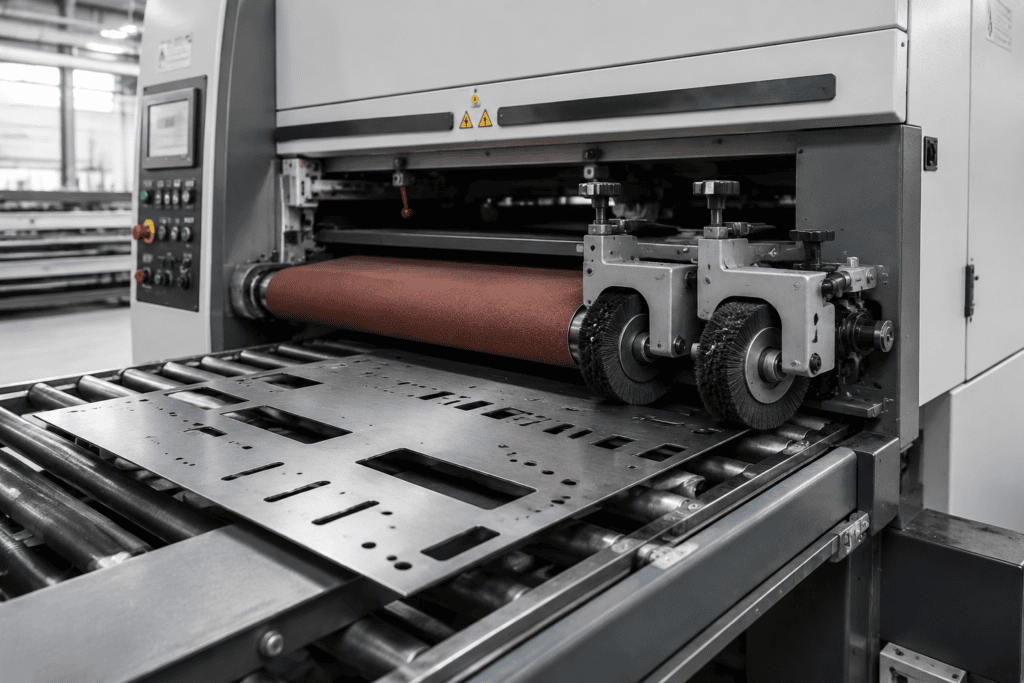
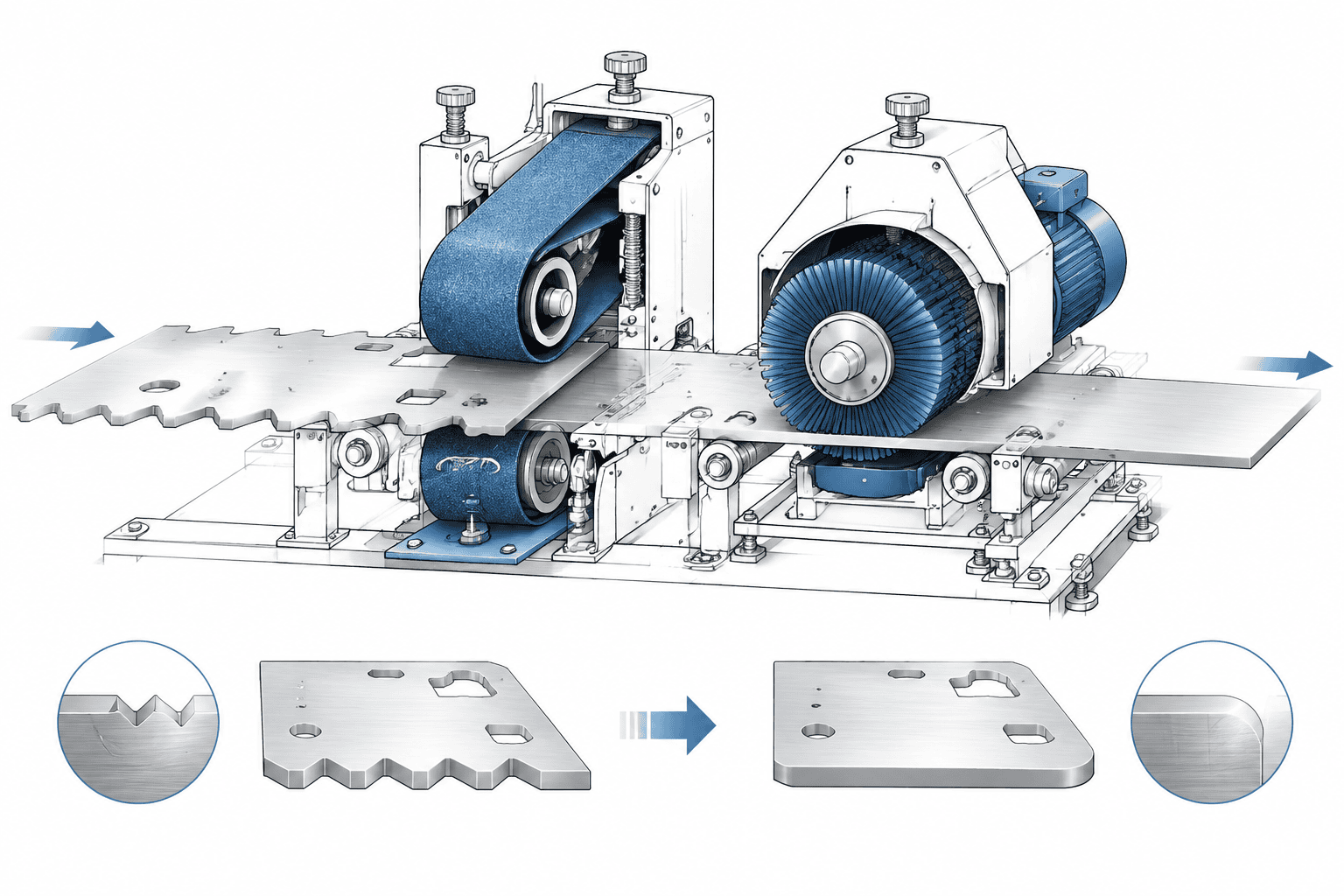
A sheet metal deburring machine is a through-feed system that removes burrs, slag, and oxide scale from the cut edges of flat sheet and plate parts in a single pass: the part rides a conveyor under a sequence of abrasive belts and rotating brushes that grind off the dross, break the sharp corner, and round the edge to a repeatable radius—typically R0.1–0.5 mm for assembly work and up to R2 mm for parts heading into powder coating. Wide-belt machines dominate laser-cut and punched sheet, rotary brush machines handle edge rounding and oxide removal, and combination machines mount both heads in one frame so a laser-cut blank exits deburred, rounded, and surface-finished with nobody touching it between stages.
One disclosure up front: UBright Solutions builds robotic deburring and polishing cells for three-dimensional parts, not wide-belt sheet metal lines. We are writing this anyway because fabricators regularly ask us whether they need a robot cell or a through-feed machine, and the honest answer depends on physics. This guide covers the four machine architectures on the market, the process chain, what to measure before requesting a quote, and where the technology stops.
Why Cut Sheet Metal Needs Deburring at All
Every cutting process leaves a defect signature, and knowing yours is the first selection step.
Laser cutting is the cleanest of the bunch but not clean. Carbon steel cut with oxygen leaves oxide scale and a nitride-affected layer 0.02–0.1 mm deep that causes weld porosity and powder adhesion failures. Nitrogen cutting of stainless and aluminum suppresses dross but leaves a razor burr on the bottom edge, 0.05–0.2 mm tall—sharp enough to draw blood through gloves.
Punching produces a burr on the die side that grows as the tool wears: 0.05 mm on fresh tooling, 0.3 mm or more on a die overdue for a regrind. Plasma and oxyfuel cutting are the worst offenders—plasma drops molten dross on the underside, from 0.5 mm skins that brush off to 3 mm-plus welds of re-solidified metal. ARKU’s EdgeBreaker line is specified to remove burr and slag beyond 3 mm thick, a number that tells you this machine class exists partly for plasma tables.
The downstream costs are concrete. Sharp edges cause lacerations, a recordable injury category in every fabrication shop. Burrs scratch mating surfaces, tear gaskets, and jam assemblies. And oxide edges make powder coating crack at the corner: surface tension thins the powder over a sharp edge to roughly half its film thickness, and it cracks there first—bare metal exactly where corrosion starts. Rounding to R0.5 mm or more lets the powder wrap the corner at full thickness, which is what made edge rounding, not just deburring, a standard requirement in architectural, appliance, and outdoor-equipment fabrication.
Manual deburring handles all of this at 5–15 minutes per part with an angle grinder and inconsistent results. A through-feed machine does the same part in 20–60 seconds, with a radius every inspection department can measure the same way twice.
The Machine Types: Wide-Belt, Rotary Brush, Combination, and Slag Grinders
The market sorts into four architectures, and the model numbers of Timesavers, ARKU, Lissmac, Loewer, and the long list of Chinese builders map onto them.
Wide-Belt Through-Feed Machines
A horizontal abrasive belt, 250–1,350 mm wide, runs above a conveyor at a fixed height; the part passes under it and the belt grinds the top face and whatever burr stands proud of it. This is the classic configuration—Timesavers’ 12 Series has been the metal industry’s dry wide-belt standard for over forty years—and it excels at slag removal, surface finishing, and leveling the cut face. What a plain belt head does not do is round an edge; it knocks the burr off and leaves a broken corner. Machines in this class run $60,000–$180,000, sized by belt width and horsepower.
Rotary Brush (Edge-Rounding) Machines
Instead of a flat belt, rotating cylindrical brushes—abrasive-impregnated nylon filament—sit across the conveyor path. The filaments wrap over the part edge as it passes, wearing the corner into a true radius. The heavy versions, like Timesavers’ 42 Series, carry brush drums with eight abrasive flap brushes each and will deburr, radius, and strip laser oxide in one pass. Rotary brush machines are the right choice when the deliverable is a specified radius rather than just “no burr,” and when parts are nested or intricate—the brush follows slots and irregular outlines that a belt only strikes at its highest point. Expect $70,000–$200,000.
Combination Belt-and-Brush Machines
Both heads in one frame: a coarse belt station up front for dross and heavy burr, brush drums behind for rounding, sometimes a fine belt in between for surface finish. The part goes in as-cut and comes out finished top-side in one pass. Timesavers’ 22 Series (sold as the EdgeMaster in edge-rounding trim, in two working widths with one to three heads) is the archetype; ARKU’s EdgeBreaker series takes the concept into automated cells. If your volume justifies one machine, this is usually the one: $120,000–$300,000 depending on width, head count, and automation.
Single- and Double-Sided Notes
Everything above treats one face. Double-sided machines process top and bottom edges simultaneously—Lissmac pioneered this geometry—while single-sided machines require a flip and a second pass. Double-sided machines cost roughly 60–100% more, but in two-shift production the labor saving pays that back fast.
Slag Grinders
A subset of wide-belt machines built brute for plasma and oxyfuel tables: thicker belts, higher horsepower, aggressive down-feed, frames meant to take hammer-blow contact with weld-quality dross. A light slag grinder is a one-shift machine; the heavy Hammerhead-class units run continuously alongside a plasma table. If dross over 2 mm is your daily reality, this is the entry category.
Wet vs Dry Operation
Dry machines grind and brush in open air with dust extraction. Wet machines flood the grind zone with coolant, filter it (paper-belt filtration is standard, as on Timesavers’ 11 Series, which also integrates a parts dryer), and keep fine particulate out of the shop air.
Choose dry when your parts are carbon or stainless steel, reasonably clean, and your extraction is adequate. Dry machines cost $10,000–$40,000 less than the equivalent wet configuration and skip the filter, coolant, and dryer maintenance stack.
Choose wet when you process aluminum or magnesium—the Combustible Dust standards (NFPA 652/654 in the US, ATEX in Europe) make dry grinding of aluminum a genuine fire engineering problem—or when parts arrive oily or the machine runs two to three shifts. The heavy multi-shift machines, like the three-shift PUMA-class units built for thin, oiled, and flammable material, are wet by design. One warning from integrations we have seen: fabricators underestimate wet-system housekeeping. Buy wet because the material demands it.
The Process Chain: From Slag Removal to Edge Rounding
A combination machine runs a fixed sequence, and understanding it tells you how to dial in a new part.
Stage 1—coarse grinding. A P40–P80 belt removes dross, oxide, and the standing burr. Feed speed drops to 1–3 m/min for heavy plasma dross, 3–6 m/min for laser-cut sheet. Pressure is set so the belt contacts the burr and the high points without digging into flat material—modern machines set this electronically, and the fact that ARKU ships software to walk operators through it tells you how often it gets botched manually.
Stage 2—fine grinding (optional). A P120–P240 belt refines the surface if the part needs a uniform finish or a specific Ra for coating or bonding. Many fabricators skip this head and let the brush carry the edge work alone.
Stage 3—edge rounding. Brush drums with 120–320 mesh abrasive filament round the edge. Dwell time and brush penetration set the radius: light contact over one pass yields R0.1–0.3 mm (assembly-grade, “no burr, no blood”), heavier penetration or a second pass yields R0.5–2 mm (powder-coating grade).
Feed speed is the master variable, in a workable band of roughly 1–10 m/min: dross-heavy thick plate at the bottom, clean nested laser blanks at the top. At 5 m/min, a stream of 300 mm parts clears 600 parts per hour through a single-sided pass—which is why flip labor becomes the bottleneck worth paying to eliminate.
Sizing the Machine: Five Factors That Decide Your Configuration
ARKU’s own selection FAQ lists five inputs—material type, part thickness, cutting process, production volume, and desired finish—and that framework holds up, so use it as the quote-request checklist.
1. Material. Carbon steel runs on anything. Stainless needs belts and brushes that will not contaminate it with free iron. Aluminum forces the combustible-dust decision above.
2. Thickness range. Machines are rated for a band—commonly 0.5–3 mm (thin sheet), 0.8–12 mm (general sheet), or 3–50 mm (plate). Your range must fit inside one band or you are buying two machines. Thin capability is harder than thick: holding a 0.5 mm shim flat under grind pressure is an engineering problem, not a spec-sheet line.
3. Cutting process. Laser and punched parts take a belt-plus-brush combination. Plasma and oxyfuel parts need slag-grinding capability first, rounding second.
4. Volume, in shifts. Duty cycle is the most honest cost lever: a one-shift machine costs far less than a 24/7-rated one of the same width. Timesavers’ line is explicit—the mid-range LYNX-class wet machine is rated for two shifts per day, the PUMA and Trident classes for three shifts and 24/7. Buy the duty cycle you actually run, plus one shift of headroom.
5. Target finish. “Deburred” (no measurable radius) is cheap. R0.3 mm needs brush heads. R0.5–2 mm for coating needs real brush dwell time and possibly a second pass. A specified Ra surface adds the fine-belt head. Write the number on the quote request—it changes the head count.
Two additions of our own. Working width: buy for your nesting width, not your largest single part—if your laser nests blanks 1,200 mm wide, a 1,100 mm machine forces you to re-nest around the deburring bottleneck. And consumables: belt and brush spend over five years rivals the machine price.
For parts that need finished flat surfaces rather than edge treatment, see our flat surface polishing machine guide first. Real price bands: entry compact machines run $15,000–$50,000; mid-range single-sided dry combination machines $80,000–$180,000; double-sided and automated cells $150,000–$300,000+; heavy plate slag systems past that. Leasing programs exist—ARKU advertises finance-to-fit options—and used machines from dealers like Surplus Record sell at 40–60% of new price, with the caveat that you inherit someone’s worn brushes.
Thin Sheet vs Heavy Plate: Different Physics, Different Machines
The thickness extremes break machines that are fine in the middle.
Thin sheet (0.5–2 mm) deforms. Downward grind pressure bows the sheet so the middle rides lower than the edges—the belt cuts a convex face instead of a flat one, and edges come out unevenly rounded. Machine responses include powered hold-down rollers ahead of each head, vacuum conveyor beds, and reduced brush penetration. If you run light-gauge parts, verify the minimum thickness rating with a test part, not the brochure number, and check the minimum part size—small nested blanks can tip between conveyor segments and jam a head, which is why builders quote a minimum part dimension, often 40–80 mm on one side.
Heavy plate (12–50 mm) needs force and rigidity, not finesse. Dross is thicker, edges are plasma or oxyfuel cut, and the target radius often rises to R1–3 mm for handling safety on plate lifted with chains. Machines in this class carry 15–40 hp belt heads, need a poured foundation, and trade the fine-brush end of the process for slag-grinding brutality.
The general sheet band between—2–12 mm, laser or punched—is where the mainstream combination machines live.
Where Through-Feed Machines Sit in the Deburring Equipment Landscape
Deburring equipment sorts by part geometry, and the full taxonomy—machines for cut sheet, machined parts, castings, and 3D welded assemblies—is covered in our deburring machine types guide. The short version: a through-feed machine processes a flat, two-dimensional part—outer contours, slots, and holes the brush can reach from the face. It cannot process:
- parts that have already been bent, welded, or assembled—once a bracket is formed, it no longer passes flat under the heads
- deep internal features, cavities, and the underside of pockets
- machined parts with burrs inside bores or threads
- anything requiring selective edge work at different radii on the same part
That second list is the territory of part-level robotic deburring, where a robot presents the part to a spindle tool with per-feature path control—the approach we build at UBright, covered in what is robotic deburring. The two technologies are complements: a through-feed line at the laser for flat blanks, a robot cell downstream for formed and welded assemblies. Deburr before bending and the through-feed removes most of the manual labor; what remains after forming is the robot’s job.
One more boundary: sheet metal parts whose requirement moves past edge quality into surface finish—mirror-finished appliance panels, polished architectural sheet—enter robotic polishing machine territory. We documented one such project, a robotic line for finishing formed stainless steel sinks, in our stainless steel sink polishing case study—relevant here because a sink starts life as laser-cut flat sheet and becomes untouchable by a through-feed machine the moment it is drawn. For shops mapping equipment classes onto their part mix, our full product overview covers the robotic end of that spectrum.
When You Don’t Need One: Small-Batch Alternatives
The case against buying runs through three options.
Manual deburring—angle grinder, file, hand tool—wins below roughly 50–100 parts per month of simple geometry. At five minutes per part that is 4–8 labor hours per month. It loses on consistency, injury exposure, and any spec that requires a measured radius.
Vibratory finishing wins for small, rigid, collision-tolerant parts in batch: load a tub with media and compound, and edges round across the whole batch unattended. It also handles laser-cut blanks too small or too thin to convey through a wide-belt machine. The tradeoffs—media lodging in narrow slots, part-on-part denting, cycles of 30 minutes to several hours—are covered in our vibratory finishing guide.
Outsourcing to a job shop with a through-feed line prices out at roughly $0.50–$2.00 per part for typical sheet sizes. Against that, a $150,000 combination machine starts to make sense once annual outsourcing spend passes roughly $35,000—about 18,000–24,000 parts per year at $1.50–$2.00 per part; the lower the per-part rate, the more volume you need.
Below those thresholds, buying a through-feed machine is capital chasing convenience. Above them, every month of delay is measurable margin.
Integrating the Machine into Your Line
Three integration questions determine whether the machine produces at its rated speed.
Loading and unloading. The baseline is an operator at each end. The upgrades, in order of cost: a return conveyor so one operator feeds and receives; a stacker at the exit; and full automation with destacking from the laser’s unload station—ARKU and the other big builders all offer robot-supported loading with part recognition. Our recurring observation from the robotics side: the machine itself is rarely the bottleneck—part presentation is. A machine rated at 600 parts per hour, fed by an operator who can stage 200, runs at 200.
Dust extraction. Dry machines move serious air: figure 2,000–6,000 m³/h depending on width and head count, through a filter unit with spark arrestment ahead of the media, because belt sparks into a dust collector is how finishing departments burn down. Spark detection on the ducting is non-negotiable if any aluminum ever crosses the conveyor.
Consumables logistics. Belts last 40–200 working hours; brush drums 300–1,000 hours, and two-shift shops change belts weekly. Stock depth and delivery time from your local dealer is a real selection criterion—Timesavers advertises a $6 million parts inventory with same-day shipping precisely because a dead machine waiting on a belt is the cost fabricators remember. Ask any builder you quote: what is the belt part number, who stocks it within one shipping day, and what does it cost?
FAQ
How much does a sheet metal deburring machine cost? Entry compact machines for small parts run $15,000–$50,000. Single-sided dry combination machines for general sheet run $80,000–$180,000. Double-sided and automated cells run $150,000–$350,000; heavy plate slag systems exceed that. Budget consumables at 5–10% of machine price per year at two-shift utilization, and dust extraction at $10,000–$40,000 if you lack suitable filtration.
Can one machine handle both laser cut and plasma cut parts? Yes, if it is a combination machine with a coarse belt head rated for your dross. Laser burr and light oxide are within every machine’s capability; plasma dross over 2–3 mm needs a slag-grinding class belt head. Tell the builder your worst-case plasma part, not your average one.
What edge rounding radius does powder coating require? R0.5 mm is the practical minimum for reliable powder edge coverage; R0.8–2 mm is the comfortable range specified in architectural and outdoor-product standards. Confirm the requirement with your coater, then verify the brush stage holds it with a test part before shipment.
Belt or brush: which wears faster, and what do consumables cost? Belts wear faster—plan 40–200 working hours per belt at $30–$120 each depending on size and grit. Brush drums last 300–1,000 hours at $300–$1,500 per drum, and they lose radius capability gradually as filament wears, so track the radius your parts actually measure and replace on drift.
Will edge rounding change my part dimensions? Yes, marginally, and it should be planned rather than discovered. Rounding to R0.3 removes roughly 0.05–0.1 mm of linear dimension per edge; slag removal on plasma parts can take 0.2–0.5 mm off the cut face. For parts with critical hole positions, hold tolerances loose enough to absorb it or grind to a documented stock allowance—and deburr immediately after cutting, so downstream features get located off the finished edge, not the as-cut one.

