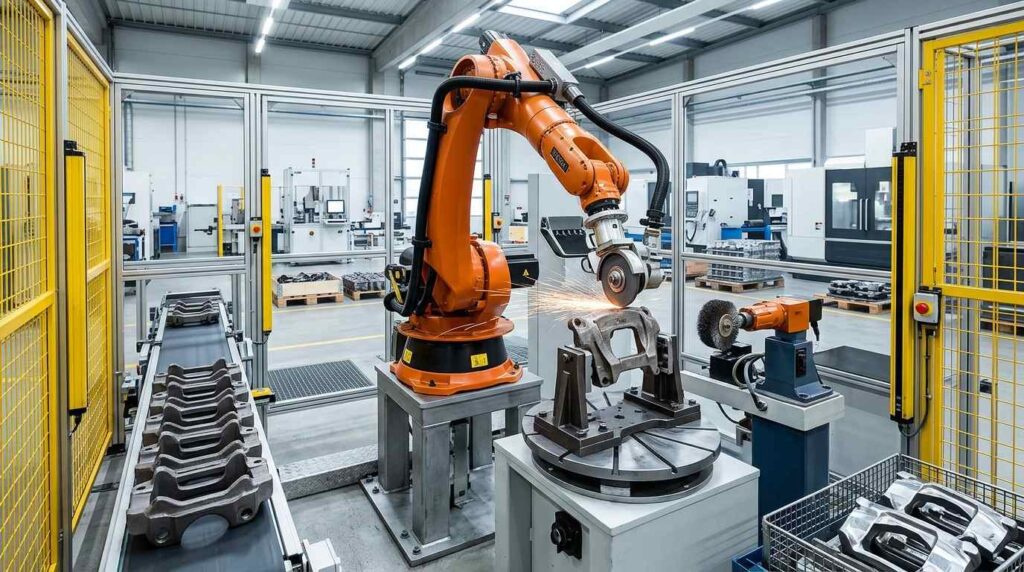
Cast iron cylinder blocks of this size class are large multi-cylinder engine castings used in commercial vehicles, industrial power systems and similar heavy-duty applications. The workpiece usually has multiple cylinder bores, inner cavities, mounting edges, water jacket openings and structural outer contours, making post-casting finishing more difficult than simple structural castings.
This robotic grinding solution is designed for large cast iron cylinder block workpieces, roughly in the 800 mm length class. It helps remove burrs, clean bore edges, process local contour defects and clear inner-cavity residue while improving finishing consistency and reducing manual grinding workload.
What Is a Cylinder Block?
A cylinder block is the main structural casting of an engine. It contains the cylinder bores, internal coolant and oil passages, mounting faces and supporting structure for other engine components. In multi-cylinder engines, the cylinder block forms the core body of the power unit and must combine structural strength, dimensional stability and internal passage integrity.

For cast iron cylinder blocks, the casting often includes multiple bore openings, deep inner cavities, external ribs, side walls, mounting edges and local flange areas. After casting and rough machining, burrs, flash, sharp edges and cavity residue may remain around bore edges, openings, contour transitions and internal channels. If these areas are not cleaned properly, they can affect later machining, assembly cleanliness and overall product consistency.
Unlike decorative parts, a cylinder block does not require mirror polishing. The main requirement is controlled grinding, deburring, bore-edge treatment and inner-cavity cleaning while protecting critical functional surfaces.
| البند | التفاصيل |
|---|---|
| اسم قطعة العمل | Cast Iron Cylinder Block |
| الحجم المعتاد | Large blocks, roughly 600–850 mm class, varies by engine design |
| المواد | الحديد الزهر |
| العملية الرئيسية | الطحن الآلي |
| العمليات المدعومة | Deburring, Bore Edge Treatment, Inner-Cavity Cleaning |
| مجالات المعالجة الرئيسية | Cylinder bore edges, inner cavities, opening boundaries, outer contours, parting lines |
| المناطق المحمية | Machining faces, sealing surfaces, precision mounting areas |
| الهدف النهائي | Remove burrs, clean cavity residue and improve finishing consistency |
Typical Finishing Challenges of Cast Iron Cylinder Blocks
Cast iron cylinder blocks are more difficult to finish than ordinary castings because they combine multiple bore openings, deep internal cavities, structural outer walls and function-related surfaces in one workpiece. Some areas require burr removal and cavity cleanup, while other areas must be protected from excessive grinding or accidental damage.
For this type of engine casting, the main difficulty comes from the combination of hole-edge treatment, inner-cavity accessibility and surface protection. Burrs and residue may remain around cylinder bores, side openings, passage edges and cavity transitions, while machining faces and sealing-related surfaces require tighter process control during grinding and cleaning.
| مشكلة شائعة | مجال محدد | التأثير |
|---|---|---|
| Bore Edge Burrs | Cylinder bore openings and hole boundaries | Affects machining preparation and assembly quality |
| Internal Residue | Inner cavities and passage openings | Reduces cleanliness and may affect downstream processes |
| فلاش الصب | Outer contours, parting lines and cavity entrances | يؤدي إلى عدم استقرار جودة التشطيب |
| حواف حادة | Mounting edges, opening boundaries and corners | ينطوي على مخاطر تتعلق بالمناولة والتجميع |
| Surface Irregularity | Outer walls and local transition areas | Reduces surface consistency |
| المجالات الوظيفية الحساسة | Machining faces and sealing-related surfaces | خطر حدوث تلف أثناء الطحن اليدوي |
Robotic Grinding Process for Cylinder Block Castings
A robotic grinding cell for cast iron cylinder blocks should be designed around bore accessibility, cavity cleaning, fixture stability and functional-surface protection. The process must remove burrs and casting residue from bore openings, inner cavities and local contour areas while avoiding damage to precision-related surfaces.

For large cylinder block castings in the 800 mm class, the process usually includes workpiece positioning, program selection, protected-area confirmation, contour grinding, bore-edge deburring, inner-cavity cleaning, inspection and unloading.
| الخطوة | العملية | الغرض | الأداة / النظام |
|---|---|---|---|
| 1 | التحميل والتثبيت | Secure the cylinder block for stable access | تركيبات مخصصة |
| 2 | اختيار البرنامج | Match the correct part model and path | واجهة المستخدم / برنامج الروبوت |
| 3 | تأكيد المنطقة المحمية | Define no-grind zones and protected faces | منطق الجدول / إعدادات البرنامج |
| 4 | طحن المحيط الخارجي | Remove flash and local surface defects | أداة طحن كاشطة |
| 5 | Bore Edge Deburring | Clean burrs around cylinder bore openings | أداة مرنة لإزالة الحواف الخشنة |
| 6 | Inner-Cavity Cleaning | Remove residue from inner channels and cavity entrances | Rotary tool / Air-assisted cleaning |
| 7 | فحص الجودة | Check burr removal and cavity cleanliness | الفحص اليدوي أو البصري |
| 8 | التفريغ والتنظيف | إزالة الغبار ونقل قطعة العمل | التنظيف بالهواء المضغوط / التنظيف بالمكنسة الكهربائية |
الخطوة 1: التحميل والتثبيت
The cylinder block is placed into a dedicated fixture that supports the main casting body and stabilizes the workpiece during grinding. Because the part is relatively large and includes multiple openings and cavity areas, accurate positioning is important for keeping robot access and tool paths consistent.
The fixture should hold the block securely without covering the bore openings, cavity entrances or main contour areas that need to be processed. Stable positioning also helps protect sensitive faces from accidental contact during automated finishing.
الخطوة 2: اختيار البرنامج
After the workpiece is fixed, the operator selects the correct robot program through the HMI. If multiple cylinder block models are processed in the same line, each model can use its own stored path and tool sequence.
This step improves repeatability and reduces the risk of incorrect processing. For batch production, saved programs allow the robot to perform the same bore-edge treatment, contour cleanup and cavity-cleaning logic on every workpiece.
الخطوة 3: تأكيد المنطقة المحمية
Before grinding begins, the system confirms which areas can be processed and which areas must remain untouched. For cylinder block castings, machining faces, sealing surfaces and precision mounting areas should be defined as protected zones.
These no-grind areas can be managed through program limits, fixture positioning or temporary shielding. This is important because the process must remove burrs and residue without affecting surfaces required for later machining, sealing or assembly.
الخطوة 4: طحن المحيط الخارجي
The robot first processes the external contour of the cylinder block, including accessible walls, edges, parting lines and local casting-defect areas. This step removes visible flash, residual protrusions and uneven contour sections left after casting.
For cast iron cylinder blocks, contour grinding should remain controlled and targeted. The goal is to clean the workpiece and improve consistency without removing unnecessary material from functional surfaces or structural sections.
Step 5: Bore Edge Deburring
After the outer contour is cleaned, the robot removes burrs from the cylinder bore openings and surrounding hole boundaries. These edges often contain casting burrs or residual roughness that must be cleaned before later processing.
A flexible deburring tool is suitable for this step because it can follow the bore-edge profile with more control. The purpose is to improve edge quality and reduce the risk of remaining burrs entering later machining or assembly stages.
Step 6: Inner-Cavity Cleaning
Inner cavities and passage entrances are important processing areas for cylinder block castings. Residual burrs, loose casting particles or local flash may remain inside the cavity entrances and internal access areas after casting or rough cleaning.
The robot can use a rotary cleaning tool, targeted abrasive tool or air-assisted cleaning method to remove accessible residue from these regions. This step is especially important because cylinder blocks contain multiple internal passages, and cavity cleanliness directly affects downstream manufacturing quality.
الخطوة 7: فحص الجودة
After grinding and cleaning, the cylinder block is inspected for burr removal quality, bore-edge condition, cavity cleanliness and protected-surface condition. Key checkpoints include cylinder bore openings, cavity entrances, contour transitions, mounting edges and sensitive faces.
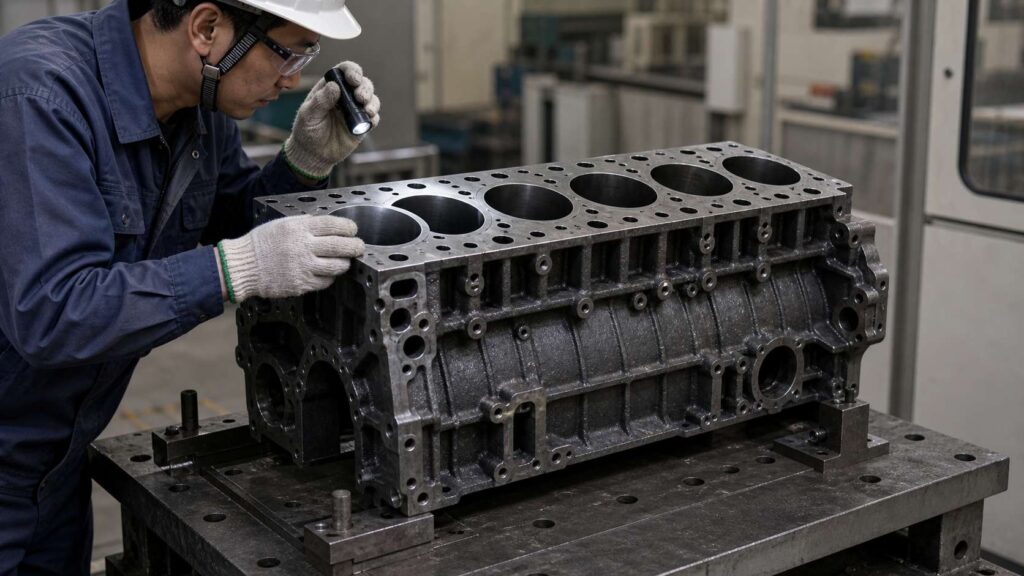
Inspection can be carried out manually or with visual assistance depending on the production requirement. The main goal is to confirm that the workpiece is properly cleaned and deburred without damaging important functional areas.
الخطوة 8: التفريغ والتنظيف
The finished cylinder block is removed from the fixture and cleaned by air blowing, vacuum suction or brushing. Cast iron dust and loose particles can remain around openings, corners and internal access areas, so final cleaning is important before the next process.
For higher-volume production, unloading and cleaning can be integrated with conveyors, rotary stations or automatic handling systems. This helps reduce non-processing time and improves the overall efficiency of the robotic finishing cell.
صعوبات التصنيع وحلولها
| التحدي | السبب | الحلول الروبوتية |
|---|---|---|
| Bore Edge Burrs | Multiple cylinder openings create repeated burr areas | Programmed bore-edge deburring path |
| Inner-Cavity Residue | Deep cavities and passage entrances are difficult to clean manually | Rotary cleaning tool and targeted access strategy |
| حماية الأسطح الوظيفية | Machining faces and sealing areas must not be damaged | المناطق المحمية المستثناة من مسارات الطحن |
| Casting Variation | Local flash and residue vary from batch to batch | Flexible tooling and controlled contact strategy |
| Large Workpiece Handling | Cylinder block size increases manual processing difficulty | Stable fixture and repeatable robotic operation |
Difficulty 1: Burrs Around Cylinder Bore Openings
Cylinder blocks contain multiple bore openings, and each opening may have burrs or rough edges after casting and rough machining. Manual deburring of repeated bore edges is time-consuming and inconsistent.
The solution is to program dedicated bore-edge deburring paths. This allows the robot to process each opening in a repeatable sequence and maintain more stable finishing quality across the full block.
Difficulty 2: Inner-Cavity Cleaning Is Hard to Standardize
The internal structure of a cylinder block includes cavity entrances, passage openings and recessed areas. These regions can trap casting residue, fine burrs and loose particles that are difficult to remove consistently by hand.
The solution is to combine robotic access paths with suitable cleaning tools and air-assisted removal methods. This improves cleaning consistency and reduces dependence on manual inspection and rework.
Difficulty 3: Functional Surfaces Must Be Protected
Cylinder blocks include important machining faces, sealing-related surfaces and mounting interfaces. If these areas are touched incorrectly during grinding, downstream machining and assembly may be affected.
The solution is to define clear no-grind zones and keep the robot path limited to approved finishing regions. Fixture support and protected-area logic help reduce the risk of accidental contact.
Difficulty 4: Workpiece Size and Weight Increase Manual Labor
A cylinder block of this size is not easy to handle manually, especially when multiple openings and cavity areas must be cleaned. Repetitive grinding and cleaning create operator fatigue and unstable results.
The solution is to use a dedicated robotic cell with stable fixturing and repeatable process logic. This improves consistency while reducing heavy manual finishing work.
Application Scenario
Production Context
An engine component manufacturer produces cast iron cylinder blocks for multi-cylinder engine applications. At this type of engine component plant, finishing previously relied on manual grinding and cleaning to remove burrs, process bore edges and clean inner cavities after casting.
As demand grows, this manual approach stops scaling. The priorities become consistent deburring, lower manual workload and cleaner internal processing before downstream machining and assembly.
التحديات التقنية
The cylinder block included multiple bore openings, inner cavities, side openings and local contour defects. Manual finishing required repeated bore-edge deburring, cavity cleanup and outer flash removal, which created unstable quality and high labor intensity.
The process also needed tighter control over sensitive faces and mounting areas. Any accidental damage in these regions could affect later machining accuracy and assembly quality.
الحل
UBRIGHT SOLUTIONS configures a robotic grinding cell of this type with a six-axis industrial robot, dedicated cylinder block fixture, abrasive grinding tool, flexible deburring tool and cavity-cleaning system. The process was divided into outer contour cleanup, bore-edge deburring, inner-cavity cleaning and protected-area finishing logic.
| البند | التكوين |
|---|---|
| قطعة العمل | Cast Iron Cylinder Block |
| الحجم المعتاد | Approx. 800 mm class casting |
| العملية الرئيسية | الطحن الآلي |
| العملية المدعومة | Deburring, Bore Edge Treatment, Inner-Cavity Cleaning |
| الروبوت | روبوت صناعي سداسي المحاور |
| الأدوات | Abrasive Grinding Tool, Flexible Deburring Tool, Cleaning Tool |
| جدول المباريات | Dedicated Cylinder Block Support Fixture |
| استراتيجية الحماية | Protected machining faces and sealing-related surfaces |
| التحكم في الغبار | خلية مغلقة مزودة بنظام لجمع الغبار |
Outcome Overview
A cell of this type improves consistency in bore-edge deburring, contour cleanup and inner-cavity residue removal, while taking over repetitive manual grinding work and improving workpiece cleanliness before downstream processing.
| مجال النتائج | التحسينات |
|---|---|
| Bore Edge Quality | More stable deburring around repeated bore openings |
| Cavity Cleanliness | Better residue removal in accessible inner regions |
| حماية الأسطح | Lower risk of accidental damage to functional faces |
| تقليل العمالة | Reduced heavy manual grinding and cavity cleaning work |
| استقرار الإنتاج | Saved programs for repeated cylinder block models |
| بيئة ورشة العمل | Cleaner finishing area with dust collection |
الأسئلة الشائعة
Q1: Is this workpiece suitable for motorcycle engine blocks?
By structure and size, the workpieces targeted here are large multi-cylinder engine blocks for commercial vehicle, industrial or similar heavy-duty engine applications, not typical motorcycle cylinder blocks.
Q2: Why is robotic grinding suitable for cylinder blocks?
Because cylinder blocks have repeated bore openings, internal cavities and multiple edge areas that are difficult to process consistently by hand. Robotic grinding improves repeatability and reduces manual finishing workload.
Q3: What areas can the robot process on a cylinder block?
The robot can process outer contours, bore edges, local opening boundaries, accessible cavity entrances and parting-line areas while avoiding protected machining and sealing-related surfaces.
Q4: Is polishing required for cast iron cylinder blocks?
In most cases, no mirror polishing is required. The main requirement is grinding, deburring, bore-edge treatment and inner-cavity cleaning before later machining or assembly. Where a defined surface finish is specified, the robotic polishing machine guide explains the equipment options.
Q5: How does the system handle inner-cavity cleaning?
The system can use targeted cleaning tools, rotary tools or air-assisted cleaning methods to remove loose residue and burrs from accessible internal regions and cavity entrances.
Q6: Can one cell handle similar cylinder block models?
Yes. If the product family is similar, separate programs and suitable fixtures can allow one robotic cell to process multiple related cylinder block castings.
الخاتمة
Cast iron cylinder blocks have multiple bore openings, inner cavities and functional surfaces, making manual grinding and cleaning difficult to standardize. A robotic grinding solution helps manufacturers remove burrs, clean cavity residue and improve finishing consistency while protecting critical workpiece areas. For the rotating assembly that runs inside the block, see also our crankshaft robotic grinding solution.
If your cylinder block production still relies on manual bore-edge deburring, cavity cleaning or contour grinding, اتصل بنا for a customized robotic solution. Additional engine-part finishing references sit under السيارات والمركبات الكهربائية, with machine details in the المعدات catalog.