In the premium plumbing and hardware market, floor drains are no longer merely functional drainage accessories; they are core aesthetic elements of modern shower design. High-value drain panels require extremely refined brushed finishes or flawless mirror effects, and crucially, their edges must be absolutely safe and smooth to the touch.
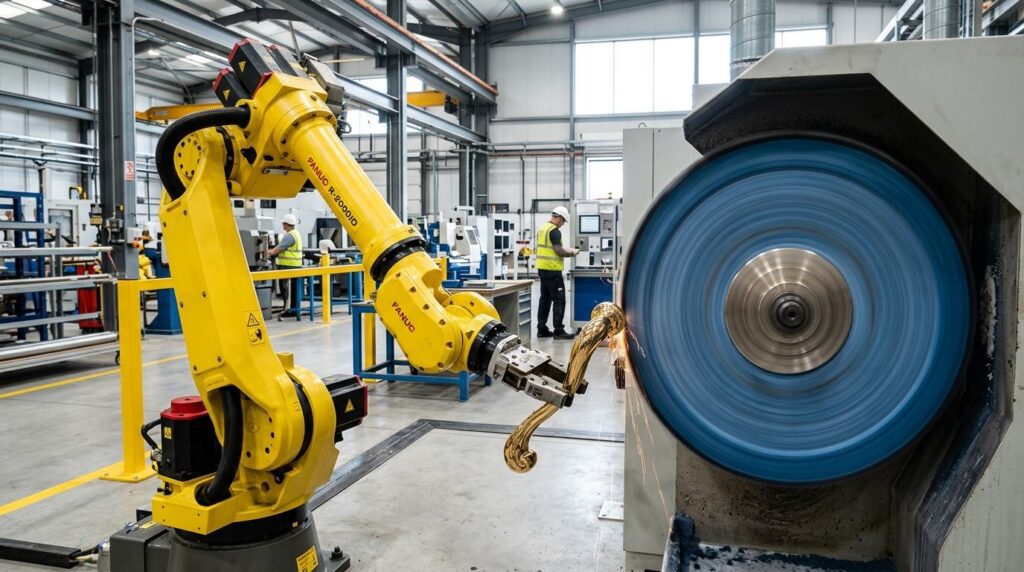
To maintain stringent cosmetic standards in high-volume production, utilizing heavy-duty industrial robots holding panels against floor-mounted wide-belt finishing machines—a process known as robotic polishing—has become the standard configuration for top-tier plumbing OEMs to eliminate “foot-cutting hazards” and unify surface textures.
What are High-End Floor Drain Panels?
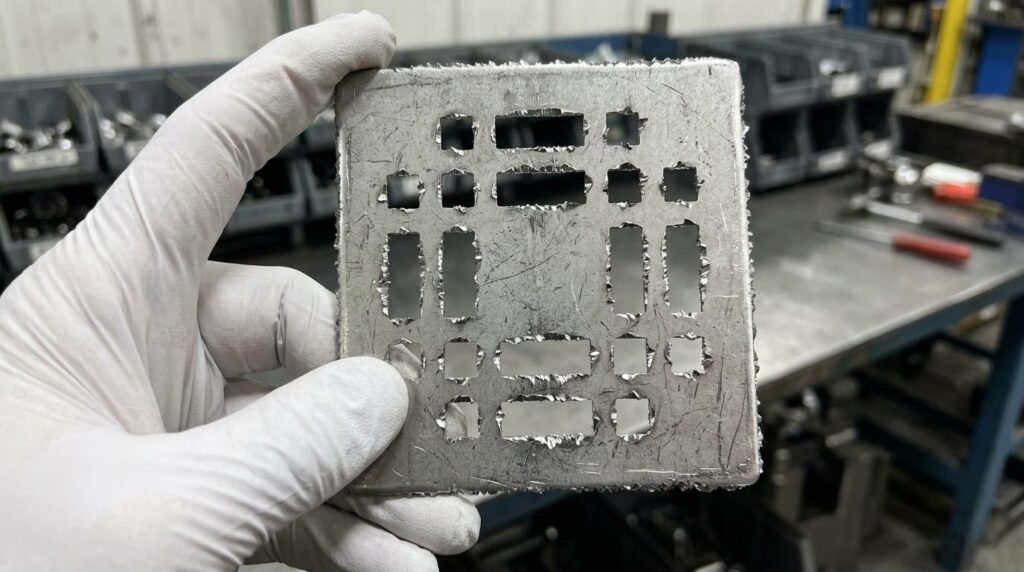
Premium invisible floor drains, linear drains, or intricately carved grid drains are typically manufactured from 304 stainless steel via stamping, or from high-quality brass via precision casting and CNC machining. Fresh off the line, the raw parts exhibit rough surfaces and stamping scratches. Most critically, the outer edges and grid cutouts retain extremely sharp microscopic burrs.
The Fatal Flaws of Manual Finishing
When finishing floor drain surfaces, traditional manual labor faces insurmountable physical bottlenecks:
- The “Foot-Cutting” Hazard (Sharp Edges): Plumbing products come into direct contact with human skin. Manual deburring frequently misses blind spots or creates uneven chamfers. If sharp edges are not thoroughly radiused, they can easily slice consumers’ feet during a shower, triggering severe customer complaints and brand crises.
- Crooked Brushing Grain: High-end drains demand absolutely parallel, straight brushed textures. When a worker manually presses the panel against a sanding belt, minute yaw deviations or hand tremors cause the brushed lines to become skewed or crisscrossed, severely destroying the industrial design aesthetic.
- Grid Distortion: For faceplates carved with complex geometric grids, uneven manual pressure can easily cause the delicate grid skeleton to deform or collapse.
Technical Parameters for Floor Drain Automation
| Objet | Plage de paramètres | Notes |
| Flat Area Brushing | Wide Nylon Flap Wheel / Fine Belt | Holds straight feed; grain runs parallel within spec |
| Safe Edge Deburring | Flexible Contact Wheel / Abrasives | 360° flash removal for a safe radiused edge |
| Cutout Micro-Deburring | Dedicated SiC Brush Disc | Penetrates grid cutouts to sweep away residual stamping flash |
| Robotic Gripping Method | Matrix Vacuum / Strong Magnetic Jigs | Keeps flat panels from distorting under cutting force |
| Constant Force Precision | ±1N (Adaptive) | Protects ultra-thin faceplates against burn-through or heat discoloration |
Why Must Floor Drains Use the “Robot-Holding-Workpiece” Architecture?
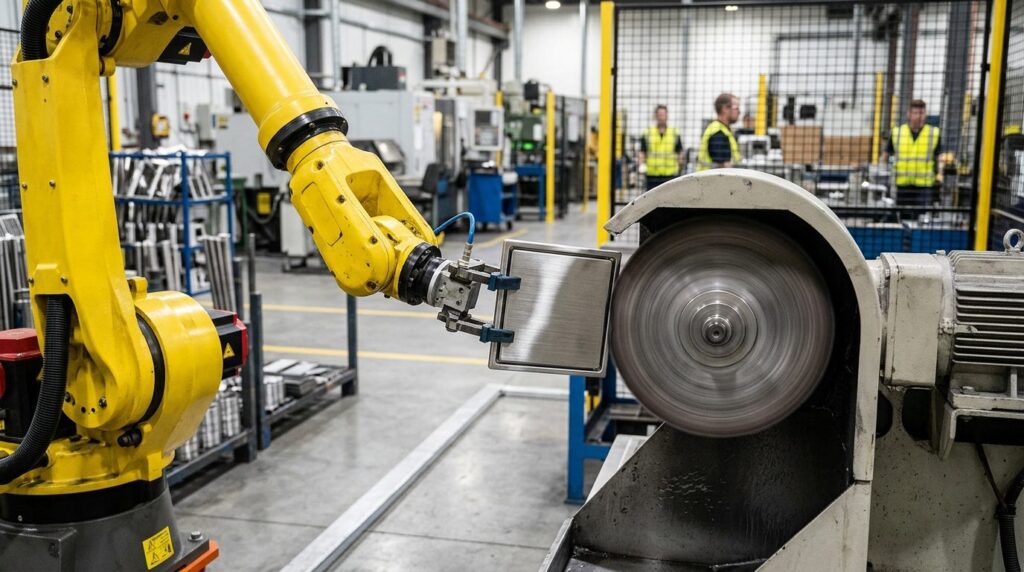
For broad, thin faceplates, the productive layout keeps the heavy machinery still and gives the robot the part: a 6-axis robot carries the drain panel on a vacuum or magnetic gripper and presents it to floor-mounted wide brushing machines and deburring centers. Straightness then comes from the machine, not the operator.
For drain production specifically, this layout pays off in three places:
- Linear Trajectory Lock: The arm behaves like a rigid rail, holding its line without yaw as it feeds the panel across the wide brushing wheel at constant speed. Brushed grain therefore runs straight on every drain off the line, not just the ones a fresh worker handled.
- Uniform Edge Radiusing: For deburring, the robot tilts the panel to a fixed 45° and sweeps it evenly along the floor-mounted chamfering belt. Because the pose is programmed, straight edges and rounded corners receive the same radiused treatment—removing the foot-cutting hazard at its source.
- Gentle Constant-Pressure Contact: A spindle force sensor governs brushing pressure, holding it light and steady across the whole pass so gloss stays uniform from the panel center to its edges.
Automated Grinding and Deburring Process Workflow
| Étape | Operation | Equipment & Consumables | Résultat |
| 01 | Vision Location & Soft Grip | Robot + Vacuum Suction Matrix | Non-destructive grip on thin plates, establishing the work coordinate frame |
| 02 | Profile Edge Radiusing | Floor-Mounted Floating Contact Belt | Traces the perimeter precisely, removing stamping burrs to form a safe R-corner |
| 03 | Deep Grid Cutout Cleaning | Floor-Mounted Planetary Brush Center | SiC bristles penetrate grids to sweep away microscopic flash |
| 04 | Flat Faceplate Brushing | Wide Nylon Brushing Machine | Straight linear feed covers stamping scratches, forming premium metal grain |
| 05 | Auto Unload & Inspection | Transfer to packaging/cleaning | Avoids secondary scratches during handover |
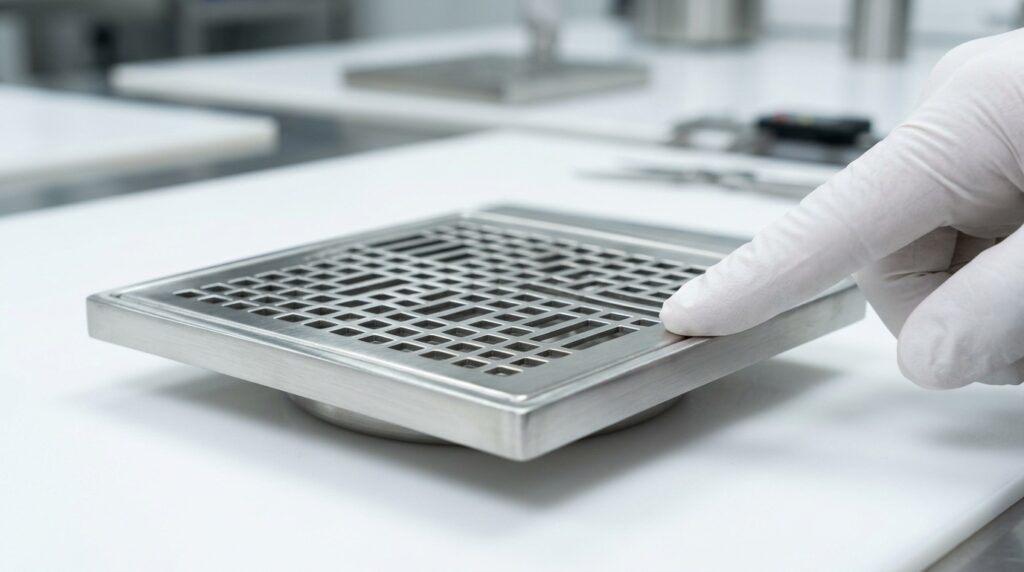
Fixturing Thin Drain Panels Without Distortion
Drain faceplates are stamped from sheet typically under two millimeters thick, which makes them obedient to every force applied—clamping, brushing, even their own weight if held at an edge. Fixturing is therefore a stiffness problem: the panel needs full-area support while both faces and all edges stay accessible to the tooling.
- Matrix vacuum holding: an array of suction cups on a backing plate supports the face across its width, so brushing pressure meets a backed panel rather than a suspended one. This is the default for stainless faceplates.
- Conformal magnetic jigs: where part geometry or coating rules out vacuum, magnetic form jigs back the plate and let the robot re-grip for second-face work.
- Datum discipline: brushing must run parallel to the visible long edge of the drain, so that edge—not the stamping blank outline—is the datum the program references.
Edge work introduces one more constraint: an unsupported rim will chatter under a deburring belt and leave a wavy edge. Cells solve this with edge-support inserts in the fixture or by scheduling edge passes while the panel is still fully backed.
Brushing and Deburring Media Selection
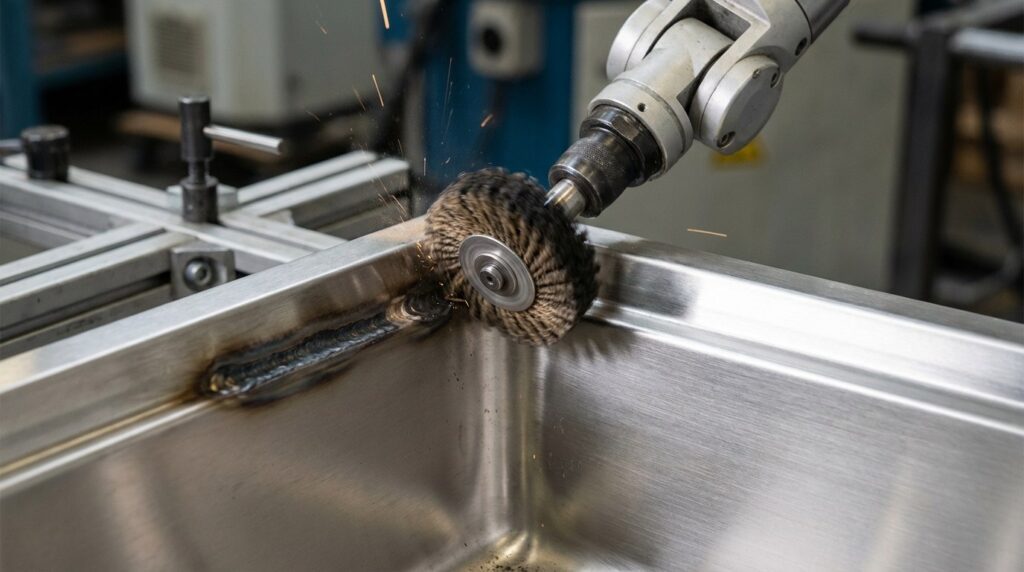
Media choice is visible in the final product—grit and material decide how the brushed texture reads. Non-woven nylon wheels and fine belts in the mid-grit range produce the even, directional grain expected on premium drains; coarser media leaves a brighter but rougher line, finer media a softer, satin line. The choice is a design decision agreed with the customer, then frozen into the program. For process vocabulary, our overview of what is robotic deburring covers the edge-treatment side of the cell.
- Grain direction: single-pass, single-direction feed gives the cleanest line; back-and-forth passes cross the grain and read as sloppy under hotel lighting.
- Edge media: flexible contact wheels or abrasive belts take the perimeter down to a uniform radius; fixed-angle passes are what keep the radius consistent part to part.
- Cutout media: planetary brushes with SiC bristles reach into grid slots where wheels cannot, sweeping stamping flash out of the corners.
Equipment formats for these two jobs—wide-face finishing and edge deburring—differ enough that they are usually separate machines in the cell row; the trade-offs are laid out in our deburring machine types guide.
Inline Edge-Safety and Grain Quality Checks
Because a drain is a barefoot-adjacent product, edge safety is checked as a release gate, not an afterthought. Operators run a tactile pass—gloved finger around the full perimeter—backed by magnified visual sampling at cutout mouths, the two spots where missed burrs hide. Any part flagged at the station is re-run through the edge program rather than reworked by hand at a bench.
Grain quality is checked under directional light: straightness, uniformity and freedom from cross-hatching are assessed in seconds against a boundary sample. Gloss or roughness instrumentation samples the batch statistically. Results feed the same quality record the robot cycle data goes into, which is what plumbing OEM audits ask to see. For the thicker-walled stainless counterpart in kitchenware, see our stainless steel sink polishing solution.
Application Scenario: Linear and Invisible Drain Panels
Consider an East China plumbing OEM running linear and invisible drain programs for hotel and residential brands—representative of the tier where brushing quality decides whether the program stays in-house.
- Before: On linear invisible drains, manual brushing scrap ran high—crooked grain above all—and sharp-edge complaints arrived with painful regularity.
- After: With the robot holding the workpiece against the floor-mounted brushing center, brushing grain runs straight along the full 600 mm length of the linear drains, and edge radiusing executes uniformly under OLP control. Edge-related complaints stop, first-pass cosmetic yield settles at consistently high levels, and manual rework shrinks to a trickle.
FAQ
Q1: Floor drain panels are often very thin (only 1.5mm – 2mm). Will the robot warp the panel when pressing it during grinding?
A: No. The cell uses large-area matrix vacuum suction or conformal magnetic jigs, which avoid hard clamping at the edges and back up the thin plate across its full area. With active force control keeping cutting force light and even, stress deformation of the faceplate is effectively designed out.
Q2: The grid patterns customized by different clients vary immensely. Does the deburring program need to be rewritten constantly?
A: No constant rewriting is needed. Deburring trajectories are produced by 3D Offline Programming (OLP): the engineer imports the CAD model of the new pattern, and the software finds every hole and contour edge and generates the trajectory from it. Changeovers stay agile enough for the high-mix, low-volume reality of premium customization.
Conclusion
In premium floor drain production, straight brushed texture and safe edge feel are what the brand is judged on. An automated architecture—a heavy-duty 6-axis robot holding the workpiece against floor-mounted wide belts and brushing centers—removes the crooked grain and missed edges that manual labor cannot help producing, and holds yield at the level serialized plumbing production requires.
Edge-safety complaints and inconsistent brushing grain trace back to the same root cause: the human hand. A robotic brushing and deburring cell takes that hand out of the process—contact us for a plumbing hardware automation assessment.