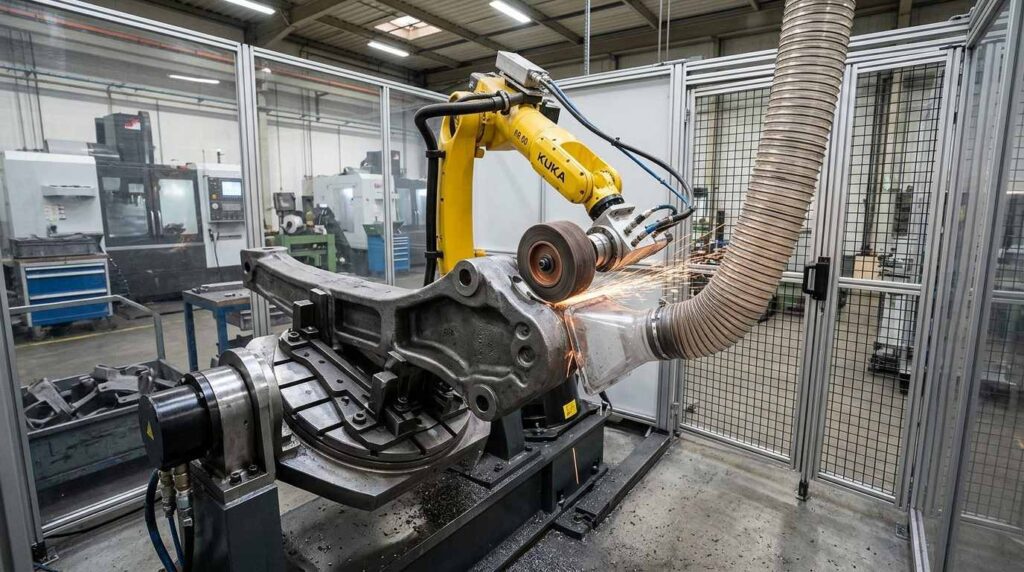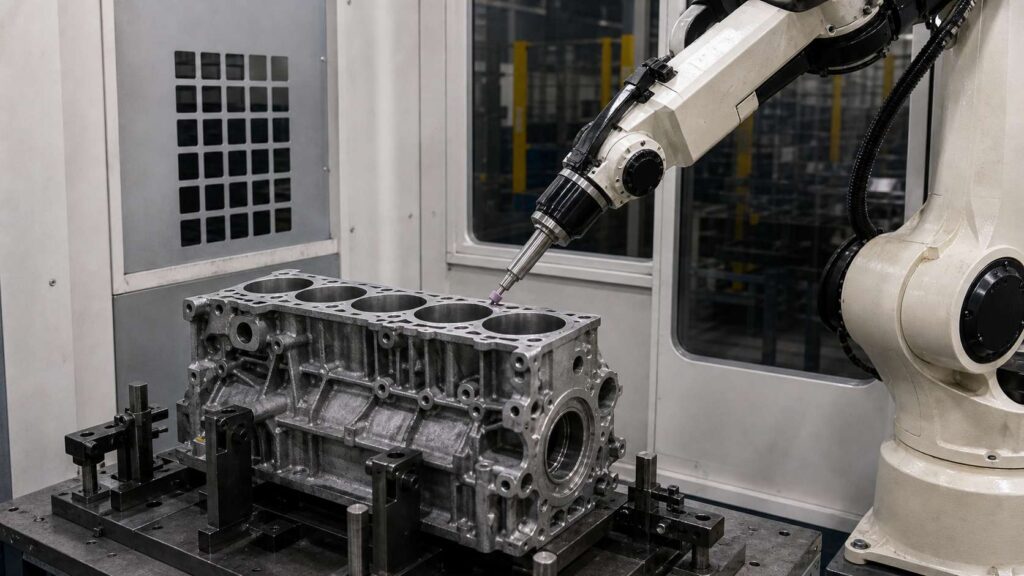
Aluminum alloy engine cylinder blocks are major structural castings used in automotive engine and powertrain systems. In its common configuration, the part carries cylinder bore openings, crankcase cavities, water jacket openings, oil passage holes, mounting holes, reinforced ribs, side walls and irregular outer contours, making post-casting deburring and local grinding more complex than on simple aluminum castings.
This robotic deburring and grinding solution is designed for aluminum alloy engine cylinder blocks with typical dimensions around 400–700 mm in length, depending on the engine model. It helps remove burrs, flash, parting line residues, sharp edges and local gate marks from outer contours, bore edges, water jacket openings, oil passage edges, crankcase openings, mounting holes and rib transitions while improving finishing consistency and reducing manual grinding workload.
What Is an Aluminum Alloy Engine Cylinder Block?
An aluminum alloy engine cylinder block is the main structural body of an engine. It supports cylinder bores, crankshaft-related areas, coolant passages, lubrication passages, mounting interfaces and surrounding powertrain components, including the oil pan bolted below it, whose finishing is covered in our oil pan assembly robotic deburring solution. Compared with an engine cylinder head, which is located above the block and includes combustion chamber and port features, the cylinder block carries the main engine structure and lower crankcase-related loads. Readers comparing manual and robotic methods will find the process fundamentals in what robotic deburring involves.
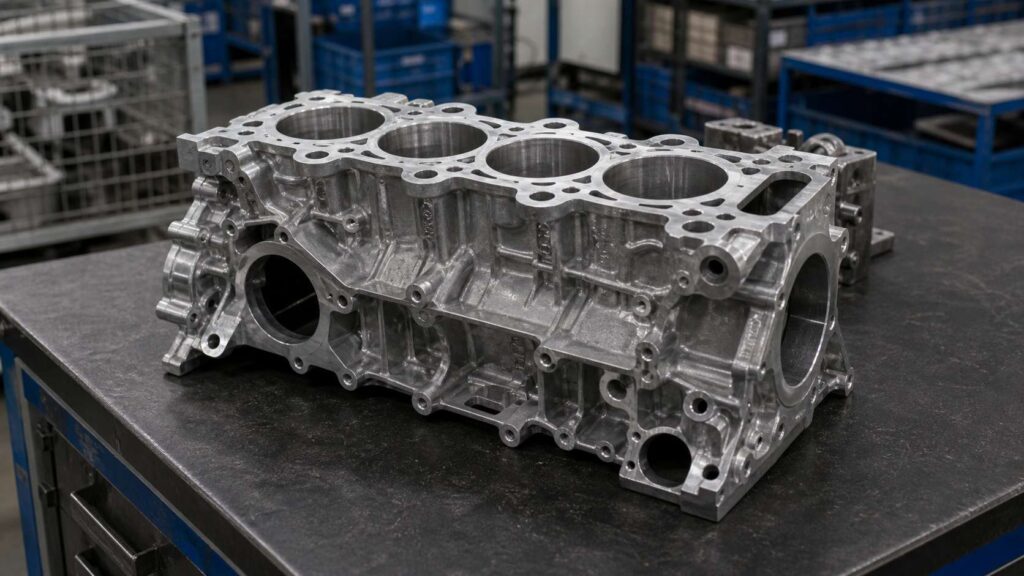
Whatever the cylinder count, the workpiece brings multiple bore openings, crankcase cavity areas, side-wall structures, water jacket openings, oil passages, bolt holes, reinforced ribs and machined mounting surfaces. After casting, trimming and rough machining, burrs, flash, parting lines, gate residues or sharp edges may remain around bore boundaries, water jacket openings, oil passage edges, outer contours, mounting holes and cavity transitions. Deburring, controlled local grinding and edge cleanup are what this casting actually needs from a finishing cell; a polished appearance is never the goal.
| Objet | Détails |
|---|---|
| Nom de la pièce | Aluminum Alloy Engine Cylinder Block |
| Taille standard | Around 400–700 × 250–450 × 250–500 mm, depending on engine model |
| Matériau | Moulage d'alliages d'aluminium |
| Processus principal | Ébavurage et meulage robotisés |
| Processus assistés | Bore Edge Deburring, Flash Removal, Local Surface Cleanup, Edge Rounding |
| Principaux domaines d'activité | Outer contours, cylinder bore edges, crankcase openings, water jacket openings, oil passage edges, mounting holes, ribs, side-wall transitions, gate-cut areas |
| Zones protégées | Cylinder bore surfaces, main bearing areas, sealing faces, machined mounting surfaces, precision holes, locating interfaces |
| But décisif | Remove burrs, flash, sharp edges and local residues while protecting precision engine functional surfaces |
Typical Finishing Challenges of Aluminum Alloy Engine Cylinder Block
An aluminum alloy engine cylinder block is difficult to finish because it has many functional openings and structural transitions distributed across a large three-dimensional casting. Burrs may appear around cylinder bores, water jacket openings, oil passages, crankcase windows, bolt holes, outer edges and reinforced rib intersections. These areas require different tool angles and different levels of material removal.
Manual deburring and grinding can be unstable because operators must frequently change posture around large cavities, side walls and bore-related features. Some burrs inside crankcase openings or water jacket edges may be missed, while exposed edges may be over-ground. Since the cylinder block includes precision surfaces and machined interfaces, uncontrolled manual grinding may damage bore-related areas, sealing faces or locating surfaces.
| Problème courant | Domaine spécifique | Impact |
|---|---|---|
| Flash de moulage / Lignes de joint | Outer contour, side walls, crankcase opening edges | Affects edge consistency and surface cleanup quality |
| Résidus de porte | Gate-cut areas on the casting body or side-wall sections | Nécessite un broyage local contrôlé |
| Arêtes vives | Cylinder bore openings, crankcase openings, mounting holes | Engendre des risques liés à la manutention et à l'assemblage |
| Bavures résiduelles | Water jacket openings, oil passage edges, rib transitions | Cela entraîne une qualité de finition irrégulière et des problèmes de contrôle qualité |
| Variation manuelle | Repeated holes, cavity edges and outer contours | Cela entraîne des résultats incohérents d'un opérateur à l'autre |
| Domaines fonctionnels sensibles | Cylinder bores, main bearing areas, sealing faces, precision holes | Risque de dommages lors de l'ébavurage ou du meulage manuel |
Robotic Deburring and Grinding Process for Aluminum Alloy Engine Cylinder Block
A robotic deburring and grinding cell for aluminum alloy engine cylinder blocks should be designed around part stability, multi-side accessibility, controlled material removal and protected-surface management. The process must remove burrs, flash and local residues from the block body, cavity edges, openings and holes while avoiding contact with cylinder bore surfaces, main bearing areas, sealing faces and machined reference surfaces.
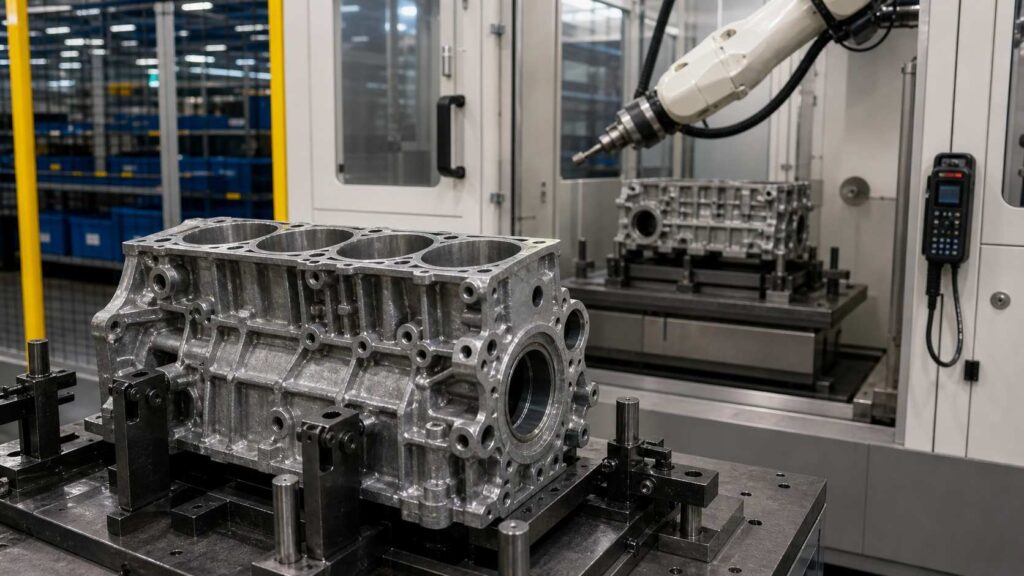
For aluminum alloy engine cylinder blocks with typical dimensions around 400–700 mm in length, the process usually includes loading, program selection, protected-area confirmation, outer contour grinding, bore and opening edge deburring, water and oil passage cleanup, crankcase edge finishing, inspection and unloading. Two-part families with high volumes are often run on 5-axis dual-station deburring equipment so that loading never blocks the robot. Different tools can be used for different areas, including abrasive grinding tools, flexible deburring tools, chamfering tools and small finishing heads.
| Étape | Processus | Objectif | Outil / Système |
|---|---|---|---|
| 1 | Chargement et positionnement | Secure the cylinder block for stable multi-side access | Dispositif de fixation spécifique |
| 2 | Sélection des programmes | Match the correct block model and robot path | IHM / Programme de robot |
| 3 | Confirmation de l'aire protégée | Define bore, bearing, sealing and precision no-grind zones | Logique de programmation / Paramètres du programme |
| 4 | Rectification des contours extérieurs et des lignes de joint | Éliminer les bavures et les résidus sur les bords extérieurs de la pièce moulée | Outil de meulage abrasif |
| 5 | Cylinder Bore Edge Deburring | Remove burrs and sharp edges around bore boundaries | Outil d'ébavurage flexible |
| 6 | Water Jacket and Oil Passage Cleanup | Clean small passage openings and local edges | Small deburring tool / Deburring spindle |
| 7 | Crankcase Opening and Rib Transition Finishing | Process cavity edges, rib roots and internal transitions | Petite tête de meulage / Outil flexible |
| 8 | Mounting Hole and Boss Edge Treatment | Deburr bolt holes, bosses and local mounting features | Outil de chanfreinage / Broche d'ébavurage |
| 9 | Contrôle qualité | Vérifier l'élimination des bavures et les zones fonctionnelles protégées | Inspection manuelle ou visuelle |
| 10 | Déchargement et nettoyage | Remove chips and transfer the cylinder block | Soufflage d'air / Aspiration |
Étape 1 : Chargement et positionnement
The aluminum alloy engine cylinder block is loaded into a dedicated fixture that supports the casting from stable non-critical areas. Because the workpiece is larger and heavier than many cover or side-wall castings, fixture rigidity is important for stable robotic grinding and deburring.
The fixture should allow the robot to access the outer contour, bore edges, crankcase openings, water jacket openings, oil passage edges and mounting holes. Stable positioning also helps maintain safe clearance from protected cylinder bore surfaces, main bearing areas and machined interfaces.
Étape 2 : Choix du programme
After the cylinder block is fixed, the operator selects the correct robot program through the HMI. This is important because cylinder block models may vary in cylinder count, bore layout, mounting hole positions, side-wall shape and crankcase structure.
Each program carries its own processing order, tool list, robot postures, feed rate, contact force and protected zones. Reusing stored programs is what holds deburring and grinding quality steady across production batches.
Étape 3 : Confirmation de la zone protégée
Before processing begins, the system confirms the protected areas of the cylinder block. These usually include cylinder bore surfaces, main bearing support areas, sealing faces, machined mounting surfaces, locating holes, precision holes and reference planes.
This step is critical because many burr-prone edges are close to precision features. The robot should remove burrs from edge boundaries and casting transitions while keeping abrasive tools away from surfaces that affect engine assembly, sealing and dimensional accuracy.
Étape 4 : Meulage du contour extérieur et de la ligne de joint
External casting edges get the first pass. Flash, parting line residues, trimming marks and local defects tend to collect on side walls, outer flanges, corner transitions, mounting bosses and gate-cut sections, and the abrasive tool works through them segment by segment.
An abrasive grinding tool can remove raised defects with controlled feed speed and contact pressure. For aluminum alloy cylinder blocks, the process should avoid excessive pressure that may create deep tool marks or remove too much base material from the casting.
Step 5: Cylinder Bore Edge Deburring
Cylinder bore openings are key areas on an engine cylinder block. Burrs or sharp edges around bore boundaries may appear after casting, trimming or rough machining, but the bore surface itself must be protected.
A flexible deburring tool can clean the bore edge with controlled pressure and a programmed circular path. The robot should treat only the edge boundary and avoid contact with precision bore surfaces or machined functional areas.
Step 6: Water Jacket and Oil Passage Cleanup
Water jacket openings and oil passage edges often contain small burrs or residual casting particles. These openings may be located on different sides of the cylinder block and may require different tool orientations.
A small deburring tool or deburring spindle can process each passage opening with repeatable posture. This helps reduce missed burrs and improves consistency compared with manual cleaning of multiple small passage features.
Step 7: Crankcase Opening and Rib Transition Finishing
The crankcase cavity and lower block structure contain internal edges, window boundaries, ribs and reinforced transitions. Burrs may remain around cavity openings and rib roots where manual tools are difficult to control.
A small grinding head or compliant deburring tool can be used for these local areas. The robot can divide the crankcase and rib structure into several finishing zones and process each transition with stable posture, reducing residual burrs in hidden or recessed areas.
Step 8: Mounting Hole and Boss Edge Treatment
Cylinder blocks include many mounting holes, threaded holes, bosses and local connection features. Burrs around these areas may affect bolt insertion, assembly seating or downstream inspection.
A chamfering tool or deburring spindle can process each hole opening with repeatable depth and angle. The robot repeats the same routine across hole groups, improving hole-edge consistency and reducing manual variation.
Étape 9 : Contrôle qualité
After robotic deburring and grinding, operators inspect the outer contours, bore edges, water jacket openings, oil passage edges, crankcase openings, mounting holes, rib transitions and gate-cut areas. Inspectors verify two things: no burrs or sharp edges remain, and no protected surface took a hit.
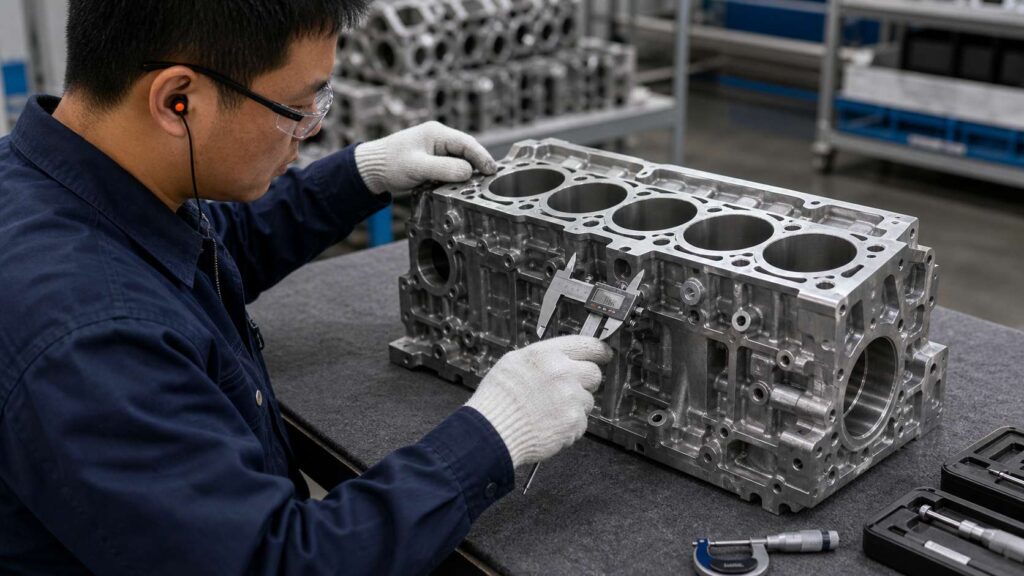
En fonction des exigences de production, l'inspection peut inclure des contrôles visuels, des contrôles manuels au toucher, l'utilisation de jauges d'échantillonnage ou une vérification par caméra. Les données issues de l'inspection peuvent également servir à la compensation de l'usure des outils, à l'optimisation locale des trajectoires et à la planification de la maintenance.
Étape 10 : Déchargement et nettoyage
After inspection, the cylinder block is unloaded and transferred to the next production process. Aluminum chips and fine particles should be removed from bore areas, water jackets, oil passages, crankcase cavities and mounting holes.
An enclosed robotic cell with aluminum chip and dust collection is recommended for cylinder block deburring and grinding. It helps improve cleanliness, reduce operator exposure and create a more controlled finishing environment than open manual grinding.
Difficultés d'usinage et solutions
| Défi | Cause | Solution robotique |
|---|---|---|
| Large Casting Handling | Cylinder blocks are larger and heavier than cover components | Dispositif de fixation dédié et positionnement robotisé stable |
| Bore Edge Burrs | Cylinder bore boundaries require edge cleanup but bore surfaces must be protected | Controlled circular deburring path with no-grind bore surface zones |
| Water / Oil Passage Burrs | Small repeated passage openings retain burrs and particles | Small tool access with local deburring routines |
| Crankcase Opening Burrs | Internal cavity edges and window boundaries are difficult to reach manually | Divided cavity finishing zones with compliant tools |
| Gate Residue Removal | Local gate-cut sections contain thicker residual stock | Dedicated local grinding path and stock-removal tool |
| Protection fonctionnelle des surfaces | Bores, bearing areas and sealing faces must not be damaged | Programmation des zones protégées et référence précise des palettes |
Difficulty 1: Large Cylinder Block Positioning and Access
An engine cylinder block is larger and more three-dimensional than a cover, side wall or small frame casting. The robot must reach outer contours, bore edges, side openings, lower crankcase areas and multiple holes without losing tool stability.
The solution is to use a dedicated cylinder block fixture with stable support and repeatable positioning. This allows the robot to approach different processing areas with predictable posture while reducing vibration during grinding and deburring.
Difficulty 2: Cylinder Bore Edge Deburring Without Bore Damage
Cylinder bore openings may have burrs or sharp edges around the boundary, but the bore surface itself is a precision functional area. Manual deburring can be risky if the tool slips or cuts into the bore surface.
The solution is to use a controlled circular deburring path with defined no-grind zones. The robot removes burrs from the bore edge while keeping the tool away from the precision bore wall and related machined surfaces.
Difficulty 3: Water Jacket and Oil Passage Burr Removal
Water jacket openings and oil passage edges are often small, repeated and distributed across different surfaces. These areas may retain burrs or casting particles that are difficult to remove consistently by hand.
The solution is to use a small deburring tool or spindle with local routines for each opening. The robot processes each passage edge with repeatable angle and depth, reducing missed burrs and improving inspection consistency.
Difficulty 4: Crankcase Cavity and Rib Transition Cleanup
The crankcase cavity contains window edges, internal transitions, ribs and lower structural areas. Burrs in these recessed zones are difficult for operators to access and may require frequent tool angle changes.
The solution is to divide the crankcase cavity into local finishing zones. A small grinding head or compliant tool can clean rib roots, cavity edges and inner transitions with stable posture and controlled contact force.
Difficulty 5: Protecting Main Bearing and Sealing Interfaces
Cylinder blocks include main bearing-related areas, sealing faces, precision holes and machined mounting surfaces. These surfaces are close to burr-prone edges but must not be scratched or over-ground.
The solution is to define all precision features as protected zones in the robot program. The robot processes only the required burr locations and keeps abrasive tools away from functional interfaces that affect assembly accuracy and engine performance.
Application Scenario
Scenario Background
Take a plant feeding aluminum cylinder blocks into passenger vehicle and powertrain assembly. Before a robot joins the line, every block needs burrs, flash, local residues and sharp edges cleared by hand from outer contours, bore openings, water jacket holes, oil passages, crankcase openings and mounting holes.
High volumes make that handwork a bottleneck and a quality lottery: small passage edges and internal cavity areas get under-processed, while exposed outer edges get over-ground depending on the operator. Robotic deburring and grinding is the usual fix for consistency, workload and surface protection on blocks.
Défis techniques
The casting mixes bore openings, crankcase cavities, water jacket openings, oil passages, mounting holes, bosses, ribs and large outer contours, with burrs on both exposed external edges and internal functional openings. Different tools and postures are needed for each zone.
Everything comes down to balancing removal against protection: gate-cut areas and parting line residues need local grinding, yet bore surfaces, main bearing areas, sealing faces and precision holes must stay untouched.
Solution
A representative build-out uses a six-axis industrial robot, a dedicated block support fixture and a multi-tool finishing system: abrasive grinding for outer contour flash and gate residues, a flexible deburring tool on bore edges, a small spindle in the water jacket and oil passage openings, and a chamfering tool for mounting holes and boss edges.
Bore surfaces, main bearing areas, sealing faces, machined pads and precision holes are all flagged as protected in the program. The fixture holds the block steady while leaving multiple faces reachable, and an enclosed cell with chip and dust collection contains the aluminum particles the tools generate.
| Objet | Configuration |
|---|---|
| Pièce à usiner | Aluminum Alloy Engine Cylinder Block |
| Taille standard | Around 400–700 × 250–450 × 250–500 mm, depending on engine model |
| Processus principal | Ébavurage et meulage robotisés |
| Processus assisté | Bore Edge Deburring, Passage Cleanup, Edge Rounding, Local Surface Cleanup |
| Robot | Robot industriel à six axes |
| Outillage | Abrasive grinding tool, flexible deburring tool, small deburring spindle, chamfering tool, compliant finishing tool |
| Calendrier | Dedicated Engine Cylinder Block Support Fixture |
| Stratégie de protection | Protected cylinder bores, main bearing areas, sealing faces, machined surfaces and precision holes |
| Lutte contre la poussière | Cellule fermée avec système de collecte des copeaux d'aluminium et de la poussière |
Résultats de la mise en œuvre
The robotic cell took over repetitive deburring and grinding work on outer contours, cylinder bore edges, water jacket openings, oil passage edges, crankcase cavity edges, mounting holes and local gate-cut areas. The crew’s job becomes loading, unloading, inspection and tool maintenance, so finishing intensity drops sharply and every batch runs the same way.
The controlled process also improved protection for precision engine surfaces. Instead of relying only on manual tool control, the robot followed saved paths with defined protected zones, reducing the risk of accidental contact near bore surfaces, bearing areas and sealing faces.
| Zone de résultats | Amélioration |
|---|---|
| Qualité du contour extérieur | Un nettoyage plus régulier le long des bords de moulage et des contours des parois latérales |
| Bore Edge Deburring | Controlled burr removal around cylinder bore boundaries |
| Passage Edge Cleanup | Better consistency around water jacket and oil passage openings |
| Crankcase Edge Finishing | Reduced missed burrs in cavity openings and rib transitions |
| Traitement des bords des trous | Ébavurage reproductible autour des trous de fixation et des bords des bossages |
| Nettoyage des points d'injection / des lignes de joint | Voies locales dédiées aux résidus de coulée plus épais |
| Protection fonctionnelle des surfaces | Lower risk of damage to bores, bearing areas and sealing faces |
| Réduction des effectifs | Réduction de la charge de travail liée aux opérations répétitives de débavurage et de meulage manuels |
| Stabilité de la production | Saved programs for repeated cylinder block batches |
| Environnement de l'atelier | Zone de finition plus propre grâce à un système fermé de collecte des copeaux d'aluminium |
Informations requises pour une proposition relative au meulage robotisé
To recommend a suitable robotic deburring and grinding cell for your aluminum alloy engine cylinder block, we usually need the part drawing, material grade, casting weight, photos of burrs, flash, passage residues or gate-cut areas, required processing areas, protected bore or bearing surfaces, current manual cycle time and annual production volume.
This is the information our engineers need to judge fixture design, robot reach, tool selection, chip collection layout and feasibility. For aluminum alloy engine cylinder blocks, it is especially important to identify which bore edges, passage openings, cavity boundaries and outer contours require burr removal, and which cylinder bore surfaces, main bearing areas, sealing faces and precision holes must be protected during robotic finishing.
FAQ
Q1: Is an engine cylinder block the same as an engine cylinder head?
No. An engine cylinder block is the main engine body that supports cylinder bores, crankcase areas and lower engine structures. An engine cylinder head is mounted above the block and includes combustion chamber, port, valve-related and passage features.
Q2: Why is robotic deburring and grinding suitable for engine cylinder blocks?
Robotic deburring and grinding are suitable because cylinder blocks have many repeated bores, holes, passages, cavity edges and outer contours. A robot can follow programmed paths with controlled contact force, improving consistency compared with manual finishing.
Q3: What areas can the robot process on an engine cylinder block?
The robot can process outer contours, cylinder bore edges, water jacket openings, oil passage edges, crankcase opening edges, mounting holes, boss boundaries, rib transitions, parting line areas and local gate residues. The exact processing range should be confirmed based on the drawing and actual burr distribution.
Q4: Does this part require decorative polishing?
Engine cylinder blocks have no decorative-polishing requirement. The work is deburring, local grinding, flash removal, passage cleanup and edge rounding.
Q5: How are cylinder bores and bearing areas protected during grinding?
Cylinder bores, main bearing areas, sealing faces and precision holes are protected through fixture positioning, robot path planning and no-grind zones. Tool paths stop at the edge or residue area in question; bore walls, bearing saddles and sealing faces never see the abrasive.
Q6: Can one robotic cell handle different cylinder block models?
Yes. One robotic cell can often handle different aluminum alloy engine cylinder block models if the fixture, robot reach and tooling are designed for part variation. Different robot programs can be saved for different cylinder counts, bore layouts or part numbers.
Conclusion
Aluminum alloy engine cylinder blocks have cylinder bore openings, crankcase cavities, water jacket openings, oil passages, mounting holes, ribs and large outer contours, making manual deburring and grinding difficult to standardize. A robotic deburring and grinding solution helps manufacturers remove burrs, flash, sharp edges and local residues while improving consistency and protecting critical engine functional surfaces.
If your engine cylinder block production still relies on manual bore edge deburring, passage cleanup, crankcase edge finishing or local casting residue grinding, Nous contacter for a customized robotic solution. Related line examples sit under Automobile et véhicules électriques; machine specifications are in Equipement.