
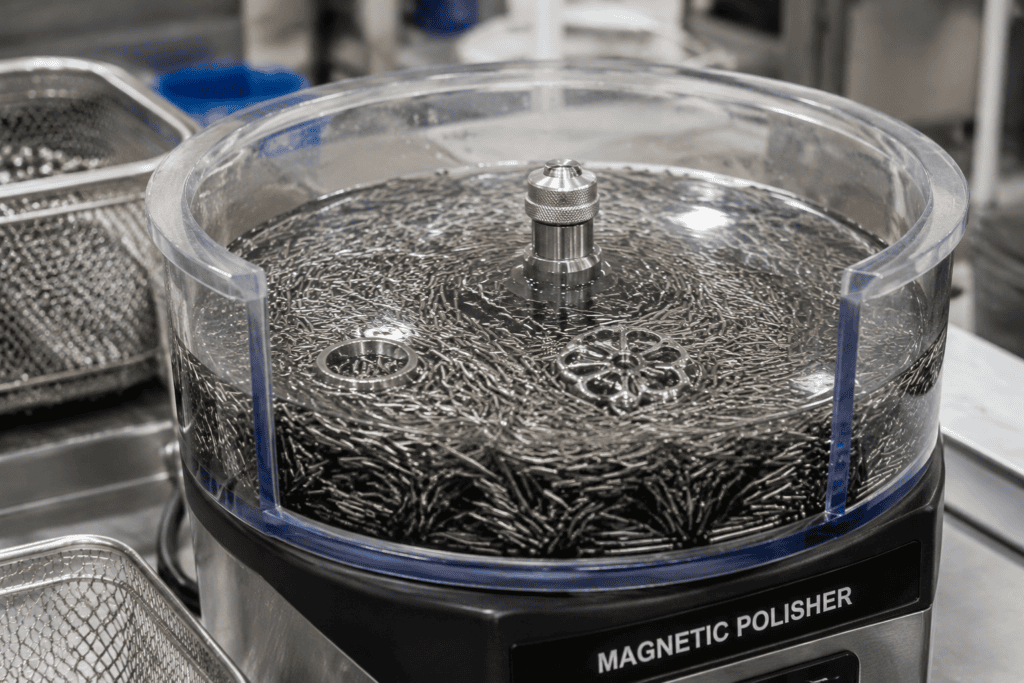
A magnetic polishing machine is a mass finishing device that uses a rotating magnetic field to drive thousands of small stainless steel pins through a bath of water and grinding compound, so the pins flow across, around, and through batches of small metal parts—deburring, descaling, and brightening them in cycles of roughly 5–30 minutes. Suppliers sell the same hardware under several names—magnetic tumbler, magnetic deburring machine, magnetic barrel finisher—and in Chinese manufacturing regions it appears as 磁研磨 (magnetic grinding) equipment. Whatever the label, the principle is identical: the field does not touch the part. It moves the media, and the media does the finishing.
That indirect drive is what makes the process unusual. In a vibratory bowl or a tumble drum, the media is a ceramic or plastic shape that has to be small enough to enter a feature yet heavy enough to cut. In a magnetic polisher, the media is a pin 0.2–1.5 mm in diameter that the field drags at speed through every opening it can physically enter—holes drilled 0.3 mm wide, thread roots, the gap between two nearly touching surfaces. Material removal stays in the micron range, so the process finishes parts without meaningfully changing their dimensions.
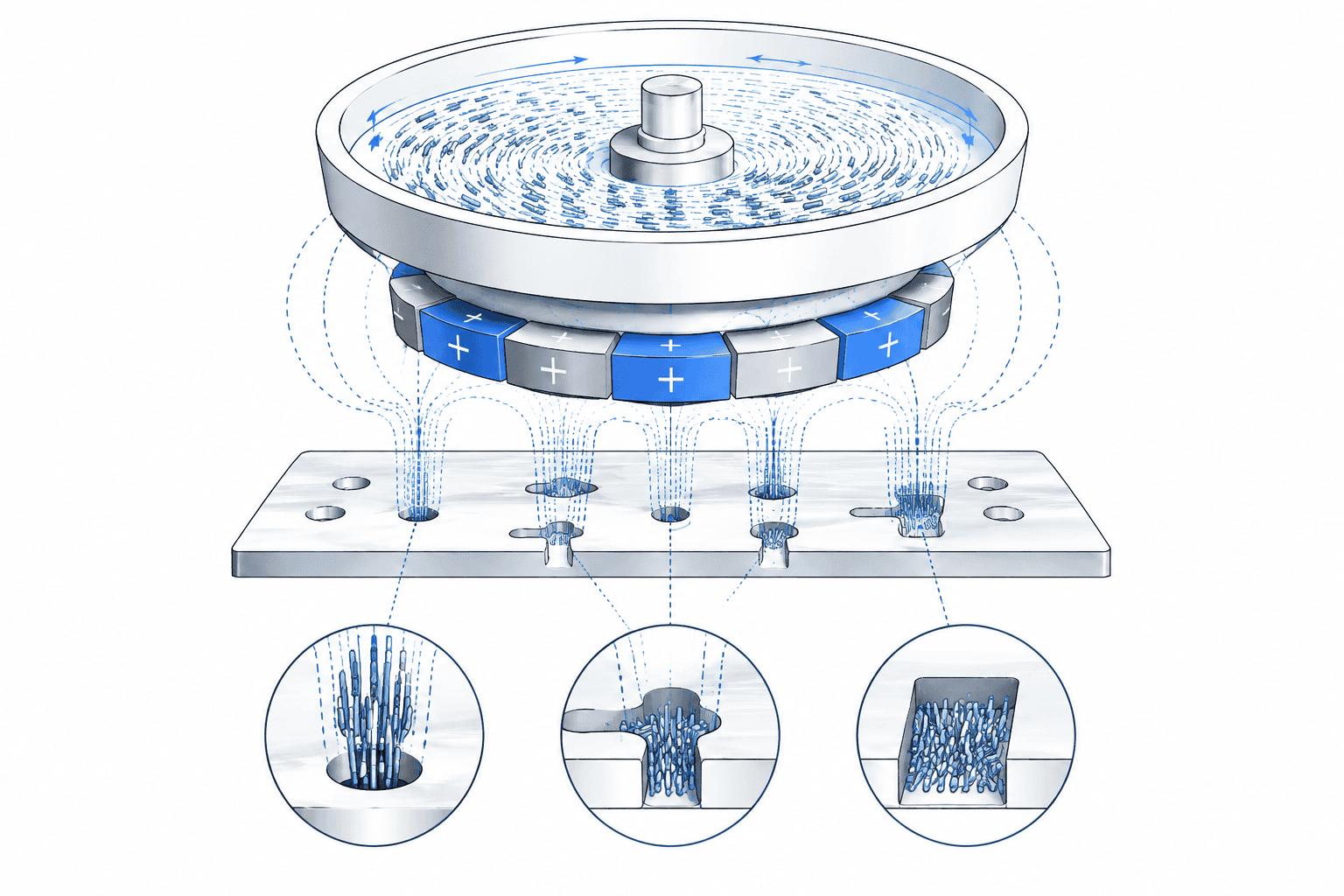
How a Magnetic Polishing Machine Works
Every magnetic polisher is built around three components: a magnetic pole assembly, a work barrel, and a control board.
The pole assembly is a disc or plate carrying an array of powerful permanent magnets—neodymium-iron-boron grades in the N38–N45 range on current machines—arranged in alternating north–south pairs. In the most common design, this disc sits underneath a stationary barrel and spins at an adjustable speed, typically 1,000–4,000 rpm depending on machine size, sweeping the field lines through the barrel in a continuously moving pattern.
Into the barrel go the parts, the pins, water, and a liquid compound. The moving field grabs the pins—each one a small ferromagnetic body—and throws them into violent, churning circulation. A single pin aligns with the field, gets yanked along it, collides with other pins, tumbles, and re-aligns thousands of times per minute. Multiply that by several hundred grams to several kilograms of pins, and the barrel contains something close to a directed fluid of abrasive needles.
Against each workpiece, three things happen simultaneously:
- Micro-cutting. Pin tips and edges scratch away oxides, discoloration, fine burrs from stamping or machining, and the amorphous layer left by EDM or wire-cut operations. Because each individual contact carries very little force, cutting is slow but extremely gentle.
- Burnishing. Pin bodies sliding across accessible surfaces compress and smooth the material, dropping roughness from a typical machined Ra 0.6–0.8 µm toward Ra 0.05–0.2 µm on favorable alloys—jewelry comes out of the barrel mirror-bright.
- Flowing and flushing. The compound suspends removed particles, prevents flash rusting, and keeps the pins from packing into a solid mat at the bottom of the barrel.
Total material removal per cycle sits in the low micron range. That is the defining constraint: a magnetic polisher is a finishing tool, not a stock-removal tool. A part carrying a heavy burr, thick scale, or needing a real edge break belongs upstream—in a vibratory bowl, a tumbler, or on a machine tool.
Two Configurations: Rotating-Disc and Reciprocating-Pole Machines
Commercial equipment splits into two mechanical families, and the choice between them follows part geometry more than anything else.
Rotating-disc machines (also called rotary magnetic polishers or magnetic tumblers) spin a circular magnet plate beneath a fixed barrel. They dominate small-batch precision work: benchtop units with small barrels around 100×90 mm; mid-size units around 180×100 mm; jewelry-batch machines around 290×170 mm that accommodate about 1.3 kg of parts; and industrial floor-standing units with roughly 500×500 mm barrels, 2.2 kW drives, and capacity for up to 10 kg of parts against 2 kg of media. The circulation is toroidal and intense—strongest near the plate, weaker at the top of the load—which suits small, dense parts that tumble freely.
Reciprocating-pole machines (translating or swing-pole types) move a linear magnet assembly back and forth under a longer trough or channel, sweeping the work zone in straight lines instead of circles. This buys three things: more uniform action over a large footprint, better handling of slender parts—needles, probes, thin shafts, wire forms—that would classify and jam in a swirling barrel, and the ability to run continuous or indexed flow in higher-volume cells. Reciprocating machines are correspondingly larger, more expensive, and more common in production lines than in job shops.
A sizing rule across both families: keep the load moving freely. Overfilling the barrel is the most common operator error—when parts and media pack into a dead mass, circulation stops and polishing stops with it.
Magnetic Pin Media: Diameters, Materials, and Loads
The pins are hardened martensitic stainless steel—magnetic, rigid, and reusable for hundreds of cycles until they wear shorter than about two-thirds of their original length or lose their temper. They are specified by diameter × length, and both numbers matter for reach.
Common stock ranges run from 0.2 mm to 1.5 mm in diameter, in lengths of roughly 3–10 mm. Typical catalog entries are 0.3×5, 0.5×5, 0.7×8, 1.0×10, and 1.5×10 mm.
| Pin diameter | Reaches into | Typical use |
|---|---|---|
| 0.2–0.3 mm | Holes and slots from ~0.3–0.5 mm | Micro-parts, watch components, fine springs |
| 0.5–0.7 mm | Holes from ~1 mm, narrow thread roots | Connectors, pen clips, stamped terminals |
| 0.8–1.0 mm | Holes 2 mm and up, general surfaces | Screws, fittings, machined small parts |
| 1.2–1.5 mm | Open surfaces, heavier descaling | Gears, cast small parts, rust removal |
Two selection rules govern the choice. First, pin diameter should be no more than one-half to two-thirds of the smallest feature it must enter—a pin that barely fits the hole will wedge rather than flow. Second, when in doubt, go finer: smaller pins give better finish and internal access at the cost of slower external cutting, and mixing two diameters in one load is a legitimate strategy for parts with both micro-features and open areas.
Load ratios follow machine size: benchtop units carry a few hundred grams of pins, jewelry-batch machines about 1 kg, industrial units about 2 kg against up to 10 kg of parts. As a working range, plan on a media-to-part weight ratio between 1:1 for aggressive small batches and 1:5 for full loads. Water should cover the load by 10–20 mm, with compound at the supplier’s recommended dilution—commonly 1–5%.
Where Magnetic Polishing Reaches and Other Processes Can’t
The reason this machine exists alongside the others is geometry. Ceramic and plastic media in a vibratory bowl are trapped in a trade-off: a shape aggressive enough to cut is too big to enter small features, and a shape small enough to enter them has no cutting mass. The magnetic pin breaks that trade-off because its driving force is external—the field—rather than its own momentum.
Features that magnetic polishing routinely finishes, and that bowl or drum media physically cannot enter, include:
- Drilled and EDM’d holes down to roughly 0.3–0.5 mm in diameter
- Internal threads, thread runouts, and tapped holes
- Narrow slots, engraved recesses, and knurling valleys
- The internal walls of tubes, nozzles, and drawn cups
- Recesses between close-proximity features, plus mesh and pierced structures with intertwined internal surfaces
For a sense of the boundary: a vibratory finishing process handles the external surfaces of the same parts with far more cutting power, but it cannot reach one millimeter into a 0.4 mm hole. When a part’s quality problem lives inside a feature—burrs from a drilling exit, recast layer in a small EDM slot, discoloration in a tube ID—magnetic finishing is usually the only mass-finishing answer short of hand work.
The process also runs clean, quiet, and cheap: benchtop units draw a few hundred watts at most, noise stays below a vibratory bowl, and consumables reduce to water, compound, and occasionally replaced pins.
The Ideal Workpiece Profile
Magnetic polishing rewards a specific kind of part: small, precision, geometrically intricate, and valued per piece. Four families dominate the application base.
Precision stamped and formed parts. Terminals, contacts, spring fingers, lead frames, and shielding cans carry burrs from the die plus micro-features—creases, embosses, close-tolerance bends—that bulk media can’t reach. Pins strip the burrs and brighten the formed surfaces without distorting thin sections.
Consumer electronics hardware. In 3C and consumer electronics manufacturing, magnetic polishers finish connector housings, button blanks, camera brackets, and the small structural parts that surround a logic board. Where a large structural component like a handset mid-frame needs macro surface blending and edge work, it goes to a dedicated robotic cell—our smartphone mid-frame polishing and deburring case covers that workflow—while the small hardware finishes in magnetic barrels.
Jewelry and watches. Rings, chains, clasps, cast findings, and watch cases are the historical heartland of the process. Silver—the most commonly tumbled jewelry alloy—comes out of a 20–40 minute cycle with a mirror finish, including inside gallery holes and behind settings that would otherwise need rotary hand tools.
Medical and dental components. Titanium implants, bone screws, and surgical instrument tips benefit from the combination of low removal and full-surface access: parts keep their dimensions while gaining a uniform, low-Ra surface that helps cleanliness and corrosion behavior.
Size-wise, the practical window runs from parts under a gram to roughly a fist-sized component, with single-batch loads topping out near 10 kg on the largest rotary machines. Anything bigger, heavier, or needing real edge radiusing moves to vibratory or robotic equipment.
Material Boundaries: What Finishes Well and What Doesn’t
The field acts on the pins; parts interact with it only through their own magnetic properties. Three cases follow.
Ferromagnetic and strongly paramagnetic parts finish best. Carbon steels, tool steels, 400-series stainless, and the weakly paramagnetic 300-series stainless and titanium couple at least partially to the field. They circulate with the media, present fresh surfaces continuously, and finish quickly and uniformly. One side effect needs managing: ferromagnetic parts and the pins pick up residual magnetism during cycling, so parts feeding into sensors, magnetically sensitive assemblies, or further machining may need a demagnetizing pass afterward.
Non-magnetic parts finish, but differently. Aluminum, copper, brass, silver, and gold are not meaningfully attracted by the field. They are finished purely by the mechanical flow of driven pins around them—which works well (brass fittings and aluminum machined parts are standard applications), but delivers lower impact energy and slower action than on coupled parts. Expect longer cycles, a slightly higher media ratio, and, on soft aluminum, real attention to dwell time: left too long among hard steel pins, soft alloys pick up dings and lose crisp edges. Thirty minutes is a sensible upper bound for most light-alloy batches unless testing says otherwise.
Plastics, rubbers, and coated parts are generally excluded. The pin load is dense and unyielding; fragile polymers, elastomeric seals, painted or plated surfaces, and soft-soldered assemblies all risk damage. Parts with thin knife-edges—scalpel blades, some cutting tools—also round beyond acceptable limits if cycled aggressively.
A final boundary is burr size: magnetic polishing removes fine burrs, oxide, and recast layers in the micron range. It will not erase a 0.3 mm stamping flash or a heavy milling burr in any reasonable cycle time—those need a coarser process first.
Process Parameters: Time, Speed, and Media-to-Part Ratio
Three variables dominate results, and all three are set on the control board before the cycle starts.
Time. Standard brightening and deburring cycles on jewelry and small hardware are short—minutes rather than hours. Light-metal alloy batches typically need around 30 minutes. Heavy descaling, rust removal, and post-EDM cleanup on steels can run 1–2 hours. Cycles beyond two hours rarely improve the part and mostly heat the load—schedule them as repeated shorter cycles with a cool-down instead.
Speed. Rotating-disc machines adjust from roughly 1,000 to 4,000 rpm. Soft, light parts and fine-finish work run at the low end (1,500–2,000 rpm); steel parts, descaling, and faster cutting run toward 3,000–4,000 rpm. Higher speed means more impact energy and more heat; if the barrel becomes uncomfortable to touch, the load is running too hard or too long. A reversal function—periodically flipping disc direction—keeps pins from settling into fixed circulation lanes and evens out the finish.
Media-to-part ratio and fill. Between 1:1 and 1:5 by weight as covered above, with water 10–20 mm over the load and compound at the supplier’s dilution. Two failure modes bracket the range: too little pin mass gives a slow, patchy finish; too much, or an overfilled barrel, and the load stops circulating entirely. After each cycle, separate parts from pins over a magnetic separator or screen, rinse both, and refresh the compound—pins carrying last cycle’s sludge cut noticeably worse.
Magnetic Polishing vs. Vibratory, Tumbling, and Robotic Finishing
No single finishing process covers the whole job shop. The four mainstream options divide the work cleanly—the full equipment landscape is mapped in our deburring machine types guide. The short version:
| Magnetic polisher | Vibratory bowl/tub | Barrel tumbler | Robotic cell | |
|---|---|---|---|---|
| Media | Steel pins 0.2–1.5 mm | Ceramic/plastic/steel media | Media + abrasive grit | Tools, discs, brushes, bobs |
| Removal per cycle | Microns | Light to moderate | Moderate, slow | Full programmable control |
| Internal/small-feature access | Excellent—the reason it exists | Limited by media size | Poor to limited | Only where a tool can reach |
| Part size | Under ~1 kg typical, small batches | Grams to tens of kg | Small to large, heavy cutting | Any size the cell envelopes |
| Cycle time | 5–30 min typical | 30 min–hours | Hours | Minutes per part |
| Changeover | Dump and reload | Media change per family | Media change | Reprogram + refixture |
| Cost per part | Very low in batch | Low | Lowest for bulk | High, justified by value |
The assignment logic follows geometry and volume. Small intricate parts in mixed batches go to the magnetic polisher. General-purpose external deburring, edge rounding, and pre-plate finishing on medium parts belong in vibratory finishing. Heavy flash removal, burnishing of bulk hardware, and applications where cycle time is cheap run in barrel tumbling. Large, high-value, or geometrically extreme parts—castings, structural components, anything with a defined edge-break spec—justify a robotic deburring cell where a programmed tool follows a controlled path.
In real plants the technologies chain rather than compete: a part may pass a robotic cell for a specified edge radius on two critical contours, then finish in a magnetic barrel to clean the internal features the robot never touched.
What to Look For When Buying a Magnetic Polisher
Five specifications separate a machine that runs for years from one that frustrates you within a month.
- Magnetic pole strength and layout. Ask for the magnet grade (N38–N45 neodymium is the current norm), the number of poles, and their arrangement. More poles in an alternating pattern produce more chaotic, more uniform pin circulation—and a stronger field runs a heavier pin load, which is the real throughput lever. A weak machine shows itself as pins that clump and slide instead of churning.
- Adjustable speed with a real range. A machine stuck at one rpm forces every job to adapt to it. Variable speed across roughly 1,000–4,000 rpm, plus a reversing mode, covers soft alloys through hard steel.
- Cooling. Continuous or multi-cycle running heats the barrel—compound degrades, aluminum parts drift, and magnetic performance at the load edge falls off. Fan cooling on the pole assembly and motor is worth having on any production machine.
- Filtration and media handling. Production use needs a plan for separating pins from parts (magnetic separator rod or screen), filtering spent compound, and draining without losing pins. Check that the barrel lifts out or drains through a screened port.
- Barrel and build details. SUS304 stainless barrels with generous corner radii clean easily and don’t trap sludge; add a splash lid, a timer that ends the cycle, an emergency stop within reach, and locally correct voltage. For benchtop units, confirm which pin and compound sizes the supplier stocks—consumables shipping from one overseas factory are a supply risk that costs more than any spec difference.
Ask for sample processing on your actual parts before committing. Any credible supplier will run your hardware and return finished samples with a cycle recipe; the before-and-after on your own micro-features says more than any brochure.
Frequently Asked Questions
Can a magnetic polishing machine finish non-magnetic parts like aluminum, brass, or silver? Yes—the field drives the steel pins, not the parts, so non-magnetic workpieces are finished by the flowing pin mass around them. Brass, aluminum, silver, and gold are standard applications. Expect longer cycles than on magnetic alloys, use a higher media ratio, and watch dwell time on soft aluminum, which can ding if left too long.
What is the smallest feature a magnetic polisher can reach into? With 0.2–0.3 mm pins, holes and slots down to roughly 0.3–0.5 mm are routinely finished, including internal threads and EDM slots. The rule of thumb: pin diameter should stay below one-half to two-thirds of the feature width so pins flow through rather than wedge.
Will magnetic polishing change my part dimensions? Not meaningfully. Removal per cycle sits in the micron range—the process strips oxide, recast layers, and fine burrs while leaving dimensions and tolerances intact, which is why it runs on finished and semi-finished precision parts. It cannot correct size or remove meaningful stock.
Should I buy a magnetic tumbler or a vibratory bowl first? Let the defects decide. If your quality problems are inside holes, threads, slots, or recesses, or the parts are small jewelry-class pieces, the magnetic machine is the only mass-finishing option. If the problems are external burrs, edge rounding, and surface conditioning on medium parts, a vibratory bowl is the more versatile first purchase and handles far larger batches.
Do parts or pins come out magnetized? Ferromagnetic parts and the pins retain some residual magnetism after cycling. Parts heading into sensors, magnetic assemblies, or further precision machining should pass through a demagnetizer. Non-magnetic parts (aluminum, brass, titanium, precious metals) pick up nothing.

