Who the Six-Axis Machine Serves
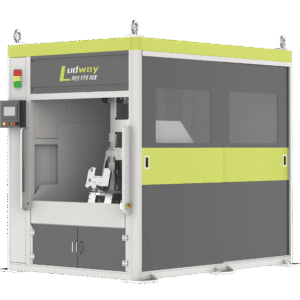
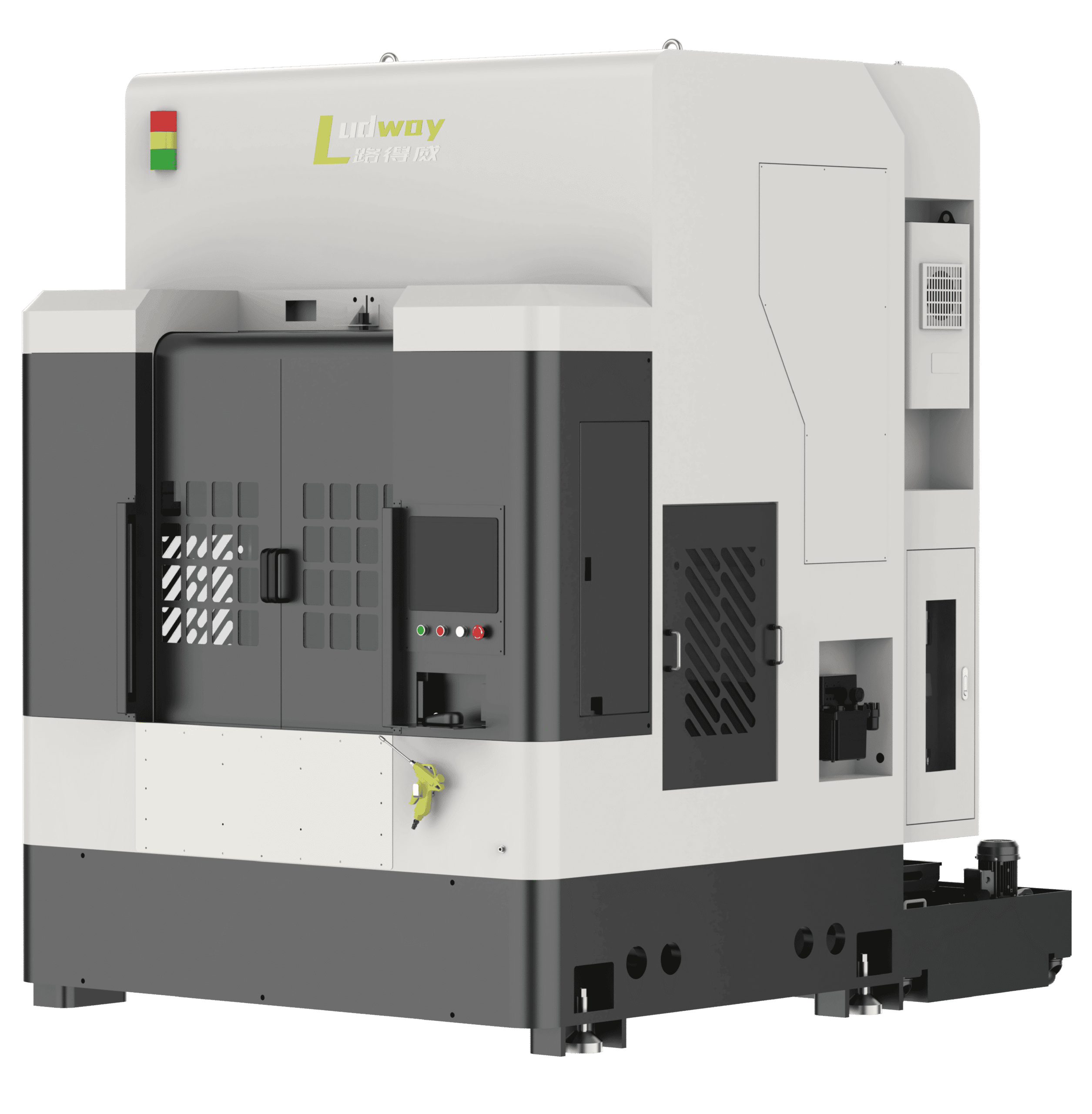
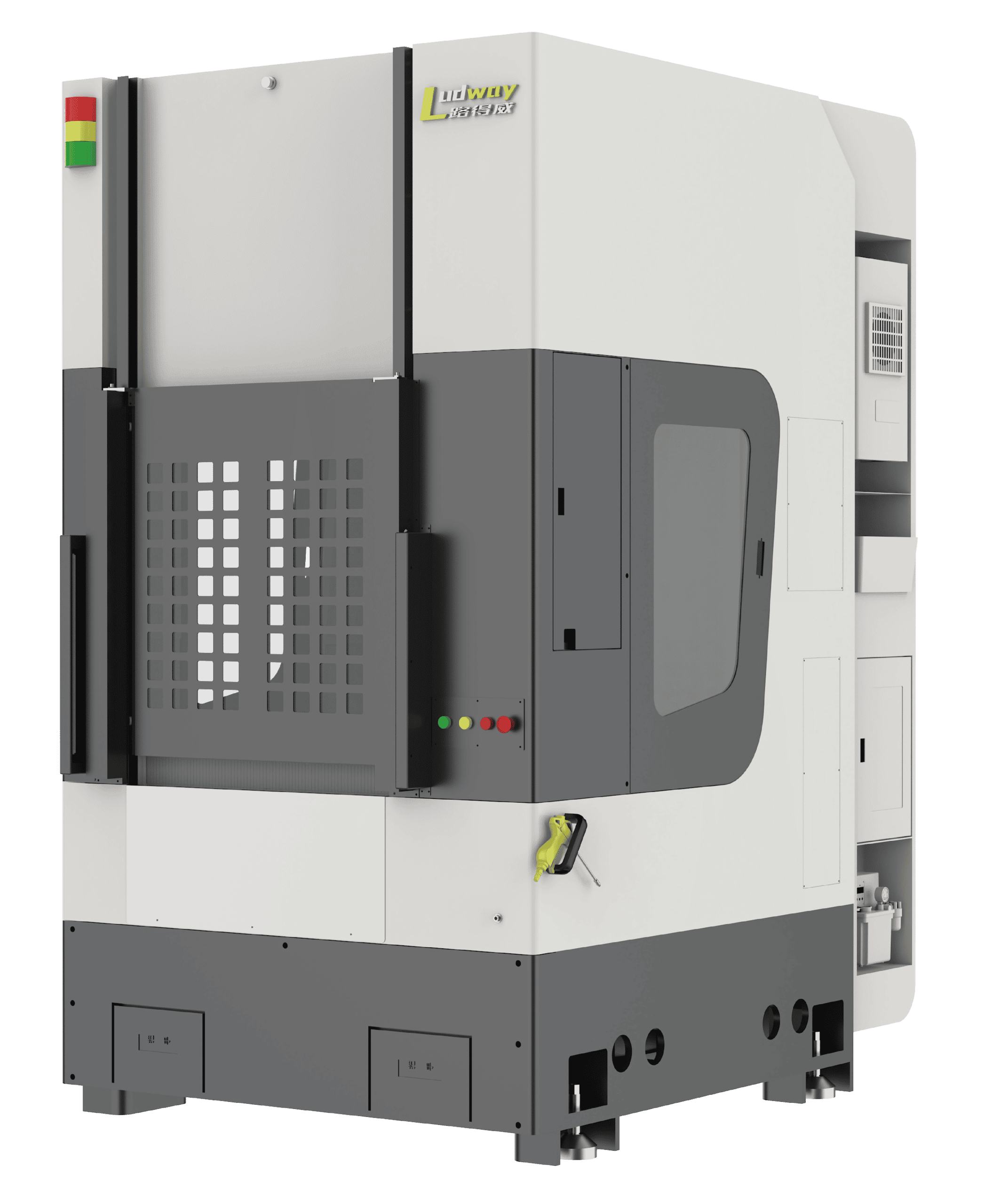
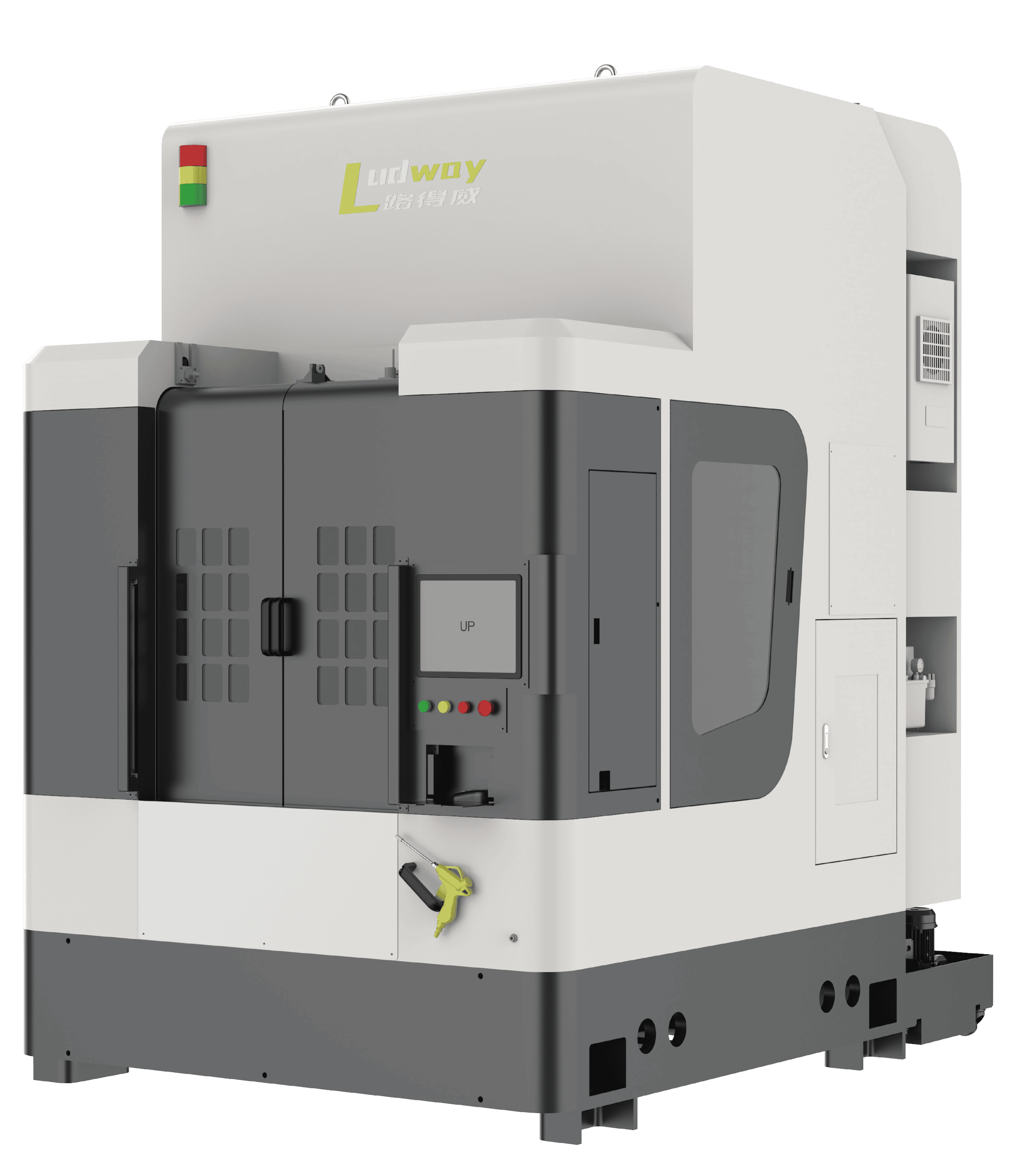
The LDW-6R series is the mid-range workhorse of the line: a machine-tool-style finishing center built around 6+2 axis control, a five-spindle head, and three travel sizes under one frame design. It exists for die castings that are too large or too geometrically demanding for a five-axis head, and for tolerances that a robot arm cannot hold. If your parts carry machined datums, sealing surfaces, or gauge-controlled edges, this is where the ±0.02 mm/300 mm specification earns its keep.
Three models share the same control architecture and differ mainly in travel. The 50 covers compact parts at X500 x Y550 x Z500 mm. The 70 steps up to X700 x Y700 x Z650 mm for mid-size housings. The 90 extends X travel to 900 mm for long castings such as bedplates, rails, and structural members that would otherwise need two setups. Picking the smallest travel that contains the part is usually the right call: footprint, price, and cycle time all scale with the axis lengths.
How the Machine Is Built and How It Runs
The platform is a traveling-column machining center adapted for finishing tools rather than milling cutters. The cast machine body gives the rigidity that finishing needs: no tool chatter on cast iron and aluminum alike, and feed rates that stay usable on heavy flash removal instead of backing off. Control is Taiwan Xindai throughout, system and servo drives from the same supplier, with a 6+2 axis configuration, six motion axes plus two auxiliary axes, and a handwheel shipped as standard equipment for setup and manual intervention.
The five-spindle head is the distinguishing feature. Because the spindle can index to any angle and change tools quickly, one program can move from a rigid carbide cutter chewing through gate stubs to a pneumatic polishing tool blending the same surface, without an operator touching the machine. Tool clamping runs from Φ3 to Φ18 mm, which spans the fine deburring burrs, chamfer tools, flap wheels, and brush packs used on cast surfaces. Drive power is distributed across 1.5 kW x 2, one 4.4 kW axis, and 750 W x 5 axes, and spindle motors come from Ludway in a 1.0 to 5.5 kW range matched to the tool list.
Programs are built by six-axis teach programming. The first part is walked through once, the taught paths are stored, and repeat batches run from the library without re-teaching. Rigid and flexible tools combine in one process plan, so brittle carbide geometry and compliant abrasive media each do the work they are good at. An automatic lubrication unit and oil or air spindle cooling support unattended shifts, and the HMI tracks output counts, alarms, and tool condition live.
Specifications Across the Three Travels
| Category | Specifications | LDW-6R-5T-50 | LDW-6R-5T-70 | LDW-6R-5T-90 |
|---|---|---|---|---|
| Basic Machine Parameters | Model | LDW-6R-5T-50 | LDW-6R-5T-70 | LDW-6R-5T-90 |
| Overall Dimensions | L2050 x W1480 x H2630 mm | L2525 x W1800 x H2731 mm | L2575 x W2030 x H2731 mm | |
| Equipment Travel | X500 mm + Y550 mm + Z500 mm | X700 mm + Y700 mm + Z650 mm | X900 mm + Y700 mm + Z650 mm | |
| Idle Speed | 32000 mm/min | 32000 mm/min | 32000 mm/min | |
| Processing Speed | 1000-10000 mm/min | 1000-10000 mm/min | 1000-10000 mm/min | |
| Distance Between Spindle Nose & Worktable | 50-550 mm | 50-550 mm | 50-550 mm | |
| Spindle Cooling Method | Oil Cooling / Air Cooling | Oil Cooling / Air Cooling | Oil Cooling / Air Cooling | |
| Air Pressure Requirement | ≥0.55 MPa | ≥0.55 MPa | ≥0.55 MPa | |
| Number of Spindles | 5 | 5 | 5 | |
| Precision & Drive Parameters | Processing Accuracy | ±0.02 mm/300 mm | ±0.02 mm/300 mm | ±0.02 mm/300 mm |
| Drive Motor Configuration | 1.5 kW x2 + 4.4 kW + 750 W x5 | 1.5 kW x2 + 4.4 kW + 750 W x5 | 1.5 kW x2 + 4.4 kW + 750 W x5 | |
| Total Machine Weight | 5T | 5T | 5T | |
| Control & Motion System | Control System Brand | Xindai (Taiwan) | Xindai (Taiwan) | Xindai (Taiwan) |
| Total Control Axes | 6+2 | 6+2 | 6+2 | |
| Handwheel Configuration | Standard Equipped | Standard Equipped | Standard Equipped | |
| Lubrication System | Automatic Lubrication Device | Automatic Lubrication Device | Automatic Lubrication Device | |
| Spindle Motor Parameters | Spindle Brand | Ludway | Ludway | Ludway |
| Spindle Power Range | 1.0 kW – 5.5 kW | 1.0 kW – 5.5 kW | 1.0 kW – 5.5 kW | |
| Tool Clamping Diameter Range | Φ3 – Φ18 | Φ3 – Φ18 | Φ3 – Φ18 |

Note: all technical specifications are subject to change without prior notice for product optimization and upgrade.
What the Machine Does on Real Parts
In die-casting plants the six-axis cell typically takes the part straight out of trimming and finishes it before machining or shipment: gate and riser stubs milled to the casting surface, parting lines blended, bore mouths chamfered, and cosmetic or sealing faces brought to a defined roughness with flexible tools. The 1000-10000 mm/min processing window spans aggressive stock removal and slow finishing passes in one program, and the 50-550 mm nose-to-table distance accommodates tall fixtures and deep-pocket parts without re-setup.
Because the process data lives in the controller rather than in an operator’s hands, the machine holds the same edge condition across a 300-piece run and across the night shift. That consistency is the usual reason a plant moves this work off manual benches: labor cost follows, but scrap and rework from inconsistent chamfers go first.
Parts That Fit the LDW-6R
- Automotive powertrain castings: engine cylinder blocks and heads, transmission housings, oil pan assemblies, bedplates.
- EV drivetrain and structural die castings in the mid-size range, where machined datums must be respected.
- Long components up to the X900 envelope of the 90 model: rails, frames, and beams that need edge work along one axis.
- Any casting family where several tool types per part is the norm and manual deburring cannot hold the print.
Background Reading for the Decision
Types of Deburring Machines: Complete Selection Guide sets this machine against the five-axis and robotic alternatives, with the part-size and tolerance boundaries of each. For the upstream context, Die Casting Deburring Automation: Process Chain Guide explains where finishing sits between trimming and machining, and what a six-axis cell contributes to cell-level takt.
Request a Configuration
Tell us the casting, the burrs that matter, and the monthly volume through the contact page. The engineering team will size the travel, draft the tool list against the Φ3-Φ18 clamping range, and quote the configuration, including a proof of concept on your sample parts if you want the process proven before the purchase order.