
Robotic Polishing & Buffing Systems for High-Quality Surface Finishes
Automate pre-polishing, buffing, and mirror-finish polishing for complex metal parts with controlled pressure, repeatable tool paths, and consistent compound application—so cosmetic quality stops depending on which polisher showed up for the shift.
What a Robotic Polishing Cell Actually Does
A robotic polishing cell is built around one or more industrial robots fitted with force control and polishing tooling—belt sanders, buffing wheels, pneumatic grinders—programmed to bring metal and plastic parts to a target surface finish. The robot moves either the tool or the workpiece along a controlled path while the force-control mechanism holds contact pressure inside a narrow band; a controller sequences the grit progression, manages tool and compound changes, and verifies surface roughness, tracked as Ra in micrometers (µm). Part number 4,000 comes off the cell matching part number 40.
One honest boundary up front: robotic polishing excels at production finishing—satin, brushed, and mirror finishes on engineered products. Ultra-precision optical mirror finishes below roughly Ra 0.05 µm, on lens molds or semiconductor components, still belong to dedicated ultra-precision polishing machines and specialist polishers. If your print calls for that class of finish, we will tell you so rather than sell you a cell that cannot hold it. For commercial cosmetic surfaces—faucets, door hardware, chair bases, wheels, sanitary parts—robotic cells are the proven production answer.
We engineer complete polishing cells: robot and end effectors, buffing and polishing stations, compound delivery, fixtures for your part family, vision or laser localization, dust extraction, and the PLC integration that connects the cell to your line. Cells are built on our five-machine finishing platform—single- and dual-station five- and six-axis layouts plus a part-in-hand configuration—selected by part size, geometry, and target volume, then validated against your actual finish samples before shipment.
Why Manual Polishing Doesn’t Scale
Manual polishing quality swings with each operator’s skill, fatigue, and turnover; the work is dirty, repetitive, and hard to staff. Three costs dominate every manual polishing operation we replace.

Inconsistent Ra and Swirl Marks
Manual buffing pressure and compound use vary shift to shift, producing swirl marks, haze, orange peel, and inconsistent appearance on Class-A surfaces. A force-controlled cell holds the same pressure and path on curve, edge, and flat alike—every cycle.
Dangerous Environment and Dust
High-speed wheels, polishing compound, metal dust, noise, and awkward work positions make manual buffing one of the least desirable jobs on the floor. Enclosed robotic cells with engineered dust collection move people out of the booth and into loading and inspection roles.
Labor Scarcity and Cost
Experienced polishers are hard to hire and harder to retain, which caps output exactly when cosmetic quality matters most. A robot polisher does not retire, does not retrain slowly, and produces its best surface on the last part of the third shift.
How Our Cells Hold Finish Consistency
Controlled pressure across 3D geometry. Force-controlled contact maintains stable polishing pressure across curves, edges, rims, and changing part geometry—the same newton setting on a spout transition as on a flat panel, which is precisely what manual operators cannot sustain.
Adaptive path planning for complex contours. Robot paths are programmed around the actual part—handles, recesses, cosmetic faces, blend zones—so media coverage is complete without over-polishing edges thin enough to burn through. Grit progression runs from coarse conditioning through final buffing under controller sequencing, not operator memory.
Automatic compound application. Integrated liquid or solid compound delivery meters abrasive compound onto the wheel at programmed intervals, keeping cut and gloss consistent across a production run instead of drifting as wheels load.
Verification, not eyeballing. Surface roughness is tracked as Ra in µm, and first-article plus periodic checks confirm the finish holds as media wears. That data trail is what lets automotive, sanitary, and consumer hardware customers audit a robotic line the way they audit a machining line.
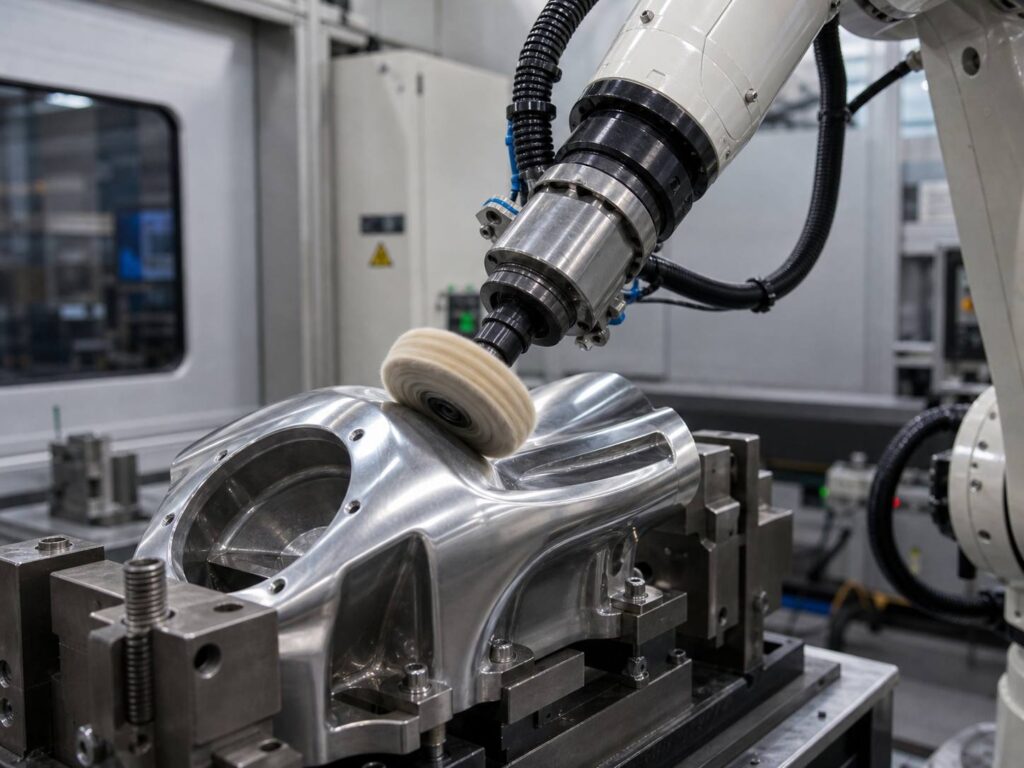
Surface Finishes We Help Produce
Cells are configured around your material, geometry, finish target, and inspection standard—brass, stainless, aluminum, zinc die cast, and hardened steel each carry their own abrasive grades, forces, and wheel speeds.
Material drives the recipe more than most buyers expect. The commercially proven list covers brass, bronze, copper, stainless steel, carbon steel, aluminum and its alloys, zinc die castings, titanium, and hard plastics or composites. Brass and aluminum cut easily and tolerate compliant tooling; stainless needs higher force and a stiffer setup; zinc die castings bring their own abrasive and dust considerations; titanium demands slower cuts and tighter heat control. We validate the full grit sequence on samples of your actual alloy before the cell is built, so the finish target is proven rather than promised.

Tool Mark Removal and Pre-Polishing
Reduce CNC tool marks, grinding lines, and surface roughness before final buffing—the conditioning pass that decides whether the gloss stage starts from a controlled surface or from whatever the upstream process left.

Satin, Brushed, and High-Gloss Finishes
Produce production-grade satin, brushed, and mirror-bright finishes with controlled polishing pressure, matched media, and repeatable compound application—reflective commercial gloss for hardware, sanitary, and consumer parts, verified batch after batch.

Complex 3D Contours
Maintain controlled contact across curved, recessed, and edge-sensitive surfaces—spouts, handles, rims, and panels—reducing burn-through, uneven gloss, and the rework that curved cosmetic parts generate on manual lines.
The Platform Behind Our Polishing Cells
Polishing cells are engineered on our five-machine robotic finishing platform—the same rigid machine bases, force-control hardware, and integration toolkit we build deburring and grinding cells on, configured here with polishing spindles, buffing stations, and compound delivery:
- 6 Axis Deburring Equipment—single-station platform configured with polishing end effectors for medium cosmetic parts
- Five Axis Deburring Equipment—compact single-station cell for small geometry-dense parts
- 6 Axis Dual Station Deburring Equipment—dual-station layout for line-rate polishing volumes
- 5 Axis Dual Station Deburring Equipment—throughput layout for smaller high-volume components
- Robot Clamping Tool Type Deburring Equipment—part-in-hand architecture presenting parts to fixed buffing and polishing stations
For part families that mix deburring and polishing—smartphone mid-frames, turbine blades, medical components—the same cell carries spindle and buffing stations behind one tool changer, so edge conditioning and gloss work run in a single fixture and a single cycle.
Robotic Polishing Case Studies
Polishing cells engineered and delivered, each documenting the part, finish target, and process approach:
- Shower head robotic polishing—curved spouts and transitions brought to uniform gloss for sanitary hardware
- Luxury door handle robotic polishing—cosmetic Class-A surfaces on architectural hardware
- Brass faucet robotic polishing—the archetypal case: curved brass spouts polished to mirror chrome prep in production volumes
- Alloy wheel robotic polishing—large cosmetic surfaces with matched cut and gloss stages
- Stainless steel sink robotic polishing—large formed stainless with linear and contoured polish zones
Polishing Knowledge Base
The engineering detail behind these cells, published so you can qualify the process before contacting any supplier:
- Robotic polishing machine: the complete selection guide—architecture, the seven selection factors, and honest budget bands
- Wheel polishing machine: how to choose the right equipment—equipment selection for wheel and large-part polishing
- Pipe polishing machine: complete buyer’s guide—configurations for tubes, bars, and long workpieces
- Buffing vs polishing: which one cuts, which one shines—the terminology that decides which process your finish spec actually needs
- Magnetic polishing machine: how it works and how to buy—when magnetic finishing beats contact polishing on small complex parts
- Flat surface polishing machine: how to choose—flat-part finishing options from dedicated machines to robotic cells
From Sample Test to Production

Step 1: Part Review and Finish Target
We review your material, geometry, surface defects, target finish, and production volume to define the polishing process—including the Ra target stated in µm and how it will be verified.

Step 2: Process Testing and Cell Design
We test polishing media, buffing wheels, compound application, fixtures, and robot paths on your samples—to confirm cycle time and finish consistency before the cell is built.

Step 3: Integration, Training and Launch
We build, install, and commission the polishing cell, then train your operators for stable production start-up—with finish samples and process data documented from first article onward.
Get a Free Cycle Time and ROI Analysis
Send Us Your Toughest Polishing Part. We Return the Process Data.
Ship us a sample part or share your finish target for a free process review. You get a recorded video of the polishing trial, recommended process steps and media, an estimated cycle time, and an ROI discussion grounded in your labor and rework figures. Send part drawings or STEP files, your finish spec or a reference sample, your current method with its reject rate, and monthly volumes—and we will return the process data before you commit to any supplier. As a planning band, entry single-station cells typically start around $80,000–150,000, with fully engineered multi-station turnkey polishing cells running to $300,000 and beyond depending on vision, tool changing, and integration scope.
- Recorded video of robotic polishing trials on your sample
- Recommended polishing and buffing process steps
- Estimated cycle time and media selection
- ROI discussion for production implementation