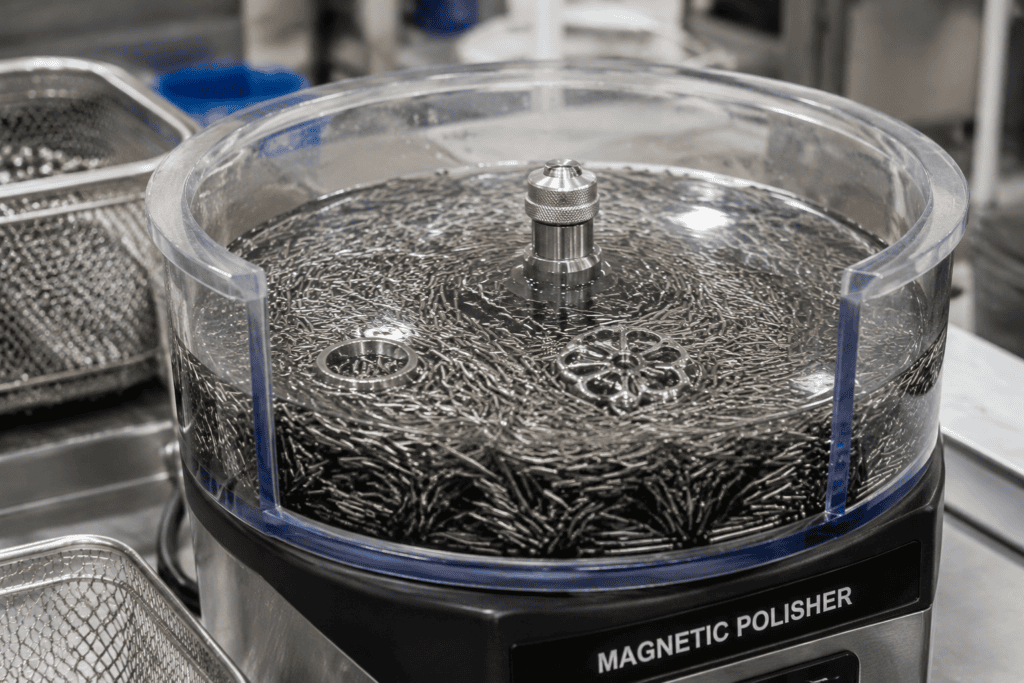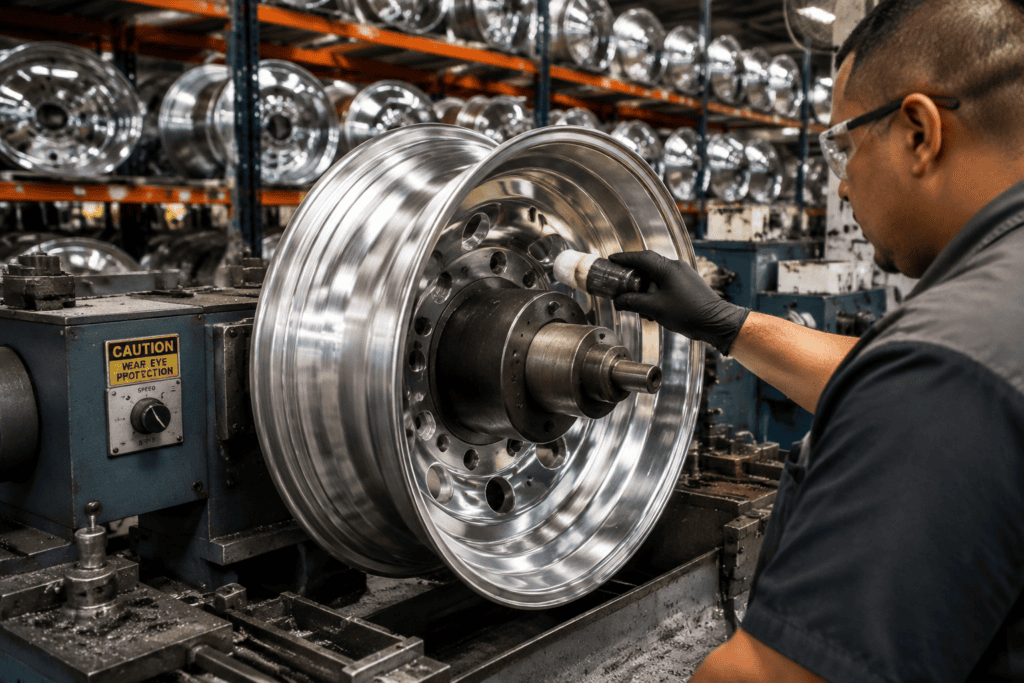
Search for a wheel polishing machine and you will land almost entirely on product pages—cabinet polishers, handheld buffing kits, CNC machines. Almost nobody explains how these formats differ or which fits a fleet maintenance bay versus a wheel refurbishing shop versus a manufacturing line. This guide covers the five formats, the shared process, the selection factors that matter, and when automation starts paying for itself.
What Is a Wheel Polishing Machine?
A wheel polishing machine is equipment used to restore the surface of aluminum or steel wheels—stripping oxidation, brake dust staining, and corrosion pitting, and returning the wheel face to a smooth, reflective finish. The category spans four levels of automation: handheld polishers, fixed buffing stations, dedicated automatic machines that cycle a mounted wheel through programmed stages, and CNC or robotic systems used mainly in manufacturing.
The key word is *restore*. Polishing removes damaged metal and contaminated surface layers—which is why a properly polished wheel also inspects better: clean, bright metal exposes cracks and bolt-hole damage that grime and oxidation hide.
Why Wheels Need Polishing: Oxidation, Brake Dust, and Pitting
Bare aluminum corrodes. Road salt, moisture, and heat build a dull gray oxide layer that thickens over months, and brake dust makes it worse: the metal-and-resin mix off heavy truck friction brakes bakes onto the wheel face at operating temperature and etches it into hard black scale. Past that stage you get pitting—small craters in the aluminum that no polish will hide until they are sanded or machined out.
Polishing sits at the intersection of three business cases:
- Fleet image and resale. Polished aluminum is one of the cheapest ways to make a five-year-old tractor look maintained—one US wheel-polishing operator reports customer trucks that sat unsold for months moving in days once the wheels were refinished.
- Inspection and safety. A clean wheel face lets inspectors see the metal. Stress cracks around bolt holes and rim flanges are far easier to detect on polished wheels than oxidized ones, which is why fleet machine makers sell damage detection alongside finish quality.
- Refurbishing revenue. A pitted aluminum wheel bought cheap and brought back to a mirror finish resells at a multiple of purchase price plus consumables—and the machine that makes that repeatable is the shop’s core asset.
Steel fleet wheels get painted, not polished; chrome follows different rules again (below).
The Five Formats of Wheel Polishing Equipment
Wheel polishing equipment has settled into five formats. They overlap less than buyers expect, and most operations end up running two in combination.
1. Handheld Polishers with Buffing Wheels and Sanding Discs
The entry point: a variable-speed polisher, abrasive discs in escalating grits, and buffing wheels—airway cotton buffs, felt bobs, cartridge rolls for the pockets between spokes. Suppliers such as Zephyr sell a complete manual ecosystem: metal polish, rouge bars, buffs, mandrels, and goblet- and cone-shaped tools for wheel cavities.
Handheld polishing is slow, skilled work. Sanding, cutting, coloring, and finishing happen section by section at arm’s length; on a neglected 22.5″ truck wheel that can take most of a morning. The quality ceiling is high—an expert with a handheld kit out-polishes a mediocre automatic machine on complex spoke designs—but the floor is low, and results depend on the operator’s shoulder at hour seven of a shift.
Where it wins: low volumes, complex one-off wheels, detail and chrome shops—hundreds of dollars plus per-wheel consumables.
2. Bench-Mounted Buffing Stations
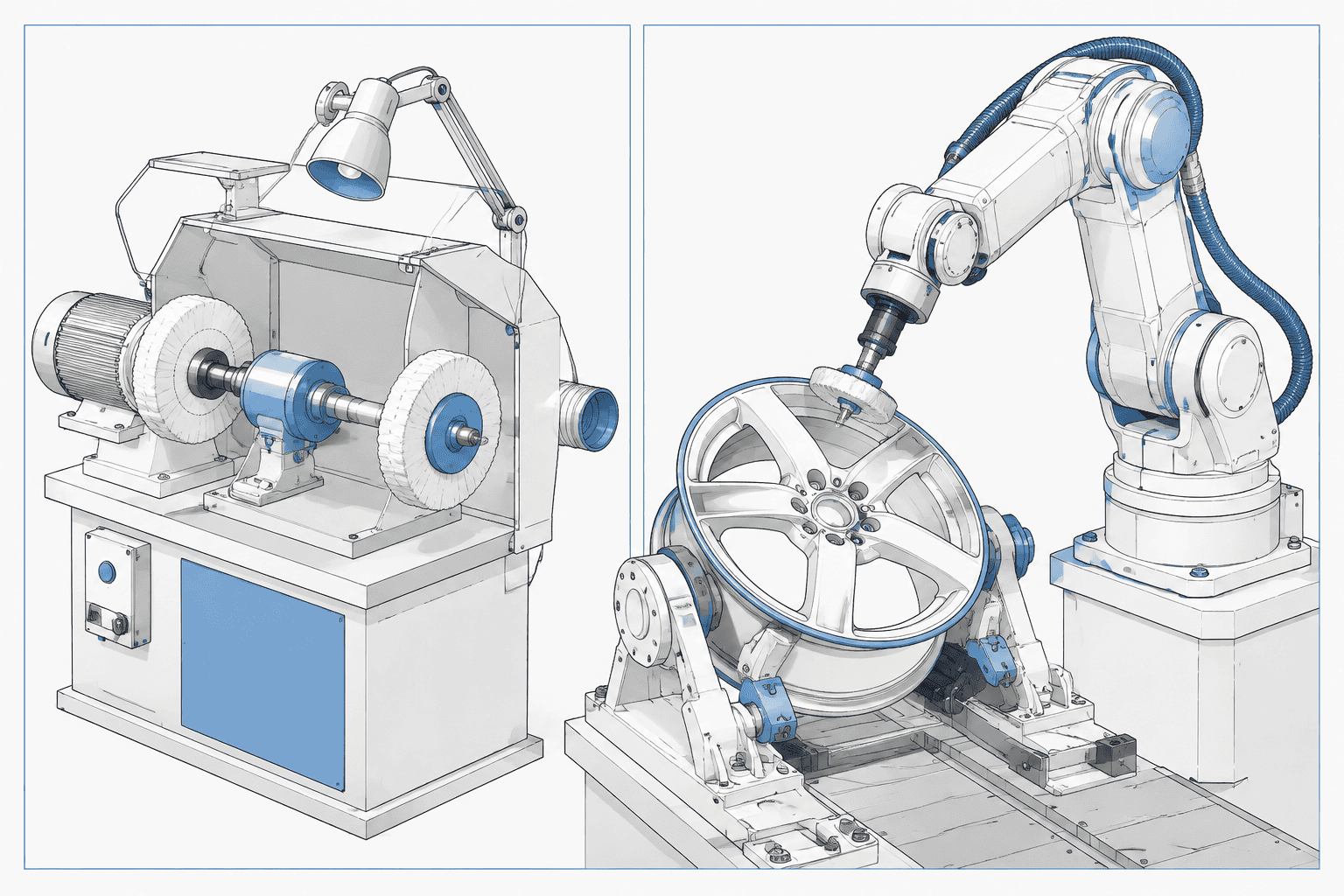
A fixed motor with tapered spindles on a stand, the operator presenting the wheel against spinning buffs charged with compound—the classic polishing-shop setup.
The inverted relationship makes cutting faster and more aggressive, and a skilled operator can move real restoration volume. The tradeoffs are skill and safety: applying an 80-pound truck wheel to a spinning buff invites grab and kickback, and the open process throws compound, dust, and lint into the shop—extraction and PPE are not optional. Investment is modest (motor, spindles, buffs, stand, extraction), but a bench buffer is a journeyman’s tool, not a training-day tool.
3. Dedicated Automatic Wheel Polishing Machines (Cabinet-Type)
This is what most people picture in a fleet context: an enclosed cabinet where the wheel mounts on a rotating spindle and a spring-loaded polishing head travels the wheel face through programmed cycles. The NEPEAN VIS-Polish is the North American reference: 19.5″, 22.5″, and 24.5″ wheels including super singles and wide-base steers, tire on or off, a 30–60 minute cycle sequencing sanding, cutting, coloring, and shining from the control panel while the technician does other work, plus a bead-cleaning cycle, in a footprint of roughly 76″ × 66″.
The format’s insight: a wheel is rotationally symmetric, so a spindle plus a following head reproduces a skilled polisher’s motion without the polisher. Mount the wheel, select the program, walk away—and every wheel comes out the same, which matters when 60 trucks’ wheels must match across side-by-side trailers.
Cycle time is the honest limit: one wheel per 30–60 minutes serves a fleet depot, commercial tire shop, or truck dealer’s used-truck line—not a high-volume plant. Investment sits in the capital-equipment tier, typically financed and justified against outsourced polishing costs, recovered technician hours, and billable polishing services.
4. CNC Wheel Polishing Machines
CNC adds programmable multi-axis motion: the machine follows the wheel’s contour—face, outer lip, spoke pockets, barrel—along a toolpath with controlled pressure and speed at every point. Where a cabinet machine’s following head does a good job on the wheel face, CNC reaches the geometry it cannot.
Buyers are wheel manufacturers and large refurbishers: OEMs store programs per wheel design and change over in minutes, and CNC handles deep-machined spokes, polished lips with machined accents, and multi-piece wheels that cabinet machines struggle with. Costs run well above the cabinet format, and you are buying machine plus programming capability—overkill for a fleet bay, the entry ticket to volume finishing for a manufacturer.
5. Robotic Wheel Polishing Cells
The newest format: a six-axis robot holding the tool (or the wheel) with active force control. Force feedback is what makes robots viable—position-controlled robots grind too hard or too light as tolerances vary, while a force-controlled cell adapts like a human wrist, every wheel, every shift. For cell architecture details, see our robotic polishing machine guide; for the underlying vocabulary of burrs and edge conditions, what robotic deburring is.
Cells also scale past the other formats: automatic loading, tool changers swapping between grinding bits for cast flash and soft buffs for finishing, vision or probing to verify wheel type, cycle times dropping from tens of minutes toward minutes per wheel. Natural buyers are aluminum wheel manufacturers—cells grind gate remnants and parting lines on fresh castings, then polish faces and barrels in one line—and high-volume refurbishing hubs. Investment is the highest of the five formats, quoted per application. This is the territory of integrators such as UBright Solutions, which designs alloy wheel robotic polishing solutions around a manufacturer’s actual wheel portfolio, not a standard box.
Comparing the Five Formats
| Format | Typical output | Skill required | Consistency | Investment tier | Best fit |
|---|---|---|---|---|---|
| Handheld polisher + discs | One wheel at a time, hours each | High, craft-based | Operator-dependent | Low | Detailers, chrome shops, low volume |
| Bench buffing station | Low–medium | High, safety-critical | Operator-dependent | Low–Mid | Polishing shops with skilled labor |
| Cabinet-type automatic | ~One wheel per 30–60 min cycle | Low–medium | High, repeatable cycles | Mid–High, capital equipment | Fleet depots, tire shops, truck dealers |
| CNC machine | Medium–high, program-driven | Programming + setup | Very high | High | Wheel manufacturers, large refurbishers |
| Robotic cell | High, continuous, minutes/wheel | Integrator sets up; operator loads | Very high, adaptive via force control | Highest, quoted per application | High-volume refurb hubs, wheel makers |
One correction: “investment tier” measures machine cost, not cost per wheel. A robotic cell finishing 400 wheels a day can carry a lower cost per wheel than a handheld kit in the wrong hands—and a cabinet machine idling in an eight-truck depot is an expensive storage rack. Throughput, not price tag, decides which tier is rational.
Six Selection Factors to Weigh Before You Buy
1. Wheel size range. Heavy truck wheels run 19.5″ (medium-duty), 22.5″ (the Class 8 standard), and 24.5″, including super singles and wide-base steers; passenger wheels run roughly 15″–22″ with far more spoke complexity. A truck wheel polishing machine is sized, clamped, and programmed for the heavy-duty family—verify clamping range and spindle capacity against your wheel list, and if you service the full wheel end, how the equipment fits truck wheel and hub reconditioning workflows. A semi wheel polishing machine that cannot mount your most common wheel is an expensive mistake to discover at installation.
2. Daily volume. Volume sorts the five formats more decisively than anything else. Three to ten wheels a day lives comfortably on handheld and bench equipment. Ten to forty daily is the cabinet machine’s sweet spot. Hundreds per day—refurbishing streams or new-wheel manufacturing—only CNC and robotic formats keep pace. Buy for the volume you can realistically win, not the third-year projection.
3. Finish type: chrome, bare aluminum, coated. An aluminum wheel polishing machine is built to *remove* metal—cutting compounds and abrasive stages level the oxidized, pitted surface back to sound aluminum, then bring up a mirror. Chrome is the opposite: the plating is a thin hard layer, and cutting compounds burn through it. Chrome gets gentle cleaning and protective polish; heavy damage goes to a plating shop. Clearcoated wheels must be stripped before any metal polishing. If your stream mixes all three, separate them in process documentation—a cutting stage on a chromed wheel destroys inventory.
4. Tire on or tire off. Tire-off reaches more of the wheel and is the refurbishing norm, where wheels arrive bare. Tire-on matters in fleet depots and tire shops, where breaking and re-inflating per wheel adds labor, and a bead-cleaning cycle adds a sellable service.
5. Space, power, and safety infrastructure. A cabinet machine needs appliance-sized floor space, its rated circuit, and loading clearance; bench stations need guards, anchoring, and serious dust extraction—compound residue and buffing lint are a housekeeping and respiratory issue at scale; robotic cells need safeguarded perimeter space and line integration. None of this is optional add-on cost.
6. Labor reality. A cabinet machine occupies a technician for minutes instead of hours, freeing them for brake work and inspections. A bench station consumes your best polisher’s day. A robotic cell converts polishing labor into loading and QC labor. Match the format to the labor you can hire: skilled hand polishers are the scarce input, and that scarcity, more than machine price, pushes operations toward automation.
The Wheel Polishing Process, Step by Step
Every format runs the same stages; they differ in who supplies the motion—and knowing the process makes spec sheets legible.
- Strip and mount. Wheel off, tire removed (or bead broken), weights and clips off—anything left behind becomes a projectile or scratch source.
- Degrease. Hot water or solvent degreasing removes road film and loose brake dust before abrasive touches the face. Polishing over contamination embeds it.
- Inspect. Check for cracks—especially around bolt holes and the outer rim flange—plus bends and previous welds. Polishing a cracked wheel to a mirror is the worst outcome: the defect becomes harder to see, not easier.
- Sanding / cutting stage. Abrasive discs in escalating grits level the surface, removing oxide, staining, and shallow pitting—the skill, or the program, is removing the minimum metal that achieves uniformity.
- Cutting compound. A coarse compound on a firm buff removes sanding scratches and brings up a uniform satin finish.
- Coloring stage. A finer compound on a softer buff refines the scratch pattern from satin toward gloss—the “coloring” cycle on machine control panels.
- Finishing stage. Fine rouge on a soft cotton or flannel buff brings up the mirror. This is where chrome-look brightness on bare aluminum comes from.
- Protect. Bare aluminum re-oxidizes immediately: refurbishers apply sealant, wax, or clearcoat; fleets running an in-house program typically schedule repeat polishing instead, since coatings eventually peel and require stripping.
Two notes. Wheel-face damage often travels with work on other wheel-end components—shops roboticizing that zone frequently evaluate brake disc robotic grinding and brake caliper robotic grinding alongside wheel finishing, since rotors, calipers, and wheels arrive at the same station. And dust management is a process stage, not an accessory: compound-laden aluminum residue requires extraction at every format level, with wet collectors standard at production scale.
When Does a Wheel Polishing Machine Pay for Itself?
The automation decision has clean structure: compare fully-loaded labor cost per wheel against machine cost per wheel, then check whether volume makes the difference real.
Manual full restoration of a neglected truck wheel—sand, cut, color, finish—consumes hours of skilled labor; at shop rates, labor alone often exceeds what a customer will pay, which is why hand-polishing-only shops either charge premium prices or quietly lose money. The cabinet machine attacks exactly this: a 30–60 minute machine cycle with minutes of operator attention cuts direct labor by most of its former cost, while the machine runs during brake inspections. For fleets, add early crack detection and resale premium—benefits equipment makers document because they close ROI cases labor savings alone do not.
Practical triggers that an operation is ready to move up a tier: polish queues running days long, or outsourcing wheel polishing at someone else’s margin; technicians spending shifts on polishing that delays higher-value work; turning away fleet accounts on volume; bidding manufacturing or refurb contracts where per-wheel cost decides the outcome.
The boundary cuts the other way. A small shop doing a handful of wheels a day with one skilled polisher is making a rational choice staying on bench equipment. A used wheel polishing machine for sale at the right price can also be a sensible middle path into the cabinet tier (next section). Automation pays when volume, consistency requirements, or labor scarcity make the manual process the expensive option—not automatically, and not as a status symbol.
Buying a Used Wheel Polishing Machine: A Checklist
The used market for cabinet-type polishers is active—fleets upgrade, shops close, dealers rotate stock—and a good unit cuts capital cost substantially. It can also inherit someone else’s problems. Check before money moves:
- Spindle and drive condition. Spin the spindle by hand and listen at speed. Bearing rumble, axial play, or runout means the heart of the machine is worn, and a spindle rebuild is real money.
- Polishing head and pressure system. The following head’s spring pressure and travel determine finish quality; worn linkages and dead springs produce the classic symptom—wheels polished in streaks.
- Controls and programs. Obsolete components turn a cheap machine into an unrepairable one; confirm every cycle stage powers and programs are retained.
- Consumables and parts supply. The quiet killer. Buffs, drive belts, springs, and wear plates for discontinued models may have no current supplier. Price a full consumable set and one wear part before buying—if you cannot buy the parts, you are buying a deadline.
- Safety systems. Interlocks, emergency stops, and enclosure integrity must all function; a door that defeats the interlock is a liability you inherit.
- Service history. Fleet-depot machines often have honest logs; auction machines have none. Ask why it is for sale and discount accordingly.
Buy through channels with recourse—dealers with warranty, or a fleet purchase with records—and budget 10–15% for transport, hookup, consumables, and first service.
Frequently Asked Questions
What is a wheel polishing machine?
Equipment that restores wheel surfaces—removing oxidation, brake-dust staining, and pitting from aluminum or steel wheels and refinishing them to a reflective state. Formats run from handheld polishers and bench stations to cabinet-type automatics, CNC polishers, and robotic cells.
How much does a wheel polishing machine cost?
Three tiers. Low: handheld polishers, discs, buffs, and compounds—an entry kit costs hundreds of dollars plus per-wheel consumables. Mid: bench stations. High: cabinet-type automatic machines (five-figure capital purchases, typically financed and quoted by dealer), CNC machines, and robotic cells, quoted per application on wheel mix and throughput.
Can you polish chrome wheels?
Not the way you polish bare aluminum. Chrome plating is thin and hard, and cutting compounds will burn through it. Chrome gets washed, decontaminated, and finished with gentle chrome-safe polish; pitting, peeling, or deep damage needs replating. Bare aluminum, by contrast, can be sanded and cut back to a mirror repeatedly—which is why fleet polishing programs center on bare polished aluminum.
How often should a fleet polish its wheels?
Tie it to the maintenance calendar: polish wheels whenever they come off for rotation, brake work, or tire replacement. As a rule of thumb, polished aluminum holds for months in benign conditions and dulls within weeks under road salt, coastal air, or heavy brake dust, so those environments shorten the cycle. The visual trigger: when faces go hazy gray, oxidation is returning.
CNC vs. manual wheel polishing: which is better?
Neither, universally. Manual wins on low volumes, unusual wheel designs, and shops with a skilled polisher on staff; it loses on consistency and throughput. CNC wins on repeatable multi-contour finishing at production volumes—the manufacturer’s case—and loses on cost and programming overhead. The cabinet-type automatic sits between them and, for most fleet and tire-shop volumes, actually matches the work.
The Bottom Line
The wheel polishing machine market is not one market. A detail shop, a fleet depot, a refurbisher, and a wheel manufacturer use the same words for different purchases. Get the format decision right first—handheld and bench gear for craft volumes, cabinet-type automatics for fleet-scale consistency, CNC and robotic cells for production throughput—then narrow within the format on wheel size range, finish types, and consumables supply. Pressure-test automation with your own labor numbers: the right machine is the one whose cost per wheel beats your hand-polished cost at the volume you actually run.
If your operation finishes high volumes of aluminum wheels—refurbishing hundreds a week, or manufacturing cast and forged wheels—robotic polishing deserves a close look. UBright Solutions designs robotic polishing, grinding, and deburring cells for exactly these workloads, including alloy wheel robotic polishing, truck wheel hub grinding, and finishing systems for automotive and EV components. Send your wheel specifications and target cycle times, and the engineering team will tell you whether a cell fits your volumes—and what it would take to run it.