The weld seam flatness on a Battery Enclosure (or Tray) directly dictates the adhesion of the top cover sealing gel, which is the absolute lifeline for ensuring the IP68 waterproof rating of an Electric Vehicle (EV) battery pack. Written for production teams in the automotive and EV manufacturing sector, this article analyzes the automated flush grinding technology for long weld seams on massive aluminum alloy battery trays. We explore the fatal defects of manual grinding that lead to leakages and scrap, and demonstrate how robotic active force control and laser seam tracking systems collaborate perfectly to achieve absolute flushness over meters of weld seams, completely eliminating safety hazards and production bottlenecks.
What is an EV Battery Tray?
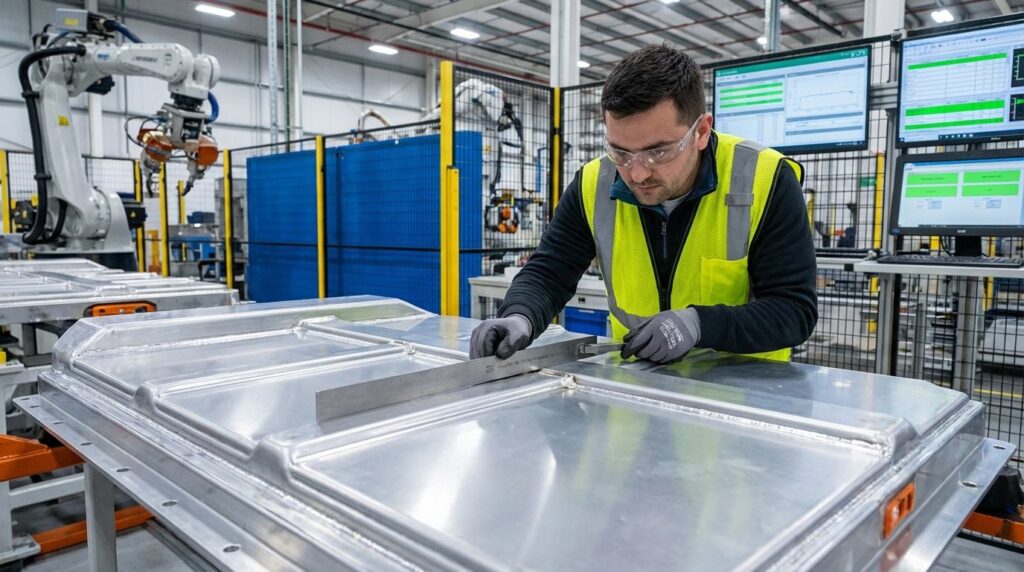
An EV battery tray (or enclosure) is the core structural component of an electric vehicle’s chassis, designed to carry and protect the expensive battery modules and liquid cooling systems. In the pursuit of extreme lightweighting, modern battery trays are typically constructed by joining extruded aluminum profiles.
Application Scenarios For EV Battery Tray
Due to the size limitations of aluminum extrusions, a complete battery tray (often measuring 2 meters long by 1.5 meters wide) must be pieced together from multiple profiles using Friction Stir Welding (FSW), MIG, or laser welding.
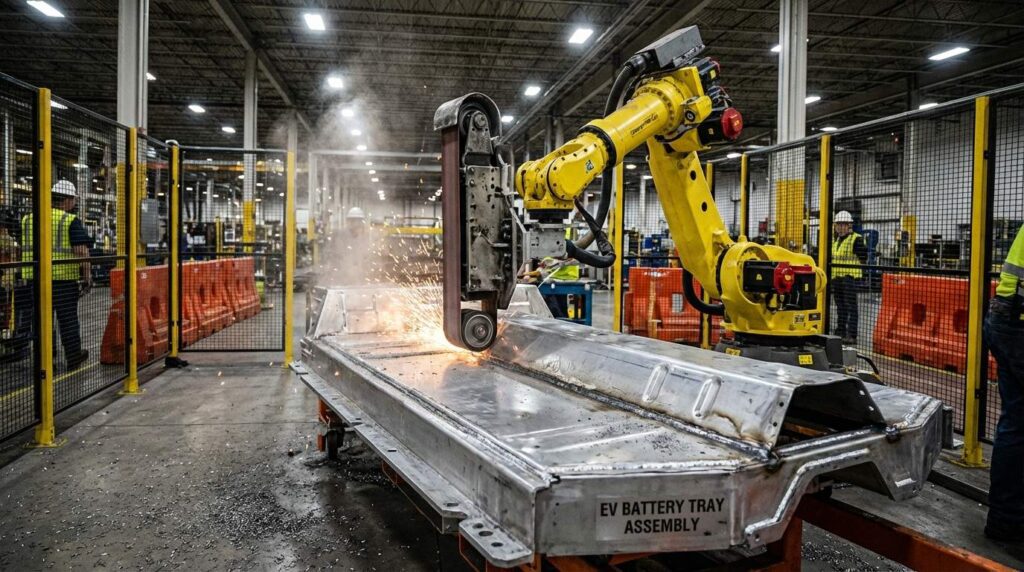
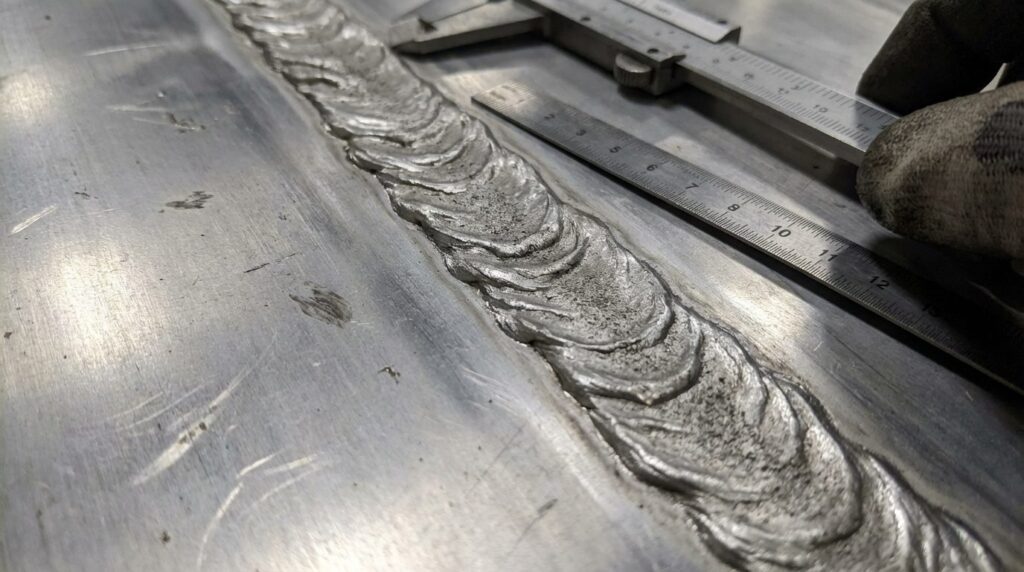
Once welded, the top perimeter of the tray (the sealing face mating with the cover) and the bottom liquid cooling plate areas are left with numerous weld beads of varying lengths that significantly protrude above the base metal. These raised seams must be thoroughly “blended flush”; otherwise, the subsequent automated glue-dispensing and sealing operations will fail.
Structural Characteristics For EV Battery Tray
Grinding battery trays presents extreme structural challenges:
- Ultra-Long and Irregular Seams: The total length of the sealing weld around the perimeter often exceeds 6 to 8 meters, including multiple 90-degree corners.
- Thin-Walled Aluminum Prone to Distortion: The wall thickness of the aluminum profiles is typically only 2-4 mm. Overheating during grinding can easily cause the entire chassis to warp.
- Dimensional Tolerances due to Welding Distortion: Massive trays undergo thermal stress deformation after welding, causing the actual physical location of the weld seams to deviate from the 3D CAD drawings by millimeters or even centimeters.
Key Characteristics of Battery Tray Grinding
الخصائص الرئيسية:
- Absolute Flatness: The ground weld seam must achieve a zero-step flush finish with the adjacent aluminum base metal. There can be no protrusions, and “over-cutting” (gouging into the parent material) is absolutely forbidden.
- Extreme Airtightness: A perfectly flat surface is required to guarantee the perfect compression of the sealing gasket, meeting the stringent IP68 (submersion) dust and waterproof test requirements for battery packs.
- Prevention of Micro-cracks: Grinding force must be uniform to prevent stress concentration and micro-cracks in the heat-affected zone (HAZ) of the weld.
Technical Parameters for Weld Blending
| البند | نطاق المعلمات | الملاحظات |
| Rough Grinding Removal | Bead height 1.5mm – 3.0mm | Primarily targets FSW or MIG welds |
| Grinding Contact Force | 30N – 80N (Dynamic Adaptive) | Maintained by heavy-duty active force control spindle |
| Final Surface Flatness | < 0.1 mm / 100mm | Meets strict requirements for sealant application |
| Surface Roughness | Ra 3.2 – 6.3 μm | Provides sufficient adhesion for structural adhesives |
| Path Tracking Precision | ± 0.2 mm | Relies on 3D laser vision tracking systems |
Why is Robotic Grinding Preferred for Battery Trays?
نقاط ألم الطحن اليدوي التقليدي
Relying on workers holding manual angle grinders to process these massive, 100+ kg trays covered in meters of welds is disastrous:
| نقطة الألم | مشكلة محددة | التأثير |
| Disastrous “Over-cut” Scrap Rates | As workers fatigue, they easily press the grinder too hard on the thin aluminum, gouging a crater into the base metal. | A “crater” destroys the sealing capability. Trays worth thousands of dollars are instantly scrapped. |
| Inefficient and Unstable | Continuously grinding meters of welds is exhausting; a worker can only process a few trays a day. | Becomes the most severe “bottleneck” on the entire automotive assembly line. |
| Aluminum Dust Explosion & Health Risks | Manual grinding fills the workshop with highly explosive aluminum dust, and poses severe occupational health risks. | Faces severe environmental shutdown risks and exorbitant worker compensation claims. |
مزايا الأتمتة الآلية الآلية
Robotic automated grinding systems (equipped with heavy-duty linear tracks or positioners) are currently the standard configuration for automotive OEMs and Tier 1 die-casters to solve battery tray delivery challenges—for equipment selection background, see our robotic grinding guide:
| بُعد المقارنة | الطحن اليدوي | الطحن الآلي | التحسينات |
| Flatness Control | Uneven, frequent scrap | Consistently flush | Grinding-related leakage complaints largely disappear |
| كفاءة التصنيع الآلي | Highly manual, very slow | 24/7 continuous high-speed cutting | Capacity tracks the auto line takt |
| الحياة المستهلكة | Sandpaper wears fast and unevenly | Auto length measure & force comp | Abrasive spend per part falls |
| Safety & Compliance | High-hazard, dirty environment | Wet dust collection, fully enclosed | Meets the strictest global ATEX/explosion-proof standards |
المزايا الأساسية:
- Active Flush Grinding: Unlike traditional rigid position control, the robot’s force-controlled spindle acts like an active suspension. No matter how hard the weld is or how much the tray surface undulates, the abrasive belt always cuts with a preset, constant pushing force. It only shaves off the protruding weld; the moment it touches the base metal, it glides over, completely preventing over-cutting.
- Laser Seam Tracking: Utilizing a front-mounted laser line scanner, the robot scans the actual 3D contour and offset of the weld seam milliseconds before grinding. It recalculates the toolpath in real-time, completely overcoming the dimensional tolerances caused by the massive thermal distortion of the aluminum parts.
Automated Weld Blending Process Workflow
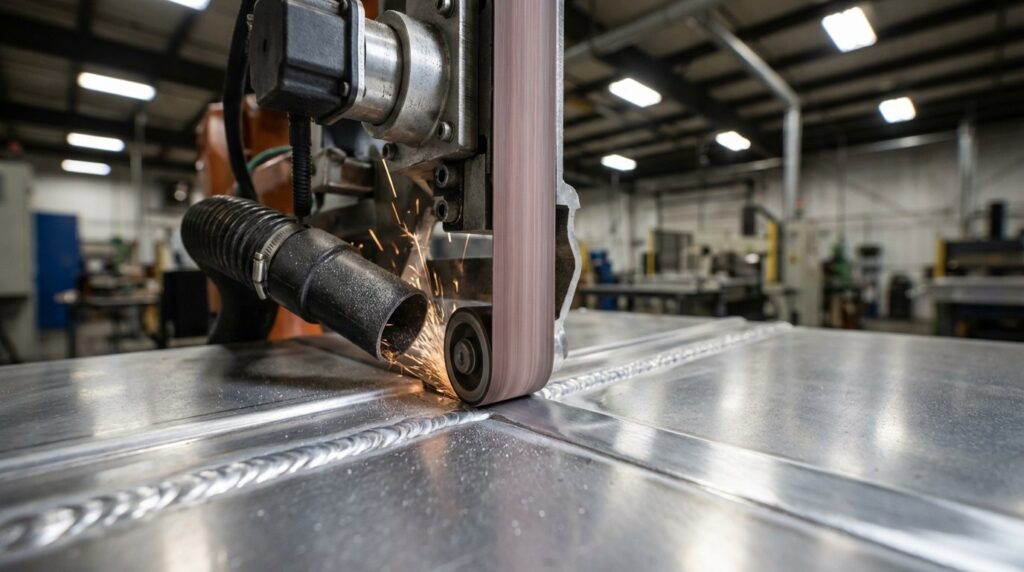
Flush-grinding the top sealing seams of a large battery tray breaks into eight steps, the heart of which is the vision-guided, constant-force cutting of steps 02-04.
Battery Trays Complete Grinding Process Flow
| العملية | اسم العملية | المعدات | مستهلك | الوقت | الدقة/الغرض |
| 01 | Auto Load/Unload | Gantry / Large Positioner | - | 45s | Rapidly secure massive 2-meter workpieces |
| 02 | Laser Scanning & Tracking | 3D Profile Laser Sensor | - | 30s | Real-time compensation for weld distortion offsets |
| 03 | Heavy Flush Grinding | Robot + Heavy Force Belt Sander | Coarse Ceramic Belt | 180s | Quickly mill down towering weld beads flush with base metal |
| 04 | Transition Blending | Robot + Flap Disc / Nylon Pad | Fine Grit Flap Disc | 120s | Eliminate coarse grind marks, provide uniform texture |
| 05 | Wet Dust Extraction | ATEX Wet Scrubber (Extractor) | Water / Defoamer | تابع. | Prevent accumulation of explosive aluminum dust |
| 06 | High-Pressure Air Blow | End-of-Arm Air Nozzle | Compressed Air | 40s | Blow off remaining metallic chips from the surface |
| 07 | In-line Flatness Insp. | Laser Distance Sensor | - | 45s | Confirm weld height deviation is < 0.1mm |
| 08 | Leak Test Prep | Transfer to Leak Check Station | - | 30s | Prepare for subsequent Helium/Air pressure decay testing |
Battery Trays Grinding Process Descriptions
Step 1: Auto Load/Unload
الغرض: Firmly lock the cumbersome aluminum tray onto the processing platform.
النقاط الرئيسية: Due to the massive size, this usually utilizes a dual-axis tilt-turn positioner, or a handling robot paired with a grinding robot, achieving non-stop alternating operations.
Step 2: Laser Scanning & Tracking
الغرض: Resolve the discrepancy between “CAD drawing coordinates” and “actual physical coordinates”.
النقاط الرئيسية: A laser mounted ahead of the grinding tool rapidly sweeps the weld seam, generating the actual height and deviation coordinates of the bead. The system algorithm instantly reconstructs the grinding path.
Step 3: Heavy Flush Grinding
الغرض: The core “peak shaving” process.
النقاط الرئيسية: The force-controlled belt sander runs at full power, rapidly milling the hard 2-3mm protruding weld bead down to a flush state. The force sensor ensures that once the weld is flush, the pressure on the parent material drops instantly, preventing any craters.
Step 4: Transition Blending
الغرض: Unify the surface texture.
النقاط الرئيسية: It requires not just flatness, but uniform roughness. The robot uses a flap disc along the path for secondary smoothing, creating an excellent “adhesive bonding surface” for the sealant.
Step 5: Wet Dust Extraction
الغرض: Cutting massive amounts of aluminum generates highly dangerous, flammable dust. It must be immediately vacuumed away at the cutting point by powerful negative pressure into a water-bath (Wet Scrubber) explosion-proof dust collector.
Step 6: High-Pressure Air Blow
الغرض: Clean the work zone to prevent residue from entering the highly dust-sensitive glue dispensing station downstream.
Step 7: In-line Flatness Inspection
الغرض: Eliminates manual feeler gauge measurements. The system uses a laser to re-scan the ground area, automatically determining if the absolute flatness meets the requirements.
Step 8: Leak Test Prep
الغرض: Passed trays are sent to the sealing test chamber for extremely rigorous helium or air pressure differential leak testing.
تحديات التصنيع الآلي وحلولها
Challenge 1: Robot “Misses” the Weld Due to Massive Part Distortion
المشكلة:
- After experiencing high-heat welding, the overall skeleton of a 2-meter long, thin-walled aluminum tray inevitably warps and twists.
- If the robot rigidly follows the path programmed offline, it will often grind empty air on one section while deeply gouging the base metal on another.
الحل:
- Introduce 3D Vision and Laser Seam Tracking Technology.
- The robot no longer grinds “blindly”. Before every pass, the vision system acquires the true deformed posture of the tray, feeding the 3D deviation data back to the robot controller in real-time.
- النتيجة: Completely ignores fixturing errors and welding thermal distortion, ensuring the grinding abrasive is always 100% precisely centered on the weld bead.
Challenge 2: Extreme Explosion-Proof Safety Requirements for Aluminum Dust
المشكلة:
- High-speed grinding of aluminum generates fine Aluminum Dust. If it reaches a certain concentration in the air, the smallest static spark can trigger a devastating explosion. European and American factories have extremely strict safety and environmental standards (ATEX / NFPA) regarding this.
الحل:
- Fully Enclosed, Explosion-Proof Grinding Cell Design.
- Employs wet dust collectors (drawing aluminum powder directly into water for passivation and settling).
- The cell uses explosion-proof motors, anti-static flooring, and is equipped with an online dust concentration monitoring/alarm system and automatic explosion relief doors.
- النتيجة: Dispels all concerns from multinational auto clients regarding facility safety, easily passing the most rigorous EHS audits.
Application Scenario
Project Profile
Project profile: a Tier 1 EV chassis component supplier in North America, serving a pure-EV OEM whose battery packs demand strict IP68 airtightness and aggressive lightweighting.
التحديات التقنية
- The client’s new generation battery tray uses 7-series high-strength aluminum extrusions joined by Friction Stir Welding (FSW).
- The FSW seams are extremely hard and total roughly 8 meters in length. A manual line staffed across three shifts could not hold flatness, and over-cut scrap ran at double-digit rates.
- Production capacity severely lagged behind the OEM’s demand.
الحل
| البند | التكوين |
| قطعة العمل | Pure EV Aluminum Battery Chassis Tray |
| Size/Weight | 2.1m x 1.4m, Approx. 85 kg |
| المعدات | 2 Heavy-Duty 6-Axis Robots on a 7th-Axis Linear Track + 2 Tilt Positioners |
| التكنولوجيا الأساسية | Laser Profile Scanning + Active Compliant Force Control |
| العملية | Laser Track -> Heavy Belt Flush Grind -> ATEX Wet Dust Extraction -> In-line Check |
| وقت الدورة | 6.5 Minutes / Entire 8-meter weld per tray |
نتائج التنفيذ
- Capacity: With two robots working collaboratively on the track, grinding time per tray falls from most of an hour by hand to a few minutes.
- Scrap Under Control: Thanks to constant-force floating technology, the gouge-type scrap that plagued the manual line essentially disappears, and ground welds approach milled-surface flatness.
- Return on Investment: Combining recovered scrap costs with labor savings, systems of this scale typically pay back within one to two years.
الأسئلة الشائعة
Q1: Can the robot handle welds in extremely narrow, inside corners of the tray?
A: Yes. Battery trays have sealing faces not only on the outer perimeter but often have short intersecting welds on internal reinforcing ribs. For these areas, the system utilizes an Automatic Tool Changer (ATC), dropping the bulky heavy-duty belt sander and picking up a compact angle grinder or flap wheel of the kind used on our 6-axis deburring equipment. Combined with the robot’s agile 6-axis posture, it precisely reaches into narrow corners for flush blending.
Q2: What if a batch of trays has exceptionally high weld beads that the robot cannot flush in one pass?
A: Our force-control spindle features intelligent feedback. When encountering an abnormally large bead that cannot be cleanly removed in a single pass, the system detects this via the spindle motor torque or post-grind laser inspection data. The robot will automatically retract and perform a secondary or even tertiary touch-up pass on that specific high spot until it meets the absolute flush standard, ensuring no defective part is passed down the line.
Q3: Why is it necessary to use a belt sander instead of a traditional hard grinding wheel to blend the welds?
A: Aluminum alloys are soft and extremely prone to “loading” (sticking) during grinding. Traditional hard ceramic wheels quickly get clogged with aluminum chips, losing their cutting ability and generating massive friction heat. We use wide-format ceramic abrasive belt sanders; the belts have a long circumference, dissipate heat rapidly, and are somewhat self-sharpening. Combined with the compliance of the force control system, it is the best choice for rapid, large-area “peak shaving” without damaging the parent aluminum.
Q4: Are there high facility requirements to install this massive robotic system?
A: Because the battery tray itself is massive, a standard grinding cell (including robots, positioners, explosion-proof enclosure, and load/unload buffers) typically requires a floor space of about 8m x 6m. Additionally, the workshop must provide stable industrial compressed air and explosion-proof rated main power. Our engineering team will provide detailed 3D layout planning during the initial phases.
الخاتمة
The weld blending of new energy aluminum battery trays is not merely surface treatment; it is “sealing engineering” that concerns the driving safety of the vehicle. Employing a heavy-duty robotic grinding system integrating laser tracking and active force control addresses the over-cut scrap, capacity limits and safety hazards of manual grinding. Blending meters of hard weld beads into the base metal within minutes, it is a proven route to scalable, high-quality delivery for automotive Tier 1 factories. For a compact aluminum casting example on the same heavy-payload platform, see our die-cast motor housing deburring solution.
Whether the pain shows up as grinding scrap, unfilled operator positions or EHS audit findings, a laser-tracked, force-controlled grinding cell addresses all three at once. Talk to our automotive team about a project assessment and proof-of-concept run on your own trays.