

A robotic polishing machine typically costs from about $80,000 for a basic single-station cell to $300,000+ for a fully engineered multi-station production system, with multi-robot lines quoted as individual projects above that band. Those are planning ranges for budgeting, not offers—every real number is set by your parts, your takt, and how much engineering stands between a demo and a cell that holds finish on shift two.
The band is wide because a polishing cell is an engineered product, not a catalog item. The robot arm everyone recognizes typically accounts for only 20–40% of the total; the rest is tooling, fixtures, integration labor, safety, and dust management. Two quotations built on the same arm can differ by a factor of three, and both can be honest.
This guide is the money half of the equation. It breaks down where a robotic polishing machine price actually goes, which variables move it, what you will spend in year one beyond the purchase order, and how to read a quotation line by line. If you are still deciding what kind of machine you need, start with our robotic polishing machine selection guide—that page covers architecture and force control; this one only covers cost.
Why Two Quotes for the Same Part Can Differ by Three Times
Send the same faucet drawing to three integrators and the numbers that come back rarely cluster. The spread is usually scope, not greed:
- __One quote is a bare cell, the other is a landed project.__ An EXW number that excludes freight, installation, commissioning, and training sits naturally 25–40% below a turnkey DDP-style proposal covering all of it.
- __Part family assumptions differ.__ One bidder prices one fixture and one program; another noticed your drawing revision sheet implies four SKUs and priced four.
- __The process route differs.__ A vendor quoting passive compliance tooling for a curved cosmetic part will come in cheaper than one who specified a force-torque sensor—then struggle to hold the Ra band later. The cheap route and the correct route are different products.
The fix is not to average the quotes. Take the lowest one, decompose it against the cost anatomy below, and find out which lines are missing. That exercise, more than any negotiation, is what a price guide is for.
Cost Anatomy: Where the Money Actually Goes
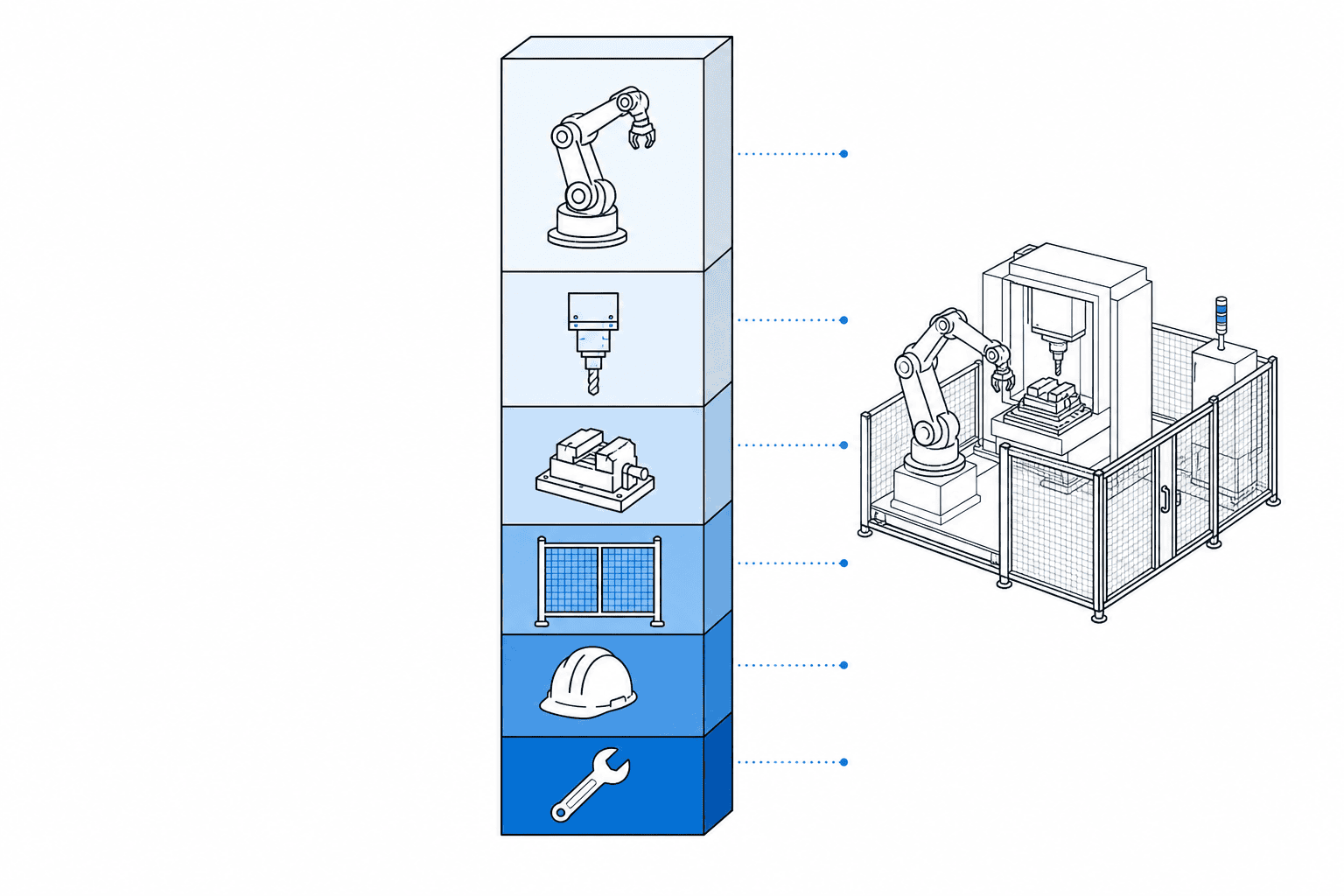
A turnkey robotic polishing cell divides into six cost blocks. Typical shares look like this:
| Cost block | Typical share of cell price | What moves it inside the range |
|---|---|---|
| Robot arm and controller | 20–40% | Payload and reach tier, protection class against dust, new vs. refurbished unit |
| End-of-arm tooling, force control, tool changers | 15–25% | Tools per cycle, active closed-loop vs. passive compliance, gripper count |
| Fixtures, stations, structure, guarding | 15–25% | Part family count, quick-change vs. dedicated fixtures, positioner axes |
| Integration engineering, programming, commissioning | 15–30% | Path complexity, teach vs. offline programming, on-site days |
| Periphery: dust extraction, safety, conveyors, documentation | 10–20% | Dust class and airflow, fencing vs. light curtains, CE/UL file |
| Spare tooling and wear-parts starter kit | 2–5% when included | Abrasive grades stocked, compound range |
Two lines deserve special attention. The engineering block is the one most often trimmed to make a number attractive—and the most common source of change orders later, because a cell that arrives but never reaches rated output was under-scoped right there, in programming and commissioning hours. And the periphery block is the one buyers forget at budgeting stage: polishing sludge is flammable, so adequate extraction is not an upgrade, it is the difference between a permitted production cell and a beautiful demo.
Read as scope rather than dollars, the price bands separate cleanly. Around $80,000–150,000 buys a single-station cell—one robot, one or two tools, a fixture or two, basic guarding and extraction—for a limited part family with moderate finish demands. From roughly $150,000 to $300,000+, the money increasingly buys engineering: multi-station layouts, automatic tool changers, vision or laser part location, quick-change fixtures for higher family counts, offline programming, and turnkey delivery with FAT and on-site commissioning. Above that band, systems commonly grow into lines rather than single cells—multiple robots, conveyor-linked stations, line-level controls—and are priced as the projects they are.
The Five Variables That Move Your Quote
Within the $80,000–$300,000+ band, five properties of your production determine where you land.
__1. Part geometry complexity.__ Simple parts—turned profiles, flat panels, single-radius extrusions—finish on basic tooling with short programs and sit at the bottom of the range. Every deep cavity, tight internal radius, and blended transition adds axes, tool variety, and above all programming hours, which bill like any engineering time. Complex cosmetic geometry does not mainly cost hardware; it costs path development.
__2. Part family count.__ One part family means one fixture and one program. Each additional family adds a fixture set (plus a gripper, in part-in-hand architectures), another program, and another trial-and-approval cycle. Ten families do not cost ten cells, but they push the design toward quick-change tooling and offline programming—upfront capex that pays back through shorter changeovers.
__3. Takt time: single vs. double stations.__ If one robot tracing your part cannot meet required parts per hour, the answer is parallel capacity: a second station, a second fixture position, a positioner that presents the part while the robot cuts, or a second robot. Doubling stations roughly doubles the station-side hardware while sharing the controller infrastructure, safety system, and extraction—this single variable is what most often lifts a project from the $100,000s into the $200,000s and beyond. One quoting discipline saves real money here: state your three-year volume, not this quarter’s, because a cell is sized once and lived with for a decade.
__4. Changeover frequency.__ High-mix plants need parametric programs, quick-change fixtures, and operators who can call a recipe without an engineer. Low-mix plants can invest the same money in hard fixtures and cycle-time optimization instead. Neither choice is wrong, but they price differently at order time and opposite at operating time.
__5. Validation requirements.__ Some buyers accept a signed sample and a Ra measurement report; others require formal process validation, capability studies across a production batch, or customer-specific documentation of the kind common in die-casting supply chains—see our die-casting deburring automation overview for what that documentation tail looks like. Validation scope converts directly into engineering days on the quotation.
Year-One Costs Beyond the Purchase Order
The purchase order is not the year-one number. Budget these lines on top of the cell price:
| Articolo | Typical year-one outlay | Note |
|---|---|---|
| Site preparation | Buyer scope in most quotations | Foundation, three-phase power, compressed air, ducting routes, floor space |
| Installation and commissioning | Included in turnkey scope; otherwise billed as engineer-days plus travel | Confirm which case applies before comparing quotes |
| Operator and maintenance training | A few days, bundled or as a line item | Ask whether refresher training is included or chargeable |
| Consumables: belts, wheels, compounds, filters | Roughly 1–3% of cell price per single-shift year, rising with shifts | Volume-driven; scales almost linearly with output |
| Scheduled maintenance and spares | Commonly 2–5% of cell price per year | Seals, spindle service, sensor recalibration, spare tools |
Site preparation is the line that surprises export buyers most often: power standards, air quality, and foundation requirements differ by country, and none of it ships inside the crate. Consumables are the line that surprises everyone eventually—an abrasive belt is a wear part, not a purchase, and a two-shift cell consumes roughly twice what a one-shift cell does. As a rough planning figure, year-one spend beyond the cell price commonly lands near 8–12% of the cell price (consumables, maintenance and power together run on the order of 5–10% per year, the same band used in our ROI guide) for single-shift operation, dominated by site works and the first consumables cycle. None of these are reasons to hesitate; they are simply the difference between a capital request and a number you can defend to finance.
For context on how these operating costs weigh against the labor they replace, our deburring and finishing automation ROI guide works through the payback calculation.
How to Get an Accurate Quotation Fast
Curious what happens after your drawings arrive? The turnkey project process guide maps the full path from inquiry to commissioning.
Integrators quote quickly and accurately in proportion to what they receive. A complete RFQ package for a robotic polishing machine contains five things:
- __3D models__—ideally STEP—plus 2D drawings with critical dimensions and tolerances
- __Physical sample parts__ where possible, in the exact incoming condition the cell will receive them
- __A measurable finish target__: Ra band, gloss units, or reference samples, not “same as the photo”
- __A takt or volume target__: parts per hour or per month, shift pattern, growth plans
- __Your current process described honestly__: how many people polish this part today, by what method, and what the typical defects are
With that package, a scoped quotation typically takes one to two weeks—simple single-family parts at the short end, multi-family cells with validation requirements at the long end. Without it, you will get either a placeholder range or an optimistic number, and both waste a cycle. The current-process description matters more than buyers expect: it tells the integrator what the part’s real incoming variation looks like, which is the single biggest driver of how much engineering the cell needs.
How to Read the Quotation: A Line-Item Checklist
Once proposals arrive, compare them on these lines before looking at the total:
| Line to verify | The question to ask | Why it matters |
|---|---|---|
| Scope of parts | Which part families, fixtures, and programs are included? | The most common silent gap between two numbers |
| Process trials | Was the number based on a trial or sample polishing study? | See the next section |
| FAT | Is factory acceptance testing at the vendor’s shop included, with your parts? | Your last cheap exit before the cell ships |
| Shipping | What Incoterms—EXW, FOB, CIF, DAP? | Freight and insurance can shift the total materially on export |
| Installation and commissioning | On-site days included, travel and living covered? | Determines whether “turnkey” is real or marketing |
| Training | Operator and maintenance sessions, refreshers, documentation language? | Determines whether the cell survives staff turnover |
| Warranty | Duration, parts and labor and travel, and what is excluded? | Wear parts are usually excluded; ask what else is |
| Acceptance criteria | What Ra, takt, and runtime define “accepted”? | Ambiguous acceptance criteria are how disputes start |
| Spares | Starter kit included, consumables priced, delivery times? | A cell is a system you will feed for a decade |
A quotation that answers all nine lines is a scoped offer you can negotiate. One that answers three of them is a marketing document with a number attached.
Where Cheap Quotes Go Wrong
Three patterns account for most expensive cheap quotes in this industry.
__The number without a trial part.__ Polishing is a contact process; nobody can price it responsibly from a PDF alone for a first-of-a-kind geometry. A serious integrator asks for sample parts or at minimum a 3D model review before quoting cycle time and finish capability. A quote produced without either was produced to win the order, not to build the cell.
__The refurbished arm sold as new.__ Refurbished robots are legitimate products at legitimate discounts—but sold as new, they carry new prices for old bearings, old harnesses, and expired support. Ask for the arm’s serial number, manufacture date, and run-hour count in writing, and check what warranty actually attaches to the arm itself rather than the cell overall.
__Integration scoped low, then change-ordered high.__ The bid comes in attractive because programming and commissioning were estimated against an idealized part with no incoming variation. Real castings arrive with a millimeter of scatter, and every discovery after signing becomes a change order at engineer rates. The defense is the acceptance criteria line above: force the trial, define the incoming part state, and pin the cycle-time commitment to that state.
Financing and Leasing: The One-Paragraph Version
Most equipment vendors, including exporting integrators, work with financing partners or accept leasing structures, and robotic cells commonly qualify for accelerated depreciation treatment where you operate. Leasing converts the capex conversation into an operating-cost one, which some finance departments prefer for exactly the labor-displacement math that polishing automation improves. Treat financing as a payment schedule question, not a machine selection question—agree the scope first, then the instrument.
Get a Line-Item Quotation, Not a Number
UBright Solutions engineers robotic polishing and deburring cells around parts, not around a catalog. Send 3D models or sample parts, your finish target, and your volume, and you will receive an architecture recommendation and a scoped, line-itemed quotation—typically within one to two weeks. Browse the full range of polishing and deburring equipment for context on cell formats, then contact our engineering team with your part package. If you are comparing equipment types before committing to a cell, our deburring machine buyer’s guide maps the alternatives and their cost logic.
Frequently Asked Questions
What is the price range for a robotic polishing machine?
Typical planning ranges: basic single-station cells start around $80,000, commonly running $80,000–150,000 for simple parts; engineered multi-station cells with tool changers, vision, and turnkey delivery typically span $150,000 to $300,000+; multi-robot production lines are quoted as individual projects. These are examples for budgeting—actual pricing depends on part geometry, family count, takt, and validation scope.
Why do robotic polishing machine prices vary so much between suppliers?
Mostly scope. The robot arm is typically 20–40% of a cell, so the majority of any quotation is tooling, fixtures, engineering, and periphery—and each bidder scopes those differently. One number may exclude freight, commissioning, training, and trial work that another includes. Normalize the quotes against the cost anatomy above before comparing totals.
What is the typical lead time?
A scoped quotation typically takes one to two weeks from a complete RFQ package. From purchase order to acceptance, cells typically take three to six months, driven less by the robot itself than by fixture design, tooling procurement, and FAT/SAT test cycles.
What payment terms are typical?
Staged payments against milestones are the norm in custom equipment—for example, a deposit with the order, progress payments, and balance against factory acceptance or shipment. Export orders frequently use letters of credit. Exact structures vary by project size and vendor, so confirm milestones in writing when you confirm scope.
What should I send to get an accurate quotation?
Five items: 3D models (STEP preferred) plus 2D drawings, physical sample parts in their incoming condition, a measurable finish target such as an Ra band, a takt or monthly volume target, and an honest description of your current process including staffing and typical defects. With that package, quotations come back scoped rather than speculative.

