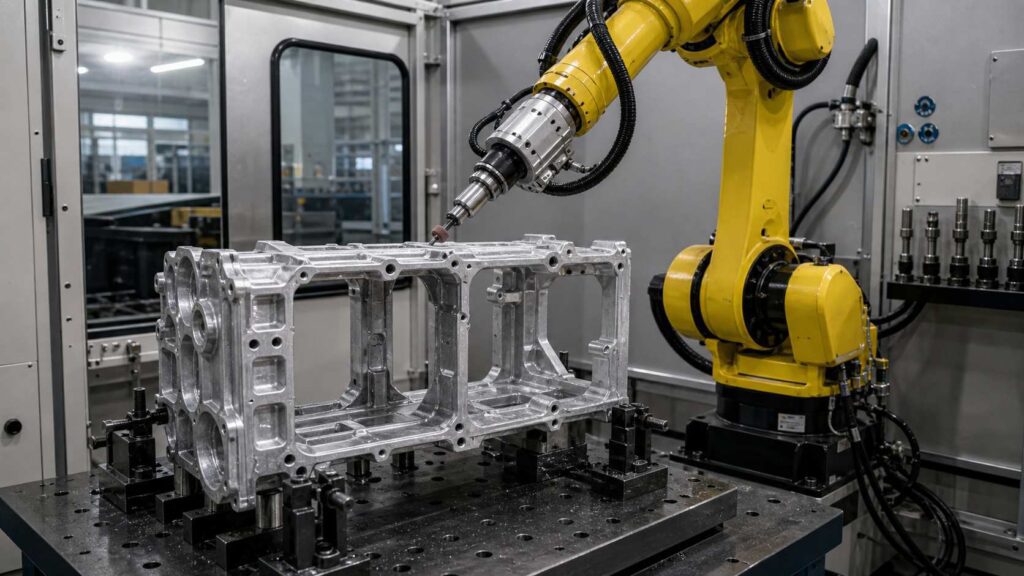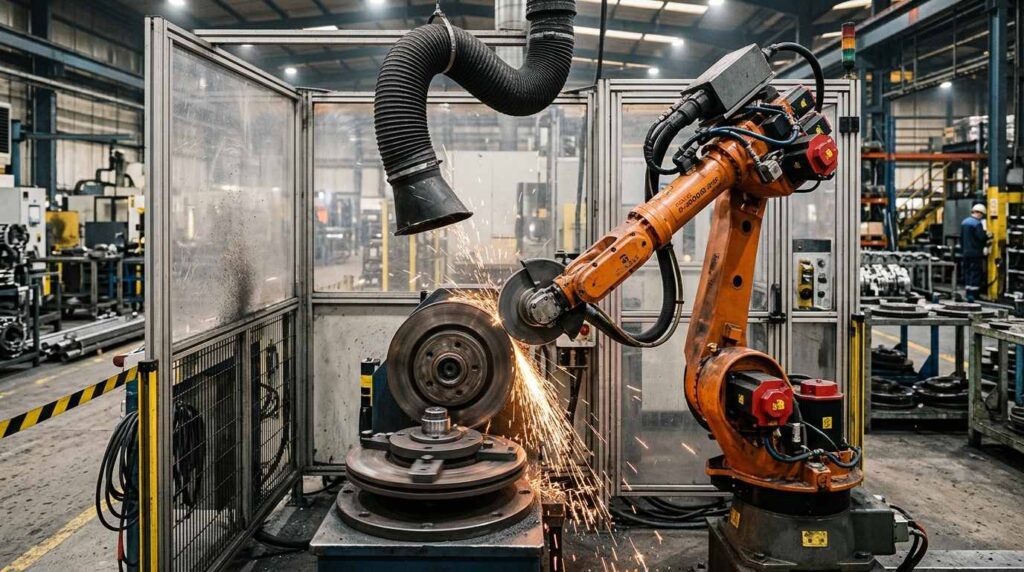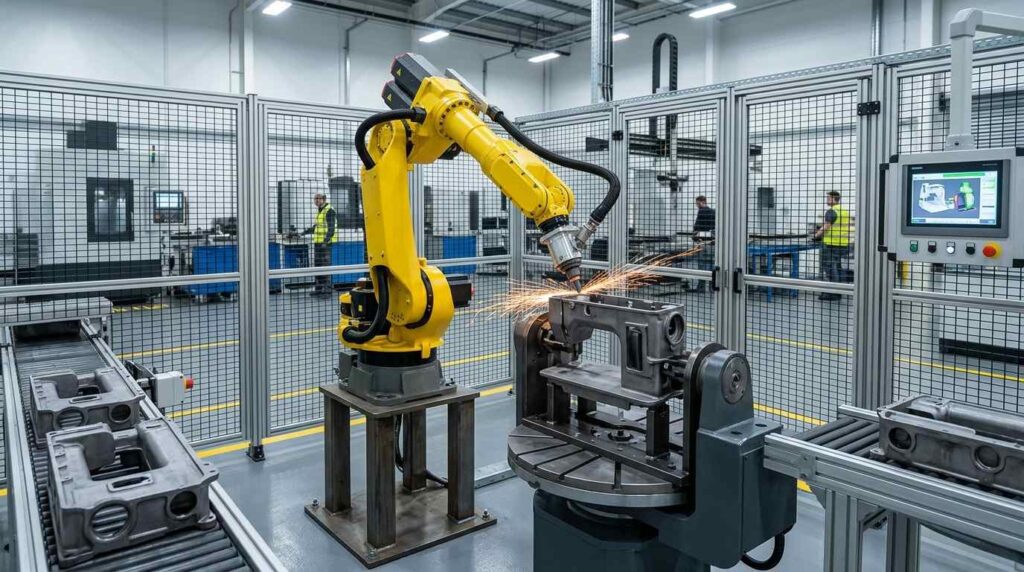
Sewing machine casings are structural housing components used in industrial sewing machines, textile machinery and related mechanical equipment. As a typical cast iron casing, the workpiece usually has an irregular housing shape, internal cavities, outer contours, mounting areas, ribs, bosses and multiple transition edges. Compared with simple flat castings, casing parts require more careful finishing because both internal and external contours may contain burrs, flash and sharp edges.
During casting and rough machining, sewing machine casings may develop casting flash, burrs, parting lines, sharp edges and local surface irregularities around the outer profile, inner cavity, rib transitions, hole edges and mounting areas. If these defects are not removed properly, they may affect assembly, coating, handling safety and the appearance consistency of the finished equipment.
Traditional manual grinding requires workers to process both the outside profile and the internal cavity of the casing. The tool angle changes frequently, and some areas are difficult to reach by hand. This makes the finishing process labor-intensive, inconsistent and highly dependent on operator experience. A robotic grinding solution provides a more stable and repeatable method for deburring and contour finishing of sewing machine casings.
This solution is designed for cast sewing machine casings with typical dimensions around 460 × 220 × 120 mm. It focuses on robotic grinding, deburring, inner and outer contour finishing, edge smoothing and surface preparation before coating, assembly or shipment.
What is a Sewing Machine Casing?
A sewing machine casing is the main housing or structural shell used to support and protect internal mechanical components of a sewing machine. In industrial sewing machines, the casing often carries shafts, gears, bearings, guide mechanisms, fasteners and other precision assemblies. It must provide rigidity, dimensional stability and reliable mounting support.
Cast iron is commonly used for industrial machine casings because it offers good vibration damping, rigidity, castability and long service life. The casing structure usually includes external profiles, internal cavities, reinforcement ribs, mounting bosses, holes, machined interfaces and local transitions. These features create many burr-prone and flash-prone areas after casting.
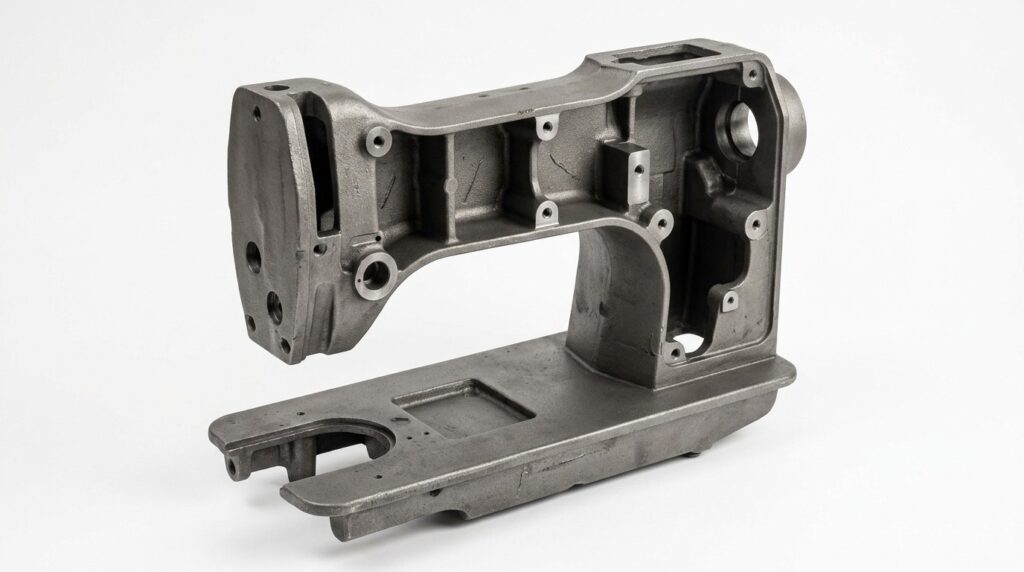
Although key assembly surfaces may be machined later, the cast body still needs finishing. Burrs and sharp edges inside the cavity can interfere with assembly or maintenance. Flash on the outer profile can affect appearance and coating quality. Rough edges around bosses, holes and ribs can create handling risks and inconsistent product quality.
| Item | Detalhes |
|---|---|
| Nome da peça | Sewing Machine Casing |
| Tamanho típico | 460 × 220 × 120 mm |
| Material | Ferro fundido |
| Processo principal | Retificação robotizada |
| Processos assistidos | Remoção de rebarbas, arredondamento de bordas, acabamento de superfícies |
| Principais áreas de processamento | Inner cavity, outer contour, rib edges, bosses, hole edges, parting lines |
| Gol da vitória | Remove burrs, casting flash, sharp edges and contour defects |
Robotic grinding on a sewing machine casing is functional work: clearing casting defects from complex internal and external contours, tightening edge consistency and getting the part ready for coating and assembly.
Typical Applications of Sewing Machine Casings
Sewing machine casings are mainly used in machinery and textile equipment where structural stability and assembly accuracy are required. The casing is usually a functional part rather than a decorative component, but its surface and edge quality still affect manufacturing quality.
| Área de aplicação | Uso típico |
|---|---|
| Industrial Sewing Machines | Main machine housing and structural support |
| Textile Machinery | Casing for mechanical transmission and guide systems |
| Garment Manufacturing Equipment | Housing for high-speed sewing mechanisms |
| Mechanical Equipment | Cast housing for shafts, bearings and internal moving parts |
| Small Industrial Machines | Structural casing with internal cavity and mounting areas |
| OEM Machinery Components | Customized cast casing for equipment manufacturers |
In these applications, burrs and flash may affect assembly efficiency, coating quality and maintenance safety. Consistent casing finishing helps manufacturers improve both production stability and final product quality.
Pain Point Analysis of Sewing Machine Casing Finishing
The first challenge is the complex casing geometry. A sewing machine casing is not a simple block or plate. It may have curved surfaces, internal cavities, side openings, ribs, bosses and mounting sections. Each area requires a different tool angle and access path, making manual grinding difficult to standardize.
The second challenge is internal cavity deburring. Burrs inside the casing are harder to reach than external edges. Manual workers may miss small burrs in deep or narrow areas, especially when the cavity shape limits tool access.
The third challenge is outer contour consistency. The external profile of the casing often affects the final appearance after painting or coating. If casting flash or parting lines are not removed evenly, the finished casing may show visible defects.
The fourth challenge is protecting assembly-related surfaces. Some surfaces are used for mounting or alignment and must not be over-ground. A controlled robotic path can help process target areas while avoiding critical surfaces.
| Problema comum | Área específica | Impacto |
|---|---|---|
| Flash de lançamento | Outer contour and parting line areas | Affects coating and appearance quality |
| Internal Burrs | Inner cavity, ribs and openings | May affect assembly or maintenance safety |
| Arestas afiadas | Bosses, holes, ribs and local transitions | Creates handling and assembly risks |
| Irregularidade da superfície | Visible outer housing surfaces | Reduces surface preparation consistency |
| Variação manual | Complex internal and external contours | Causes unstable finishing quality |
| Dust and Labor Burden | Operação de retificação | Increases operator fatigue and workshop dust |
Compared with manual finishing, robotic grinding provides better repeatability for complex casing contours. The robot can follow programmed paths for external profiles, internal cavities and local burr-prone areas.
| Item de comparação | Esmerilhamento manual | Retificação robotizada |
|---|---|---|
| Inner Cavity Deburring | Difficult to reach consistently | Programmed access paths for internal areas |
| Outer Contour Grinding | Depends on operator angle and force | Repeatable contour finishing |
| Edge Quality | Varies by worker experience | More stable edge smoothing |
| Proteção de superfícies | Difícil de controlar manualmente | Defined target and protected zones |
| Intensidade de mão de obra | High due to complex shape | Reduces repetitive manual grinding |
| Produção em lote | É difícil padronizar totalmente | Programs can be saved and reused |
For manufacturers producing sewing machine casings in batches, robotic grinding helps reduce manual variation and improve consistency across repeated housing parts.
Robotic Grinding Process for Sewing Machine Casings
A robotic grinding cell for sewing machine casings can be configured according to the casing structure, burr locations, required finishing scope and production volume. The system usually includes a six-axis robot, dedicated fixture, abrasive grinding tool, flexible deburring tool, small grinding spindle, dust extraction system and safety enclosure.
Because the casing has both inner and outer features, the robotic process should be planned by zones. The robot may first process external flash and contour edges, then move to internal cavity burrs, hole edges, ribs and selected assembly-related areas.
| Etapa | Processo | Finalidade | Ferramenta / Sistema |
|---|---|---|---|
| 1 | Carregamento e posicionamento | Secure the casing accurately | Dedicated casing fixture |
| 2 | Seleção de programas | Selecione o caminho de acabamento correto | IHM / Programa do robô |
| 3 | Outer Contour Grinding | Remove flash and parting lines from external profile | Ferramenta de retificação abrasiva |
| 4 | Inner Cavity Deburring | Remove burrs from internal ribs and cavity edges | Ferramenta flexível para remoção de rebarbas |
| 5 | Hole and Boss Edge Finishing | Smooth edges around holes and bosses | Cabeçote de retificação pequeno |
| 6 | Local Transition Finishing | Process corners, ribs and geometry changes | Compliant abrasive tool |
| 7 | Controle de Qualidade | Verifique a remoção de rebarbas e as superfícies protegidas | Inspeção manual ou visual |
| 8 | Descarregamento e limpeza | Remova a poeira e transfira a peça | Limpeza com jato de ar / aspiração |
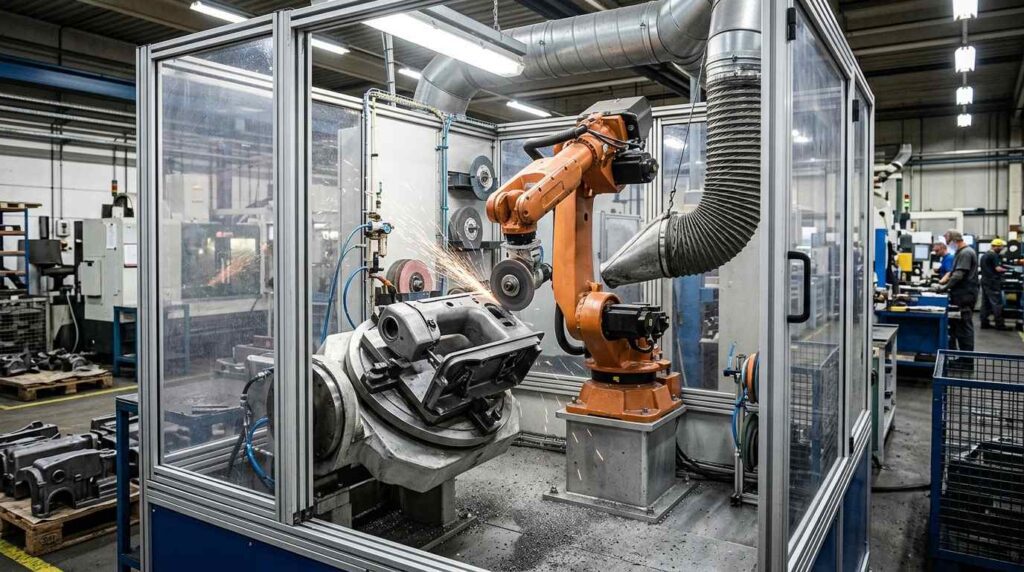
Etapa 1: Carregamento e posicionamento
The sewing machine casing is placed into a dedicated fixture. The fixture should hold the part securely while keeping the inner and outer processing areas accessible to the robot.
Because the casing may have an irregular shape, positioning accuracy is important. Stable clamping helps the robot maintain consistent tool contact and prevents vibration during grinding.
Etapa 2: Seleção do programa
The operator selects the corresponding robot program based on the casing model. Different sewing machine casings may have different cavity shapes, rib positions, hole layouts and outer contours.
For mixed production, the system can use recipe management, barcode scanning or fixture recognition to reduce the risk of selecting the wrong program.
Step 3: Outer Contour Grinding
The robot first processes the external profile of the casing. This step removes casting flash, parting lines and sharp edges along the outer contour. These areas are usually visible after painting or coating, so consistent finishing is important.
Abrasive grinding tools or compliant grinding heads can be used to follow curved or irregular casing profiles.
Step 4: Inner Cavity Deburring
After the outer contour is processed, the robot moves to the internal cavity. Burrs inside the casing may appear around ribs, openings, transition edges and local internal structures.
A flexible deburring tool or small abrasive spindle can remove burrs from these areas. The tool path must be planned carefully to reach internal features without damaging protected surfaces.
Step 5: Hole and Boss Edge Finishing
Sewing machine casings often include mounting holes, bearing-related bosses or local raised features. Burrs around these areas can affect assembly quality and handling safety.
The robot uses a smaller grinding head or deburring tool to smooth the edges around holes and bosses. This improves assembly readiness and reduces manual rework.
Step 6: Local Transition Finishing
Local corners, rib intersections and curved transitions often retain small burrs after the main grinding process. These areas are difficult for manual workers because the tool angle changes frequently.
The robot can process these local features with predefined approach angles, improving consistency and reducing missed burrs.
Etapa 7: Inspeção de qualidade
After grinding, the casing is inspected for burr removal, edge smoothness, outer contour quality and proper protection of assembly surfaces. Key inspection areas include the inner cavity, rib edges, hole edges, bosses and outer profile.
Inspection can be performed manually or with visual assistance depending on production requirements.
Etapa 8: Descarregamento e limpeza
The finished casing is removed from the fixture. Residual dust comes off with an air blast, a vacuum wand or a brush. The part can then move to coating, machining, assembly or packaging.
Dificuldades e soluções na usinagem
Sewing machine casings are challenging because they combine external contour finishing and internal cavity deburring in one workpiece. The robot system must provide accurate access, stable clamping and proper tool selection for different local features.
| Desafio | Causa | Solução robótica |
|---|---|---|
| Complex Outer Contour | Irregular casing profile creates changing tool angles | Programmed contour path with compliant tool |
| Internal Burrs | Cavity, ribs and openings are hard to reach manually | Flexible deburring tool with defined access path |
| Hole and Boss Edges | Local features create burrs after casting or machining | Small grinding head for local edge finishing |
| Proteção de superfícies | Assembly areas must not be over-ground | Accurate fixture and defined target zones |
| Geração de poeira | Cast iron casing grinding creates fine particles | Câmara fechada com sistema de extração de poeira |
Difficulty 1: Complex Outer Profiles Require Changing Tool Angles
The external contour of a sewing machine casing may include curves, steps, ribs and transitions. Manual grinding quality depends heavily on operator angle and pressure.
The solution is to use programmed robotic contour paths. The robot maintains repeatable motion and tool orientation, helping create more consistent finishing results on the outer profile.
Difficulty 2: Internal Cavity Burrs Are Difficult to Remove
Burrs inside the casing are harder to see and reach. Manual workers may miss burrs in internal ribs, openings or recessed areas.
The solution is to use flexible deburring tools and carefully planned internal access paths. The robot can process selected internal areas in a defined sequence and reduce missed burrs. Cell platforms such as our 6-axis deburring equipment are built around exactly this kind of multi-feature access.
Difficulty 3: Hole and Boss Edges Need Controlled Finishing
Holes and bosses are important assembly-related features. Burrs in these areas can interfere with fastener installation, bearing placement or internal component assembly.
The solution is to use small grinding heads or deburring tools for local edge finishing. The robot can target these features without unnecessary grinding on nearby protected surfaces.
Dificuldade 4: As superfícies funcionais devem ser protegidas
Some casing surfaces may be used for mounting, alignment or sealing. These surfaces should not be over-ground during burr removal.
The solution is to use accurate fixturing and clearly defined robot paths. Only the designated burr-prone areas are processed, while critical surfaces are avoided.
Difficulty 5: Manual Grinding Creates Dust and Fatigue
Casing finishing requires workers to repeatedly change tool angles and handle multiple local areas. This increases fatigue and exposes operators to cast iron grinding dust.
The solution is to integrate the robotic grinding cell with dust extraction and safety enclosure design. This improves the working environment and reduces heavy manual labor.
Application Scenario
Scenario Background
Take a machinery component maker supplying cast sewing machine casings to industrial sewing equipment builders. Each casing brings an internal cavity, outer contours, mounting bosses and multiple local edges that all need burr removal before coating and assembly.
With manual grinding and deburring, the strain lands on exactly the two hardest tasks: reaching internal burrs and keeping the outer contour consistent once volumes climb.
Desafios técnicos
Irregular external surfaces and internal ribs that resist hand access define the difficulty. Burrs survive deep in the cavity, and outer contour quality shifts with whichever worker is on the job.
Assembly-related surfaces need protection while burr-prone edges, holes and bosses gain consistency, and manual grinding dust hangs over the whole finishing area.
Solução
A typical UBRIGHT SOLUTIONS cell for this part is built from a six-axis industrial robot, a dedicated casing fixture, an abrasive grinding tool, a flexible deburring tool and dust extraction.
Flash leaves the outer contour and parting lines first. The robot then works through internal cavity burrs, hole edges, bosses and selected transitions with smaller, more flexible tooling, while the fixture holds positioning steady for both inner and outer features.
| Item | Configuração |
|---|---|
| Peça de trabalho | Sewing Machine Casing |
| Tamanho típico | 460 × 220 × 120 mm |
| Processo principal | Retificação robotizada |
| Processo assistido | Internal Deburring and Contour Finishing |
| Robô | Robô industrial de seis eixos |
| Ferramentas | Abrasive Grinding Tool, Flexible Deburring Tool, Small Grinding Head |
| Calendário | Dedicated Casing Fixture |
| Controle de poeira | Célula fechada com coleta de poeira |
| Inscrição | Inner cavity deburring, outer contour grinding, local edge finishing |
Expected Results
The configuration is expected to settle inner cavity deburring and outer contour quality into a stable pattern. Manual finishing workload falls, and burr removal standardizes across repeated casing models.
The enclosure keeps dust in check, and validated paths are reused from saved programs whenever a recurring casing model returns to the cell.
| Área de Resultados | Expected Improvement |
|---|---|
| Inner Deburring | Fewer missed burrs inside cavity and rib areas |
| Outer Contour Quality | More consistent external profile finishing |
| Redução da mão de obra | Redução da carga de trabalho manual repetitiva de esmerilhamento |
| Proteção de superfícies | Melhor controle das áreas-alvo e das áreas protegidas |
| Process Stability | Reusable robot programs for repeated casing models |
| Controle de poeira | Cleaner finishing environment with dust extraction |
PERGUNTAS FREQUENTES
Q1: Why is robotic grinding suitable for sewing machine casings?
Robotic grinding is suitable because sewing machine casings have complex internal and external contours. The robot can process defined burr-prone areas with repeatable paths, improving consistency compared with manual grinding.
Q2: What areas of a sewing machine casing are typically processed?
Common areas include the outer contour, parting lines, internal cavity edges, ribs, bosses, hole edges and local transition zones. The exact processing scope depends on the casing structure and finishing requirements.
Q3: Can the robot remove burrs inside the casing cavity?
Yes. With suitable tool selection and path planning, the robot can remove burrs from internal cavity edges, ribs and openings. Flexible deburring tools and small grinding heads are often used for these areas. If you want the basics first, see what robotic deburring is.
Q4: Does the robot grind the entire casing surface?
Not always. In most cases, the robot processes defined target areas such as flash zones, burr-prone edges and local contours. Functional mounting or alignment surfaces should be protected according to process requirements.
Q5: Can one robotic cell process different casing models?
Yes. Different casing models can be processed if suitable fixtures and robot programs are prepared. For product families with similar structures, quick-change fixtures can reduce changeover time.
Q6: How does robotic grinding improve outer contour consistency?
The robot follows a predefined contour path with stable tool movement and repeatable orientation. This reduces variation caused by different manual operators and improves finishing consistency across batches.
Q7: Is polishing required for sewing machine casings?
In most cases, no. Sewing machine casings usually require grinding, deburring and surface preparation rather than decorative polishing. The main goal is to remove burrs and prepare the part for coating and assembly.
Q8: Can the system include dust extraction?
Yes. Dust extraction is recommended for cast iron casing grinding. The robotic cell can include an enclosure, local suction and filtration equipment to improve workshop cleanliness.
Conclusão
Sewing machine casings are complex cast housing components that require reliable finishing on inner cavities, outer contours, hole edges, ribs and local transition areas. Burrs, casting flash, sharp edges and surface irregularities can affect assembly efficiency, coating quality and final product consistency if they are not removed properly.
A robotic grinding solution helps sewing machine casing manufacturers improve internal deburring consistency, outer contour finishing quality and batch production stability. With dedicated fixtures, flexible grinding tools and integrated dust extraction, robotic finishing is well suited to repeated casing production. For a flat-surface cast part from the same machinery world, see our track pad grinding solution.
If your sewing machine casing production still relies on manual internal deburring, contour grinding or local edge finishing, Entre em contato conosco for a customized robotic solution. Other machinery-casting projects sit under Metal geral, with the hardware listed in Equipamentos.