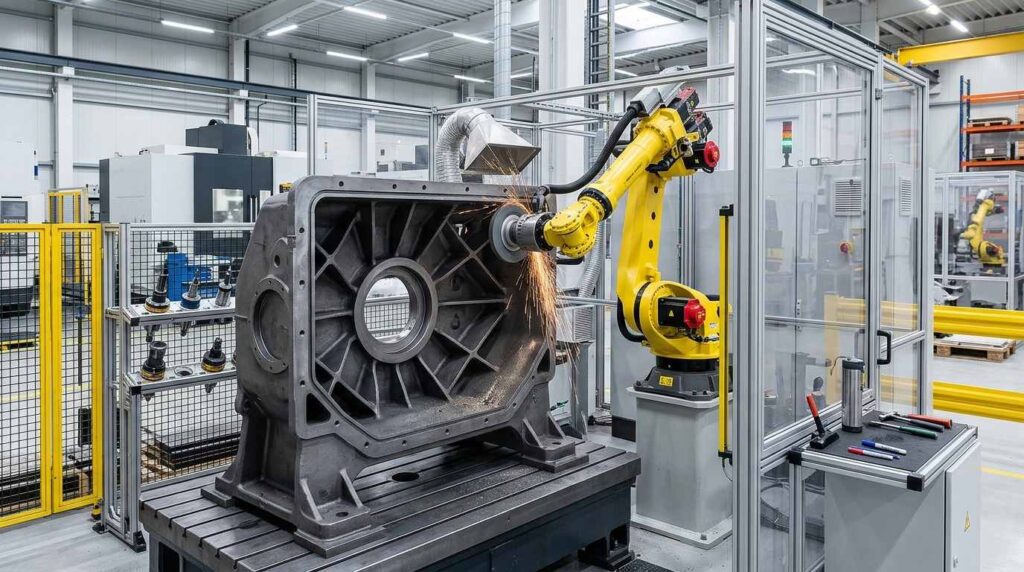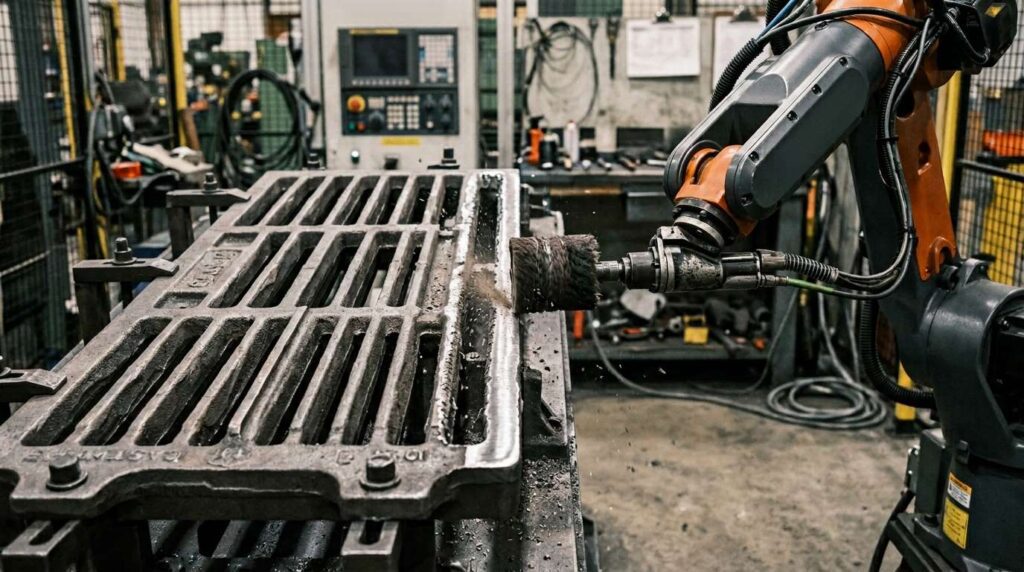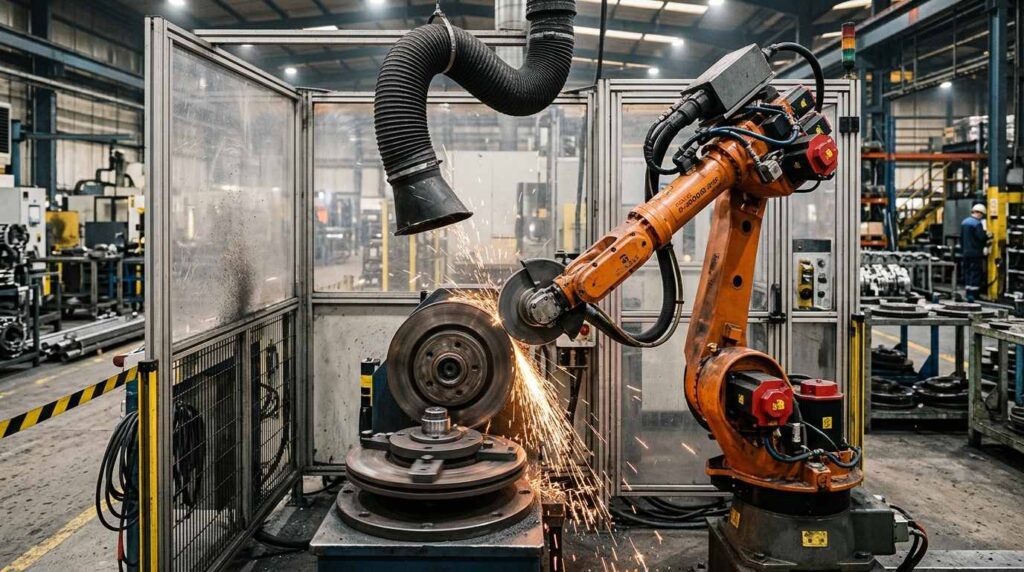
Brake discs are critical safety components widely used in passenger vehicles, commercial vehicles, new energy vehicles and various industrial braking systems. As a typical cast iron automotive part, a brake disc usually features a circular profile, a central mounting area, multiple edges, vent structures or local transitions that require reliable post-casting finishing. Although the overall geometry is more regular than many complex housings, the finishing process still demands stable quality and repeatable edge treatment.
During casting and rough machining, brake discs may develop flash, burrs, sharp edges, parting lines and local surface irregularities on non-friction areas. If these defects are not removed properly, they may affect handling safety, coating quality, assembly performance and the visual consistency of the finished part. For manufacturers producing brake discs in large quantities, manual grinding can easily become a bottleneck.
Traditional manual grinding requires workers to repeatedly process the outer edge, center bore area, vent edges, rib transitions and other burr-prone areas. This leads to unstable quality, high labor intensity and a dusty working environment. A robotic grinding solution offers a more consistent and scalable way to finish cast iron brake discs, especially in batch production environments where repeatability and process stability are important.
This solution is designed for cast iron brake discs with typical dimensions around φ100 × 400 mm based on your sample reference. It focuses on robotic grinding, deburring, edge smoothing and surface preparation on non-friction areas before coating, assembly or shipment.
What is a Brake Disc?
A brake disc is a key rotating component in a disc braking system. It is mounted to the wheel hub and works together with the brake caliper and brake pads to generate braking force through friction. During braking, the pads clamp the rotating disc, converting kinetic energy into heat and slowing the vehicle.
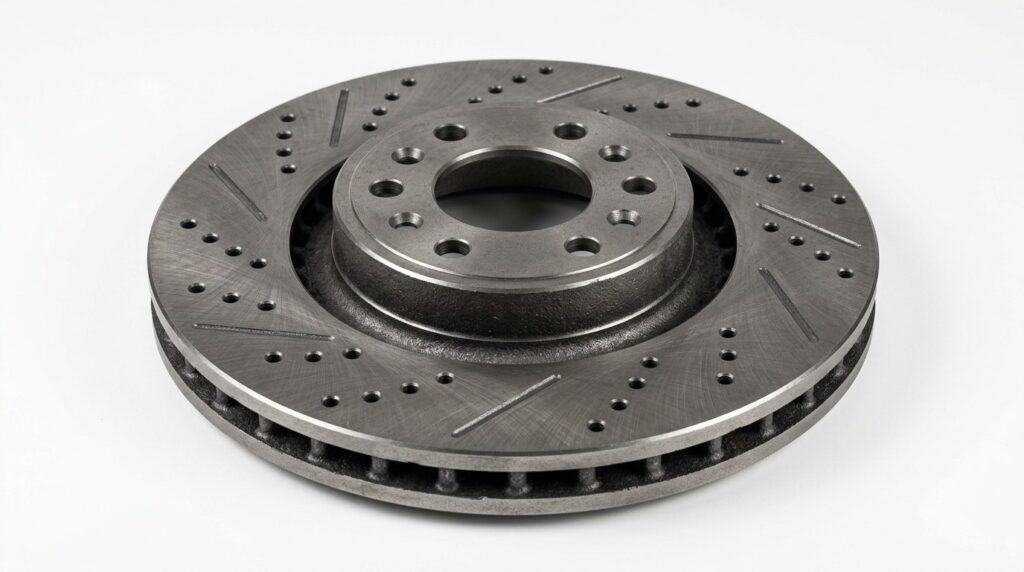
Most automotive brake discs are made from cast iron because it provides good thermal stability, wear resistance, machinability and cost performance. Depending on the design, a brake disc may include a friction ring, central hat section, mounting face, outer circumference and sometimes internal ventilation channels.
Although the friction surface is usually controlled by machining processes such as turning or grinding, many non-friction areas still require post-casting finishing. These include the outer edge, inner edges, vent openings, parting lines and transition areas where flash or burrs may remain after casting and machining.
| Артикул | Details |
|---|---|
| Workpiece Name | Brake Disc |
| Chinese Name | 刹车盘 |
| Typical Size | φ100 × 400 mm |
| Материал | Cast Iron |
| Main Process | Robotic Grinding |
| Assisted Processes | Deburring, Edge Rounding, Surface Finishing |
| Main Processing Areas | Outer edge, center area edges, vent openings, mounting transitions, non-friction surfaces |
| Industry | Автомобили и электромобили |
| Finishing Goal | Remove flash, burrs, sharp edges and surface irregularities on non-friction areas |
For brake discs, the key objective is not decorative polishing. The more important goal is to remove burrs, clean casting defects, smooth edges and improve process consistency. Therefore, robotic grinding is a practical and suitable solution for brake disc finishing.
Typical Applications of Brake Discs
Brake discs are mainly used in braking systems where stable friction performance, structural integrity and dimensional consistency are required. Their application is clearly linked to automotive and transportation equipment.
| Application Area | Typical Use |
|---|---|
| Passenger Vehicles | Front or rear disc braking systems |
| Commercial Vehicles | Heavy-duty braking assemblies |
| New Energy Vehicles | EV brake systems with lightweight or high-efficiency designs |
| Performance Vehicles | High thermal load braking systems |
| Industrial Equipment | Rotational braking systems for machinery |
| Specialty Vehicles | Braking systems for custom or off-road applications |
In these applications, burrs and sharp edges on non-friction areas may affect assembly, handling safety, coating quality and downstream process stability. For large-scale production, robotic grinding helps maintain more consistent finishing standards.
Pain Point Analysis of Brake Disc Finishing
Brake discs are often produced in high volumes, which means even a small finishing issue can create a large cumulative cost. The first challenge is repetitive edge treatment. Although the brake disc is circular and relatively standardized, the outer circumference, central opening transitions and vent edges may all require deburring or grinding.
The second challenge is quality consistency. Manual workers may apply different force and grinding angles, causing inconsistent edge quality. Some discs may still have burrs, while others may be over-ground in local areas. This variation becomes unacceptable in automotive production where consistency is important.
The third challenge is labor intensity and dust. Cast iron grinding creates particles and noise. When workers repeatedly process brake discs throughout the day, fatigue and environmental concerns increase. Recruiting and retaining labor for repetitive grinding tasks is also increasingly difficult.
The fourth challenge is process protection. For brake discs, not all surfaces should be treated in the same way. The friction face, mounting face and critical geometry require protection, while non-friction edges and burr-prone areas need grinding. This requires controlled tool paths and reliable fixture design.
| Common Problem | Specific Area | Воздействие |
|---|---|---|
| Casting Flash | Outer circumference and parting line areas | Affects appearance and downstream handling |
| Sharp Edges | Outer edge, inner edge, vent openings | Creates safety and assembly risks |
| Local Burrs | Center transitions and vent structures | Difficult to remove consistently by hand |
| Surface Irregularity | Non-friction cast areas | Reduces coating and appearance consistency |
| Manual Variation | Repeated edge treatment areas | Causes unstable quality between operators |
| Cast Iron Dust | Grinding operation | Affects workshop cleanliness and operator comfort |
Compared with manual finishing, robotic grinding offers a more controlled and repeatable process. It allows the manufacturer to define exactly which areas should be processed and which areas should be protected.
| Comparison Item | Ручное шлифование | Robotic Grinding |
|---|---|---|
| Quality Consistency | Depends on operator skill | Repeatable path and stable processing |
| Labor Intensity | High repetitive workload | Reduces manual grinding burden |
| Edge Treatment | May vary from part to part | Consistent programmed finishing |
| Dust Exposure | Operators work near grinding dust | Enclosed cell with dust extraction |
| Batch Production | Difficult to standardize fully | Suitable for automotive batch production |
| Surface Protection | Hard to control manually | Controlled paths for selected areas |
For brake disc manufacturers, robotic grinding improves standardization and helps integrate finishing into a more stable automotive production workflow.
Robotic Grinding Process for Brake Discs
A robotic grinding cell for brake discs can be configured based on disc size, production volume and the required finishing scope. The system usually includes a six-axis robot, dedicated fixture or rotary table, abrasive grinding tool, deburring tool, dust collection system and safety enclosure.
Since brake discs are rotational parts, robotic grinding can take advantage of stable positioning and repeatable circular tool paths. The robot processes only the required non-friction areas while avoiding unnecessary contact with critical functional surfaces.
| Шаг | Процесс | Назначение | Tool / System |
|---|---|---|---|
| 1 | Loading and Positioning | Secure the brake disc accurately | Dedicated fixture or rotary table |
| 2 | Program Selection | Select the correct finishing path | HMI / Robot program |
| 3 | Outer Edge Grinding | Remove flash and sharp edges from outer circumference | Abrasive grinding tool |
| 4 | Center Area Deburring | Clean burrs from mounting and inner transition areas | Flexible deburring tool |
| 5 | Vent / Transition Finishing | Process vent openings or local structural edges | Small grinding head |
| 6 | Surface Cleaning Grinding | Improve non-friction surface consistency | Grinding wheel or abrasive tool |
| 7 | Quality Inspection | Check burr removal and protected surfaces | Manual or visual inspection |
| 8 | Unloading and Cleaning | Remove dust and transfer the part | Air blow / vacuum cleaning |
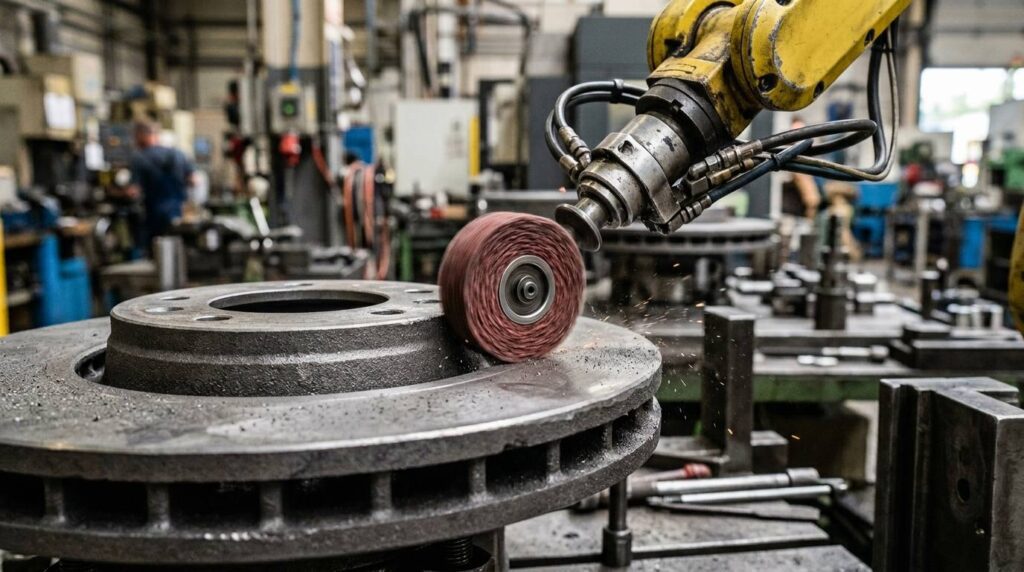
Step 1: Loading and Positioning
The brake disc is placed into a dedicated fixture or on a rotary positioning system. Accurate positioning is important because the robot must process selected edges without affecting critical functional areas.
For large-scale production, the system can be integrated with conveyors, indexing tables or automatic loading devices. Stable clamping ensures repeatable tool contact during grinding.
Step 2: Program Selection
The operator selects the corresponding robot program according to the brake disc model. Different vehicle platforms may use different disc sizes, shapes or vent structures, so separate programs may be stored for different products.
If the production line handles multiple variants, barcode scanning, recipe management or fixture recognition can be used to reduce the risk of program mismatch.
Step 3: Outer Edge Grinding
The robot first processes the outer circumference of the brake disc. This step removes flash, sharp edges and local burrs from the outer contour. Since this area is continuous and circular, robotic grinding can achieve stable and repeatable quality.
Abrasive grinding tools or compliant grinding heads can be used to adapt to minor dimensional variation while maintaining controlled contact pressure.
Step 4: Center Area Deburring
After the outer edge is finished, the robot processes burr-prone areas around the center opening, mounting transitions and other local geometric features. These areas may contain sharp edges or residual burrs after casting and machining.
A flexible deburring tool or smaller abrasive head helps improve safety and assembly readiness without damaging critical faces.
Step 5: Vent or Transition Finishing
For ventilated brake discs or designs with local structural transitions, the robot can process the edges of vent openings and internal transitions. These areas may be difficult and repetitive for manual workers.
The robotic system can follow programmed access paths to finish local edges more consistently.
Step 6: Surface Cleaning Grinding
The robot then performs light grinding or surface cleaning on selected non-friction areas. The goal is to improve surface consistency, remove minor casting defects and prepare the part for coating or visual inspection.
Functional friction surfaces should remain protected according to process requirements.
Step 7: Quality Inspection
After grinding, the brake disc is inspected for burr removal, edge smoothness, consistency and proper protection of critical surfaces. Inspection may focus on the outer edge, center area, vent openings and non-friction surfaces.
Depending on the automation level, the cell can include manual checks or vision-assisted inspection.
Step 8: Unloading and Cleaning
The finished brake disc is removed from the fixture. Dust and grinding residues are cleaned by air blowing, vacuum suction or brushing. The part can then move to coating, assembly, packaging or the next manufacturing step.
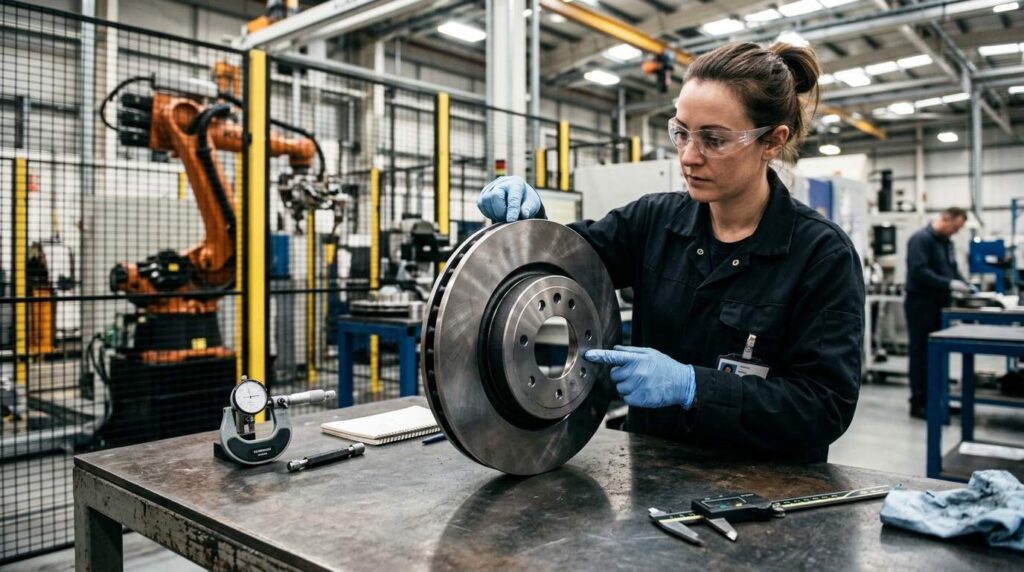
Machining Difficulties and Solutions
Brake discs are more regular in shape than many cast housings, but their finishing requirements are still demanding because of batch volume, quality consistency and selective processing requirements. The challenge is not only grinding the right areas, but also avoiding the wrong ones.
| Challenge | Cause | Robotic Solution |
|---|---|---|
| Repeated Circular Edge Treatment | Outer circumference requires uniform grinding | Programmed circular finishing path |
| Burrs in Center Transitions | Local geometry changes after casting and machining | Flexible deburring tool for inner areas |
| Vent Edge Finishing | Vent openings are repetitive and hard to process manually | Small tool with repeatable access path |
| Functional Surface Protection | Friction faces must not be over-processed | Controlled path and fixture positioning |
| Dust Generation | Cast iron grinding creates fine particles | Enclosed cell with dust extraction |
Difficulty 1: Circular Edge Requires Consistent Grinding
The outer circumference of a brake disc must be processed evenly. Manual grinding can produce inconsistent chamfers or uneven edge quality if the operator changes tool angle or pressure.
The solution is to use a programmed circular grinding path. The robot maintains stable motion and tool contact around the disc edge, improving consistency across batches.
Difficulty 2: Center Area Has Local Burrs and Transitions
The center section may include bore edges, mounting transitions and other local features where burrs remain after machining or casting. Manual workers may process these areas inconsistently.
The solution is to use smaller deburring tools and dedicated tool paths for local geometry. This allows the robot to target burr-prone areas without touching protected surfaces.
Difficulty 3: Vent Structures Increase Finishing Complexity
Ventilated brake discs contain repeated internal openings or transition edges. These areas can be tedious for manual grinding and may easily be missed during batch production.
The solution is to define a repeatable access strategy with a compact tool. The robot can process the same vent edges on every part with stable sequencing.
Difficulty 4: Functional Surfaces Must Be Protected
Unlike some general castings, a brake disc includes functional areas that should not be altered during finishing. Uncontrolled grinding may affect product quality or downstream machining results.
The solution is to use accurate fixturing, protected process zones and carefully defined robot paths. Only the target non-friction areas are processed.
Difficulty 5: Dust and Repetitive Labor Affect Production
Brake disc grinding creates dust, noise and repetitive manual work. Over time, this reduces labor efficiency and worsens the workshop environment.
The solution is to integrate the robotic grinding cell with a dust collection system and process enclosure. This improves cleanliness and reduces direct operator exposure.
Manufacturing Case
История клиента
An automotive casting manufacturer produces cast iron brake discs for vehicle braking systems. The customer needed to improve consistency in post-casting edge finishing and reduce dependence on manual grinding in a growing production line.
Технические проблемы
The brake disc had repetitive outer edge finishing requirements and local burrs around the center transition areas. For certain product types, vent-related edges also required treatment. Manual grinding quality varied between operators, and the customer needed a more repeatable process for batch production.
Another challenge was protecting critical functional surfaces while processing only the required non-friction areas. Dust from cast iron grinding also affected workshop management.
Решение
UBRIGHT SOLUTIONS designed a robotic grinding cell for cast iron brake discs. The system used a six-axis industrial robot, dedicated fixture, abrasive grinding tool, flexible deburring tool and enclosed dust extraction system.
The robot first processed the outer circumference, then moved to the center transition areas and local burr-prone edges. For applicable disc structures, vent-related edges were also included in the finishing path. The fixture ensured stable positioning and protected functional areas from unnecessary contact.
| Артикул | Конфигурация |
|---|---|
| Заготовка | Cast Iron Brake Disc |
| Typical Size | φ100 × 400 mm |
| Main Process | Robotic Grinding |
| Assisted Process | Deburring and Edge Rounding |
| Robot | Six-Axis Industrial Robot |
| Tooling | Abrasive Grinding Tool, Flexible Deburring Tool |
| Fixture | Dedicated Brake Disc Fixture |
| Dust Control | Enclosed Cell with Dust Collection |
| Application | Outer edge grinding, burr removal, surface preparation |
Результаты внедрения
After implementation, the customer achieved more consistent edge finishing quality and reduced manual grinding workload. The robotic system standardized repetitive outer edge processing and improved consistency on local burr-prone areas.
The enclosed cell also improved dust control and made the finishing process easier to manage within an automotive production environment. Robot programs could be saved and reused for repeat brake disc models.
| Result Area | Улучшение |
|---|---|
| Grinding Consistency | More stable outer edge and local deburring quality |
| Labor Reduction | Reduced repetitive manual grinding workload |
| Production Stability | Reusable robot programs for repeat brake disc models |
| Surface Protection | Better control of target and protected areas |
| Dust Control | Cleaner enclosed grinding environment |
| Scalability | Easier support for automotive batch production |
Отзывы клиентов
“The robotic grinding system helped us improve consistency on brake disc edge finishing and reduced the burden of repetitive manual grinding in our production line.”
ЧАСТО ЗАДАВАЕМЫЕ ВОПРОСЫ
Q1: Why is robotic grinding suitable for brake discs?
Robotic grinding is suitable because brake discs are produced in large quantities and require repeatable edge finishing. The robot can process the same outer edges and local burr-prone areas consistently, which is difficult to maintain manually over long production runs.
Q2: What areas of a brake disc are typically processed by robotic grinding?
Common areas include the outer circumference, center transition areas, vent-related edges and selected non-friction surfaces. The exact processing scope depends on the brake disc design and manufacturing route.
Q3: Are the friction surfaces ground by the robot?
Usually, the robotic grinding solution described here focuses on non-friction areas such as edges and burr-prone transitions. Critical friction faces should be protected according to process requirements unless a separate precision process is specifically designed for them.
Q4: Can one robotic cell process different brake disc models?
Yes. Different brake disc models can be processed if the system uses suitable fixtures and stored robot programs. Quick-change fixtures and recipe management can help reduce changeover time.
Q5: How does the robot avoid damaging critical surfaces?
The system uses accurate fixturing, predefined process zones and controlled robot paths. Only selected non-friction areas are processed, while critical functional surfaces remain protected.
Q6: Does robotic grinding help with brake disc burr removal after casting?
Yes. Robotic grinding is effective for removing flash, burrs and sharp edges from outer contours, center transitions and other non-friction areas after casting or rough machining.
Q7: Can the system include dust extraction?
Yes. Dust extraction is strongly recommended for cast iron brake disc grinding. The cell can include an enclosure, suction ports and filtration equipment to improve workshop cleanliness.
Q8: Is robotic grinding suitable for both standard and ventilated brake discs?
Yes. With proper fixture design and robot programming, the system can be adapted for both standard solid discs and ventilated brake disc structures.
Заключение
Brake discs are critical cast iron components that require reliable finishing on outer edges, local transitions and other non-friction areas. A robotic grinding solution helps manufacturers improve consistency, reduce manual labor and build a more stable finishing process for batch production.
If your brake disc production still relies on manual grinding, burr removal or edge finishing, Свяжитесь с нами for a customized robotic solution. You can also explore our Автомобили и электромобили applications and Оборудование to learn more about our robotic finishing systems.