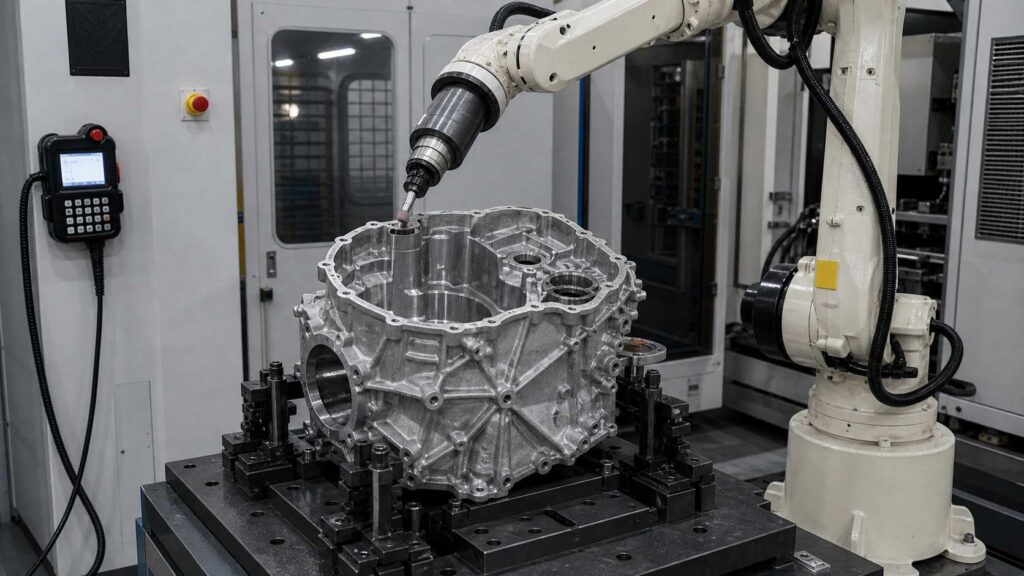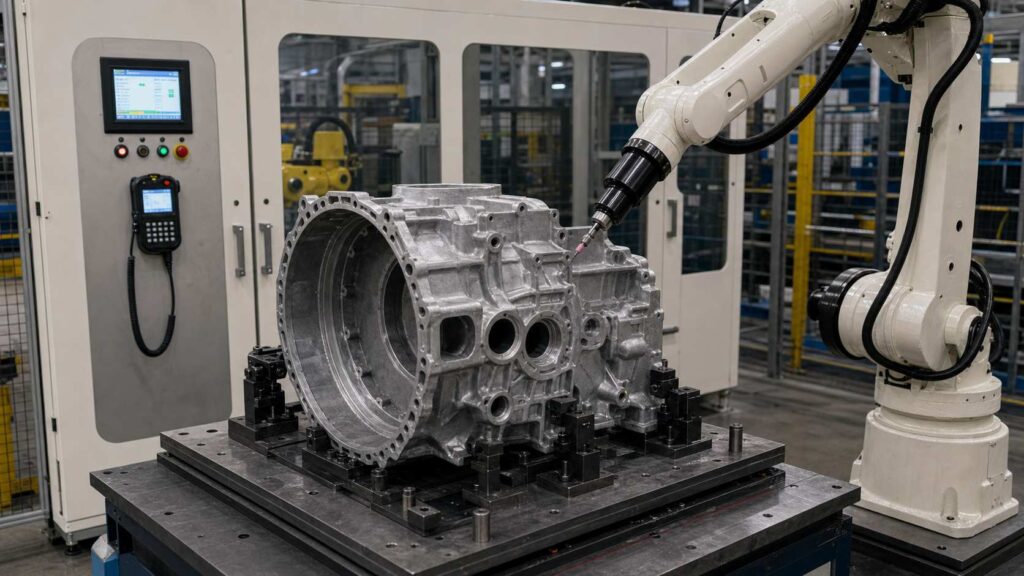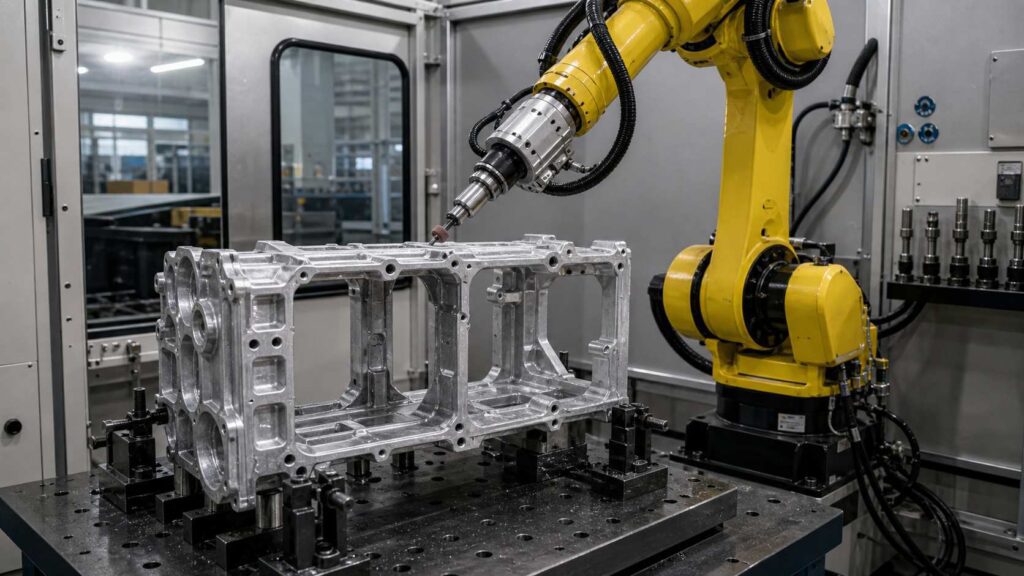
Aluminum alloy cylinder block skirt frames are structural casting components used in automotive engine and powertrain systems. This part includes a large open frame structure, multiple window openings, mounting holes, reinforced ribs, bosses, outer flanges and recessed cavity areas, making post-casting deburring and grinding more difficult than simple aluminum castings.
此款機器人去毛刺與研磨解決方案,專為鋁合金汽缸本體裙部框架設計,其典型尺寸長度約為 400–600 公釐,具體尺寸視引擎型號而定。 該解決方案有助於清除窗孔、外輪廓、安裝孔、肋條過渡區及凹槽邊緣處的毛刺、鑄造飛邊、分型線、銳角及澆口殘留物,同時提升表面處理的一致性並減輕人工研磨的工作量。.
What Is an Aluminum Alloy Cylinder Block Skirt Frame?
鋁合金汽缸體裙部框架是一種結構鑄件,安裝於引擎下部或曲軸箱支撐區域周圍。它有助於強化引擎結構、支撐與軸承相關的區域,並透過安裝孔、法蘭及配合面與其他動力傳動系統組件連接。.

The workpiece has a rectangular open-frame layout with large internal windows, dense reinforcing ribs, multiple bolt holes, raised bosses and irregular outer contours. After casting and trimming, burrs, flash, parting lines, gate residues or sharp edges may remain around the window edges, outer perimeter, hole openings, rib roots and cavity transitions. For this type of workpiece, the main finishing requirement is robotic deburring, local grinding and edge rounding rather than decorative polishing.
| 項目 | 詳細資訊 |
|---|---|
| 工件名稱 | 鋁合金汽缸本體裙部框架 |
| 典型尺寸 | 約 400–600 × 250–400 × 80–180 毫米,視型號而定 |
| 材質 | 鋁合金鑄件 |
| 主要製程 | 機器人去毛邊與研磨 |
| 輔助流程 | 邊緣倒角、去毛邊、局部表面修整 |
| 主要處理區域 | 外輪廓、窗孔、安裝孔、肋條過渡處、凸緣邊緣、凹槽邊緣、澆口切口區域 |
| 保護區 | 裝配面、密封面、軸承相關接合面、精密孔、機加工配合區域 |
| 完成目標 | 去除毛邊、飛邊、分型線、澆口殘留物,並提升表面處理的一致性 |
鋁合金汽缸本體裙部框架常見的表面處理挑戰
相較於簡單的平面鑄件,鋁合金汽缸體裙部框架的表面處理難度更高,因為其結構包含眾多開放式開口、狹窄的肋條結構、孔群、凸台以及功能性表面。毛刺並非集中於單一區域,而是分布於外緣、內部開口、肋條交界處、孔邊界以及凹陷過渡處。.
手動去毛邊的加工品質可能不穩定,因為操作人員必須頻繁調整刀具姿勢和研磨壓力。薄壁區域和內部窗框邊緣容易被忽略,而若操作人員施加過大力量,靠近毛邊區域的功能性表面則可能受損。由於鋁合金的硬度低於鑄鐵,過度研磨也可能導致不必要的刀具痕跡或局部材料去除。.
| 常見問題 | 特定區域 | 影響 |
|---|---|---|
| 鑄造飛邊/分型線 | 外輪廓、框架周長、法蘭邊緣 | 影響邊緣的一致性與外觀 |
| 閘極殘留物 | 鑄件本體或法蘭區域周圍的切口位置 | 需要進行更徹底的局部材料去除 |
| 尖銳邊緣 | 窗戶開口、安裝孔、外緣 | 造成處理和組裝風險 |
| 殘留毛刺 | 肋根、凸緣邊緣、凹槽過渡 | 導致成品品質不穩定 |
| 手動變化 | 重複的窗框邊緣、孔洞群組及肋條過渡 | 導致不同操作員之間得到不一致的結果 |
| 敏感功能區域 | 安裝面、密封面、軸承相關接合面、精密孔 | 手動研磨時可能造成的損壞風險 |
鋁合金汽缸體裙部框架的機器人去毛邊與研磨製程
A robotic deburring and grinding cell for aluminum alloy cylinder block skirt frames should be designed around fixture stability, multi-angle accessibility, controlled contact force and protected-surface control. The process must remove burrs, flash, parting lines and gate residues from the complex frame structure while avoiding damage to mounting faces, sealing surfaces and precision fitting areas. To compare robot cells with dedicated machine formats for this kind of work, see our deburring machine types guide.
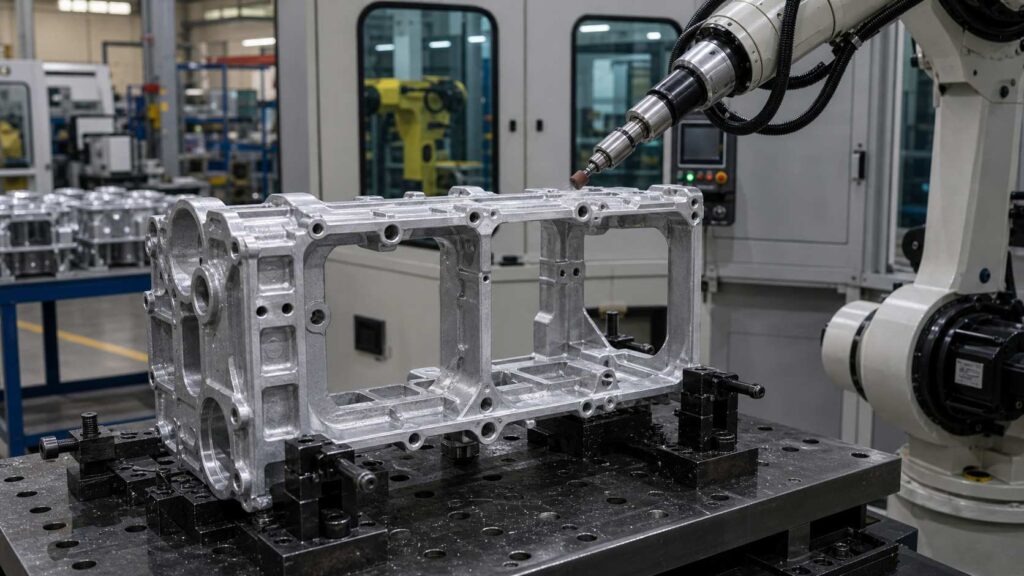
對於長度通常約為 400–600 公釐的鋁合金汽缸體裙部框架,該製程通常包含工件定位、程式選取、保護區域確認、外輪廓磨削、窗口與孔邊去毛刺、肋部過渡修整、品質檢驗及卸料。 針對不同區域,可選用不同的工具,包括磨料磨削工具、柔性去毛刺工具、倒角工具及小型磨削頭。.
| 步驟 | 製程 | 目的 | 工具/系統 |
|---|---|---|---|
| 1 | 載入與定位 | 將工件固定好,以確保操作穩定 | 專用夾具 |
| 2 | 計劃選擇 | 將正確的模型與路徑配對 | 人機介面 / 機器人程式 |
| 3 | 保護區確認 | 定義無研磨區與受保護的介面 | 賽程邏輯 / 程式設定 |
| 4 | 外輪廓磨削 | 從框架邊緣去除毛邊和分型線 | 研磨工具 |
| 5 | 窗戶與孔邊去毛刺 | 清除內部開口及安裝孔的毛邊 | 多功能去毛邊工具/倒角工具 |
| 6 | 肋條與凸緣過渡處的表面處理 | 加工肋根、凸台及凹陷過渡區 | 小型研磨頭 / 柔性工具 |
| 7 | 品質檢驗 | 檢查毛刺清除情況及受保護區域 | 手動或目視檢查 |
| 8 | 卸貨與清潔 | 清除灰塵並移出工件 | 氣吹 / 真空清潔 |
步驟 1:裝載與定位
鋁合金汽缸體裙部框架被裝入專用夾具中,該夾具從穩定且非關鍵的區域支撐鑄件。由於工件具有大型開口、薄肋及不規則的外形輪廓,因此穩定的夾持對於防止在去毛刺和磨削過程中產生振動至關重要。.
該夾具應能讓機器人無需反覆手動重新定位,即可觸及外輪廓、內部窗邊緣、安裝孔及肋條過渡處。良好的定位精度也有助於機器人與受保護的安裝面及加工接面保持安全距離。.
步驟 2:選擇計劃
Once the frame is clamped, the matching program is selected at the HMI. This is what lets one cell run several skirt frame models with different window shapes, hole positions or rib layouts.
所選的程式會定義刀具路徑、加工順序、機器人姿勢、刀具速度、進給速度及保護區域。儲存的程式有助於提升重複性,並在重複生產批次時降低對操作員經驗的依賴。.
步驟 3:保護區確認
在機器人開始研磨之前,系統會確認哪些區域不得被研磨工具接觸。對於汽缸體裙部框架而言,受保護區域通常包括安裝面、密封面、精密孔、與軸承相關的接合面以及經加工的配合面。.
此步驟至關重要,因為許多毛邊都位於功能區域的極近處。機器人應清除邊緣界線及局部過渡處的毛邊,同時避免接觸那些會影響組裝精度或密封性能的表面。.
步驟 4:外輪廓磨削
機器人首先處理裙框的外輪廓,該處通常會出現鑄造毛邊、修邊痕跡及分型線殘留物。這些邊緣可能包含直線段、彎角、局部凸起以及法蘭過渡處。.
研磨工具可沿著預設的輪廓路徑運行,並去除邊緣區域反覆出現的凸起缺陷。對於鋁合金鑄件,應控制研磨壓力,以避免切入基材或在鑄件表面留下深痕。.
步驟 5:窗戶與孔邊緣去毛刺
該工件的大型內窗及多個安裝孔是主要的去毛刺區域。這些開口周圍的毛刺可能造成搬運風險,並可能影響後續的組裝或加工準備工作。.
可使用柔性去毛刺工具或倒角工具來處理窗框邊緣及孔洞開口。機器人應以正確的工具角度接近每個邊緣,特別是在狹窄窗框、圓形孔洞及不規則切口周圍。如此一來,加工單元便能在去除銳利邊緣的同時,維持鋁鑄件的原始幾何形狀。.
步驟 6:肋條與凸緣過渡處的收尾處理
加固肋條、凸起凸緣及凹陷腔體的過渡處,其加工難度高於外露的外緣。毛刺常殘留於肋條根部、凸緣邊界及狹窄的角落區域,而人工操作人員可能無法察覺這些微小缺陷。.
Local features like rib roots and boss corners are handled with small-diameter grinding heads or compliant tools. The robot can divide the inner structure into several processing zones and finish each rib or boss transition with repeatable posture. This improves consistency in areas where manual deburring is usually unstable.
步驟 7:品質檢查
After robotic deburring and grinding, the operator checks the outer contour, window openings, mounting holes, rib transitions, boss edges and gate-cut areas. The check verifies that every window and hole edge is clean and that machined faces show no tool contact.

On high-volume lines a camera system can take over the first-pass check while operators sample-audit the rest, and over time the inspection data feeds back into tool life planning, path compensation and local process parameters.
步驟 8:卸載與清潔
經檢驗後,完成的汽缸本體裙部框架將被卸下並轉移至下一道生產工序。應清除窗孔開口、孔邊緣及凹陷腔體區域中的鋁屑、灰塵及細微顆粒。.
建議在進行鋁合金研磨與去毛刺作業時,採用配備集塵系統的封閉式機器人工作站。此舉有助於減少空氣中的粉塵、提升車間清潔度,並相較於開放式手動研磨,營造出更受控的表面處理環境。.
加工困難與解決方案
| 挑戰 | 原因 | 機器人解決方案 |
|---|---|---|
| 長外輪廓閃光 | 大型框架邊緣會產生重複的閃光和分型線區域 | 編程的輪廓磨削路徑 |
| 窗框邊緣的毛邊 | 寬大的內部開口可保留銳利的鑄造邊緣與修邊 | 沿窗框型材進行靈活的去毛邊處理 |
| 孔銑刀與凸緣銑刀 | 多個安裝孔和凸台會導致邊緣反覆出現缺陷 | 倒角或局部去毛刺程序 |
| 肋根刺 | 加強肋條和狹窄的過渡段難以觸及 | 小型刀具的切入路徑與分區局部精加工區域 |
| 功能性表面保護 | 安裝、密封及軸承相關部位不得受損 | 研磨路徑中排除的受保護區域 |
| 鋁材的敏感性 | 鋁合金可能因過度研磨或施加過大力量而產生痕跡 | 受控的施力、適當的研磨材選擇以及符合要求的工具 |
難點 1:外輪廓冗長且不規則
該鋁合金汽缸體裙部框架具有長條狀的外周邊緣,其特徵包含直邊、圓角、局部凸起以及法蘭過渡面。鑄造與修邊後,這些區域常會出現飛邊及分型線殘留物。.
解決方案是採用預先編程的機器人輪廓磨削路徑。此舉能讓機器人沿著不規則的框架邊界進行磨削,同時保持刀具與工件的穩定接觸,既可減少人工操作造成的誤差,又能避免從鋁鑄件上進行不必要的材料去除。.
難點 2:大型窗洞邊緣的毛邊
These castings include large internal window openings that create long inner edge boundaries. These edges often retain burrs or sharp corners, especially around window intersections and narrow internal transitions.
解決方案是使用一種具有可控接觸壓力的柔性去毛刺工具。機器人能夠沿著每個窗框輪廓運行,並從內緣去除毛刺,同時不會改變原始開口形狀,也不會損壞附近的肋條結構。.
難度 3:多個安裝孔與凸緣邊緣
氣缸體裙部框架通常包含許多安裝孔、凸起凸台及局部圓形特徵。這些區域周圍的毛邊可能會影響組裝前的準備工作、螺栓的鎖緊效果或操作安全性。.
解決方案是使用倒角工具、彈性去毛刺主軸或小型研磨工具,對孔緣進行局部處理。機器人可採用相同的進角和刀具深度來加工重複的孔洞,從而提升整個工件的加工一致性。.
難度 4:肋狀根部與內嵌式過渡段
加強肋是重要的結構特徵,但它們也會形成狹窄的交會處和內凹的角落。肋根處的毛刺對於人工操作者而言難以始終如一地清除,特別是在肋條方向於框架上發生變化時。.
解決方案是將肋骨結構劃分為局部精加工區域。透過採用小型研磨頭或柔性去毛刺工具,並以受控姿勢進行操作,即可觸及肋骨根部及轉角過渡處,從而減少隱蔽區域的毛刺遺漏。.
難點 5:保護功能性表面
裙邊框架包含安裝面、密封面、精密孔洞及與軸承相關的接合面,這些部位在研磨過程中絕不可受損。這些功能區域可能靠近容易產生毛邊的邊緣,因此進行手工精加工存在風險。.
解決方案是在機器人程式和夾具參考系統中定義「禁止磨削區域」。機器人會在清除周邊邊緣區域的毛邊時,同時確保工具遠離那些會影響組裝精度的受保護接合面。.
Application Scenario
Production Context
A skirt frame is essentially a frame made of edges: the outer perimeter, several large window openings, and dozens of holes all need the same treatment, inside and out. Manual deburring means working both sides of the frame, changing posture at every window, and keeping the force light near the bearing and sealing areas.
At engine-component volumes, that combination of repetition and precision is where manual results start to scatter, and it is the usual trigger for moving the part to a robotic cell.
What Slows Manual Finishing Down
The windows are the main issue. Each large opening has a long inner edge that is awkward to reach with a hand tool, and burrs concentrate exactly where the rib intersections meet the window boundary. Exposed outer edges, by contrast, are easy to reach, and easy to over-grind, so one operator typically finishes the outer contour quickly and thoroughly while the window interiors receive uneven attention.
Gate stubs on the frame add a second process mode, since they need heavier removal than the edge work happening nearby, and all of it has to happen without visible marks on the alloy.
How the Cell Is Set Up
The usual configuration is a six-axis industrial robot with a tool set split by feature: an abrasive grinding tool for outer contour flash and parting lines, a flexible deburring tool for the window openings, a chamfering tool for the hole pattern, and a small grinding head for rib roots and boss transitions. Dual-station equipment, such as our six-axis dual-station deburring machine, suits this part family well, since one frame can be loaded while another is being finished.
The fixture holds the frame in one stable position that leaves both outer and inner edges reachable, protected surfaces are registered as no-grind zones, and the cell runs enclosed with extraction for aluminum chips and grinding dust.
| 項目 | 組態 |
|---|---|
| 工件 | 鋁合金汽缸本體裙部框架 |
| 典型尺寸 | 約 400–600 × 250–400 × 80–180 毫米,視型號而定 |
| 主要製程 | 機器人去毛邊與研磨 |
| 輔助流程 | 邊緣倒角、去毛邊、局部表面修整 |
| 機器人 | 六軸工業機器人 |
| 模具 | 研磨工具、柔性去毛刺工具、倒角工具、小型研磨頭 |
| 固定裝置 | 專用汽缸本體裙部框架支撐夾具 |
| 保護策略 | 受保護的安裝面、密封面、精密孔及與軸承相關的接合面 |
| 塵埃控制 | 配備鋁製集塵裝置的密閉式機箱 |
What Improves After the Switch
With the frame divided into programmed zones, every window edge gets the same pass sequence as the outer contour, and the hidden rib intersections are visited in a fixed order instead of being found by eye. Force stays within limits set for the alloy, so the surfaces around the protected zones stay clean, and the operator role narrows to loading, inspection and tool changes.
The enclosure also keeps aluminum chips and grinding dust inside the workstation rather than spread around the surrounding area.
| 結果區域 | 改進 |
|---|---|
| 輪廓品質 | 針對外框及不規則邊緣進行更穩定的清理 |
| 窗框邊緣去毛刺 | 在大型內部開口周圍的結構更為一致 |
| 孔邊處理 | 在安裝孔及凸緣邊緣進行可重複的去毛刺處理 |
| 肋骨過渡處的收尾處理 | 減少肋根部及凹陷處的殘毛 |
| 澆口/分型線清理 | 針對反覆出現的缺陷區域所設計的專用刀具路徑 |
| 表面保護 | 降低對安裝面、密封面及精密表面的損壞風險 |
| 減少勞動力 | 減少重複性的手動去毛邊和打磨工作量 |
| 生產穩定性 | 已儲存的程序,用於重複生產氣缸體裙部框架批次 |
| 研討會環境 | 配備封閉式鋁製集塵系統的更潔淨的後處理區 |
機器人研磨提案所需資訊
為了為您的鋁合金汽缸體裙部框架推薦合適的機器人去毛邊與研磨工作站,我們通常需要零件圖、材料等級、鑄件重量、毛邊、飛邊、分型線或澆口殘留物的照片、所需去毛邊區域、需保護的表面、目前的手工工序週期時間以及年產量。.
This information lets our team verify clamping points, arm access, abrasive selection and extraction design before drafting a proposal. For aluminum engine structural castings, the decisive inputs are which areas need material removal and which mounting, sealing or precision interfaces must stay protected.
常見問題
Q1: Is this workpiece a cylinder block skirt frame?
Yes. With a large open-frame layout, internal windows, mounting holes, reinforced ribs and bosses, the workpiece fits the description of an aluminum alloy cylinder block skirt frame. It has typical features such as a large open-frame layout, multiple internal windows, mounting holes, reinforced ribs, bosses and irregular outer contours.
Q2: Why is robotic deburring suitable for this workpiece?
由於工件上存在大量重複出現的邊緣、孔洞、開窗及肋條過渡處,因此採用機器人去毛刺是合適的。機器人能夠依照預設路徑運行,並保持穩定的刀具姿勢與接觸壓力,這有助於提升加工的一致性,相較於人工去毛刺更為優異。.
Q3: What areas can the robot process on a cylinder block skirt frame?
該機器人可處理外輪廓、內部窗邊緣、安裝孔邊緣、凸台邊界、肋根、凹槽過渡區、澆口切口區域及分型線位置。確切的加工區域應根據圖面及實際毛刺分布情況予以確認。.
Q4: Does this aluminum alloy part require polishing?
No. As a structural engine casting, the skirt frame needs clean edges and undamaged functional surfaces; a deburred, technically finished surface meets the requirement.
Q5: How are protected surfaces controlled during grinding?
受保護的表面是透過夾具定位、機器人路徑規劃以及程式中的「禁磨區」來進行管控。安裝面、密封面、與軸承相關的接合面以及精密孔洞均被排除在磨削路徑之外,以降低受損風險。.
Q6: Can one robotic cell handle similar skirt frame models?
Yes. One robotic cell can often handle similar cylinder block skirt frame models if the fixture, robot reach and tool system are designed for part variation. Switching models is then a matter of changing the fixture setup and recalling the stored program.
總結
Aluminum alloy cylinder block skirt frames have large open windows, long outer contours, mounting holes, bosses, ribs and recessed transitions, making manual deburring difficult to standardize. A robotic deburring and grinding solution helps manufacturers remove burrs, flash, parting lines and gate residues while improving finishing consistency and protecting key functional areas. The neighboring casting in the same engine lower-end family is covered in our engine bedplate side wall deburring solution.
若貴公司的汽缸體裙部框架生產仍依賴人工進行窗緣去毛刺、孔緣清理或外輪廓研磨,, 聯絡我們 for a customized robotic solution. Similar engine structural casting projects are grouped in our 汽車與電動車 applications, with full cell specifications in the 設備 catalog.