
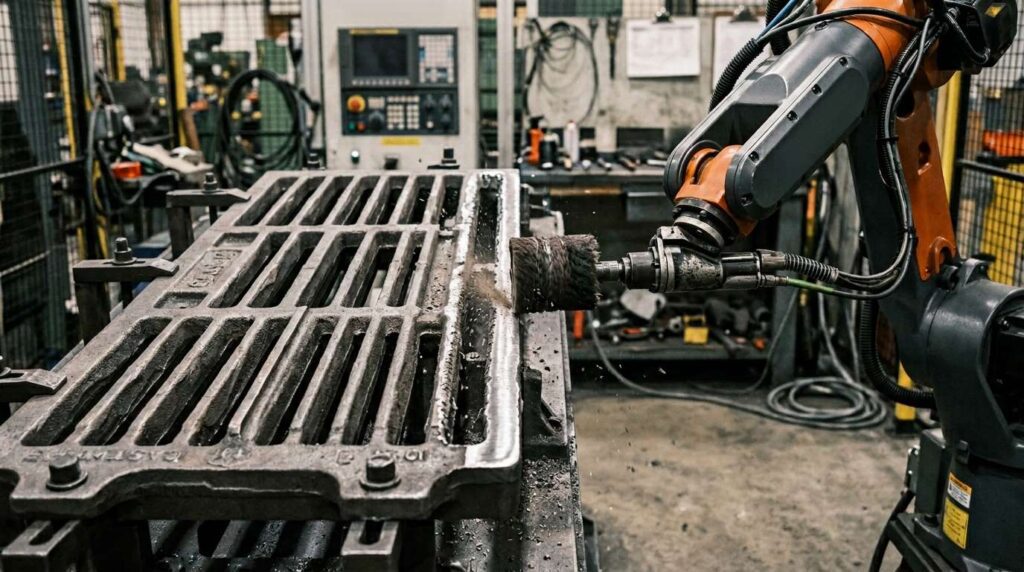
Cast iron grate plates are typical grid-type castings used in industrial furnaces, boilers, combustion equipment, incineration systems, heat treatment equipment and general industrial machinery. They are commonly designed with a rectangular frame, multiple parallel ribs, long slots and repeated internal edges. This structure is useful for supporting, ventilation, separation, ash discharge or material screening, but it also creates many burr-prone areas after casting.
During the casting process, cast iron grate plates often develop flash, parting lines, sharp edges, rough surfaces and burrs around the outer frame, slot edges and rib intersections. Because the workpiece has many repeated ribs and narrow openings, manual grinding is time-consuming, physically demanding and difficult to keep consistent across batches.
Traditional manual finishing requires workers to repeatedly process the outer frame, each rib, every slot edge and local corner areas. This creates high labor intensity, unstable grinding quality, dust exposure and production bottlenecks. A robotic grinding solution provides a more stable and scalable method for finishing cast iron grate plates, especially for manufacturers producing repeated cast iron components in batches.
This solution is designed for cast iron grate plates with typical dimensions around 440 × 300 × 10 mm. It focuses on robotic grinding, deburring, edge smoothing and surface preparation before coating, assembly or shipment.
What is a Cast Iron Grate Plate?
A cast iron grate plate is a grid-type cast component used in industrial equipment where strength, heat resistance, ventilation, separation or material support is required. Depending on the application, it may be used as a furnace grate, boiler grate, incinerator grate, support grid, ash discharge plate or industrial screening component.

Cast iron is widely used for this type of workpiece because it offers good castability, wear resistance, compressive strength and cost efficiency. For furnace and combustion-related applications, the grate plate may need to withstand heat, load, abrasion and repeated thermal cycles. For general industrial machinery, it may function as a supporting, filtering or separating component.
Although the workpiece structure appears simple, the finishing requirement is not simple. The repeated grid shape creates many internal edges, long slots and rib intersections. After casting, these areas often contain flash and burrs that must be removed before the part can be coated, assembled or delivered to the end user.
| Item | Details |
|---|---|
| Workpiece Name | Cast Iron Grate Plate |
| Chinese Name | 铸铁篦板 / 炉篦板 / 篦子 |
| Typical Size | 440 × 300 × 10 mm |
| Material | Cast Iron |
| Main Process | Robotic Grinding |
| Assisted Processes | Deburring, Edge Rounding, Surface Finishing |
| Main Processing Areas | Outer frame, ribs, slot edges, rib intersections, parting lines |
| Finishing Goal | Remove casting flash, burrs, sharp edges and surface irregularities |
The main purpose of robotic grinding is not mirror polishing. For cast iron grate plates, the key requirement is to remove casting defects, smooth sharp edges, improve handling safety and prepare the part for coating or assembly. Therefore, robotic grinding is a more suitable core process than polishing for this type of industrial cast iron workpiece.
Typical Applications of Cast Iron Grate Plates
Cast iron grate plates are not usually treated as decorative parts. They are functional industrial components used in equipment where repeated slots, ribs and openings are required. Their applications are more closely related to industrial machinery and thermal equipment than to common municipal drainage products.
| Application Area | Typical Function |
|---|---|
| Industrial Furnaces | Support materials and allow heat or air circulation |
| Boilers | Support fuel layers and assist combustion ventilation |
| Incineration Systems | Support waste materials and allow ash discharge |
| Heat Treatment Equipment | Provide support and airflow channels inside furnace systems |
| Combustion Equipment | Allow air passage, separation and material support |
| General Industrial Machinery | Used as support, screening, filtering or protection plates |
For these applications, burrs and sharp edges are not only appearance issues. They may affect assembly, coating, handling safety and equipment reliability. If flash remains on slot edges or rib intersections, it can also interfere with installation or create quality problems during later processing.
Pain Point Analysis of Cast Iron Grate Plate Finishing
The main finishing challenge of cast iron grate plates comes from their repeated grid structure. Each slot creates two long edges, each rib has multiple sides, and each intersection can become a burr accumulation point. When the part is produced in batches, manual grinding becomes repetitive, slow and difficult to standardize.
Another challenge is the uneven nature of cast iron parts. Casting flash thickness may vary from one batch to another. Some areas may only require light deburring, while others may require heavier grinding to remove parting lines or residual flash. Manual workers often rely on experience, which causes variation between parts and operators.
Dust is also a serious issue. Cast iron grinding produces fine particles and a harsh working environment. If operators grind these parts manually for long periods, the process becomes physically demanding and difficult to manage. Robotic grinding can move workers away from direct grinding tasks and integrate dust collection into the finishing cell.
| Common Problem | Specific Area | Impact |
|---|---|---|
| Casting Flash | Outer frame, parting lines, slot edges | Affects assembly, coating and appearance |
| Sharp Edges | Ribs, slots and outer contour | Creates handling safety risks |
| Internal Burrs | Long slots and rib intersections | Difficult to remove consistently by hand |
| Surface Irregularity | Cast surfaces and frame areas | Reduces surface preparation quality |
| Manual Variation | All repeated grinding areas | Causes unstable quality between operators |
| Cast Iron Dust | Grinding operation | Affects workshop cleanliness and operator comfort |
Manual grinding can handle small quantities, but it becomes inefficient when the same grate plate must be processed repeatedly. Robotic grinding is more suitable for stable batch production because the robot can follow the same path, apply consistent processing logic and repeat the same operation for every part.
| Comparison Item | Manual Grinding | Robotic Grinding |
|---|---|---|
| Quality Consistency | Depends on operator skill | Repeatable path and stable processing |
| Labor Intensity | High physical workload | Reduces heavy manual grinding tasks |
| Slot Edge Processing | Easy to miss burrs in narrow slots | Programmed processing of repeated edges |
| Dust Exposure | Operators work close to grinding dust | Enclosed cell with dust extraction |
| Batch Production | Difficult to scale efficiently | Suitable for repeated cast iron parts |
| Process Control | Hard to standardize | Programs can be saved and reused |
For manufacturers of furnace grates, boiler grate plates or industrial cast iron grid components, robotic grinding can turn a labor-intensive finishing process into a more predictable and controllable production step.
Robotic Grinding Process for Cast Iron Grate Plates
A robotic grinding cell for cast iron grate plates can be configured according to production volume, part variation and required finishing level. The system usually includes a six-axis robot, dedicated fixture, abrasive grinding tool, flexible deburring tool, force-control or compliant mechanism, dust collection system and safety enclosure.
The process focuses on removing flash, smoothing edges and preparing the cast surface for later coating or assembly. Since grate plates contain many repeated slots and ribs, the robot path should be designed to process both the external contour and internal grid features.
| Step | Process | Purpose | Tool / System |
|---|---|---|---|
| 1 | Loading and Positioning | Secure the grate plate in the fixture | Dedicated fixture |
| 2 | Program Selection | Select the correct grinding path | HMI / Robot program |
| 3 | Outer Frame Grinding | Remove flash and sharp outer edges | Abrasive grinding tool |
| 4 | Slot Edge Deburring | Remove burrs from long slot edges | Flexible deburring tool |
| 5 | Rib Surface Grinding | Clean ribs and visible cast surfaces | Grinding wheel or abrasive belt |
| 6 | Rib Intersection Finishing | Process local corner and crossing areas | Small grinding head |
| 7 | Quality Inspection | Check burr removal and edge smoothness | Manual or visual inspection |
| 8 | Unloading and Cleaning | Remove dust and transfer the part | Air blow / vacuum cleaning |

Step 1: Loading and Positioning
The cast iron grate plate is placed into a dedicated fixture. The fixture should support the outer frame and key rib areas to prevent vibration during grinding. Because the workpiece is relatively thin and has multiple openings, poor support may cause unstable contact between the tool and the part.
For batch production, the fixture can be designed with quick positioning features. If multiple similar grate plate models are produced, quick-change fixtures can be used to reduce changeover time.
Step 2: Program Selection
The operator selects the corresponding robot program according to the grate plate model. For repeated production, the grinding program can be saved and reused. This is one of the key advantages of robotic grinding over manual finishing.
If the production line handles several workpiece sizes, the system can use barcode scanning, fixture recognition or HMI-based model selection to avoid program errors.
Step 3: Outer Frame Grinding
The robot first processes the outer frame of the grate plate. This area often contains casting flash, parting lines and sharp edges. The robot follows the external contour and removes unwanted material using an abrasive grinding tool.
For cast iron parts, stable contact pressure is important. A compliant or force-controlled grinding system can help compensate for small casting variations and reduce the risk of over-grinding.
Step 4: Slot Edge Deburring
After the outer frame is processed, the robot moves to the long slot edges. These areas are the most repetitive and time-consuming sections for manual workers. Each slot has two long edges, and burrs may remain along the entire opening.
A flexible deburring tool, rotary abrasive brush or small grinding wheel can be used to smooth the slot edges. The goal is to remove burrs and sharp edges without changing the functional structure of the grate plate.
Step 5: Rib Surface Grinding
The robot then processes rib surfaces and visible cast areas. This step removes rough casting marks, local surface irregularities and small residual flash. For parts that require coating, surface preparation helps improve coating adhesion and final product consistency.
Depending on the finishing requirement, abrasive belts, grinding wheels or flexible grinding heads can be selected.
Step 6: Rib Intersection Finishing
Rib intersections and local corners are common areas where burrs remain. These areas are difficult to process consistently by hand because the tool angle must change frequently.
The robot can use a smaller grinding head or flexible abrasive tool to reach these local areas. Proper path planning ensures that the same areas are processed consistently on every part.
Step 7: Quality Inspection
After grinding, the part is inspected for burr removal, edge smoothness, surface consistency and over-grinding. Key inspection areas include the outer frame, slot edges, rib intersections and parting line areas.
Inspection can be performed manually, or the system can be integrated with visual inspection depending on the customer’s quality control requirements.
Step 8: Unloading and Cleaning
The finished grate plate is removed from the fixture. Dust and grinding residues can be cleaned by air blowing, vacuum suction or brushing. The part can then move to coating, assembly, packaging or the next production process.
For larger production lines, the robotic cell can be integrated with automatic loading, unloading, conveyors and centralized dust collection systems.

Machining Difficulties and Solutions
Cast iron grate plates are not complex in overall shape, but they are challenging because of the high number of repeated edges and slots. The robot system must be designed to handle repeated paths, casting variation, vibration and dust control.
| Challenge | Cause | Robotic Solution |
|---|---|---|
| Many Slot Edges | Long openings create repeated burr areas | Programmed path for every slot edge |
| Rib Intersection Burrs | Corners accumulate flash and burrs | Flexible tool and local finishing path |
| Thin Plate Vibration | Workpiece has open grid structure | Multi-point support fixture |
| Casting Variation | Flash thickness varies by batch | Force control and path compensation |
| Dust Generation | Cast iron grinding creates fine particles | Enclosed cell with dust extraction |
Difficulty 1: Repeated Slot Edges Require Heavy Manual Work
A cast iron grate plate contains many long slots. Each slot has two edges, and every edge may require burr removal. When workers grind these edges manually, the process becomes repetitive and tiring. Missed burrs are common, especially when production volume is high.
The solution is to create a dedicated robotic grinding path for the slot structure. The robot processes each slot edge in a defined sequence, ensuring that the same areas are treated on every part. This improves consistency and reduces dependence on worker experience.
Difficulty 2: Burrs Remain at Rib Intersections
Rib intersections and local corner areas often accumulate casting flash or small burrs. These areas are difficult to reach with large grinding tools. Manual workers may skip these areas or grind them unevenly.
The solution is to use a flexible deburring tool or smaller grinding head for local finishing. The robot can approach the intersections from programmed angles and complete repeatable finishing without damaging the main rib structure.
Difficulty 3: Open Grid Structure May Vibrate During Grinding
Because the grate plate has long slots and a relatively thin structure, vibration may occur during grinding if the fixture only supports the outer frame. Vibration can cause uneven marks, unstable tool contact and faster abrasive wear.
The solution is to use a multi-point support fixture. The fixture should support both the outer frame and selected rib areas while keeping the grinding path accessible. Combined with controlled grinding force, this helps improve process stability.
Difficulty 4: Casting Variation Between Batches
Cast iron grate plates may have different flash thickness, surface unevenness or small dimensional variations between batches. A rigid grinding path may not handle these differences well.
The solution is to use force-controlled or compliant grinding tools. For more demanding applications, 3D vision or laser scanning can be added to identify workpiece position and compensate the robot path.
Difficulty 5: Dust Control During Cast Iron Grinding
Cast iron grinding produces fine dust and particles. Manual grinding exposes operators directly to dust, while dust accumulation can also affect equipment maintenance and workshop cleanliness.
The solution is to use an enclosed robotic grinding cell with integrated dust collection. Local suction ports, protective covers and filtration equipment can be added to remove dust from the grinding area and improve the working environment.
Cast Iron Grate Plate Manufacturing Case
Customer Background
A cast iron component manufacturer produces grate plates for industrial furnace and combustion equipment applications. The parts have a rectangular grid structure with multiple ribs and long slots. Before automation, workers manually removed casting flash, burrs and sharp edges after casting.
As production volume increased, manual grinding became a bottleneck. The customer needed a more stable finishing process to reduce manual workload, improve batch consistency and control dust in the workshop.
Technical Challenges
The grate plate had many repeated slot edges and rib intersections. Manual workers spent a long time processing each opening, and quality varied from one operator to another. Some parts still had burrs around the slot edges, while others showed uneven grinding marks.
The workpiece was also relatively thin, so fixture support was important. Without stable support, vibration occurred during grinding and affected the surface finish. Cast iron dust also made the manual grinding area difficult to manage.
Solution
UBRIGHT SOLUTIONS designed a robotic grinding cell for cast iron grate plates. The system used a six-axis industrial robot, dedicated multi-point support fixture, abrasive grinding tool, flexible deburring tool and enclosed dust collection system.
The robot first processed the outer frame and parting line areas, then removed burrs from the long slot edges and rib intersections. A controlled grinding strategy was used to reduce over-grinding and improve edge consistency. The fixture was designed to support both the frame and rib areas, improving stability during grinding.
| Item | Configuration |
|---|---|
| Workpiece | Cast Iron Grate Plate |
| Typical Size | 440 × 300 × 10 mm |
| Main Process | Robotic Grinding |
| Assisted Process | Deburring and Edge Rounding |
| Robot | Six-Axis Industrial Robot |
| Tooling | Abrasive Grinding Tool, Flexible Deburring Tool |
| Fixture | Multi-Point Support Fixture |
| Dust Control | Enclosed Cell with Dust Collection |
| Application | Flash Removal, Slot Edge Deburring, Surface Preparation |
Implementation Results
After implementation, the customer achieved more stable grinding quality and reduced manual finishing workload. The robot could repeatedly process the outer frame, slot edges and rib intersections according to the saved program.
The enclosed cell improved dust control, while the dedicated fixture reduced workpiece vibration during grinding. The customer also gained a more standardized finishing process for repeated production of cast iron grate plates.
| Result Area | Improvement |
|---|---|
| Grinding Consistency | More stable finishing on slot edges and outer frame |
| Labor Reduction | Reduced heavy manual grinding workload |
| Production Stability | Reusable robot programs for repeated grate plate models |
| Dust Control | Enclosed cell improved workshop cleanliness |
| Quality Control | Fewer missed burrs at slots and rib intersections |
| Scalability | Easier to support batch production of cast iron components |
Customer Feedback
“The robotic grinding system helped us standardize the finishing process for cast iron grate plates. It reduced repetitive manual grinding work and improved consistency on slot edges and rib intersections.”
FAQ
Q1: Why is robotic grinding suitable for cast iron grate plates?
Robotic grinding is suitable because cast iron grate plates have many repeated ribs, slots and internal edges. These areas require consistent burr removal and edge smoothing. A robot can follow programmed paths and process the same areas repeatedly, making it suitable for batch production.
Q2: What defects can robotic grinding remove from cast iron grate plates?
The system can remove casting flash, burrs, sharp edges, parting lines, rough casting marks and small surface irregularities. The most common processing areas are the outer frame, long slot edges, rib surfaces and rib intersections.
Q3: Is polishing required for cast iron grate plates?
In most cases, mirror polishing is not required. Cast iron grate plates are usually functional industrial components. The main requirement is grinding, deburring and surface preparation before coating, assembly or shipment.
Q4: Can one robotic grinding cell process different grate plate models?
Yes. Different grate plate models can be processed if the system uses suitable fixtures and saved robot programs. For similar product families, quick-change fixtures can be designed to reduce changeover time.
Q5: How does the robot handle burrs inside long slots?
The robot can use a flexible deburring tool, rotary brush or small abrasive wheel to process the slot edges. The tool path is programmed according to the slot layout, allowing the robot to remove burrs from repeated internal edges consistently.
Q6: How can over-grinding be avoided?
Over-grinding can be reduced by using optimized robot paths, compliant tools and force-controlled grinding. Proper fixture support also helps maintain stable contact between the tool and workpiece.
Q7: Can the system include dust collection?
Yes. Dust collection is strongly recommended for cast iron grinding. The robotic cell can include an enclosure, suction ports, dust extraction pipes and filtration equipment to improve workshop cleanliness and operator safety.
Q8: Is robotic grinding suitable for small-batch production?
Robotic grinding is most valuable for repeated batch production. For small-batch production, it can still be considered if the workpieces belong to the same product family and share similar grinding paths. For highly variable parts, fixture and programming cost should be evaluated first.
Conclusion
Cast iron grate plates have many ribs, long slots and repeated internal edges. After casting, these areas often contain flash, burrs, parting lines and sharp edges. Manual grinding is repetitive, labor-intensive and difficult to keep consistent across batches.
A robotic grinding solution provides a more stable method for finishing cast iron grate plates. With a six-axis robot, dedicated fixture, flexible grinding tools and dust collection system, manufacturers can improve edge consistency, reduce heavy manual labor and create a cleaner production environment.
For manufacturers producing furnace grate plates, boiler grates, combustion equipment components or industrial cast iron grid parts, robotic grinding is an effective solution for improving finishing quality and production stability.

