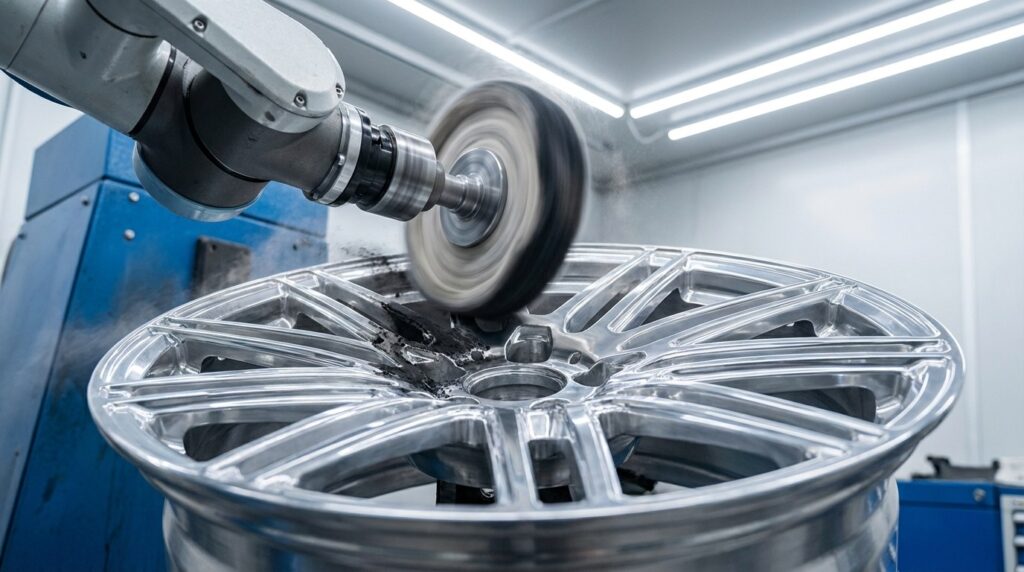
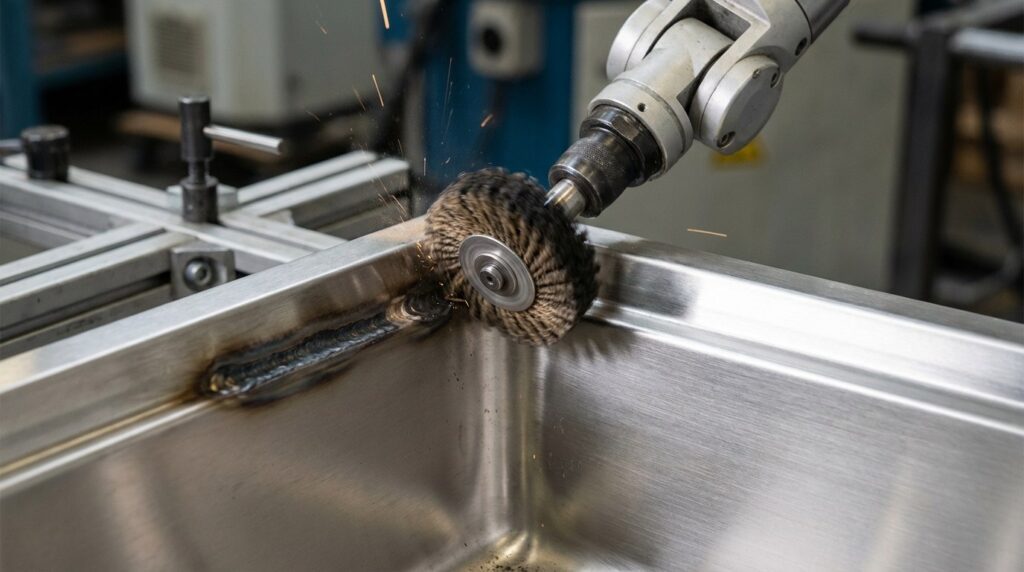
In the manufacturing of high-end office furniture and General Metal hardware, the 5-Star Chair Base is the core structural component that supports human weight and showcases the chair’s premium feel. Whether pursuing a minimalist brushed texture or a high-gloss mirror effect, its five radiating prongs must read as visually identical.
Faced with such massive, heavy die-castings requiring multi-faceted grinding, traditional manual labor has long been overwhelmed. Adopting an automated architecture—where a heavy-duty 6-axis industrial robot grips the center hole and maneuvers the part against high-power floor-mounted abrasive belt machines, known as robotic polishing—has become the ultimate solution for top global office furniture OEMs to smash capacity bottlenecks and eliminate manual fatigue errors.
What are Aluminum 5-Star Chair Bases?
The star bases of mid-to-high-end office chairs are typically formed via high-pressure die-casting machines using high-strength aluminum alloys (such as ADC12 or A380). Fresh from the mold, the raw casting typically has a diameter ranging between 600mm and 750mm. Its surface is rough, exhibiting die-casting cold shuts, and the side edges of all five prongs are covered with extremely coarse and sharp parting lines and gating residue.
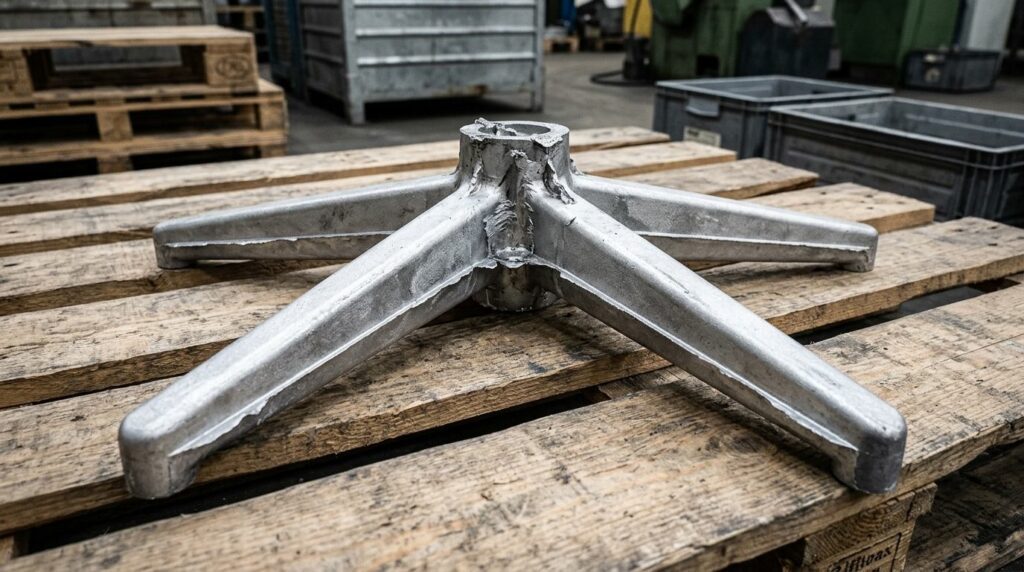
The Dual Crisis of Manual Grinding: Fatigue and Inconsistency
Due to the massive size of the star base, manual grinding faces brutally severe challenges:
- Extreme Physical Exhaustion: An aluminum star base weighs several kilograms. Workers must grip it with both hands, press it hard against a belt sander, and continuously rotate it manually to grind all five different prongs. This intense, heavy physical labor leads to rapid worker fatigue and severe turnover rates.
- Fatal “Asymmetrical” Defects: Human stamina depletes throughout a shift. A worker might apply strong pressure when grinding the 1st prong but significantly less pressure by the 5th. This directly causes the gloss level and R-corner chamfer sizes to be completely inconsistent across the five prongs of the exact same chair base.
- Explosive Aluminum Dust: Grinding large areas of aluminum alloy generates highly concentrated aluminum dust. This not only damages workers’ lungs but also poses a severe explosion risk in enclosed workshops, making it a primary target for safety regulators.
Technical Parameters for Aluminum Chair Base Automation
| Item | Parameter Range | Notes |
| Gating & Heavy Flash Prep | High-Cut SiC Wide Belt | Rapidly removes die-cast overflow residue, leveling side profiles |
| Radial Prong Curve Blending | Floating Nylon Wheel / Fine Belt | Conforms to the tapering curves of the prongs, erasing stepped die-marks |
| Large Face & Side Polishing | High-Density Sisal / Cloth Center | Combined with auto-waxing to awaken the aluminum’s natural high-gloss |
| Robot Payload Requirement | 160kg – 210kg | Heavy-duty robots are mandatory due to massive part size and lever forces |
| Prong Consistency Error | ≤ 0.05 mm | Holds geometry and gloss of all 5 prongs to a matched finish |
Why Must Large Hardware Use the “Robot-Holding-Workpiece” Architecture?
A star base is the classic “wide-span, heavy-body” workpiece, and it dictates its own layout: a heavy-payload robot drives a dedicated expanding gripper into the central gas-lift hole, locks it, and swings the whole casting against high-power floor-mounted belt machines and polishing centers. The center-hole grip turns an awkward casting into a predictable rotating workpiece.
For large-part grinding, this arrangement delivers where manual lines cannot:
- Indexed Posture Switching: One grip is all the setup the part gets. Rotating the 6th axis—or an external 7th—presents each of the five prongs to the stationary belt in turn, with the indexing precision of a rotary table. No human repositioning means no repositioning errors.
- Matched Prong Finishes: Constant feed and programmed trajectories give the 1st prong and the 5th prong the same pressure and dwell time. Symmetry across the product stops depending on how the worker felt at hour seven.
- Reaction-Force Stiffness: Grinding broad aluminum surfaces loads the arm heavily. A heavy-payload robot carries those cutting reactions without deflection or judder, which is why the surface texture stays smooth and wave-free.
Automated Grinding and Polishing Process Workflow
| Step | Operation | Tooling & Consumables | Purpose |
| 01 | Heavy-Duty Internal Grip | Robot + Pneumatic Expanding Mandrel | Expands inside the center hole for a dead-lock, establishing the 5-star coordinates |
| 02 | Heavy Side Flash Removal | Floor-Mounted High-Power Coarse Belt | High-pressure passes flatten die-cast flash on the sides of all 5 prongs |
| 03 | Uniform Face Blending | Wide Floating Contact Belt Machine | Erases mold release marks, giving the 5 curved panels a unified baseline roughness |
| 04 | High-Gloss Mirror Buffing | Auto-Wax Multi-Station Cloth Center | High-speed buffing for bases requiring a mirror aluminum finish |
| 05 | Auto Unloading Handover | Transfer to packaging/cleaning | Releases gripper, placing part smoothly for subsequent quality inspection |
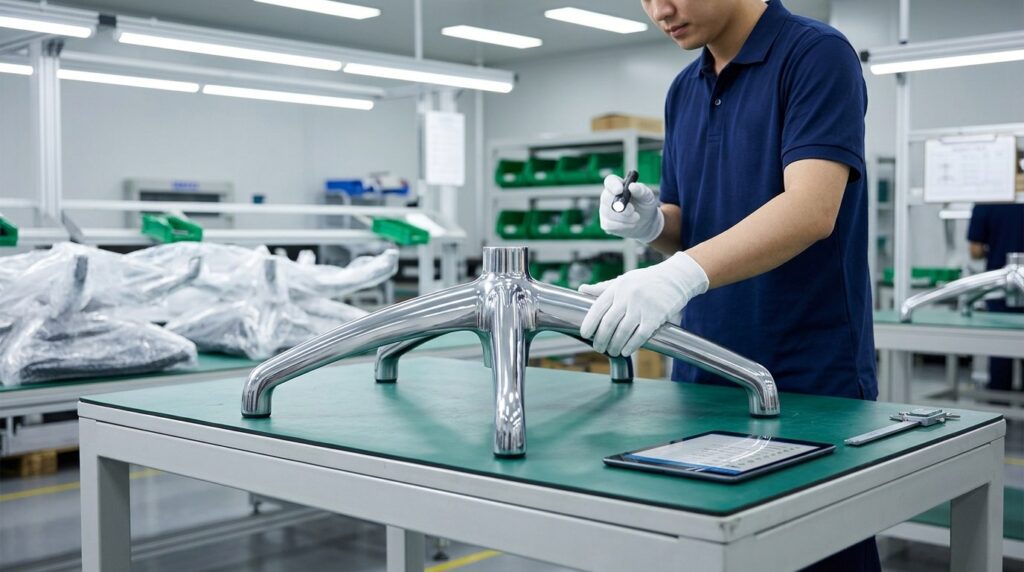
Workholding and Datum Setup for Star Bases
Everything about star-base workholding follows from two facts: the part is heavy and wide, and it already contains a precision feature—the tapered gas-lift bore—at its center. The expanding mandrel grip exploits that bore for both holding and location, and the program establishes its angular zero on the centerline of prong one, so every subsequent indexing move is relative to a physical feature rather than a fixture guess.
- Mandrel locking: pneumatic or hydraulic expansion grips the bore wall over a length sized to the casting’s weight; grip pressure is set high enough to resist prong-tip cutting loads without distorting the bore.
- Overhang management: at 600-750 mm across, prong tips work at a long lever arm; the cell pairs robot stiffness with the shortest practical gripper to keep tip deflection out of the finish.
- Incoming variation: die-cast parting lines wander from shot to shot; the program banks on floating toolheads and generous lead-ins rather than expecting castings to repeat like machined parts.
Abrasives for Large Aluminum Castings
Aluminum die-castings are abrasive-system unkind: the metal smears, loads belts, and burns if the cut is allowed to glaze. The media ladder therefore runs from open-coat SiC belts that stay free-cutting through heavy flash removal, to floating nylon and fine belts that fair the prong curves, and finally to sisal and cloth wheels with auto-waxing for the mirror grades. Open-coat construction and disciplined belt changes matter more here than in steel work—aluminum does not forgive a loaded belt.
- Flash and gate residue: the coarse stage exists to remove bulk material fast; spending fine media on roughing is the fastest way to inflate consumable cost per base.
- Curved prong flanks: compliant wheels follow the tapering prong geometry so the surface is cut, not chased—stepped die-marks disappear without flattening the design intent.
- Dust strategy: every stage runs under extraction, wet where the fire risk assessment requires it, because aluminum fines are combustible; the cell’s dust handling is engineered as part of the process, not bolted on. Deburring fundamentals are covered in what is robotic deburring.
Cycle Structure and Consistency Verification
The cycle exploits indexing: prong by prong, side pass then top pass, the whole base machined around one grip. Loading and unloading overlap the grinding via a second station or an exchange table, so spindle time is nearly all cutting time. Lines running mixed models store per-family programs and gripper inserts, and changeovers between base families reduce to selecting the program and swapping the insert.
Consistency is checked the way customers see it: side-by-side prong comparison under consistent lighting, gloss sampling against the approved master, and dimensional spot checks on the bore and prong profiles. Because every part runs the same indexed program, a verified first part carries real weight—the rest of the batch is running the same physics. Wheel-machine selection for this class of work is covered in our wheel polishing machine guide; for a compact aluminum casting on the same platform, see our die-cast motor housing deburring solution.
Application Scenario: Large Die-Cast Star Bases
A hardware manufacturer in South China casting star bases for top-tier ergonomic chair brands is a typical case—eight heavy-payload cells now anchor its finishing line.
- Before: Recruitment had become the constraint—younger workers would not take heavy, high-dust aluminum grinding jobs. Manual grinding left the five prongs mismatched in gloss, brand rejections arrived regularly, and yield sat well below what the business needed.
- After: With 210 kg-class robots holding the workpieces, the line runs lights-out under fully enclosed negative-pressure dust extraction. The five prongs of every base come out visibly matched, first-pass cosmetic yield holds in the high nineties, cycle times shorten, and the capacity ceiling and dust hazard go with them.
Aluminum Chair Bases Polishing FAQ
Q1: Star bases are massive, creating a long lever arm when grinding the tip of a prong. Can the robot grip it stably?
A: Yes. External clamping jaws are the wrong tool here. Instead, a high-strength pneumatic or hydraulic expanding mandrel enters the conical gas-lift hole in the center and expands outward, taking a positive lock on the bore interior. With a 160 kg-class robot, grinding pressure at the very tip of a prong still produces no chatter or shift. The same center-bore logic carries across design changeovers, as covered below.
Q2: Furniture factories frequently update star base designs (flat vs. arched profiles). Is it difficult to change over the robotic line?
A: It is straightforward. Because center-bore gripping suits the vast majority of star bases, a changeover is mostly a software event: the engineer imports the new CAD model, and 3D Offline Programming (OLP) plans the paths and indexing angles for all five prongs from it. No teach-pendant hours in a dusty workshop—which is what keeps high-mix furniture hardware production practical.
Conclusion
In high-end office furniture hardware, the matched finish of a 5-star base and its surface quality are baseline requirements, not aspirations. An automated architecture—a heavy-duty 6-axis robot gripping the center hole against high-power floor-mounted belt machines—takes workers out of the most punishing job on the floor and ends the asymmetry problem, while opening the capacity ceiling for furniture hardware suppliers.
Large aluminum castings punish every inconsistency a human brings to the job. When heavy grinding yields stop making sense, ask our team about a heavy-payload cell for your furniture hardware line: contact us.