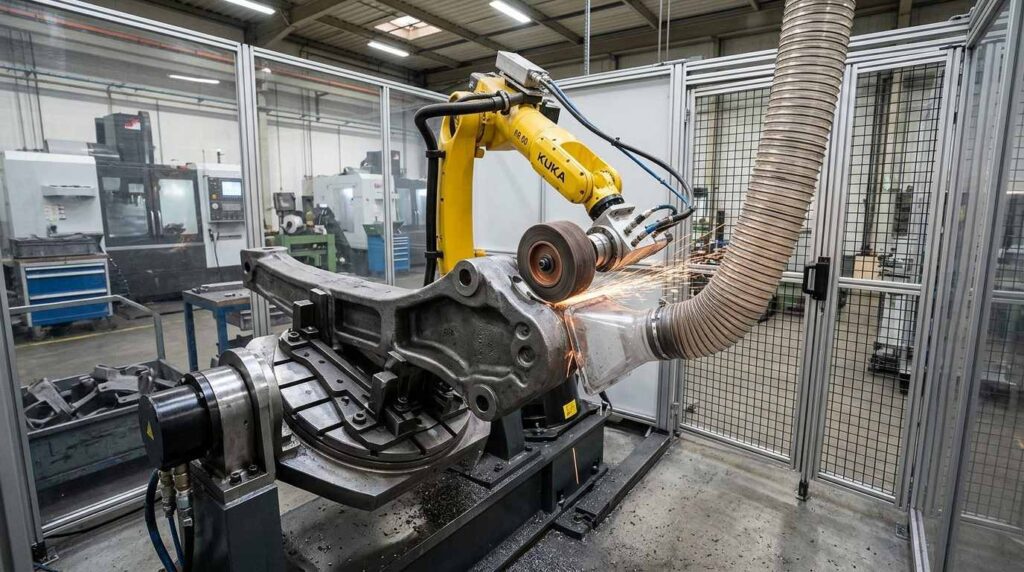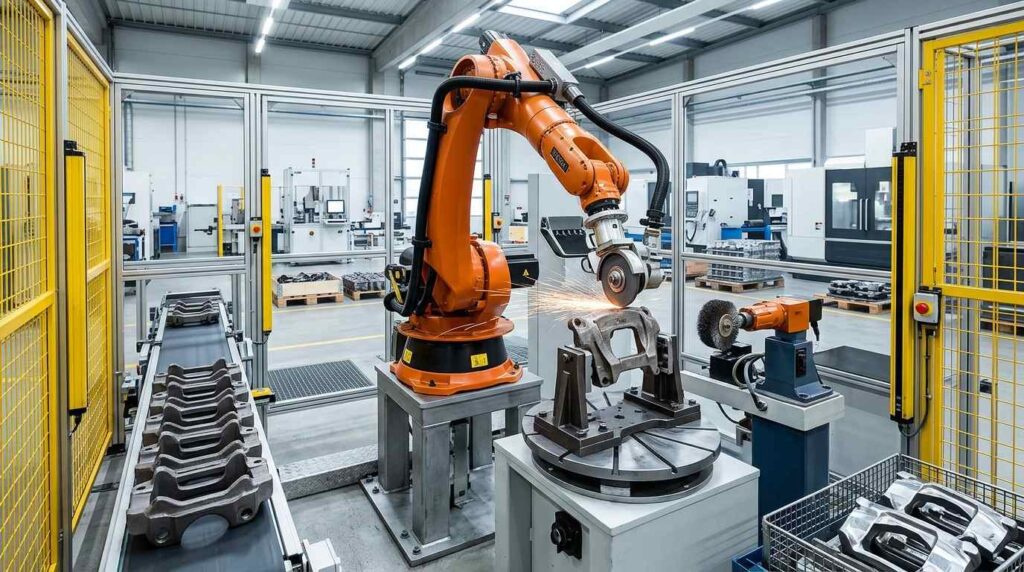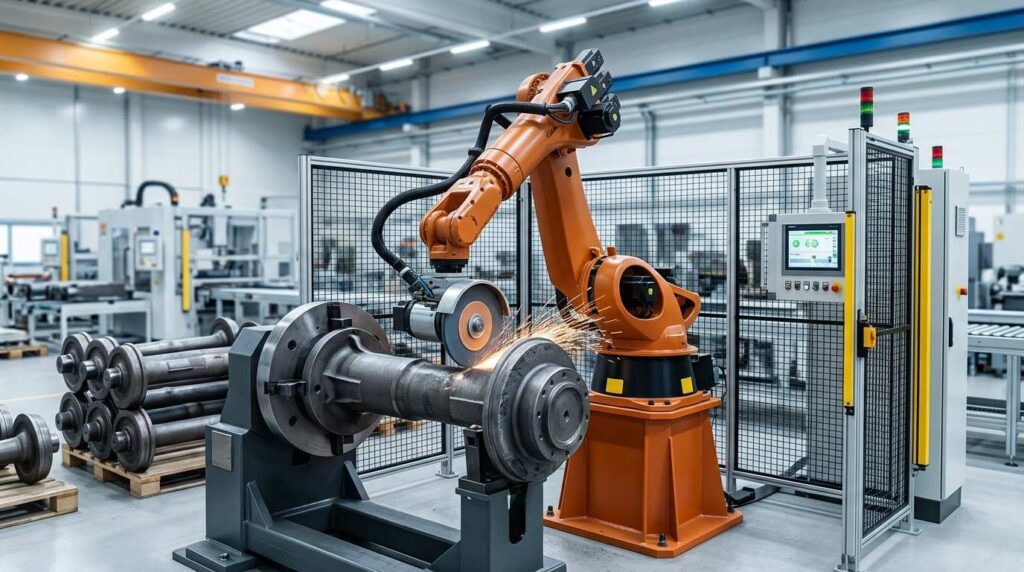
Axles are important structural components widely used in commercial vehicles, heavy-duty trucks, trailers, special-purpose vehicles and other transportation equipment. As a typical large cast iron workpiece, an axle usually features a long body, multiple mounting sections, end connection areas and several transition zones with varying geometry. Compared with smaller automotive castings, axle finishing requires stronger process stability because the workpiece is large, heavy and difficult to handle manually.
During casting, axles may develop flash, parting lines, burrs, sharp edges and local surface irregularities along the main beam, end sections and structural transition areas. If these defects are not removed properly, they may affect handling safety, downstream machining preparation, coating quality and overall product consistency. For manufacturers producing axle castings in batches, manual grinding is often labor-intensive and difficult to standardize.
Traditional manual grinding requires workers to repeatedly process long parting lines, local junctions, mounting transitions and end edges. This creates high labor intensity, unstable finishing quality and a harsh dust environment. A robotic grinding solution provides a more controlled and scalable way to finish cast iron axles, especially where repeatability, productivity and worker safety are important.
This solution is designed for cast iron axle workpieces with typical dimensions around 2360 × 300 × 250 mm based on your sample reference. It focuses on robotic grinding, deburring, edge smoothing and surface preparation before coating, assembly or shipment.
What is an Axle?
An axle is a major load-bearing and connecting component in a vehicle chassis or drivetrain system. Depending on the design, it may support the wheel assembly, connect suspension elements, transmit load or serve as part of the axle housing structure in heavy-duty vehicle applications.
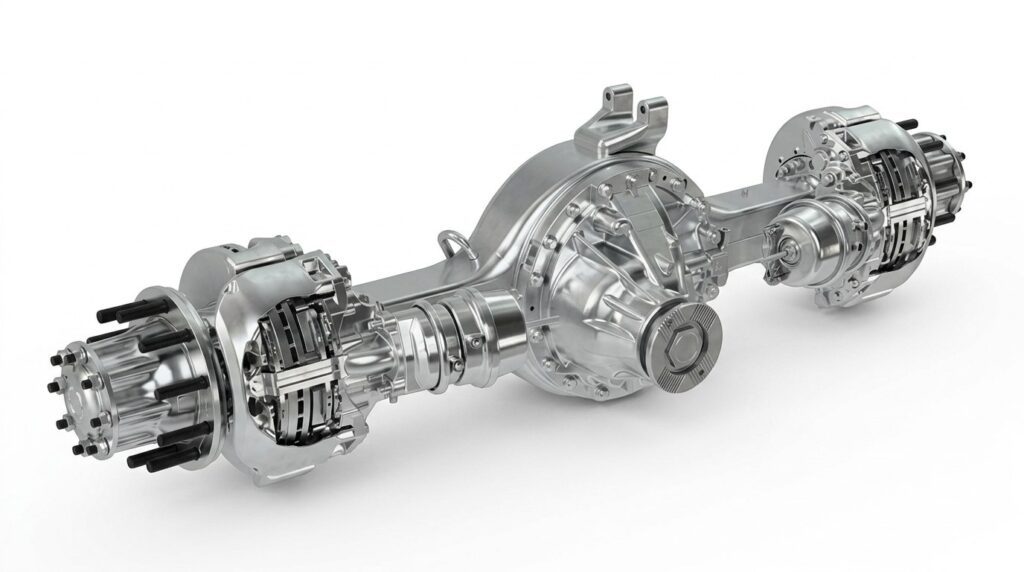
Cast iron or cast steel axle-type components are often used where strength, rigidity and manufacturing efficiency are required. These parts are usually large, with long structural sections and several critical transition areas. Even when major functional surfaces are machined later, the cast body still requires post-casting finishing to remove flash, burrs and sharp edges.
Because axles are large workpieces, manual finishing becomes difficult not only because of the number of burr-prone areas, but also because of the part size itself. Operators must move around the workpiece repeatedly, and finishing quality may vary from one section to another.
| Artikel | Einzelheiten |
|---|---|
| Name des Werkstücks | Axle |
| Chinesischer Name | 车桥 |
| Typische Größe | 2360 × 300 × 250 mm |
| Material | Gusseisen |
| Hauptprozess | Robotisches Schleifen |
| Unterstützte Prozesse | Entgraten, Kantenverrundung, Oberflächenveredelung |
| Hauptverarbeitungsbereiche | Long parting lines, end sections, mounting areas, structural transitions |
| Industry | Automotive & EV / Commercial Vehicle |
| Fertigstellung des Ziels | Remove flash, burrs, sharp edges and surface irregularities |
For axle castings, the main objective is not polishing for appearance. The more important requirement is to remove casting defects, smooth unsafe or assembly-critical edges, improve downstream process readiness and achieve more stable batch quality. That is why robotic grinding is a practical solution for this type of large structural casting.
Typical Applications of Axles
Axles are used in transportation and heavy-duty equipment where structural strength and dimensional stability are essential. The exact design may differ depending on the vehicle platform, but the finishing logic is generally similar.
| Anwendungsbereich | Typical Use |
|---|---|
| Commercial Vehicles | Axle structures for trucks and logistics vehicles |
| Heavy-Duty Trucks | Load-bearing axle components |
| Trailers | Structural axle-related cast components |
| Special Vehicles | Axles for engineering, utility or custom vehicles |
| Off-Road Equipment | Heavy structural vehicle axle applications |
| Industrial Transport Equipment | Axle-type structural components for transport systems |
In these applications, burrs, flash and sharp edges are not only appearance issues. They can interfere with handling, coating, downstream machining, fixture positioning and final assembly quality.
Pain Point Analysis of Axle Finishing
The first challenge in axle finishing is workpiece size. An axle is much larger than a brake disc or bracket, which means manual grinding requires more operator movement, more repositioning and more time. Large castings also create more fatigue during repetitive finishing work.
The second challenge is long parting lines and extended surface areas. Because the workpiece body is long, the parting line may run across a large section of the casting. If finished manually, quality can vary along the length of the part.
The third challenge is local geometry changes. Axles often include thicker joints, mounting interfaces, curved transitions and end structures. These areas tend to accumulate flash or burrs and are difficult to process evenly by hand.
The fourth challenge is dust and labor intensity. Grinding a large cast iron workpiece produces a significant amount of dust and requires workers to maintain awkward postures. As production volume increases, manual finishing becomes harder to sustain.
| Gemeinsames Problem | Spezifischer Bereich | Auswirkungen |
|---|---|---|
| Guss-Blitz | Long parting lines and outer transitions | Affects coating and downstream finishing |
| Scharfe Kanten | End areas, junctions and transitions | Creates handling and assembly risks |
| Local Burrs | Mounting sections and geometry changes | Difficult to remove evenly by hand |
| Unregelmäßigkeit der Oberfläche | Long cast surfaces | Reduces surface preparation consistency |
| Manuelle Variation | Full-length grinding areas | Verursacht instabile Qualität zwischen den Betreibern |
| Gusseisenstaub | Schleifen | Affects workshop environment and operator comfort |
Compared with manual grinding, robotic grinding is better suited to repeated long-path finishing and controlled treatment of specific zones on large castings.
| Vergleich Artikel | Manuelles Schleifen | Robotisches Schleifen |
|---|---|---|
| Qualität und Konsistenz | Depends on operator skill and position | Wiederholbarer Weg und stabile Verarbeitung |
| Arbeitsintensität | High for large workpieces | Reduces heavy manual grinding workload |
| Long Path Processing | Difficult to keep uniform by hand | Consistent finishing over full-length areas |
| Staubexposition | Operators work close to grinding area | Enclosed or semi-enclosed cell with dust extraction |
| Batch-Produktion | Hard to standardize fully | Suitable for repeated axle production |
| Prozesskontrolle | Varies by operator | Programme können gespeichert und wiederverwendet werden |
For axle manufacturers, robotic grinding helps transform a physically demanding manual process into a more standardized automated finishing operation.
Robotic Grinding Process for Axles
A robotic grinding cell for axle castings can be designed according to workpiece size, casting variation, required finishing range and production volume. Because the axle is a large workpiece, the system may use a heavy-duty robot, floor-mounted configuration, track-mounted robot or positioner-assisted setup depending on the project scope.
The process is designed to remove flash, smooth sharp edges and improve surface consistency on selected non-functional areas. It can also prepare the workpiece for coating, machining or assembly.
| Schritt | Prozess | Zweck | Werkzeug/System |
|---|---|---|---|
| 1 | Laden und Positionieren | Secure the axle in the fixture | Dedicated heavy-duty fixture |
| 2 | Programmauswahl | Wählen Sie den richtigen Schleifweg | HMI / Roboterprogramm |
| 3 | Long Parting Line Grinding | Remove flash and uneven edges along the main body | Schleifwerkzeug |
| 4 | End Area Deburring | Clean burrs from ends and connection areas | Flexibles Entgratungswerkzeug |
| 5 | Transition Zone Grinding | Process curved and mounting transition areas | Grinding wheel or compliant tool |
| 6 | Local Fine Finishing | Improve consistency on critical non-functional areas | Kleiner Schleifkopf |
| 7 | Qualitätskontrolle | Check burr removal and surface consistency | Manuelle oder visuelle Prüfung |
| 8 | Entladung und Reinigung | Staub entfernen und das Teil übertragen | Luftblasen / Staubsaugen |
Schritt 1: Laden und Positionieren
The axle is placed into a dedicated heavy-duty fixture. Because of the part length and weight, stable positioning is essential for safe and repeatable grinding. The fixture should support the main beam and key structural areas to prevent vibration or movement during processing.
For automated production, cranes, conveyors or transfer devices may be integrated with the grinding cell.
Schritt 2: Programmauswahl
The operator selects the corresponding robot program based on the axle model. Different axle types may have different body lengths, transition geometry or end structures, so separate saved programs are usually needed.
For mixed-model production, the system can use recipe management, barcode scanning or fixture-based identification.
Step 3: Long Parting Line Grinding
The robot first processes the main parting line and extended flash areas along the axle body. This is one of the most time-consuming tasks in manual grinding because the path is long and must remain consistent across the entire workpiece.
With robotic grinding, the tool follows a defined path and maintains more uniform edge treatment over the full length.
Step 4: End Area Deburring
After the main body is processed, the robot moves to the end sections and local connection areas. These zones may contain sharp edges, residual burrs and local flash around openings or structural features.
A flexible deburring tool or smaller abrasive head helps remove burrs without excessive material removal.
Step 5: Transition Zone Grinding
Axles often include thick-to-thin transitions, curved geometry and mounting interfaces. These areas are difficult to process evenly by hand because the tool angle changes frequently.
The robot can use a compliant grinding head or well-defined path strategy to improve consistency in these transition zones.
Step 6: Local Fine Finishing
Some non-functional but visible or handling-sensitive areas may require additional finishing. The robot can perform local smoothing to improve surface consistency and prepare the part for painting or coating.
This step is particularly useful when the customer wants a more uniform appearance or better coating preparation.
Schritt 7: Prüfung der Qualität
After grinding, the axle is inspected for burr removal, edge smoothness, consistency and over-grinding. Inspection focuses on long parting lines, end sections, transition areas and any defined processing zones.
Depending on the project, this can be done manually or with visual assistance.
Schritt 8: Entladen und Reinigen
The finished axle is removed from the fixture, and dust or grinding residue is cleaned by air blowing, brushing or vacuum collection. The part then moves to coating, machining, assembly or storage.
Bearbeitungsschwierigkeiten und Lösungen
Axle castings are challenging not because of intricate micro-features, but because of their size, long processing paths and multiple structural transition zones. A good robotic solution must combine stable fixturing, repeatable paths and dust control.
| Herausforderung | Ursache | Robotische Lösung |
|---|---|---|
| Long Parting Lines | Large casting body creates extended flash areas | Programmed long-path grinding |
| End Burrs and Edges | Geometry changes at the ends accumulate burrs | Flexible deburring tools for local zones |
| Transition Area Complexity | Thick-to-thin and curved sections require angle changes | Compliant grinding and optimized path planning |
| Large Workpiece Handling | Size and weight make manual processing difficult | Heavy-duty fixture and automated loading support |
| Staubentwicklung | Schleifen von Gusseisen erzeugt feine Partikel | Dust extraction integrated with robotic cell |
Difficulty 1: Long Parting Lines Are Hard to Grind Uniformly
Because the axle body is long, the flash or parting line may extend over a large area. Manual grinding often leads to inconsistent edge quality from one section to another, especially when different operators handle different workpieces.
The solution is to use programmed robotic grinding paths that follow the same route for each axle. This improves consistency across the full length of the workpiece.
Difficulty 2: End Areas Accumulate Burrs and Sharp Edges
The ends of an axle often include more geometry changes, mounting sections or connection features. These areas are more likely to retain sharp edges and burrs after casting.
The solution is to use flexible deburring tools and dedicated local tool paths. This helps the robot clean difficult areas without unnecessary grinding on adjacent surfaces.
Difficulty 3: Transition Zones Are Difficult to Process by Hand
Curved transitions and structural junctions require frequent tool angle changes. Manual finishing in these areas is highly dependent on worker experience and often lacks consistency.
The solution is to use compliant grinding tools and optimized robot orientation control. The robot can approach these zones from repeatable angles and maintain more stable contact.
Difficulty 4: Workpiece Size Increases Labor Burden
A large axle casting is physically demanding to finish manually. Operators must reposition themselves frequently and work around a heavy part for long periods.
The solution is to automate the grinding path and reduce direct manual contact with the workpiece. Automated loading support and proper fixture layout further improve productivity.
Difficulty 5: Dust Control Is Critical in Large Casting Grinding
Large cast iron grinding generates significant dust. If the process remains manual and open, the workshop environment becomes difficult to manage.
The solution is to integrate the robotic grinding cell with dust extraction, local suction and protective enclosure design. This improves cleanliness and reduces operator exposure.
Manufacturing Case
Kundenhintergrund
A commercial vehicle component manufacturer produces cast iron axle structures for heavy-duty vehicle applications. The company needed to improve finishing consistency on large castings and reduce manual grinding effort in a growing production environment.
Technische Herausforderungen
The axle workpiece had a long body with extended parting lines, several local transition zones and end features that required burr removal. Manual grinding was slow and physically demanding, and the quality varied between operators. Because the workpiece was large, it was difficult to maintain uniform treatment over the full length.
The customer also wanted a cleaner finishing area and a more standardized process before coating and downstream handling.
Lösung
UBRIGHT SOLUTIONS designed a robotic grinding cell for cast iron axle castings. The system used a heavy-duty industrial robot, dedicated fixture, abrasive grinding tool, flexible deburring tool and dust extraction system.
The robot first processed the long parting line areas, then moved to end sections and structural transitions for local deburring and edge smoothing. A stable fixture layout was used to support the large workpiece, while the grinding path was optimized for full-length consistency.
| Artikel | Konfiguration |
|---|---|
| Werkstück | Cast Iron Axle |
| Typische Größe | 2360 × 300 × 250 mm |
| Hauptprozess | Robotisches Schleifen |
| Unterstützter Prozess | Entgraten und Kantenverrundung |
| Roboter | Heavy-Duty Six-Axis Industrial Robot |
| Werkzeugbau | Schleifwerkzeug, flexibles Entgratungswerkzeug |
| Halterung | Dedicated Axle Support Fixture |
| Staubkontrolle | Robotic Cell with Dust Extraction |
| Anmeldung | Long parting line grinding, end deburring, transition area finishing |
Ergebnisse der Umsetzung
After implementation, the customer achieved more stable finishing quality and reduced heavy manual grinding work on large axle castings. The robotic system standardized the treatment of long flash lines and local edge areas, improving repeatability across batches.
The cell also improved the working environment by reducing operator exposure to dust and repetitive grinding. Saved robot programs allowed the manufacturer to reuse the process for repeated axle models and improve production stability.
| Ergebnis Bereich | Verbesserung |
|---|---|
| Konsistenz beim Schleifen | More stable finishing over long parting lines |
| Arbeitsreduzierung | Verringerung des Arbeitsaufwands für schweres manuelles Schleifen |
| Stabilität der Produktion | Reusable programs for repeated axle models |
| Staubkontrolle | Cleaner grinding environment with extraction system |
| Qualitätskontrolle | Better consistency on end areas and transitions |
| Skalierbarkeit | Easier support for batch axle production |
Kunden-Feedback
“The robotic grinding system helped us improve consistency on large axle castings and significantly reduced repetitive manual finishing work in our production process.”
FAQ
Q1: Why is robotic grinding suitable for axle castings?
Robotic grinding is suitable because axle castings are large, repetitive workpieces with long parting lines and multiple burr-prone transition areas. The robot can process these areas with repeatable paths and reduce the burden of manual grinding.
Q2: What areas of an axle are typically processed by robotic grinding?
Common processing areas include long parting lines, end sections, mounting transitions, structural junctions and selected non-functional surfaces that require deburring or edge smoothing.
Q3: Is robotic grinding suitable for large and heavy axle parts?
Yes. With a heavy-duty robot, proper fixture design and suitable loading support, robotic grinding can be applied to large axle castings effectively.
Q4: Can one robotic cell process different axle models?
Yes. Different axle models can be processed if the system uses suitable fixtures and saved robot programs. For mixed production, model identification and recipe management can be added.
Q5: How does robotic grinding improve consistency on long parting lines?
The robot follows a predefined path along the full length of the parting line. This creates more uniform grinding results than manual processing, which often varies depending on operator movement and fatigue.
Q6: Can the system include dust extraction?
Yes. Dust extraction is strongly recommended for large cast iron grinding applications. The robotic cell can include local suction, dust collection and enclosure protection.
Q7: Is polishing necessary for axle castings?
In most cases, no. The main requirement is grinding, deburring and surface preparation rather than decorative polishing. The focus is on removing flash, burrs and sharp edges before coating or assembly.
Q8: What is the main benefit of robotic grinding for axle manufacturers?
The main benefit is improved consistency with lower manual labor intensity. It helps standardize finishing on large castings and supports safer, cleaner and more scalable production.
Schlussfolgerung
Axles are large cast iron structural components that require reliable finishing on long parting lines, end sections and transition areas. Flash, burrs, sharp edges and local surface defects can reduce finishing consistency and increase the burden of manual grinding in batch production.
A robotic grinding solution helps axle manufacturers improve consistency, reduce heavy manual labor and build a more stable finishing process for large castings. With dedicated fixtures, controlled tool paths and integrated dust extraction, robotic finishing is well suited to repeated axle production.
If your axle production still relies on manual grinding, burr removal or edge finishing, Kontakt for a customized robotic solution. You can also explore our Automobil & EV applications and Ausrüstung to learn more about our robotic finishing systems.