
Präzisions-Roboter-Schleif- und Schweißmischsysteme
Automate heavy material removal, weld seam blending, gate and riser grinding, and surface preparation with force-controlled robotic grinding cells built for consistent, repeatable results—engineered around your casting geometry, removal target, and required surface condition.
What a Robotic Grinding Cell Actually Does
A robotic grinding cell is an industrial robot driving a belt grinder, cup wheel, or spindle-driven abrasive along programmed paths, with controlled contact force, to remove gates, risers, flash, and parting-line mismatch from castings—and to bring fabricated weldments to a consistent surface condition before coating or assembly. For heavy cast iron work the power head is typically a 5–15 kW electric spindle belt grinder with a contact wheel sized to the part’s contours; wheel hardness tunes how aggressively the belt bites.
Because a robot is not a machine tool—a six-axis arm under grinding load is a comparatively springy chain of joints, and castings arrive millimeters proud of nominal—the cell needs a deliberate contact strategy. Rigid position control works when stock is thin and geometry is trustworthy. Active force control closes a loop through a wrist force-torque sensor or spindle motor current, holding normal contact force in the tens of newtons—roughly 10–100 N on heavy removal passes—so the tool follows the actual surface. Passive compliance, a spring-loaded or air-floating spindle mount, absorbs variation mechanically for lighter duty. Production cells usually mix all three: authority on gate stubs, force control along wandering flash lines, passive float on delicate edges.
We deliver these cells on our own five-machine deburring and finishing platform—single-station and dual-station five- and six-axis machines plus a part-in-hand robot-clamping layout—configured with heavy grinding heads, abrasive belt stations, rigid fixturing, vision or laser localization, dust extraction engineered for the material being ground, and the PLC integration that connects the cell to your line. Dual-station layouts keep the robot cutting while the operator loads, which is how grinding throughput actually reaches line rate.
Why Manual Grinding Fails at Scale
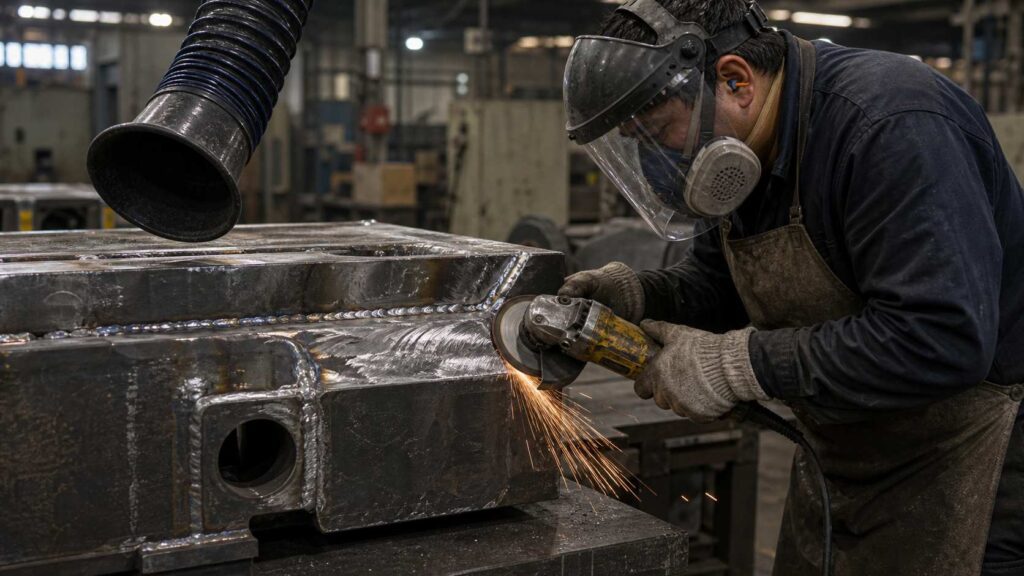
Manual grinding is difficult to control at production volume: operator fatigue, inconsistent pressure, abrasive wear, and heat buildup produce uneven surfaces, rework, and delayed throughput. Three costs recur across the plants we quote.
Inkonsistente Nivellierung der Oberfläche
Manual grinding pressure varies operator to operator and hour to hour, leaving waves, gouges, undercuts, and uneven transition zones that only show up under coating. A cell holding 10–100 N of controlled normal force grinds the same weld at the same pressure every pass.
Slow Weld Seam Blending
Long seams and large fabricated parts make blending a labor bottleneck right before coating, painting, or assembly. Robots trace meters of seam per part at consistent feed, on parts like battery trays and fabricated frames where seam count keeps climbing.
Operator Fatigue and Safety Risk
Heavy tools, vibration, dust, sparks, and awkward part positions drive fatigue, injury, and turnover. These are the shifts no one bids for—automating them removes the hardest staffing problem in the finishing department, not just the labor line item.
How Our Cells Grind Consistently
Compliance matched to the feature. The single biggest engineering decision in a grinding cell is how the tool meets the metal—rigid, actively force-controlled, or passively floating. We assign it per feature: rigid setups for gate-stub passes where you want authority, force control along flash lines and mismatch blends where the part wanders, passive float on edges that must not be rounded over.
Abrasives and heat under control. Belt grit, wheel hardness, contact force, and feed rate are tuned together to hit the removal target without overheating, discoloring, or smearing the surface—critical for parts heading to painting, plating, or anodizing where grinding burn becomes a visible reject later.
Localization before contact. Castings arrive with placement error and batch-to-batch variation; a fixed path ground blind either removes too much or misses entirely. Vision and laser scanning correct the programmed path to the actual casting before the belt touches it, which is the strongest available answer to casting variability.
Layout built around part size. Robot-holds-tool cells suit large parts such as blocks, housings, and fabricated weldments clamped in a fixture; part-in-hand layouts suit small high-volume parts presented to a stationary belt or wheel. Choosing correctly is why the same robot payload covers both a truck wheel hub and a caliper bracket.
Material drives the recipe. Aluminum and zinc castings cut freely but load belts quickly and demand engineered dust extraction—fine aluminum dust is a combustion risk the cell must be designed around, not an afterthought. Gray and compacted graphite iron take heavier passes with stiffer setups and harder wheels. Thin-wall parts such as oil pans and stamped or cast pans tolerate only light force-controlled passes and edge work, because the engineering objective there is not stock removal but not distorting the part. We tune abrasive, force, and feed against the alloy on your print, and we will state plainly where the honest limits sit.
Grinding Applications We Automate
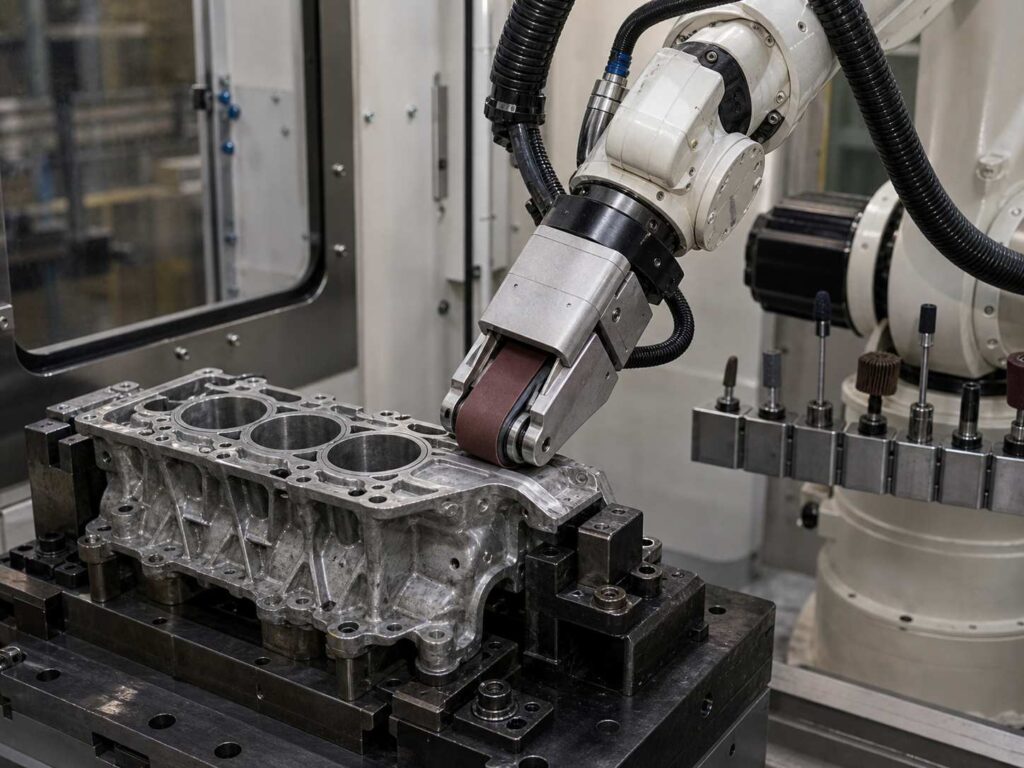
From welded fabrications and cast gates to large machined surfaces, cells are configured around your part geometry, material, removal target, and required finish. Three application families cover most of what we build, and many parts need two of them in sequence—a transmission housing needs gate removal before its sealing-surface pass, and a battery tray needs seam blending before leak test and coating.
Schweißnahtvermischung
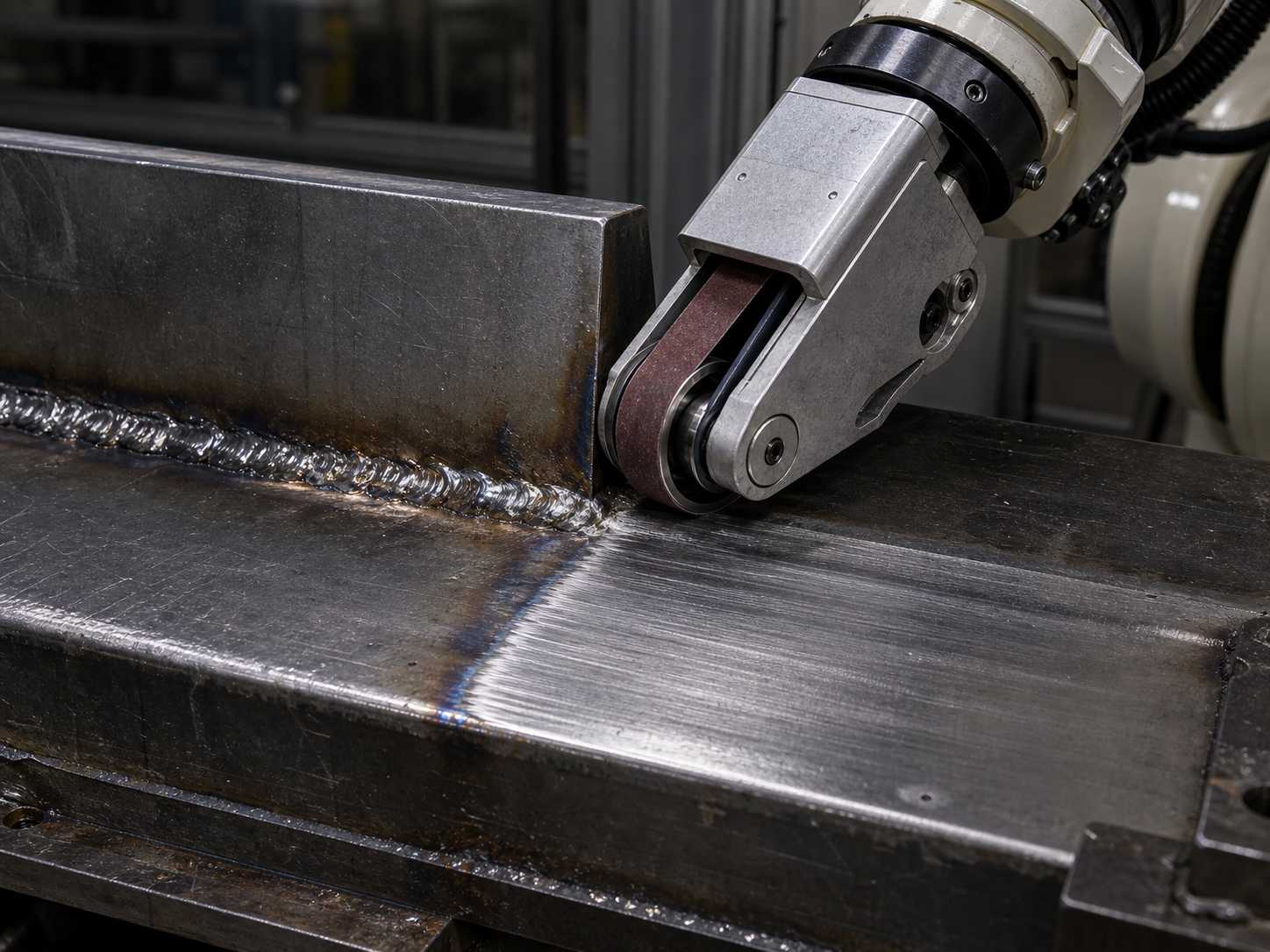
Blend raised weld beads and smooth transition zones on fabricated parts with repeatable robotic paths—preparing surfaces for coating or final finishing without the waviness and undercut that hand blending leaves behind.
Gate and Riser Removal
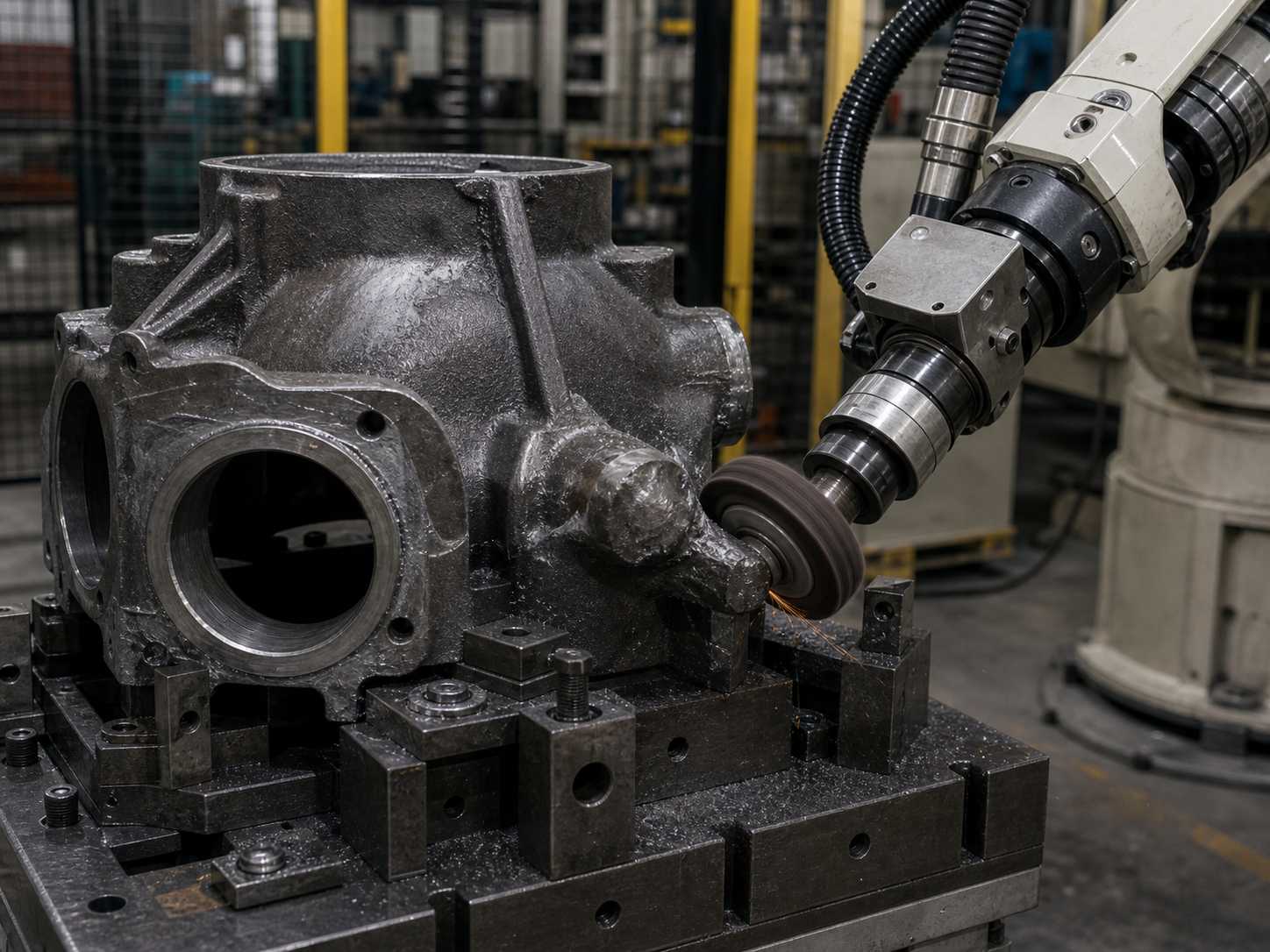
Remove heavy casting gates, risers, flash, and core fins with controlled robotic grinding, rigid fixturing, and abrasives matched to the alloy—from aluminum transmission castings to compacted graphite iron.
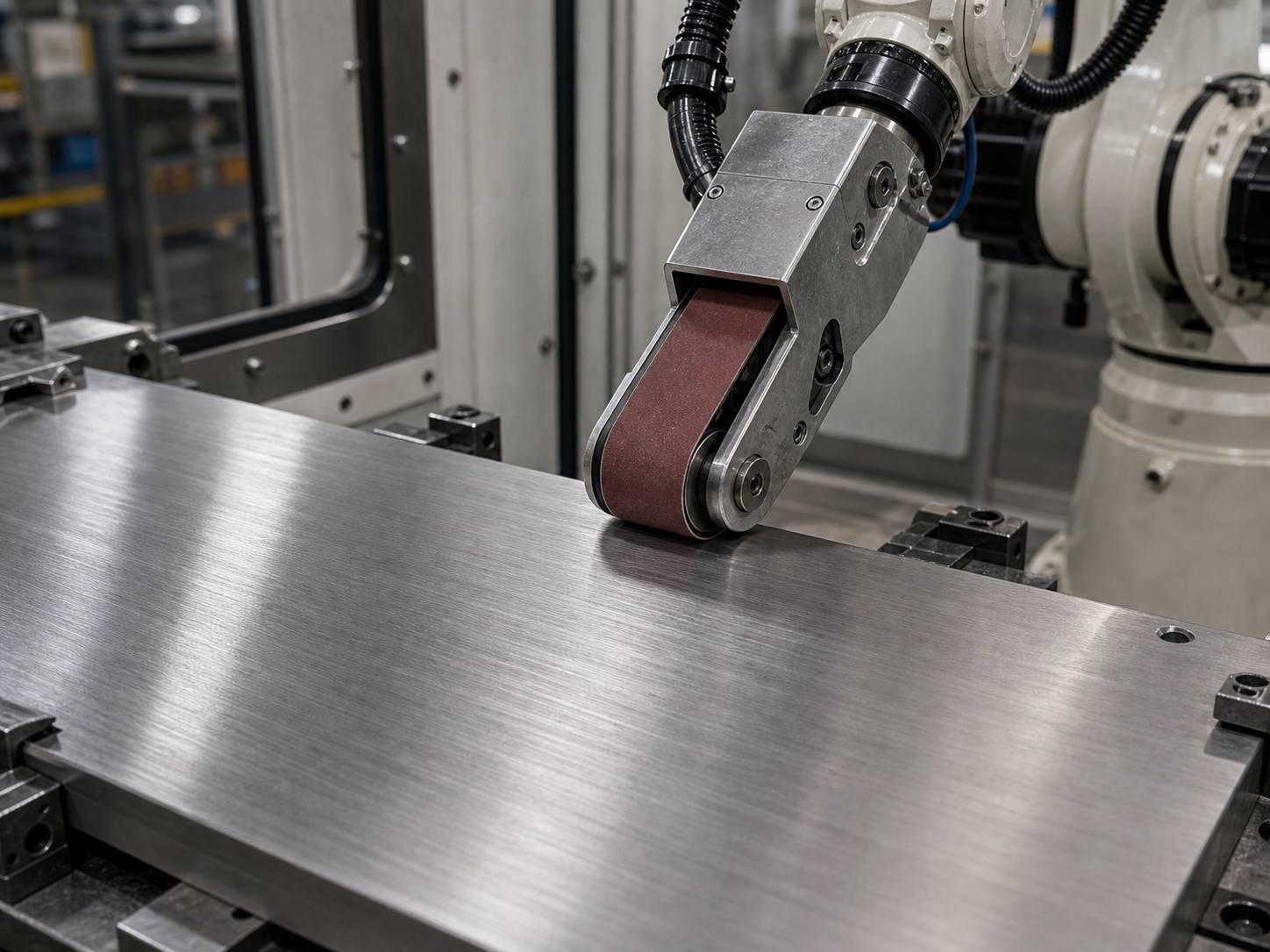
Vorbereitung der Oberfläche
Create consistent linear or non-directional scratch patterns for painting, plating, bonding, or downstream polishing—with grit sequence and contact force documented so the surface condition repeats batch after batch.
Robotic Grinding Equipment for Your Part
Grinding cells are built on our five-machine finishing platform, configured with heavy grinding heads and belt stations rather than light deburring spindles. The same platform, fixtures, and integration toolkit apply:
- 6 Axis Deburring Equipment—single-station platform configured for heavy grinding on medium castings
- Five Axis Deburring Equipment—compact single-station cell for smaller castings and ground weldments
- 6 Axis Dual Station Deburring Equipment—load-while-grinding layout for line-rate casting cleanup
- 5 Axis Dual Station Deburring Equipment—dual-station throughput for smaller ground parts
- Robot Clamping Tool Type Deburring Equipment—part-in-hand layout presenting workpieces to stationary belt and wheel stations
Robotic Grinding Case Studies
Cells engineered and delivered, each with the part, defect, tooling approach, and process result documented:
- Cylinder block robotic grinding—gate and flash removal on engine blocks with localization-corrected paths
- Crankshaft robotic grinding—finish grinding on rotationally symmetric powertrain parts
- Brake caliper robotic grinding—casting cleanup on safety-critical chassis components with full process logging
- EV battery tray robotic grinding—weld seam blending on large fabricated trays before leak test and assembly
- Mid-axle reduction housing robotic grinding—heavy-stock removal on commercial drivetrain castings
- Gearbox housing robotic grinding—casting cleanup with chamfer and edge preparation for assembly
Grinding and Casting Finishing Knowledge
The engineering detail behind these cells, published so you can qualify the process before contacting any supplier:
- Robotic grinding: complete guide to casting finishing—cell architecture, compliance strategies, and honest limits of robot grinding
- Die casting deburring automation: process chain guide—where gate and riser grinding sits in the full die-casting finishing chain
From Sample Test to Production
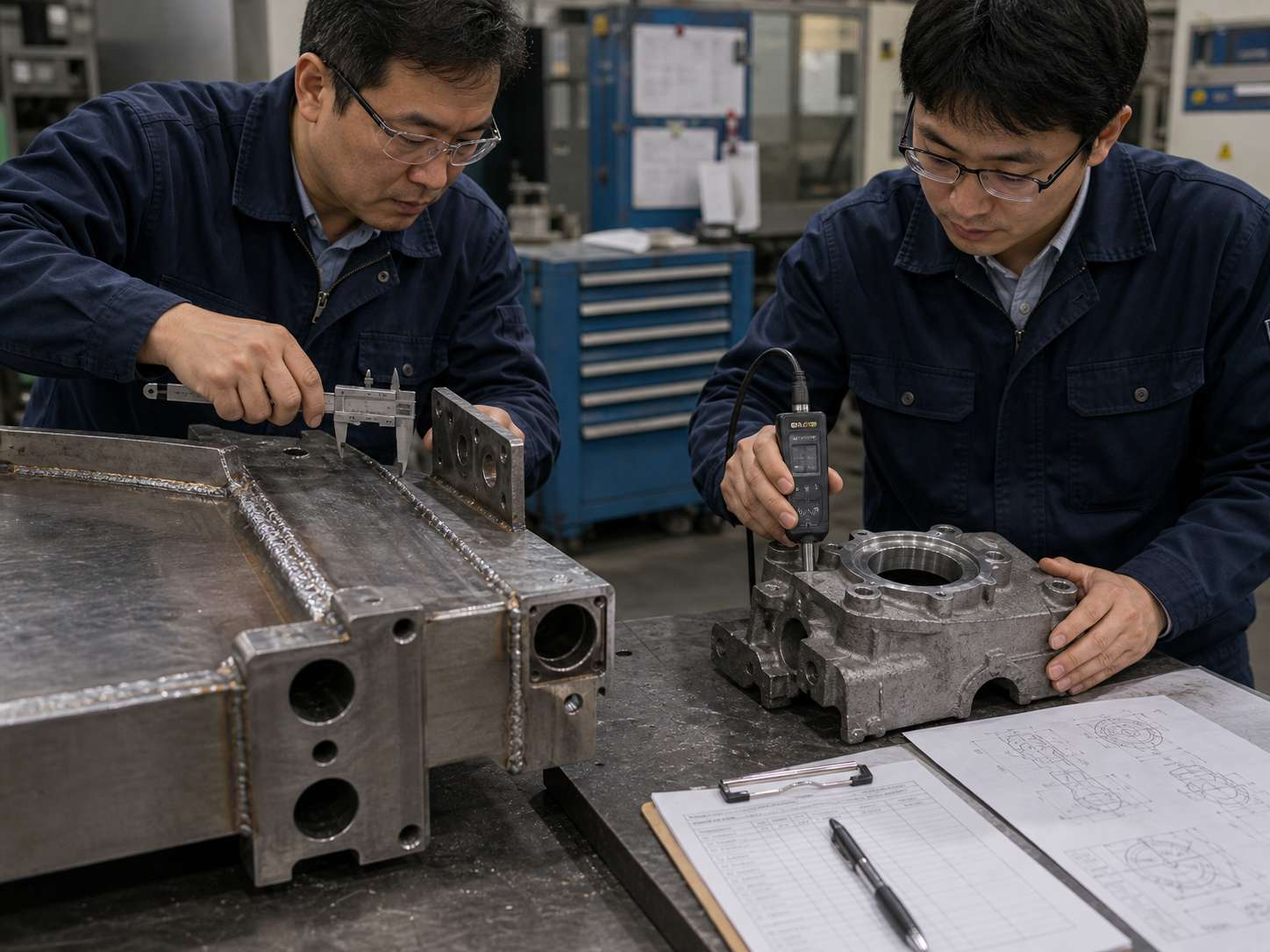
Step 1: Removal Target and Surface Requirement
We review weld seams, gates, risers, surface defects, material, and the required finish condition on your actual castings—to establish how much stock comes off, where, and what the surface must look like afterward.
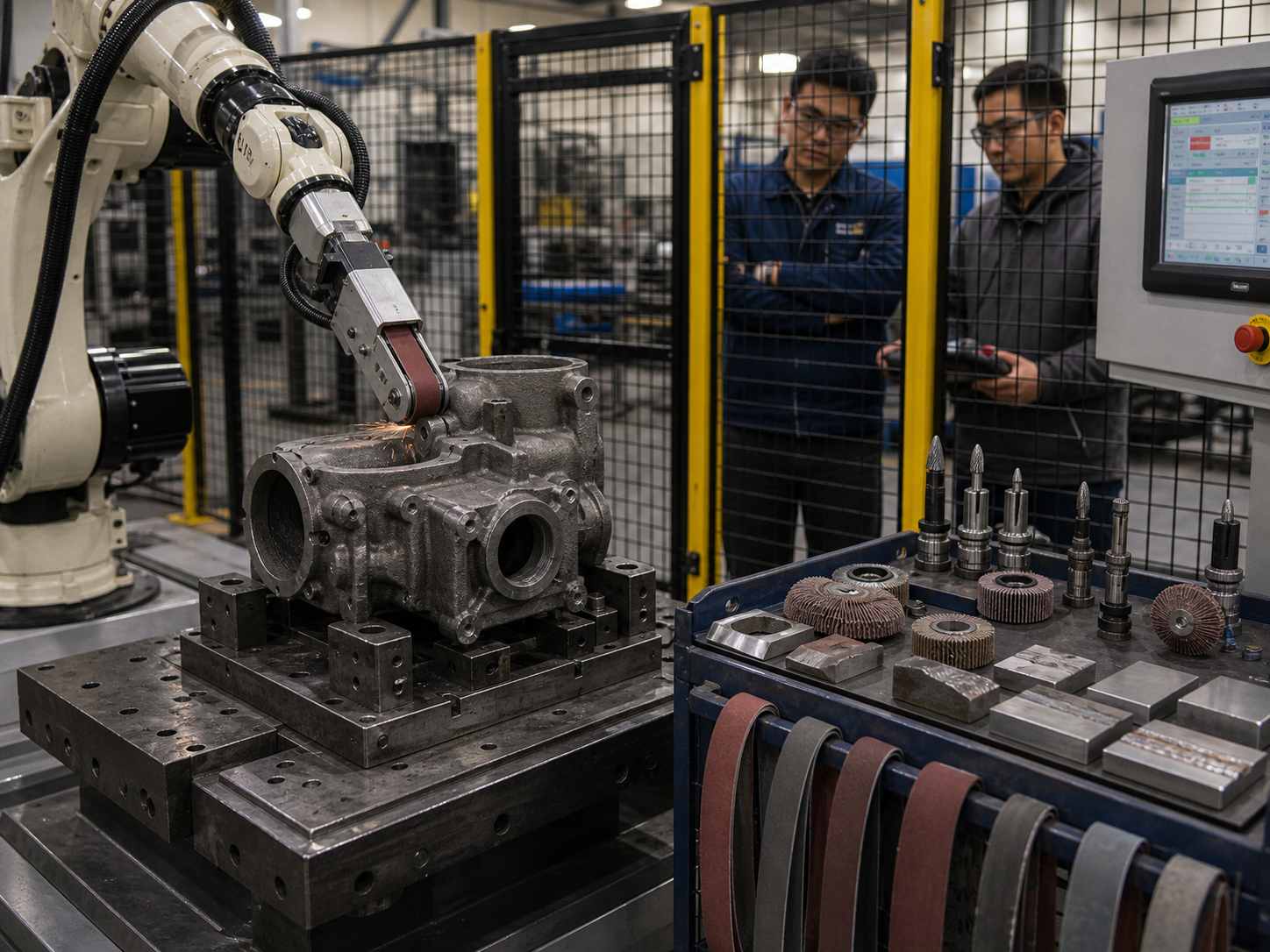
Step 2: Abrasive Testing and Cell Design
We validate grinding media, contact force, fixturing, heat control, and cycle time on sample parts—recording removal rates per pass so the production recipe is evidence, not hope.
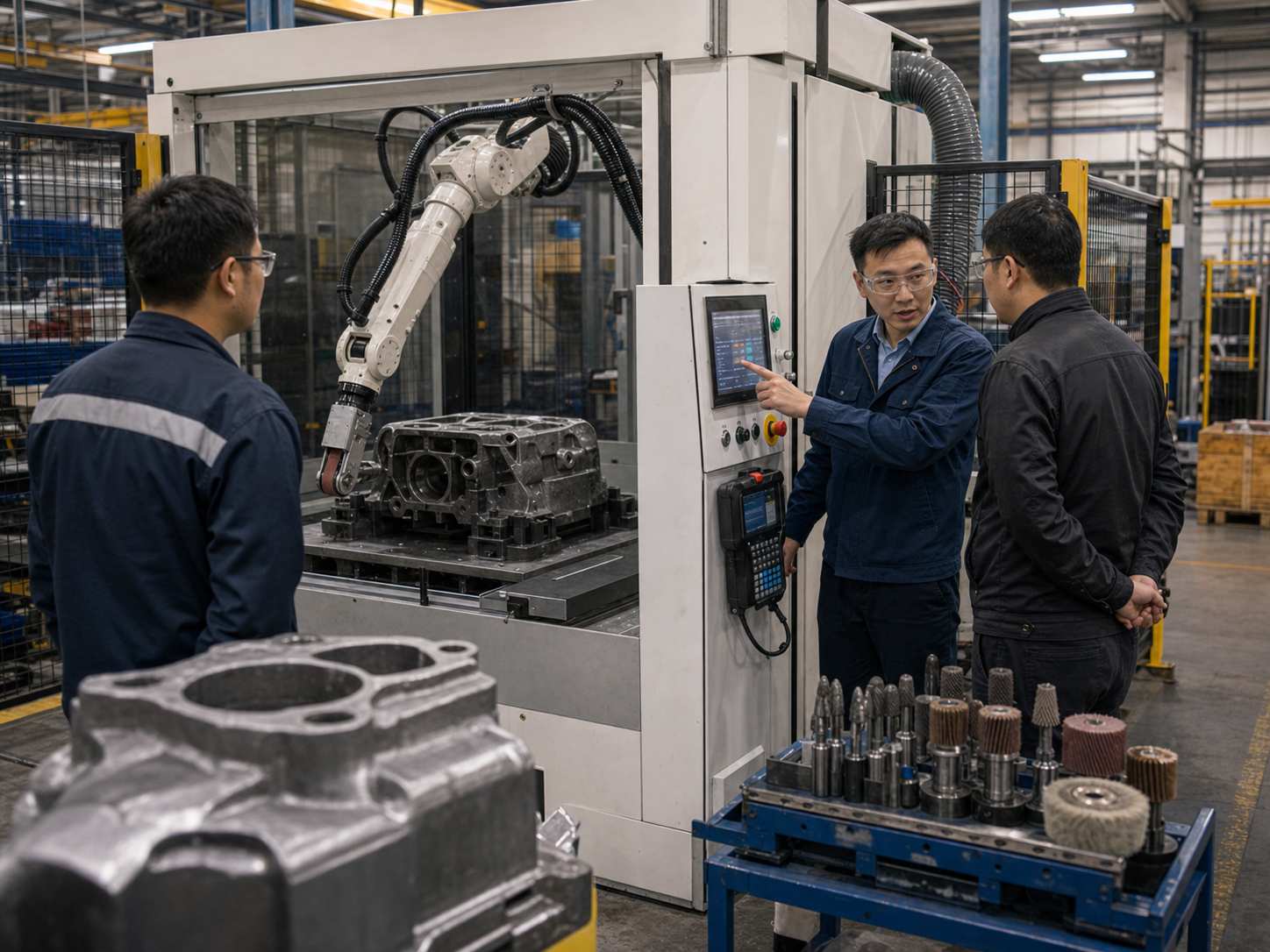
Step 3: Integration, Training and Launch
We commission the grinding cell in your plant and train your team for reliable production start-up, with documented force, removal, and cycle data from first article onward.
Send Us Your Toughest Grinding Part
Ship us your sample part or project details for a free process review. You receive a recorded video of the grinding trial, an estimated cycle time and removal strategy, abrasive media and tooling recommendations, and an ROI discussion grounded in your labor and scrap figures. Send part drawings or STEP files, the casting or weldment with its actual gate stubs and mismatch, your current method with its reject rate, and monthly volumes—and we will tell you what a cell for them would look like, down to paths, forces, and cycle time. As a planning band, engineered single-station grinding cells typically start around $80,000, with fully integrated multi-station turnkey systems running to $300,000 and beyond depending on power heads, vision, and line integration scope.
- Recorded video of robotic grinding trials on your sample
- Estimated cycle time and removal strategy
- Abrasive media and tooling recommendations
- ROI discussion for production implementation