
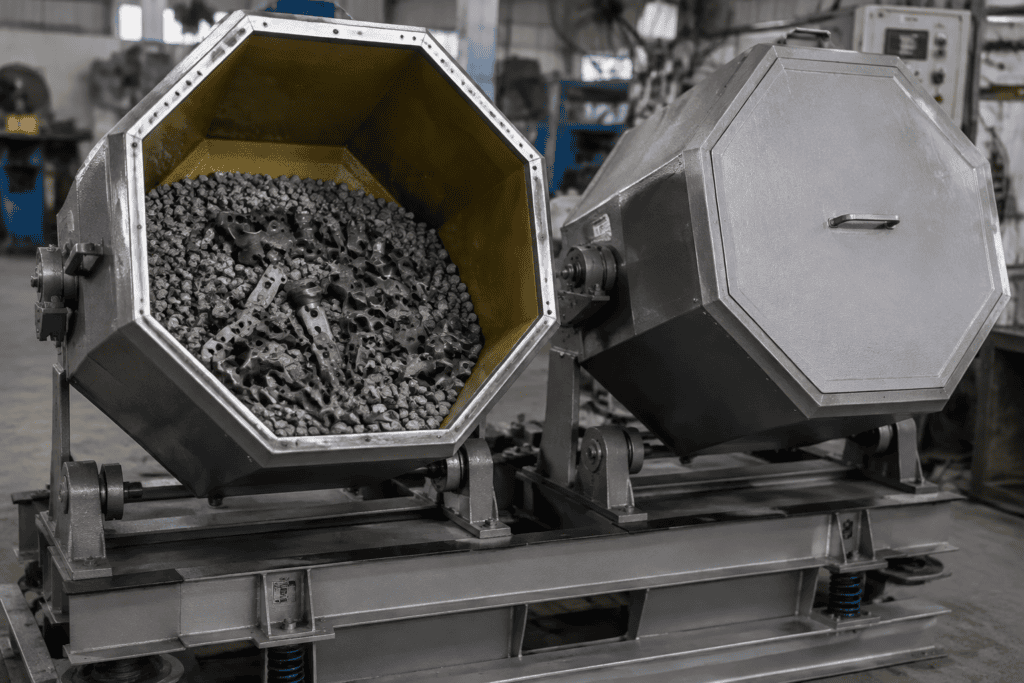
Tumble deburring is a mass finishing process in which small parts are loaded into a rotating barrel together with loose abrasive media, water, and a chemical compound, so that the continual cascade of the load rubs media against the parts and wears down burrs, rounds edges, and smoothes surfaces in bulk. Also called barrel tumbling or barrel finishing, it is the oldest mechanized deburring method still in wide use, and for large batches of small, collision-tolerant parts it remains the lowest cost per part of any edge finishing technology—including the robotic cells we build and sell at UBright Solutions.
That admission matters, because the first result you will find for this topic is often an article explaining why tumbling is “no longer the best answer.” We are a robotic deburring equipment maker, and we think that framing oversells the decline: tumbling did not survive seventy years in machine shops by accident. It earns its place with brutally simple mechanics, cheap consumables, and an unattended batch cycle that runs while your operators do something else. What it is not is a universal answer, and knowing exactly where its ceiling sits is the difference between a workhorse and a bottleneck.
What follows covers the mechanism, the three main barrel formats, media and load ratios, the process variables that decide the result, a straight comparison against vibratory finishing, and the situations that call for other equipment.

How the Barrel Actually Removes Metal
The physics of tumble deburring is gravity, applied repeatedly. As the barrel rotates, friction between the load and the barrel wall or flat faces lifts the mass of parts and media up the rising side. At some height a little past the barrel’s horizontal centerline, the load can no longer hold together and the top layer breaks away, sliding down over the material beneath it. That collapse is the cascade—the characteristic tumbling action the finishing trade has described for decades as rocks falling down a steep hillside.
Two distinct zones form inside the working load, and deburring happens in only one of them. The bulk of the load below the collapse point travels in near-solid rotation, carried up by the barrel with little internal relative motion. Above it sits the active sliding layer, where media and parts move at different speeds past each other. All the edge rounding, burr shear, and surface compaction comes from sliding contact inside this layer, typically the top 15–25% of the load depth. A well-run barrel simply arranges for every part to cycle through that layer as often as possible over the batch.
This mechanism explains three facts that surprise newcomers:
- Fill level matters as much as speed. Below roughly 40% of internal volume the slide is weak and shallow; above about 60% there is no headroom for the cascade to develop. The working range is 50–60%.
- There is a speed ceiling. Faster rotation does not speed the process up—it pins the load against the wall by centrifugal force, the cascade stops, and finishing stops with it. Practical barrel speeds sit between roughly 10 and 35 rpm, larger drums at the lower end.
- Contact is intermittent and aggressive. A part only sees sliding media while in the active layer, but the contact pressures there are high. That is why barrels cut faster per hour than gentler processes—and why they can ding soft workpieces.
Tumble Deburring Equipment: Three Barrel Formats
Barrel finishing is a category, not a single machine. Three formats cover nearly everything on the market.
Octagonal and Hexagonal Barrels: The Standard Workhorse
The classic tumbling barrel is a horizontal drum with six or eight flat faces, mounted on driven rollers or a shaft, usually lined with urethane or rubber. The flat faces give the load positive grip so it lifts cleanly instead of slipping—the chronic failure mode of unlined round drums. Octagonal barrels remain the least expensive powered deburring equipment available: benchtop units start in the low thousands of USD, and even large floor-standing barrels cost a fraction of a vibratory bowl of equivalent capacity. They run wet or dry, in batches, and unload by tipping or door discharge.
Horizontal Wet Tumbling Drums: The Production Version
Scaled-up production barrels add the infrastructure that makes tumbling compatible with daily shifts: internal water lines, compound dosing, lined multi-compartment interiors (isolating one part type from another, or staging a coarse-then-fine sequence in one drum), discharge chutes, and screens that separate parts from media automatically at cycle end. Timers and inversion-unloading turn the process into load-run-separate-reload repetition a single operator can manage across several drums. These systems dominate in fastener, stamping, powder metal, and small die-casting plants moving tens of thousands of parts per day.
Centrifugal Barrels: The High-Speed Version
A centrifugal barrel machine mounts four small barrels on a rotating turret and spins the turret while the barrels counter-rotate, generating a force field commonly in the range of 10–20 times gravity. The gentle hillside becomes a sustained avalanche: cycle times drop by a factor of ten or more compared to conventional tumbling, and the action reaches edges ordinary cascading misses. The trade-offs are real—part-on-part impact forces scale up with everything else, bath temperatures can exceed 50°C without cooling or compound management, and machine cost rises by an order of magnitude. Centrifugal barrels suit small, hard, valuable parts—watch components, medical screws, precision gears—where an 8-hour tumble must become 30–45 minutes. To place tumble equipment in the wider map of edge-finishing options, our deburring machine types guide compares every category side by side.
Media, Compound, and the Load Ratio Question
Media does the cutting; everything else in the barrel either supports it or gets out of its way.
Ceramic media—sintered clay bonded with abrasive grain—carries the heavy deburring load: dense, aggressive, and long-lived, it is the default for steel, iron, brass, and hard aluminum parts. Plastic (resin-bonded) media cuts far more slowly at much lower pressure, suiting soft metals, pre-plating smoothening, and surfaces that must not pick up texture. Steel media barely cuts at all; it burnishes, compressing surface peaks into a bright finish, typically as a second stage after ceramic deburring. Organic granules—corn cob, walnut shell, often impregnated with polishing paste—run dry for water-free drying and lustering.
Shape is a selection variable, not a style choice. Angle-cut cylinders and triangles present sharp working edges and reach into corners; rounded and ball shapes resist lodging in holes. The standing rule for parts with through-holes: keep media’s smallest dimension at least 1.5–2 times the hole diameter, or accept prying wedged pieces out at unloading.
The media-to-parts ratio is the most consequential loading decision, expressed by loose volume:
| Part situation | Media : parts (by volume) | Effect |
|---|---|---|
| Heavy burr removal on robust parts | 1:1 to 2:1 | Fastest cutting, highest ding risk |
| General deburring, mixed small parts | 2:1 to 3:1 | The everyday default |
| Delicate, plated, or cosmetic parts | 3:1 to 6:1 | Media cushions the parts; slower, cleaner result |
Compound and water complete the load. Dosed at roughly 0.5–1.5% of water volume, the compound keeps parts clean, suspends metal and media fines so they wash off instead of re-scratching, and leaves a rust-inhibiting film on steel. Water level generally sits at or slightly below the top of the media mass; too much water damps the slide, too little lets the load run dirty and hot.
What Parts Belong in a Tumble Barrel
Tumbling rewards a specific part profile, and honest process selection starts with checking your parts against it:
- Small enough to cascade. Parts beyond roughly 200–300 mm, or a few kilograms each, stop being batch material—the barrels and media volumes required become impractical, and one heavy part landing on its neighbors does real damage.
- Made in large batches. The economics come from amortizing a 1–6 hour unattended cycle across thousands of parts per load; low-volume, high-mix work makes every media changeover a tax.
- Tolerant of contact. Stamped brackets, fasteners, washers, small die castings, sintered components, screw machine parts—these families shrug off part-on-part contact. Thin sheet flags, brittle cast iron with thin webs, and brazed assemblies do not.
- Deburred everywhere at once. The barrel cannot tell one edge from another. If your drawing requires a controlled radius on one feature and untouched surfaces elsewhere, no barrel can comply.
A useful test before committing a part family: drop a handful of the parts in a bucket and shake it. If they come out marked, the barrel will mark them worse, over hours.
Process Variables: Speed, Time, and Sequence
Barrel deburring has only a handful of knobs, but each has a correct range and a failure mode.
Barrel speed. Between roughly 10 rpm (large drums) and 35 rpm (small octagons) sits the cascade sweet spot. Too slow and the load slumps and slides without turning—cutting nearly stops. Too fast and centrifugal pinning takes over, the load glazes and rotates as a solid mass, and finishing stops just as completely. When results degrade inexplicably, verify actual drum speed against spec; worn drive rollers quietly change it.
Cycle time. Light deburring and edge rounding run 30 minutes to 2 hours; heavy burr and scale removal runs 2–6 hours; steel-media burnishing extends to 4–8 hours or more. Longer is not automatically better—over-cycling rounds edges past spec, thins features, and wastes media. Establish the time by inspecting parts at intervals during first articles, then lock it into the standard work sheet.
Media condition. Abrasive media wears and glazes as fines wash off; ceramic media that once cut a burr in 90 minutes will need 3 hours when rounded. Track cycle-time drift per media batch and refresh on a schedule rather than reacting to a failed audit.
Water, compound, and temperature. Refresh the solution when it goes gray with suspended fines—a spent solution recuts nothing and stains parts. In long wet cycles and all centrifugal cycles, monitor bath temperature; above roughly 50°C, compound chemistry degrades and delicate parts see thermal as well as mechanical stress.
Sequencing. Demanding parts often need stages: coarse ceramic for burrs, fine ceramic or plastic for the pre-finish, steel or organic media for burnish and dry. Multi-compartment drums and centrifugal barrels make this practical—planning it from day one is far cheaper than retrofitting.
Tumble vs. Vibratory Deburring: The Honest Comparison
Tumbling and vibratory finishing are the two pillars of mass finishing, and most plants eventually own both because their strengths barely overlap. The mechanism difference drives everything: a barrel applies intermittent, high-pressure cascading contact a few times a minute, while a vibratory tub applies continuous, low-amplitude oscillation—typically 1,000–3,600 vibrations per minute—that keeps the entire load in gentle relative motion the whole cycle.
| Criterion | Tumble (barrel) | Vibratory |
|---|---|---|
| Cutting intensity | High, aggressive | Moderate, uniform |
| Cycle time | Longer—often 2–6 h | Shorter—often 30 min–2 h |
| Surface character | Brighter, directional; ding risk on soft parts | Uniform matte-to-satin, low impact damage |
| Media consumption | Low (enclosed, slow-moving load) | Higher (constant attrition) |
| In-process inspection | Not practical mid-cycle | Open tub—parts visible anytime |
| Unloading | Batch dump, then separation | Continuous or batch, with screens |
| Automation path | Limited; batch logic dominates | Strong—through-feed designs |
| Large or delicate parts | Poor fit | Better cushioning |
| Noise | Lower (closed, lined drum) | Higher (open tub) |
| Entry equipment cost | Lowest of any powered finishing | Moderate |
Read that table as a division of labor. Tumbling wins when parts are hard, small, cheap, and burry—maximum cutting per unit of equipment and media, running unattended overnight. Vibratory wins when parts are delicate, larger, cosmetic, or tied to an inline pace; our vibratory finishing guide covers bowl and tub selection in detail. Neither process can selectively finish one edge while leaving adjacent surfaces alone—for that, the options change category entirely.
Where Tumble Deburring Falls Short—and When to Upgrade
Before committing capital, it is worth running the full cost comparison in our deburring automation ROI guide.
The robotic-deburring corner of the internet is fond of declaring tumbling obsolete. That claim deserves pushback, but so does blind loyalty to barrels. Tumbling has four structural limits, each with a defined escape route:
Large parts that cannot cascade. Beyond the few-hundred-millimeter range, barrels stop making sense; these parts move to vibratory tubs, wide-belt or brush machines for flat work, or robotic cells where a spindle follows edges under force control.
Precision and selective edges. If the spec reads “0.2–0.5 mm radius, this edge only,” no mass finishing process can honor it—the technology family genuinely shifts to CNC path control or a robot tracing programmed edges. The fundamentals of that approach are laid out in our what is robotic deburring guide, and the full equipment landscape in the deburring machine types guide.
Internal cavities and blind features. Media lodges in tapped holes, undercuts, and deep pockets; compound sludge settles in blind cavities. Screening media size helps, but parts riddled with internal geometry often finish poorly and clean worse.
Damage on vulnerable parts. Plated surfaces, thin walls, brazed assemblies, and exposed threads will show contact marks. Higher media ratios and plastic media mitigate; they do not eliminate.
Two upgrade paths are cheaper than a robot. Centrifugal disc finishers often solve the cycle-time problem while keeping mass finishing economics. And if your parts are already large or geometrically demanding, the jump to a robotic cell is not an admission that tumbling failed—it is a different part class. Curved cosmetic surfaces and complex prismatic parts are exactly where force-controlled finishing, covered in our robotic polishing machine guide, earns its capital cost. For shops running many families in mixed materials, our general metal finishing overview shows how the methods stack in one line.
Choosing a Tumble Deburring Machine: What to Check
Buying well in this category is mostly about avoiding the cheap-end failure modes:
- Barrel construction and lining. Urethane or rubber lining, properly bonded, with a published wear-life expectation. Unlined steel drums wear parts, rust the bath, and transmit noise.
- Drive quality. Sealed, serviceable rollers and a speed you can verify. Variable speed is worth a modest premium; it lets you tune the cascade per media density.
- Realistic capacity math. Rate barrels by usable load volume (the 50–60% fill), not total drum volume—a “100 L” barrel is roughly a 50–60 L working machine.
- Separation and handling. Budget from day one for a screen, media return, and drying (centrifugal dryer or corn cob dry-tumble). Wet parts sitting in bins flash-rust within hours.
- Compound and water management. Even simple dosing beats guessing; on multi-compartment production drums, insist on plumbing that supports sequence staging.
- Vendor process support. Good suppliers will run your parts in their barrel at their cost and hand you the media, ratio, time, and compound recipe. A vendor who cannot or will not trial your parts has told you everything.
Pricing makes the category friendly to experiment with: benchtop octagonal barrels start around $2,000–5,000 USD, production wet drums with separation run in the tens of thousands, and four-barrel centrifugal machines occupy the low hundreds of thousands.
Frequently Asked Questions
What is tumble deburring?
A mass finishing process in which small parts are batch-loaded into a rotating barrel with abrasive media, water, and a chemical compound. As the barrel turns, the load lifts and cascades, and the sliding contact between media and parts removes burrs, rounds edges, and refines surfaces across the whole batch at once. It is also called barrel tumbling or barrel finishing.
How long does tumble deburring take?
Light deburring and edge rounding typically run 30 minutes to 2 hours; heavy burr or scale removal runs 2–6 hours; burnishing with steel media can extend to 4–8 hours. Centrifugal barrel machines compress those cycles by roughly a factor of ten. Establish times by inspecting parts at intervals during first articles, then lock them in—over-tumbling degrades parts as surely as under-tumbling.
Tumble vs. vibratory deburring—which should I choose?
Choose tumbling for small, hard, high-volume parts that tolerate contact, where its aggressive cutting, low media consumption, and low equipment cost shine—especially in long unattended cycles. Choose vibratory for delicate or larger parts, cosmetic surfaces, faster cycles, and inline automation. Many production shops run both: tumbling on rough stock removal, vibratory on finish work.
Can tumble deburring damage parts?
Yes, in defined ways: part-on-part impacts can ding soft metals and cosmetic surfaces, over-cycling can round edges past spec, and media can lodge in holes smaller than about 1.5–2 times the media’s smallest dimension. All three are managed by media selection, ratios of 3:1 to 6:1 for delicate work, and validated cycle times—damage from a correctly specified barrel process is rare.
What parts should never go in a tumble barrel?
Parts longer than roughly 300 mm or heavier than a few kilograms; parts requiring a controlled edge on one feature with untouched surfaces elsewhere; parts with blind cavities, deep pockets, or tapped holes that trap media; brazed, soldered, or plated assemblies; and any part that would be rejected for visible contact marks. Those families belong in vibratory, CNC, or robotic edge-finishing processes.
The Bottom Line on Barrel Finishing
Tumble deburring survives every obsolescence prediction for a structural reason: nothing else removes burrs from a crate of small parts for less cost per part, and nothing is simpler to keep running. Its limits are just as structural—no selectivity, no large parts, no tolerance for fragile work—and the plants that finish best respect both halves of that sentence. Run barrels where barrels are strong, and when part size, edge specifications, or surface expectations outgrow the cascade, step up deliberately: vibratory for uniformity and inline flow, centrifugal for speed on small precision parts, robotic edge following for the selective, high-precision work mass finishing will never do.
If you are weighing where your parts fall on that ladder, UBright Solutions engineers and builds robotic polishing and deburring systems from Nanjing, China, and we will tell you plainly when a barrel is the better answer for your application. Send part drawings, materials, target edge specs, and monthly volumes through our contact and product pages, and the response will match the equipment to the part—not the other way around.

