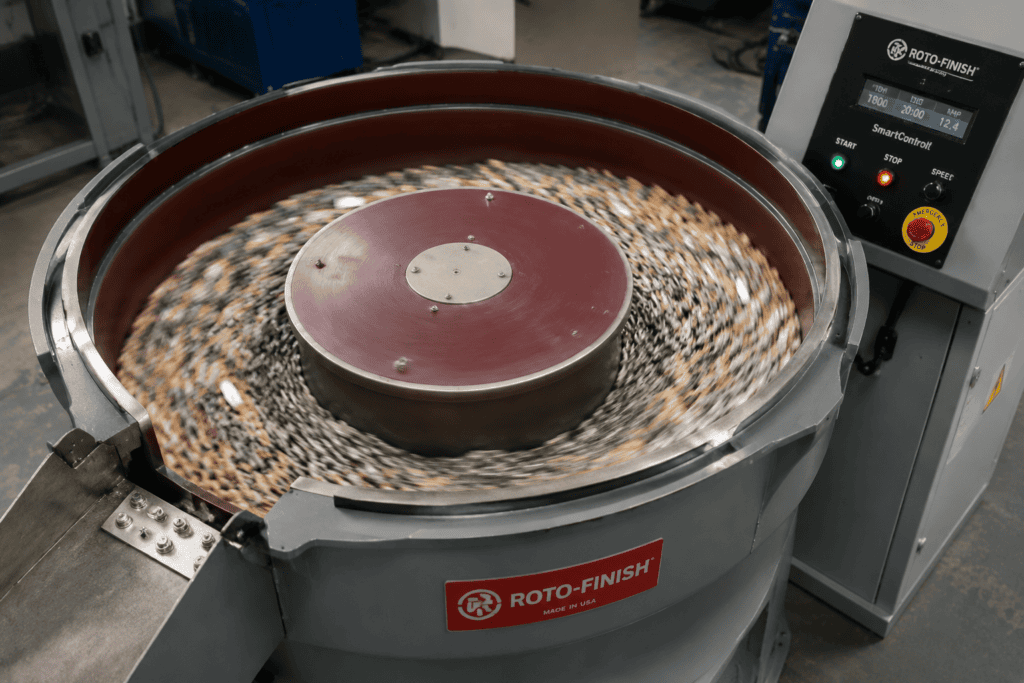
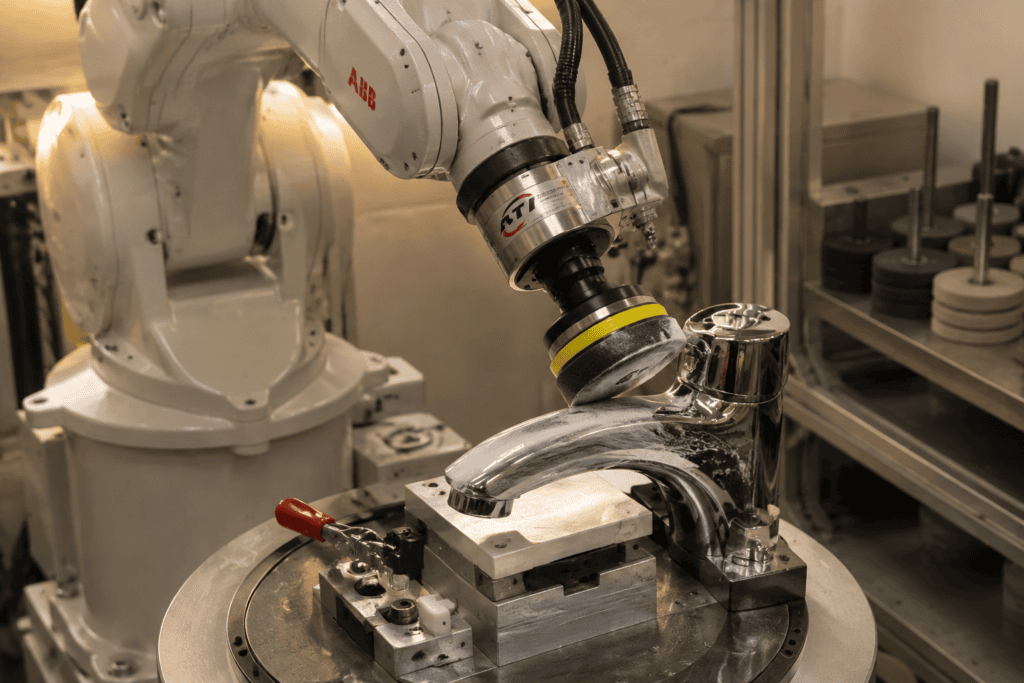
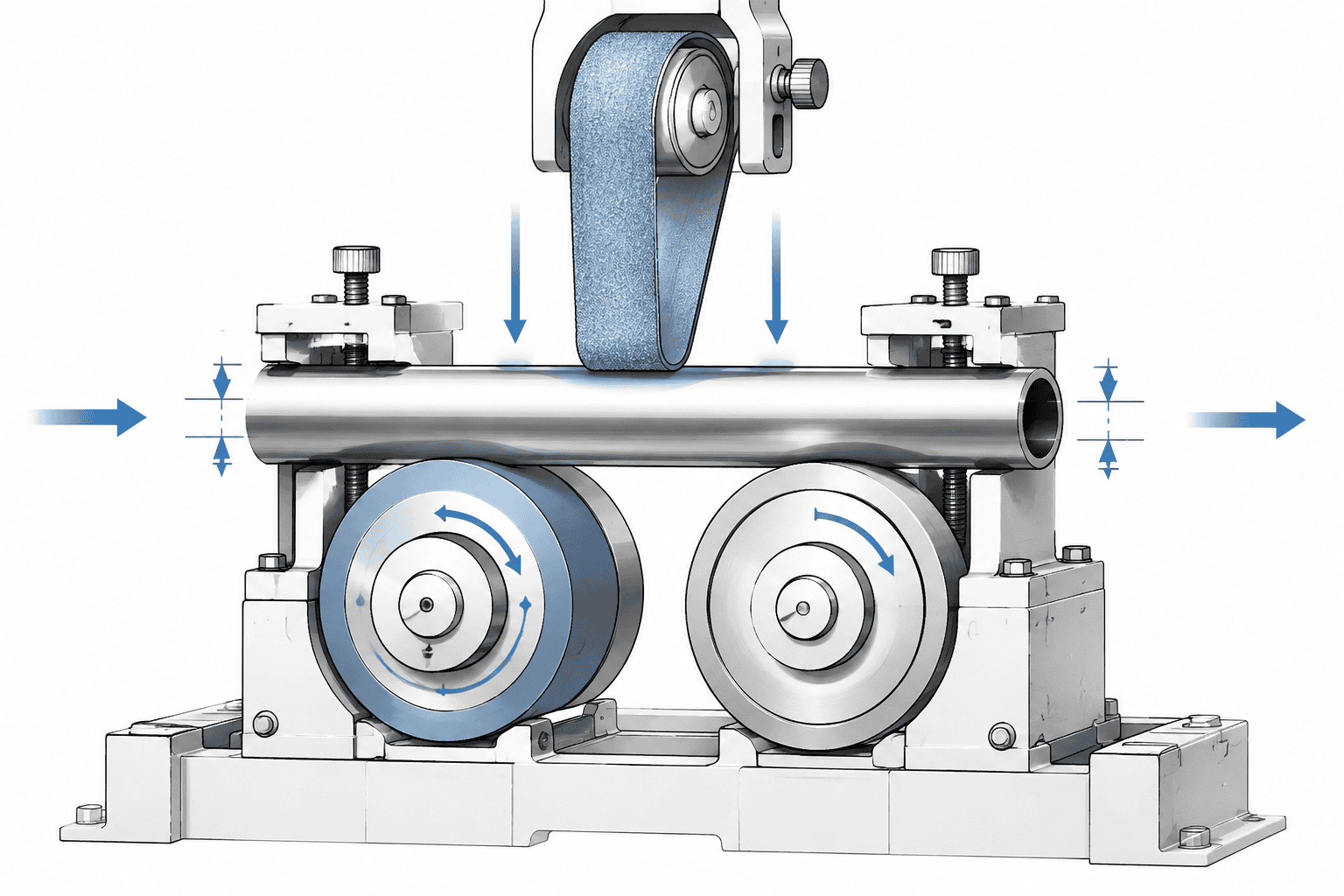
A pipe polishing machine sands, grains, or polishes the outside surface of metal tubes, bars, and shafts. In production, it usually means a centerless polisher: the tube rotates between a drive wheel and a support wheel while an abrasive belt presses against it, feeding through lengthwise to produce a repeatable satin, grained, or mirror finish.
That is the short answer. The longer answer—which machine, for which parts, at what budget—is what this guide covers.
What Is a Pipe Polishing Machine?
The term covers a wide band of equipment, from a hand-held wrap-around belt sander used on weld seams to a fully enclosed multi-station line that brightens stainless tube at several meters per minute. What all of them do is controlled material removal on the outer diameter of a round workpiece: each pass strips a thin layer of metal and leaves a predictable scratch pattern, and by stepping down through abrasive grits you walk the surface from mill scale to mirror.
One distinction worth fixing early: polishing changes the *surface*, grinding changes the *dimension*. A centerless polishing machine does remove a few hundredths of a millimeter per pass and will incidentally tighten an out-of-round tube, but nobody buys one to hold a diameter tolerance—that is a centerless grinder’s job, with a rigid grinding wheel instead of a belt. For abrasive stock removal on cast and welded parts, see our robotic grinding guide. If your drawing calls out a tight OD tolerance, budget for grinding first and polishing second.
Terminology shifts by region and industry. “Pipe polishing machine” and “tube polishing machine” are used interchangeably by most equipment makers; stricter readers reserve *pipe* for pressure applications and *tube* for structural and decorative work. Suppliers of bar and shaft finishing often say “cylindrical polishing machine” or “OD polisher” for the same hardware. When you specify a machine, describe the actual workpiece—material, OD range, length, incoming condition—not the word on your drawing.
What Runs Through These Machines?
A short tour of typical work explains why the equipment looks the way it does:
- Stainless decorative tube. Handrail, balustrade, furniture frame, architectural tube. Volumes are huge, finishes are visual (usually a uniform linear grain or bright satin), and the through-feed centerless polisher was practically built for this part.
- Industrial and sanitary tube. Food, dairy, and pharmaceutical lines need smooth, cleanable surfaces in the Ra 0.4–0.8 µm range—often specified numerically rather than by appearance.
- Round bar and bright steel. Bar stock drawn or peeled to size then polished for sale as bright bar; the machine doubles as a cosmetic and cleaning operation.
- Hydraulic cylinder rods and transmission shafts. Long, rigid, precision parts; polishing precedes chrome plating or serves as final surface prep. Shaft-family parts like axles have their own robotic grinding programs when the geometry gets more complex than a straight tube.
- Furniture, exhaust, and consumer tube. Tapered legs, bent exhaust tubing, painted-then-brushed parts—the segment where geometry starts fighting the centerless machine.
The common thread: a round cross-section, a length that is several times the diameter, and a customer who judges the part by its surface.
The Five Main Types of Pipe and Tube Polishing Equipment
Hand-held pipe sander
A wrap-around belt sander that hugs the tube—the belt forms a partial circle around the OD so one pass sands the full perimeter. Indispensable on site for weld seams, repairs, and one-off fabrication. It is also the slowest and least consistent option, and it belongs nowhere near a production line feeding 500 tubes a day. Cost sits in the low hundreds of dollars.
Bench belt grinder / tube polishing lathe
A fixed belt machine or a lathe-style setup where the operator presents small parts by hand or the tube rotates in stands while a portable tool works it. Suited to job shops, short and bent parts, and low volumes where a through-feed machine cannot pay for itself. Think a few thousand dollars and one skilled operator per part.
Centerless polisher (through-feed)
The production workhorse. The tube feeds in one end and comes out the other finished, with no chucking and no operator handling each part. Machines are specified by belt size and width, wheel speed, and the maximum part length and weight they can support—a representative single-belt machine handles work in the multi-meter range and substantial part weights, while dual-belt versions run two opposed abrasive belts so both sides of the tube see equal pressure in one pass. This is the default answer for straight tube and bar at volume.
Multi-station polishing-straightening line
For tube mills and large processors: several centerless stations in series (coarse, intermediate, fine) frequently paired with a straightener, because long thin tube arrives with bow that polishing cannot hide. Straightening is a sister process to polishing on these lines—the two operations share infeed and outfeed handling, and a tube that is polished but not straight gets rejected just as fast as one that is straight but scratched. (UBright builds straightening lines alongside its robotic finishing cells for exactly this reason.)
Robotic OD polishing cell
A robot with a force-controlled spindle or tool interface presents the part—or tracks along it—against belt, brush, and buff stations. It cannot beat a centerless line on cost per meter for straight tube. It wins when the part is not straight, not round, or not uniform (cell architecture details in our robotic polishing machine guide). More on this below.
How a Centerless Pipe Polisher Works
The mechanism is worth understanding because every selection trade-off traces back to it.
The tube rests in a cradle formed by two wheels below: a drive wheel with a rubber surface that spins the tube, and a support wheel that sets its height. Above, an abrasive belt wrapped around a contact wheel presses down on the top of the tube. The drive wheel axis is tilted a degree or two from horizontal, so friction gives the tube not only rotation but a slow forward crawl—tilt angle and wheel speed together set the feed rate. The tube spirals through the machine, presenting every point of its circumference to the belt by the time it exits.
Three practical consequences:
- Round parts only, and straight ones at that. The support geometry assumes a constant diameter. A weld bead, a bend, or a tapered section rides up and out of the contact zone.
- Dwell time is fixed by feed rate. Deeper defects either need a second, slower pass or a coarser first station.
- Pressure is set by the contact wheel, not an operator’s hands. Thin-wall tube deflects under belt pressure—push too hard and a round tube exits slightly oval with a wavy finish, so wall thickness limits how aggressively you can cut.
Dual-belt machines run a second belt from below, cutting both sides simultaneously with balanced force: better roundness on thin tube and roughly double the stock removal per pass.
Dust extraction is not optional. Dry-polishing stainless throws fine combustible dust; every serious machine specification assumes a matched dry (or wet) collector, and your insurer will agree.
Six Factors That Decide Which Machine You Need
1. Diameter range. Every centerless machine has a minimum and maximum OD set by its wheel spacing and belt width. Decorating tube from 12 to 110 mm and shafts at 120 mm means either two machines or one very configurable one. Get the range in writing, including the changeover time and cost between wheel sets—a machine that “handles” your diameters with a four-hour changeover does not, in practice, handle them.
2. Wall thickness and deflection. A 6 mm wall behaves like a solid bar. A 0.5 mm decorative wall is a spring. Thin-wall tube needs light belt pressure, close support, and often slower feed—the finish spec drives the machine configuration more than the diameter does.
3. Part length and weight. Through-feed machines are length-limited by their support structure and handling, not the polishing zone itself. Long, heavy bar needs powered infeed and outfeed stands. Very short parts (under roughly ten diameters) may not track stably through a centerless machine at all and shift the answer toward a lathe-type polisher or a robot.
4. Target finish. Specify it the way your customer does: a Ra number, a grit number, a named finish (No. 4 satin, No. 8 mirror), or a physical sample. The gap between “uniform 180 grit grain” and “mirror” is two to four additional process steps and a different machine configuration. If the requirement is a tight Ra band rather than an appearance, that is precision grinding territory, not polishing.
5. Throughput. Do the arithmetic in meters per hour: feed rate times effective working time, minus changeovers. Single-pass capacity that misses your target by 30% means a second station or a second shift—cheaper to plan as a two-station line on day one than to discover in month three.
6. Incoming surface condition. Weld flash, mill scale, and deep drawing marks all eat coarse-grit capacity upstream of the finish you actually sell. A machine quoted to polish clean bright-annealed tube will not magically handle as-welded tube; be honest with the supplier about the worst-case incoming surface and demand a sample run on *your* material, not theirs.
Surface Finish Reference: Grit, Ra, and Appearance
Typical correspondence between abrasive stage, roughness, and appearance for stainless and carbon steel tube (industry-typical ranges—actual values depend on material, belt pressure, and lubrication):
| Stage | Typical grit | Typical Ra | Appearance |
|---|---|---|---|
| Pickled / annealed (mill finish) | — | 0.8–1.2 µm | uniform matte |
| Heavy stock removal | 80–120 | 0.8–1.6 µm | coarse linear grain |
| Standard brushed finish | 180 | 0.5–0.8 µm | visible, uniform grain |
| Fine satin | 240 | 0.3–0.5 µm | soft sheen |
| Very fine satin | 320 | 0.2–0.4 µm | near-bright, faint grain |
| Pre-mirror | 400–600 | 0.1–0.2 µm | bright, trace grain |
| Mirror | buffing + compound | < 0.1 µm | reflective |
Two rules of thumb that save money: never skip more than one grit step per station (a 320 belt asked to erase 120-grit scratches glazes, burns, and costs more in belts than the extra station would have); and remember that Ra alone does not describe a finish—a 240-grit satin and a random-orbit matte can measure the same Ra and look nothing alike, so always pin the spec to a physical sample.
Multi-Station Lines: Rough and Fine Polishing in Series
Once throughput justifies it, stations are arranged in series along a common conveyor: a coarse station (80–120) removes incoming defects, an intermediate station (180–240) erases the coarse scratch pattern, and a fine station (320 and up, or a non-woven belt for a soft satin) lays down the final grain. Each station runs its own belt speed and contact pressure; the line speed is common, so each station’s removal rate must be tuned to finish its job in the time the tube spends in its contact zone.
Design points that separate good lines from frustrating ones:
- Matched, not identical, stations. Coarse stations need power and stiff contact wheels; fine stations need stability and fresh belts. A line of identical stations optimizes for nothing.
- Belt consumables dominate running cost. Ask for belt life data in meters of tube per belt, per station, and price the consumables before you sign for the machine.
- Skip-gauge or brushing inserts between stations remove dust so the next belt cuts metal instead of grinding yesterday’s swarf into the surface.
- A straightener ahead of the line for anything that arrives with bow—polishing follows the tube’s axis, and a bowed tube polishes unevenly no matter how good the stations are.
When a Robotic Polishing Cell Makes Sense
Say it plainly first: if your parts are straight, round, constant-section, and produced in volume, buy the centerless line. It is cheaper per meter, faster, and simpler to maintain. A robot does not improve that deal.
The robot earns its place when geometry breaks the centerless assumptions:
- Bent tube. Elbows, U-bends, handrail returns, exhaust assemblies—nothing about a 90° bend feeds through fixed wheels.
- Shaped and tapered sections. Oval, D-shape, square tube with radius corners, taper legs. The robot follows the cross-section it is given.
- Weld seams to blend. Circumferential and longitudinal seams with standing bead that must be dressed flush and feathered into a matching grain—a force-controlled tool tracks the seam path and blends it, which is fundamentally a robotic task, close kin to the weld-dressing and general metal finishing work in our other cells.
- Short parts and multi-surface parts. A 150 mm long tube with a chamfered end, a machined feature, and an OD to polish is one robot program, not three machines and a handler.
- High-mix, low-volume. When the part changes every hour, a new program beats a wheel-set changeover.
The economics usually cross over somewhere in “many parts, each of them awkward”: fixture nests let a single cell run several SKUs back to back, and consistent force control holds a tighter finish spread than manual polishing across shifts.
At UBright, our robotic finishing experience is rooted in exactly these awkward round and near-round parts—programs like our crankshaft, cylinder block, and machine base grinding cells—and the same force-control discipline carries over to OD polishing of bent and formed tube.
Frequently Asked Questions
What is a pipe polishing machine?
It is any machine that finishes the outer surface of round tube, bar, or shaft—in practice, most often a through-feed centerless polisher in which the tube rotates between wheels while an abrasive belt presses against it. Hand-held wrap-around sanders and robotic cells cover the parts centerless machines cannot reach.
Centerless or robotic polishing—which do I need?
If the part is straight with a constant round cross-section and you run volume, centerless. If it is bent, shaped, tapered, weld-beaded, short, or high-mix, robotic. Most fabricators doing both kinds of work end up with one of each rather than forcing either to do the other’s job.
What grit sequence gives a mirror finish on stainless tube?
A typical progression is 180 → 240 → 320 → 400/600 abrasive, then a buffing stage with compound to reach a true mirror below Ra 0.1 µm. Trying to jump from 180 straight to buffing leaves haze; each step exists to erase the previous step’s scratch pattern.
Can a pipe polishing machine handle bent or shaped tubes?
A centerless machine cannot—the part must present a straight, constant diameter to the wheels. Bent and shaped tube is polished in lathe-type machines, by hand, or (at production volumes) in a robotic cell with force control following the part’s contour.
How much does a pipe polishing machine cost?
Planning ranges, not quotes: hand-held pipe sanders run in the low hundreds of dollars; bench machines a few thousand; a single-station centerless polisher roughly $15k–60k depending on width, features, and origin; multi-station lines run well into six figures; robotic cells sit above that, driven by part complexity and tooling. In every category, consumables (belts, wheels, compound) and dust collection are recurring line items that belong in the same budget as the machine price.
Match the Machine to the Geometry
The selection logic compresses to one question: what does the part look like? Straight, round, constant-section parts at volume belong on a centerless through-feed line—say so, buy accordingly, and demand a sample run on your own tube before paying. Parts that bend, taper, carry weld seams, or change every other hour belong in a robotic cell, where force control follows the contour instead of assuming one.
If your shop produces the second kind of part—bent tube, formed assemblies, weld-blended fabrications—that is where we work. UBright Solutions builds robotic polishing, grinding, and deburring cells for metal fabricators, and we will run your actual parts and return finished samples before you commit to anything. Send us the part, and we will tell you whether a robot is the right machine for it.