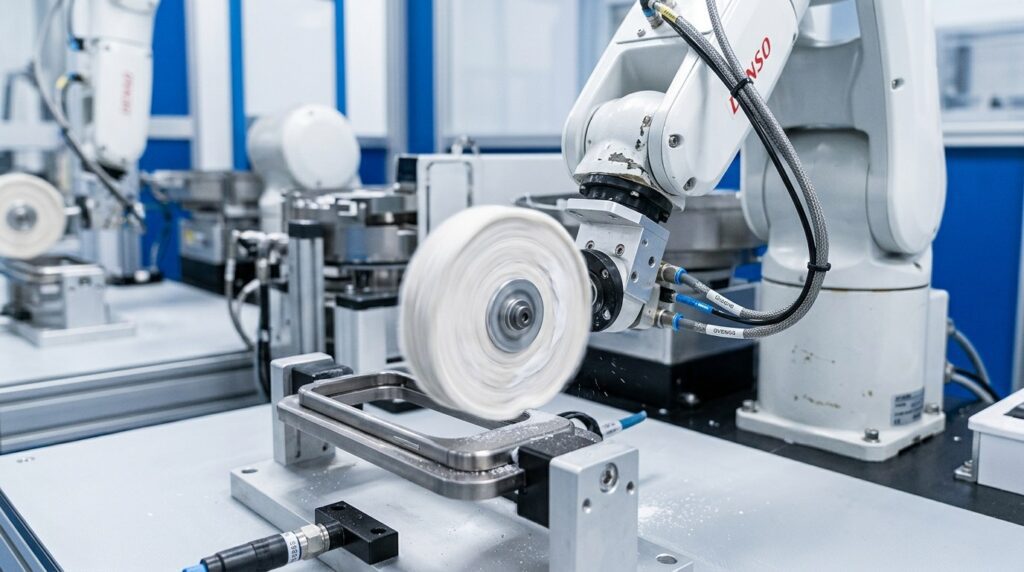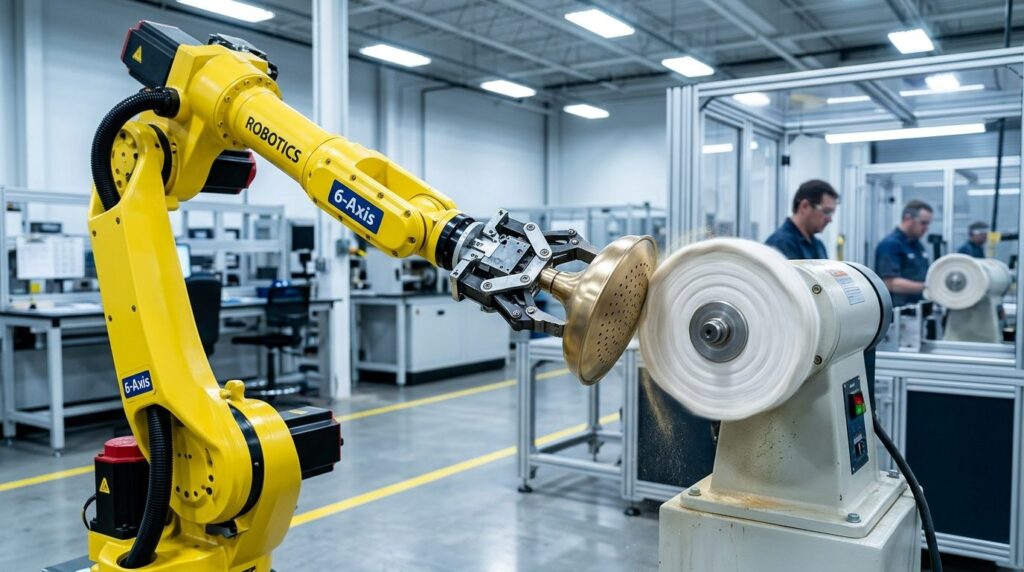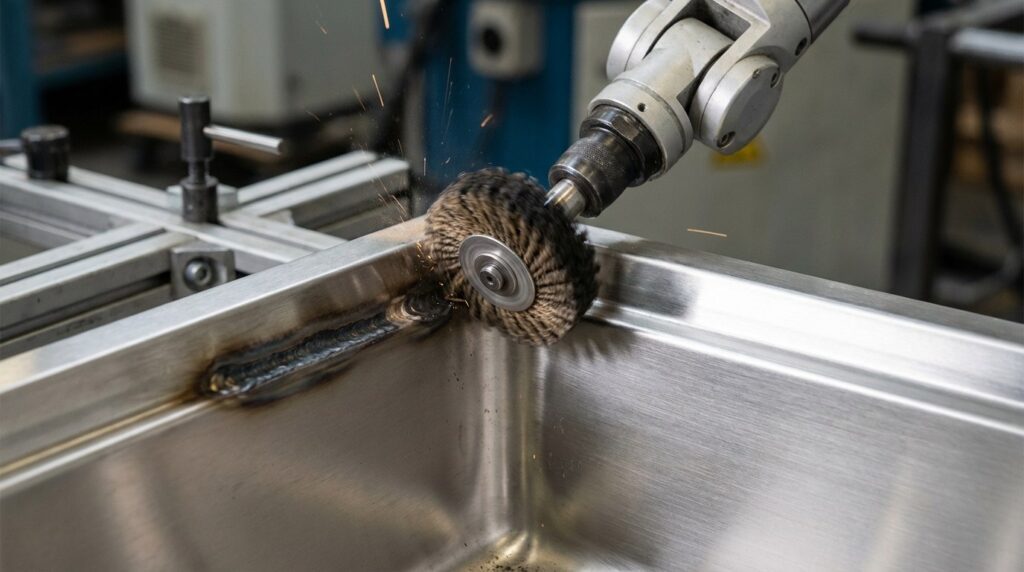
In high-end modern kitchen and commercial laboratory design, stainless steel sinks featuring an extreme high-gloss or mirror finish are the ultimate symbol of premium quality. However, completely eliminating weld marks on thin-walled metal and polishing the surface to a flawless, mirror-like seamless state is an intensely challenging process in hardware and sanitary manufacturing. This article deeply analyzes the surface polishing pain points of handmade stainless sinks and demonstrates how utilizing a robotic automated polishing system with active force control completely eradicates manual over-cutting, thermal distortion, and unpolished dead zones. Discover how to achieve stable delivery of seamless, mirror-quality premium sinks.
What is a Premium Stainless Steel Sink?
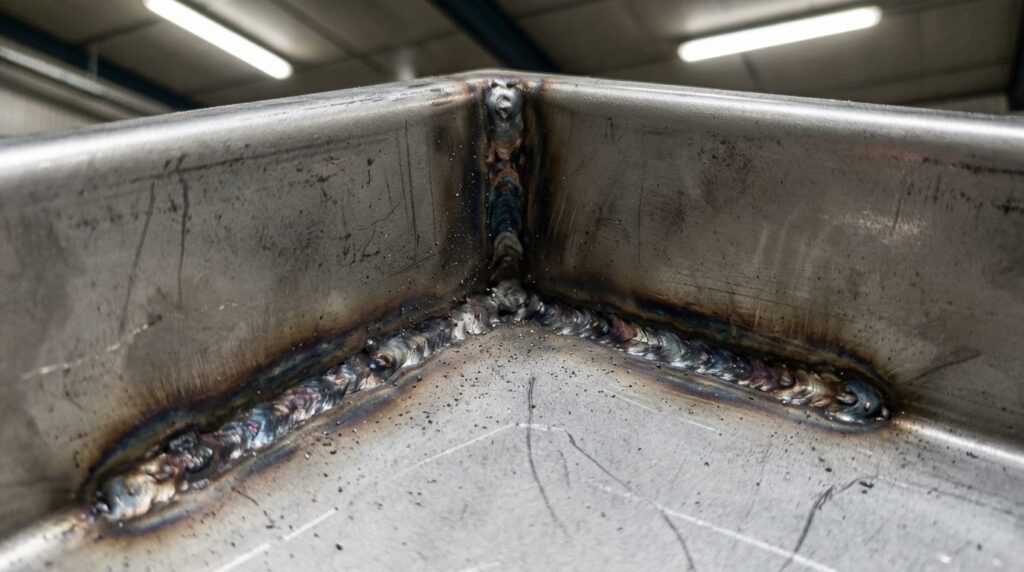
We are specifically referring to premium handmade stainless steel sinks. These are typically constructed from high-quality SUS304 or SUS316 stainless steel sheets that are laser-cut, folded, and then assembled using manual TIG welding or laser welding at the seams.
High-Gloss Sink Application Scenarios
Beyond the common brushed/satin finishes, many high-end applications—such as luxury hotel suites, sterile washing stations in medical facilities, and commercial bar countertops—heavily favor high-gloss or mirror-polished sinks.
A high-gloss polish not only delivers a striking sense of luxury but serves a critical functional purpose: a perfectly smooth mirror surface has zero microscopic pores, drastically inhibiting bacterial growth and making it incredibly easy to clean. This demands that the sink’s welded corners be thoroughly ground and polished flat, achieving the visual illusion of a “seamless, unibody construction.”
Stainless Steel Sink Structural Characteristics
Polishing these sinks presents immense physical and process challenges:
- The “Magnifying Glass” Effect of High-Reflective Surfaces: A polished surface acts like a mirror. Even a micron-level depression (caused by over-grinding) or a slight waviness will be infinitely magnified under reflected light, leading to immediate product rejection.
- Narrow and Deep Internal Corner Welds: The four vertical welded corners offer very little space. Standard buffing wheels cannot enter, making it extremely easy to gouge a crater into the parent metal when attempting to remove the dark oxidation layer.
- Thin-Walled Materials Highly Prone to Thermal Distortion: Sheet thickness is typically 1.2mm – 1.5mm. High-speed buffing with sisal or cotton wheels generates immense friction heat. If pressure is too high or dwell time too long, the steel plate will scorch (turn yellow) or severely warp and buckle locally.
Key Characteristics of Premium Sink Polishing
Caratteristiche principali:
- Seamless Visual Blending: After multiple polishing stages, the welded corners must fuse perfectly with the parent metal, revealing absolutely no boundary between the weld and the surrounding plate.
- High Gloss / Mirror Finish: The surface must be free of scratches and dull patches, achieving a highly reflective, absolute mirror effect with an Ra < 0.05 μm.
- Absolute Flatness without Deformation: Relies on masterful temperature and pressure control to maintain the physical flatness of the large, thin sheet metal.
Technical Parameters for Sink Polishing
| Articolo | Intervallo dei parametri | Note |
| Weld Bead Rough Grinding | P80 – P120 Ceramic/Flap Disc | Rapid removal of protruding weld beads |
| Sisal Buffing (Prep) | 1500 - 2500 giri/min. | Used with cutting compound to remove grind marks |
| Cloth Polishing (Mirror) | 2000 – 3000 rpm | Used with high-gloss wax for brilliant reflections |
| Contact Force Control | 15N – 30N (High-Freq Dynamic) | Absolutely prevents over-cutting & thermal warp |
| Tempo di ciclo di produzione | 4 – 6 Minutes / Sink | Depends on size and specific polish grade |
Why is Robotic Polishing Preferred for Premium Sinks?
Punti dolenti della lucidatura manuale convenzionale
If a sink factory relies on workers wielding hand-held angle grinders and polishers to achieve high-gloss finishes, they face insurmountable quality and capacity bottlenecks:
| Punto dolente | Problema specifico | Impatto |
| High “Over-cut & Scorch” Scrap | To increase speed, workers press down hard, causing the thin steel to rapidly heat, warp, and turn yellow. | Once a mirror sink has a wavy crater or burn mark, it’s nearly unrepairable and scrapped. |
| Black Oxidation Left in Corners | It is difficult to control manual force and angle in internal 90-degree corners, often leaving unpolished weld oxidation. | Destroys the premium look; residual oxidation layers are highly prone to rusting. |
| Extreme Reliance on Masters | Mirror polishing relies entirely on the “feel” and “eyes” of a master with a decade of experience. | Severe talent shortage; the departure of one master can paralyze a high-end production line. |
Vantaggi dell'automazione robotica
Introducing a robotic automated polishing system equipped with active force control is the ultimate answer for sink manufacturers looking to upgrade their products and leapfrog their production capacity:
| Dimensione di confronto | Lucidatura manuale | Lucidatura robotizzata | Miglioramento |
| Surface Flatness | Prone to craters and waves | Constant force floating, flat as a calm lake | Zero visual flaws under high-reflection light |
| Temp Control | Easily scorches/discolors | Even feed rates, no localized heat buildup | Completely eliminates burnt scrap, protects steel |
| Capacity & Cycle | Slow, workers fatigue easily | 24/7 stable high-speed cutting & coloring | Capacity explosion; confidence to take massive orders |
| Dead Zone Finishing | Prone to dark spots | Agile posture, finely polishes every inch | 100% seamless blend, boosting product premium |
Vantaggi principali:
- High-Frequency Active Compliant Force Control: This is the lifeline for achieving a flawless high-gloss polish. When the robotic polishing wheel contacts the thin sink wall, it acts like independent car suspension, fine-tuning the Z-axis at lightning-fast frequencies. No matter how much the steel plate rebounds, the system maintains an extremely light (e.g., 15N) and absolutely constant pressure. This ensures polishing stays strictly at the micron level on the surface, never “gouging” or “burning through.”
- Multi-Station Collaboration & Automatic Tool Changer (ATC): High-gloss polishing is a superposition of multiple processes. The robot can automatically drop the rough grinding head, pick up a sisal wheel for the corners, and finally switch to a massive pure cotton wheel for overall coloring. This not only changes tools swiftly but coordinates with the auto liquid compound system to ensure uniform abrasive distribution.
Flusso di lavoro automatizzato del processo di lucidatura
Questo processo utilizza 8 passi to complete the metamorphosis of a premium single-bowl sink from a “dark welded blank” to a “seamless mirror.” Polishing is an intricate process of subtraction.

Stainless Steel Sink Complete Polishing Process Flow
| Processo | Nome del processo | Attrezzatura | Consumabile | Tempo | Precisione / Scopo |
| 01 | Non-Destructive Load | Flexible Vacuum Suction Jig | - | 15s | Firmly grips, eliminating resonant noise |
| 02 | Weld Bead Rough Grind | Robot + mandrino ad alta velocità | Small Dia. Flap Disc | 60s | Mills down protruding TIG beads in the 4 corners |
| 03 | Localized Sisal Prep | Robot + Small Buffing Spindle | Mounted Sisal + Cutting Wax | 75s | Removes grind marks, treats discolored corner welds |
| 04 | Global Sisal Flattening | Robot + Heavy Pedestal Buffer | Large Sisal Wheel + Cut Wax | 90s | Initial coloring and flattening of bottom and walls |
| 05 | Cloth Mirror Polish | Robot + Heavy Pedestal Buffer | Soft Cotton Wheel + Gloss Wax | 120s | Large-area high-speed polish for ultimate reflection |
| 06 | Ultrasonic Dewaxing | Auto Ultrasonic Wash Tank | Medical-Grade Dewaxer | 180s | Dissolves stubborn wax from pores and surface |
| 07 | DI Water Spray Rinse | High-Pressure Wash Cabin | Acqua deionizzata (DI) | 40s | Washes away solvents, ensuring surface purity |
| 08 | High-Light Mirror Insp. | Zebra Stripe Inspection Light | - | 30s | Checks for micro-craters or unpolished dark areas |
Stainless Steel Sink Polishing Process Descriptions
Fase 1: caricamento non distruttivo
Scopo: Stably clamp the thin sheet metal sink.
Punti chiave: Mechanical hard clamping must NEVER be used. A profiled array of high-density vacuum suction cups grips the sink from the outside bottom and sides. This leaves no marks on the cosmetic face and massively absorbs polishing vibrations, preventing the thin plate from generating resonant “water ripple” chatter marks.
Step 2: Weld Bead Rough Grind
Scopo: Completely mill down the hardest weld seams in the corners.
Punti chiave: Space is tight. The robot uses the ATC to swap to a small grinding head, executing high-RPM point-milling to carefully cut away the protruding weld bead without damaging the surrounding parent metal.
Step 3 & 4: Localized and Global Sisal Buffing (Prep)
Scopo: Eliminate rough scratch marks and seamlessly blend the welded areas with the rest of the plate.
Punti chiave: Paired with an auto-spray system applying liquid cutting compound. The robot’s force control system plays a massive role here, sweeping rapidly with uniform thrust (to prevent heat buildup), causing the dark weld to gradually reveal a uniform metallic color, achieving a “seamless visual effect.”
Step 5: Cloth Mirror Buffing
Scopo: The “coloring” stage that gives the product its soul.
Punti chiave: Utilizes extremely soft cotton cloth wheels and high-gloss compounds. The robot strictly controls contact force and dwell time. The cloth wheel executes complex, intersecting cross-hatch paths over the large flat areas of the sink, ensuring absolutely even gloss and achieving a mirror effect that clearly reflects objects.
Step 6 & 7: Dewaxing and Cleaning
Scopo: Polishing compound becomes incredibly sticky under high heat. It must be thoroughly stripped using heated ultrasonic vibration, and finally rinsed with DI water, revealing the pristine, brilliant stainless steel surface.
Step 8: High-Light Mirror Inspection
Scopo: Under brilliant zebra stripe lights, any micro-craters caused by uneven grinding pressure (orange peel effect) or unpolished shadows have nowhere to hide.

Sfide e soluzioni di lavorazione
Challenge 1: Extreme Overheating and Warping of Thin Steel Plates
Problema:
- Stainless steel has poor thermal conductivity, combined with a 1.2mm thin wall. During large-area sisal and cloth polishing, immense friction causes localized temperatures to spike instantly.
- High heat directly causes the steel plate to oxidize and turn yellow (which cannot be washed off) and releases internal stresses, severely warping the flat bottom of the sink.
Soluzione:
- High-Frequency Sweeping Strategy + Force-Controlled Coolant Compensation.
- Programmers set the robot to use extremely fast feed rates (dwelling in one spot is strictly forbidden), utilizing large-area, reciprocating cross-hatch paths to allow heat to dissipate. Concurrently, the auto liquid compound system not only provides cutting abrasives but the liquid wax itself acts as an excellent coolant.
- Risultato: Completely eliminated burnt, yellowed scrap. The polished sink bottom retains its perfect physical flatness.
Challenge 2: Unpolished Dead Zones in Complex Geometric Corners
Problema:
- High-end sinks are often designed with sharp internal corners (R10 or smaller). The physical volume of large polishing cloth wheels is simply too big to squeeze into these corners, leaving the four corners of the sink dull and dark, creating ugly “black eyes.”
Soluzione:
- Fully Automatic Tool Changer (ATC) and Flexible Ball-Nose Polishing.
- Much like a surgeon, after processing the large flat areas, the robot automatically drops the massive cloth wheel and picks up micro-mounted polishing bobs specifically designed for dead zones. Paired with a high-speed spindle, it dives into the deepest corners of the sink to “fill in the light.”
- Risultato: Achieved true 100% dead-zone-free polishing. From the broad bottom flat to the deepest internal corners, it presents a perfectly uniform high-gloss finish.
Studio di caso
Background del cliente
A manufacturer based in North America focusing on luxury commercial kitchens and high-end yacht sanitary facilities. Their products are renowned for their heavy-duty feel and breathtaking seamless mirror finishes, commanding exorbitant retail prices.
Sfide tecniche
- The client uses 1.5mm thick SUS316L marine-grade stainless steel, which is extremely hard.
- The client had insane requirements for the mirror finish (absolutely zero visible brushing or grinding marks allowed; it must be pure, high-gloss reflection).
- Local high-level master polishers were incredibly expensive and extremely hard to recruit, severely restricting order fulfillment capacity.
La soluzione
| Articolo | Configurazione |
| Pezzo in lavorazione | Premium Yacht/Commercial Seamless Mirror Sinks |
| Materiale | 1.5mm SUS316L Stainless Steel |
| Attrezzatura | Heavy-Duty 6-Axis Robot + High-Speed Spindle + Liquid Compound System |
| Core Tech | High-Freq Force Control Anti-Warping + OLP Complex Path Planning |
| Processo | Auto-change Corner Grind -> Sisal Blending -> Pure Cotton Deep Polish |
| Tempo di ciclo | 5.5 Minutes / Comprehensive mirror finish per standard sink |
Risultati dell'implementazione
- Unrivaled Quality: The polished sinks look like modern art. The constant-force system and precise path control created flawless mirrors with no ripples, craters, or dead spots, completely satisfying the discerning eyes of luxury yacht clients.
- Cost Reduction & Efficiency: A single robotic cell running one shift replaced the output of 3 of the highest-paid veteran master polishers. Polishing yield skyrocketed from 82% in the manual era to a stable 99.5%.
- Agile Manufacturing: Using offline programming software, the client can instantly import 3D models of various irregular, customized sinks for automated proof-of-concept polishing, drastically boosting their capability to take on lucrative custom orders.
Feedback dei clienti
“When your robot finished polishing that first sink, the entire workshop went dead silent. That mirror finish—without a single stray mark, where you absolutely cannot tell it was ever welded—is more perfect than what our most experienced master could achieve after 40 minutes of grueling hand labor. This machine gives us boundless confidence in our capacity.”
FAQ
Q1: Can robotic polishing thoroughly handle the weld spatter and overflow on the back (outside) of the sink?
A: Absolutely. While customers typically only see the inside, the back of premium sinks must also be flattened to facilitate countertop installation. The robot has a massive reach and six degrees of freedom. While the sink is held in the same fixture, the robotic arm can easily reorient itself to quickly blend and rough-polish the exterior weld seams.
Q2: Is it difficult to design fixtures for odd-shaped sinks of varying depths and slopes?
A: Our standard approach is a “Flexible Back-Mounted Vacuum Array.” These suction cups feature universal ball joints and spring floating mechanisms, automatically adapting to various depths, slopes, and even bottoms with drain-channel creases. As long as the sink is placed on the array, the vacuum secures it firmly. There is absolutely no need to machine expensive, hard metal fixtures for every new sink design.
Q3: Liquid polishing wax splatters heavily. How does the equipment protect itself?
A: We are acutely aware of how harsh polishing environments are. Our robotic polishing cells come standard with comprehensive protection: the robot arm wears a customized, corrosion-resistant, and oil-proof protective suit; the electro-spindle and force sensors feature high-level IP65+ sealing. The entire workstation is a fully enclosed explosion-proof glass cabin with a sloped collection trough at the bottom to automatically reclaim excess liquid wax and metal dust.
Q4: How is the Return on Investment (ROI) calculated for investing in this high-gloss polishing system?
A: High-end mirror sinks are classic high-profit, highly labor-dependent products. When calculating ROI, beyond the most obvious “hundreds of thousands of dollars saved in master polisher wages,” you must factor in the massive material cost recouped by dropping the over-cut scrap rate from 15% to 0. Based on real-world cases from our project assessment and proof-of-concept services, for a factory running two shifts, the system payback period is typically as short as 10 to 14 months.
Conclusione
The surface treatment of premium stainless steel sinks is not just a manufacturing step; it is the core process that endows the product with its “luxurious luster.” Adopting a robotic polishing cell integrating active force control and an automated compound spraying system completely upends the traditional workshop model reliant on human feel and stamina. With absolute constant pressure, dead-zone-free microscopic grinding, and tireless high-speed operation, it perfectly resolves the three massive challenges of preventing thin-wall thermal warping, seamless weld blending, and achieving ultimate mirror finishes. This is the ultimate weapon for kitchen and sanitary hardware enterprises to break free from capacity constraints and dominate the high-end custom market.
If your factory is struggling to hire high-wage polishers, suffering from high mirror sink scrap rates, or failing to guarantee delivery times, contact our automated polishing expert team to obtain a dedicated technical assessment and machine trial solution.