In the specific segment of plumbing and hardware manufacturing, smart door locks are experiencing unprecedented explosive growth. As the “first face” of a smart home, the exterior texture of the lock panel directly determines consumer perception of the product’s security and premium quality. However, because smart lock panels feature large flat areas, surface imperfections are easily magnified.
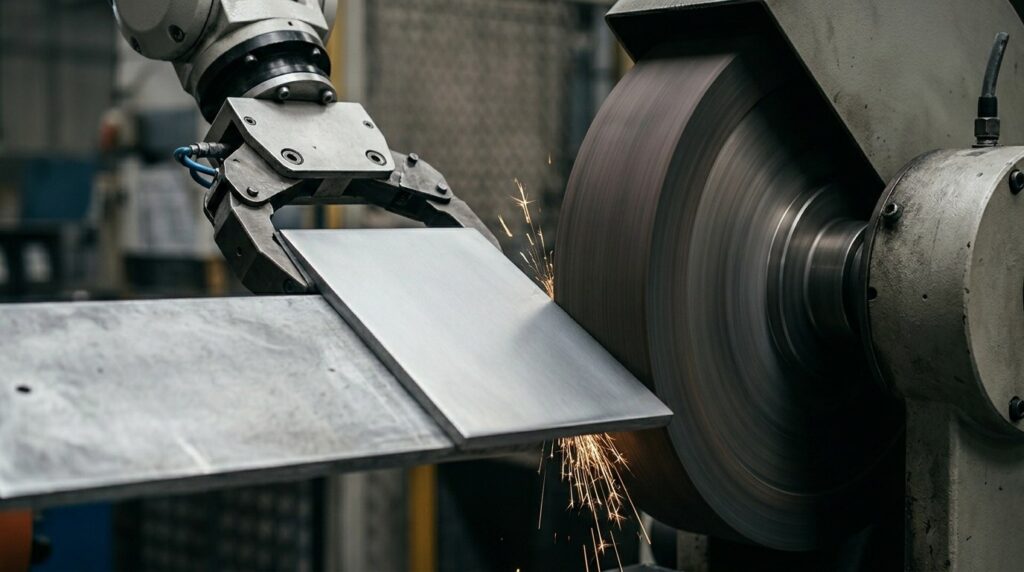
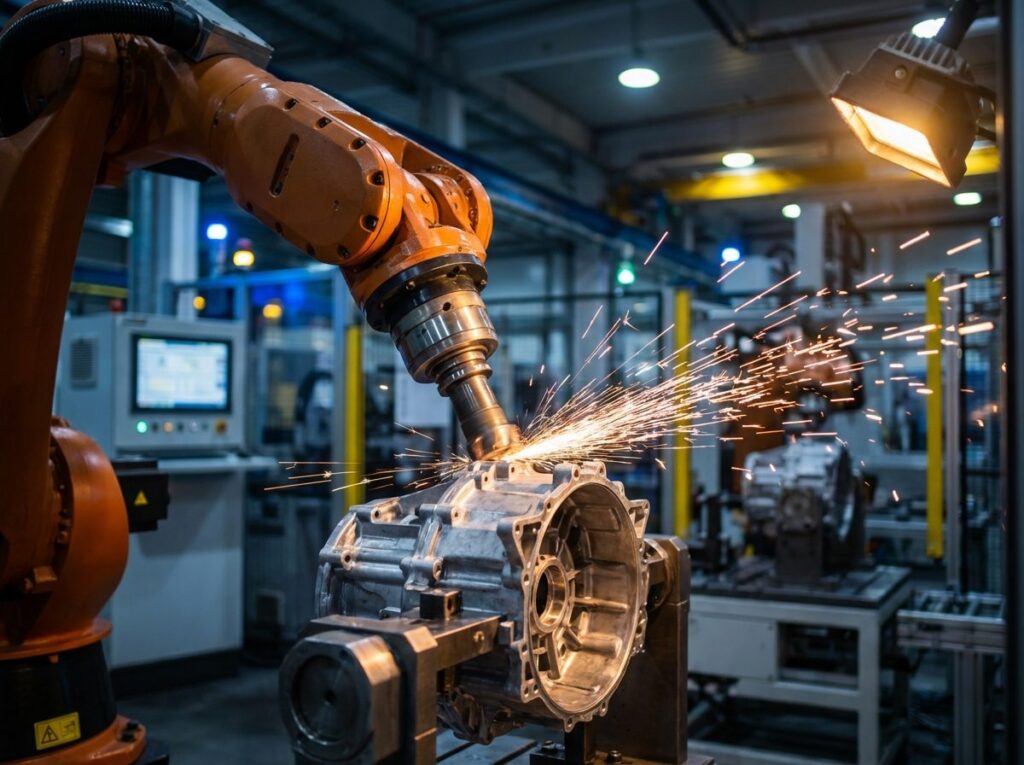
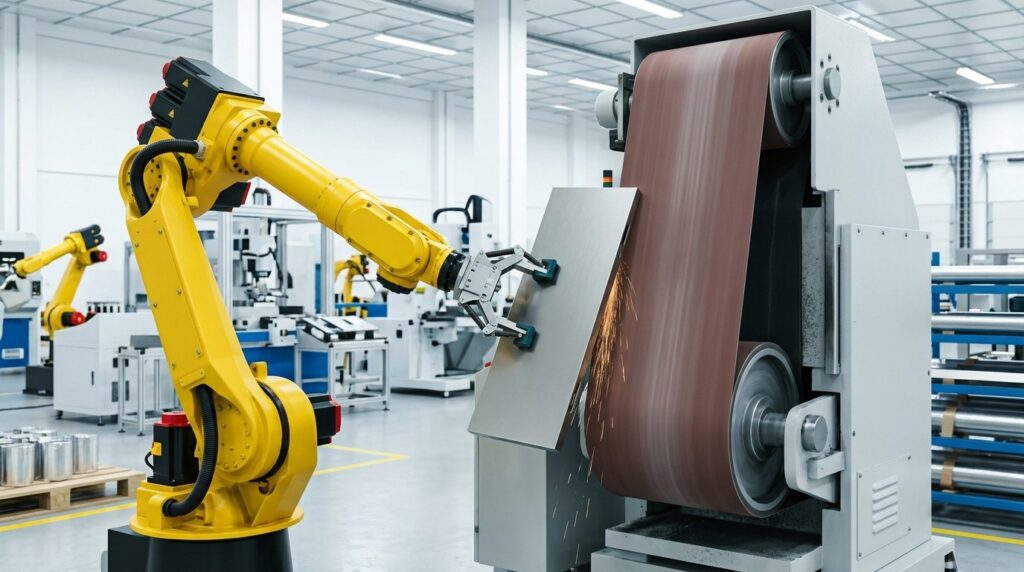
To meet the demands of millions in shipping volume and draconian cosmetic standards, utilizing heavy-duty industrial robots holding die-castings against floor-mounted abrasive belt machines—a process known as robotic polishing—has become the absolute primary solution for top-tier lock enterprises to solve flatness pain points and boost electroplating yield.
What are Smart Door Lock Panel Die-Castings?
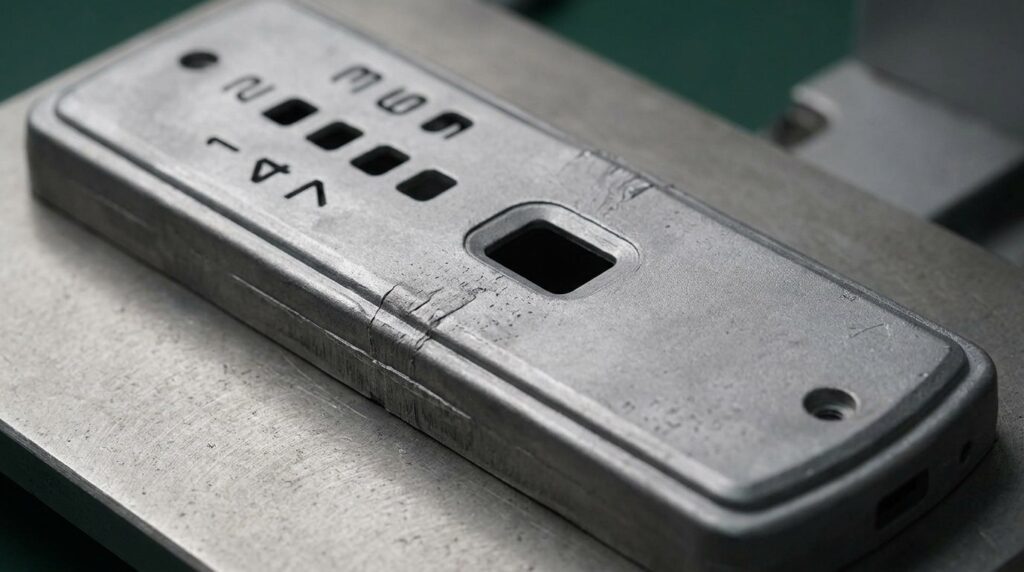
The casings and panels of mid-to-high-end smart locks on the market are typically formed via high-pressure die casting using high-strength Zinc Alloy or Aluminum Alloy. Fresh off the die-casting machine, the raw casting surface exhibits mold release residue, cold flow marks, micro-porosity, and extremely sharp parting line flash on the edges.


The Fatal Flaw of Manual Grinding (The Flatness Crisis)
The most typical design language for smart lock panels is “broad mirror or brushed flat surfaces.” This poses a disastrous challenge for manual grinding:
- Disastrous Waviness / Ripples: When a worker manually presses a panel against a sanding belt, arm fatigue and uneven pressure easily carve microscopic pits or ripples into an otherwise flat surface. After subsequent PVD vacuum coating or high-gloss electroplating, these ripples are infinitely magnified under light, severely distorting the reflection and causing immediate product rejection.
- Distorted Cutouts and Edges: Lock panels are riddled with cutouts for keypad numbers, fingerprint sensors, and cameras. Manual polishing easily “rounds off” or collapses the sharp right angles of these cutouts, preventing glass panels or fingerprint modules from assembling flush later on.
- High-Risk Dust Environments: Grinding zinc and aluminum alloys generates massive amounts of highly concentrated, combustible metal dust, endangering worker health and triggering severe safety compliance pressures.
Technical Parameters for Smart Lock Polishing
| 項目 | パラメータ範囲 | 備考 |
| Flash & Sprue Removal | High-Cut SiC Belt / Flap Wheel | Rapidly flattens die-cast parting lines to reshape profiles |
| Large Flat Surface Leveling | Wide AlOx Belt / Nylon Wheel | Absolutely straight cutting to completely eliminate die-cast orange peel and waviness |
| High-Gloss Mirror Finish | High-Density Sisal / Pure Cotton | Combined with wax to awaken fine alloy base luster for plating |
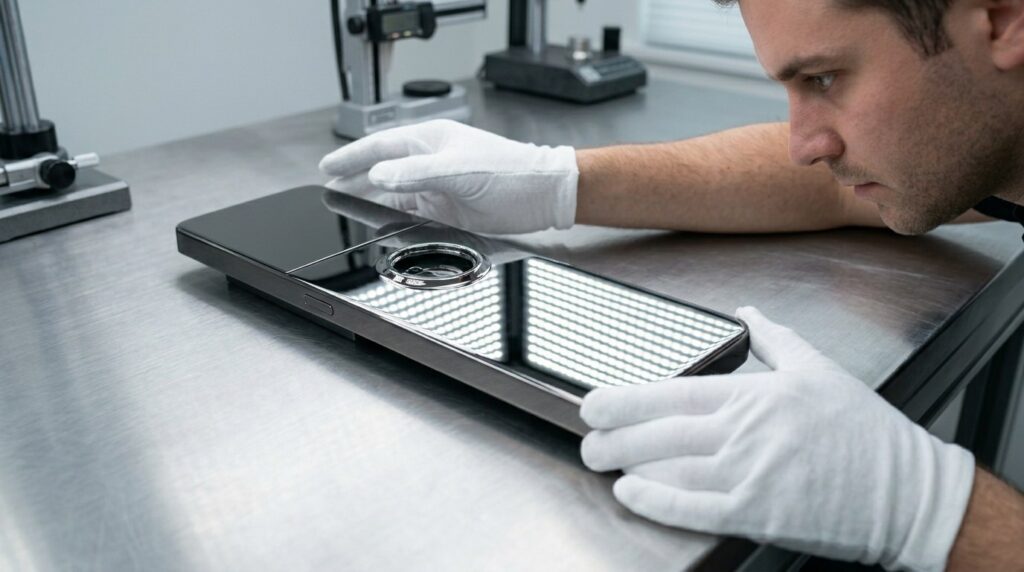
| Surface Flatness Error | ≤ 0.05 mm | The core metric ensuring zero reflection distortion after plating |
| Cutout Edge Control | Zero Edge Rounding | Ensures perfect fitment of keypads and biometric modules |
Why Must Lock Panels Use the “Robot-Holding-Workpiece” Architecture?
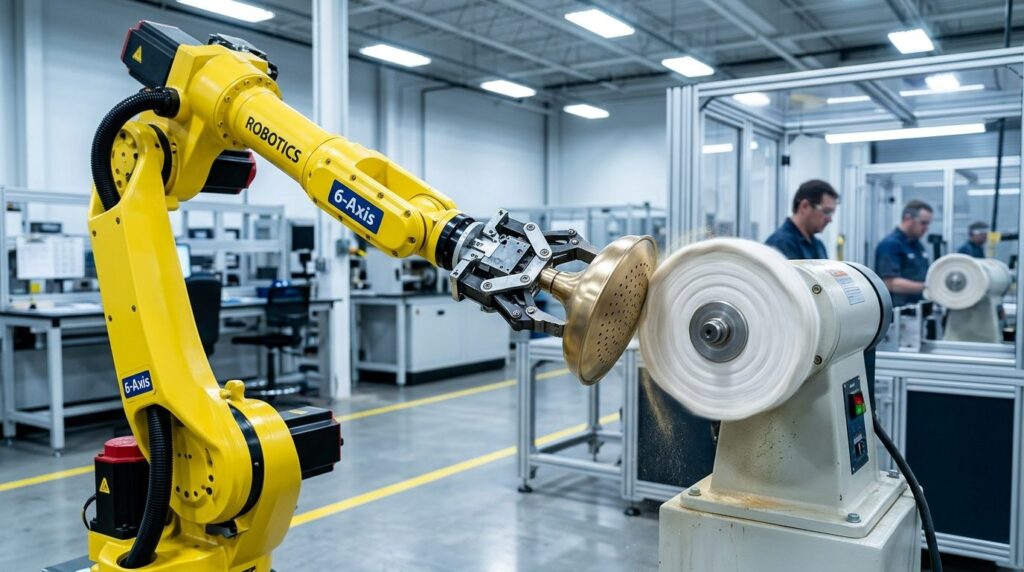
Faced with smart lock panels that demand extreme flatness, the most advanced automated solution in the industry is: A heavy-duty 6-axis industrial robot on the left firmly grips the door lock panel, maneuvering it at absolutely precise angles against wide, floor-mounted abrasive belt machines and polishing centers secured on the right.
This “workpiece-to-tool” architecture perfectly solves the flatness crisis:
- Absolutely Parallel Cutting Trajectories: Relying on formidable mechanical rigidity, the robot grips the panel and performs absolutely straight, linear movements across the wide abrasive belt. Regardless of the volume processed, the robot’s posture never deviates, physically eradicating the ripples caused by manual grinding.
- Milli-Newton Active Force Control: When grinding fragile areas like fingerprint cutouts, the active force sensor on the robot’s wrist automatically adjusts contact pressure with milli-Newton precision. It guarantees smoothness without ever collapsing the edges of the holes.
- Highly Efficient Flexible Routing: Gripping the panel, the robot seamlessly transitions between multiple stationary floor stations—from coarse grinding to fine blending, brushing, and buffing—in one continuous flow.


Automated Grinding and Polishing Process Workflow
| Step | プロセス名 | Equipment & Consumables | Purpose & Precision |
| 01 | ビジョンガイド付きローディング | Robot + Custom Soft Gripper | Non-destructive grip on raw casting to prevent surface scratches |
| 02 | Profile Flash Removal | Floor-Mounted Coarse Belt | Traces the perimeter to rapidly shear off sharp die-cast flash |
| 03 | Absolute Flat Leveling | Wide Contact Wheel Belt / Brusher | Constant-pressure straight feed eradicates waviness and unifies texture |
| 04 | Edge & Cutout Refining | Floating Fine Belt / Nylon Wheel | Smoothly blends R-corners while protecting the dimensional accuracy of sensor cutouts |
| 05 | Base Mirror Buffing | Auto-Wax Sisal/Cloth Wheel | Completely flattens scratches to reveal a flawless, high-gloss texture |
Case Study: Top-Tier Smart Home Hardware OEM
We deployed a fully enclosed robotic polishing matrix for a leading smart door lock OEM in South China.
- Pain Points Solved: This client previously focused on high-end black titanium brushed and mirror-electroplated locks. Due to the extremely poor flatness of manual grinding, the post-plating cosmetic yield was a mere 65%, resulting in mountains of scrap.
- 実施結果: After introducing the architecture featuring high-payload robots synergizing with wide floor-mounted belt machines, the flatness error of the lock’s large flat surfaces was controlled to within 0.05mm, thanks to the system’s superior trajectory precision and force control. After electroplating, the reflections were as still as a calm lake. First-pass cosmetic yield soared to 98%, and the workshop achieved fully automated dust extraction, securing massive OEM orders from top international plumbing and security brands.


Smart Lock Polishing FAQ
Q1: Smart lock panel designs iterate frequently with significant shape variations. Can the automated equipment adapt?
A: Absolutely. Our system is equipped with advanced 3D Offline Programming (OLP) software. Faced with a new lock design, engineers simply import the CAD model, and the software automatically generates collision-free polishing trajectories. Combined with a quick-change gripper system, line changeovers typically take only 15-30 minutes, perfectly matching the fast-paced iteration of the smart home industry.
Q2: If zinc alloy die-castings are ground too deeply, internal porosity (sand holes) is easily exposed. How does the robot control the cutting depth?
A: The “dense skin, porous core” characteristic of zinc alloys dictates that cutting depth must be extremely precise. Our system monitors the friction resistance between the belt and the workpiece in real time via a high-frequency spindle force sensor. The system precisely controls the removal of only the top 0.1-0.2mm of oxidation skin and minor tool marks. It will never “over-cut” and destroy the dense outer layer, perfectly mitigating the risk of exposing internal porosity.
結論
In the highly competitive arena of smart door locks, a perfect mirror/brushed surface texture is the core capital for premium pricing. Adopting an automated architecture featuring heavy-duty 6-axis robots holding workpieces, synchronized with massive floor-mounted polishing centers, definitively marks the end of “manual waviness.” It delivers extremely high flatness consistency, soaring electroplating yields, and a safe, dust-free modern manufacturing environment for hardware OEMs.
If your factory is facing customer rejections due to surface ripples on lock panels, or if you are struggling with the dual pressures of environmental compliance and labor shortages, please feel free to contact us today for a dedicated smart hardware automated polishing assessment.