Walk through any machine shop and you will find it: the deburring bench. Tucked in a back corner, staffed by whoever is free that day, quietly responsible for a surprising share of rework, late shipments and customer complaints. Burrs are a side effect of nearly every milling, drilling, turning, stamping and laser cutting operation, so every manufacturer has to deal with them.
The real question is with what. Between barrel tumblers that have barely changed since the 1950s and force-controlled robotic cells running three shifts unattended, the range of deburring machines on the market is wider—and more confusing—than ever. Most guides you will find online were written by directory sites or single-product machine builders, each framing the problem around the one machine they sell.
If burr terminology is new to you, our guide to what robotic deburring actually means covers the fundamentals first. This guide takes a different approach. We build robotic deburring and polishing systems at UBright Solutions in Nanjing, China, and we are the first to admit a robot is not always the answer. Below is every major category of deburring equipment, explained honestly—including the ones we do not sell—followed by a comparison table, selection rules and a realistic look at ROI.
Why Choosing the Right Deburring Machine Matters
Deburring looks trivial, and that is exactly why it is so expensive when it goes wrong. The costs hide in three buckets.
Scrap and downstream failures. A burr that escapes your inspection bench does not usually fail at your plant. It fails at the customer’s assembly line—scoring a cylinder bore, jamming a spool valve, breaking a seal face. By then the cost is a rejected lot, not a reworked part. In fluid power and automotive supply chains, a single escaped-burr claim can exceed a year of deburring labor at that line.
Labor that is getting harder to find. Manual deburring with a hand file, scraper or die grinder is repetitive, dusty work with high rates of repetitive strain injury. In most industrialized countries it has become one of the hardest positions to staff and keep. When your only deburring specialist leaves, tribal knowledge about which edge needs extra attention leaves with them.
Inconsistency that blocks tighter tolerances. Two operators produce two different edge breaks; even one operator differs from hour to hour. For coated parts, sealing surfaces and hydraulic components, the edge condition is a functional specification—an edge radius or chamfer with limits—and hand finishing cannot hold it across a shift.
One more factor drives the choice before any machine is considered: the burr itself. Machining produces four common types—rollover burrs from cutting-edge push-out, tear burrs from punching and drilling breakthrough, Poisson burrs from material squeezed sideways at the edge, and cut-off burrs or laser dross at the end of a cut. Thin rollover burrs on outside edges come off with almost any method. Burrs at the bottom of a cross-drilled hole inside a casting eliminate several machine categories on their own. Location, thickness and accessibility narrow the field before price enters the discussion.
Mass Finishing Machines: Tumble, Vibratory and Centrifugal Disc
Mass finishing is the oldest and still the most cost-effective way to deburr large volumes of small parts, and nothing we say later in this guide changes that.
Tumble (barrel) deburring machines rotate a drum loaded with parts and loose abrasive media. As the mass lifts and cascades, media rubs against the parts, wearing down burrs and rounding edges. Barrels deliver aggressive action at low cost, but part-on-part collision is real—delicate components can pick up dings that count as new defects.
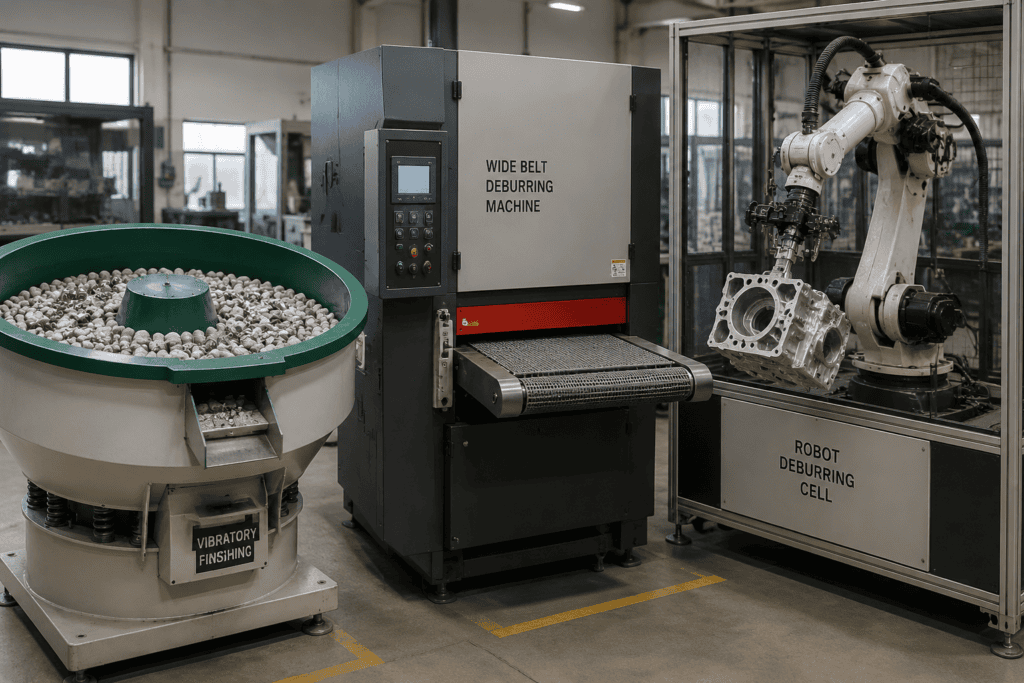
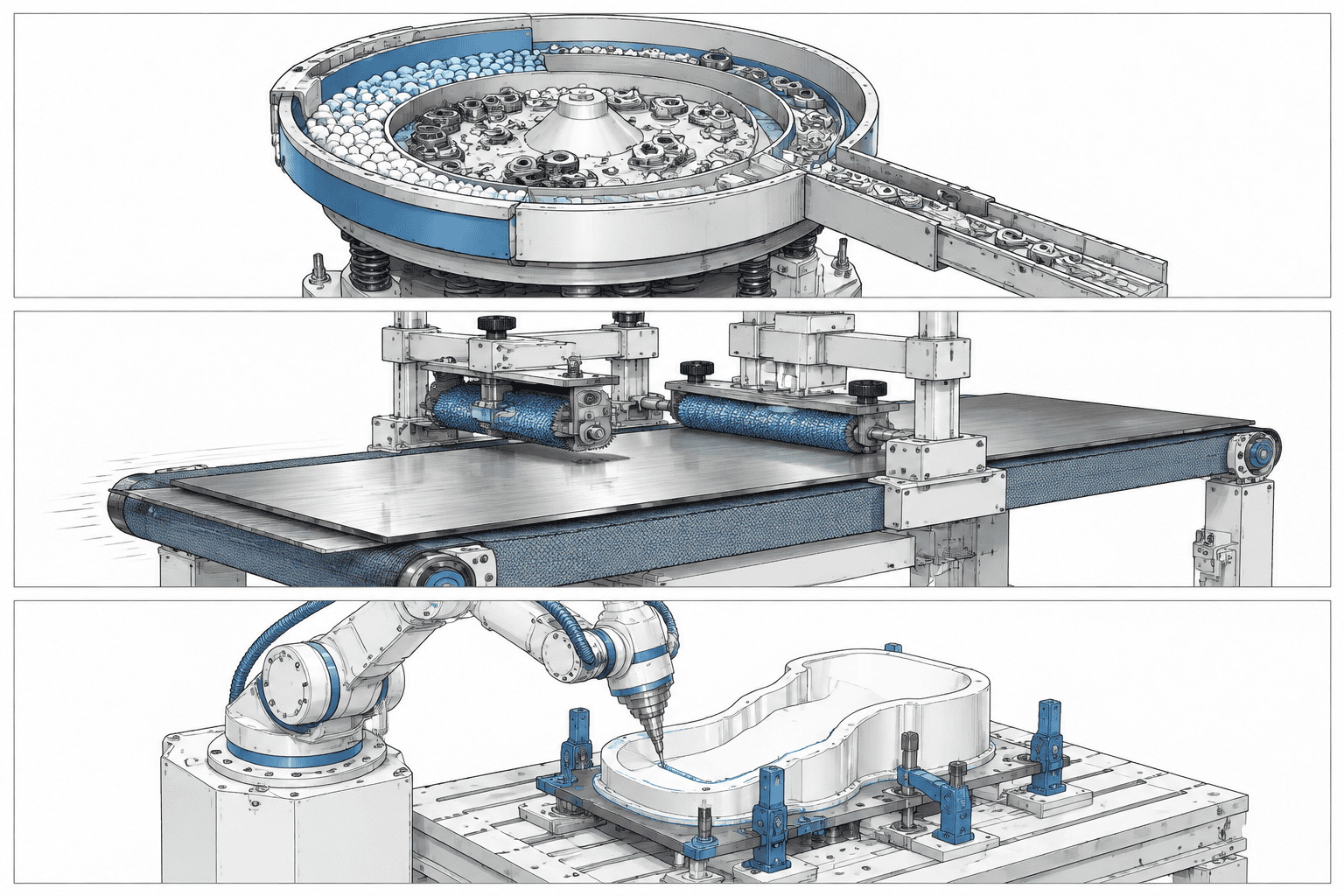
Vibratory deburring machines replace the cascade with a high-frequency oscillation in an open trough or bowl. Parts and media churn in a corkscrew motion, producing a smoother, more uniform finish with far less impact damage. Add circulating compound solution and you get simultaneous degreasing. Vibratory bowls handle mixed part sizes in one load, which makes them the default high-volume workhorse in fastener, stamping and investment casting shops.
Centrifugal disc finishers spin a bottom disc at high speed inside a stationary barrel. The velocity difference creates a fast, turbulent media flow that cuts 5 to 10 times faster than a vibratory bowl at similar quality. They are the go-to for small, precise components—fuel system parts, medical screws, small gears—where cycle time matters and surface refinement is part of the spec.
Where mass finishing hits its ceiling: large parts that will not fit (or will damage each other) in the media mass; parts where media can lodge in tapped holes or cavities; and parts that need burrs removed on specific edges while other surfaces stay untouched. A vibratory bowl deburrs everywhere at once. If your drawing calls out a controlled edge break on one feature only, it is the wrong tool.
Thermal, Electrochemical and High-Pressure Water Deburring
Three specialist processes share one mission: removing burrs no mechanical tool can reach.
Thermal energy deburring (TEM) loads parts in a sealed chamber, injects a hydrogen-oxygen mixture and ignites it. The burn lasts milliseconds. Because burrs have enormous surface area relative to their mass, they flash to oxidation temperature and burn off while the bulk part barely warms—same physics reason a sheet of paper chars while a phone book survives. TEM reaches every cross-hole, thread and internal passage in one shot, regardless of geometry. The trade-offs: the part sees a brief thermal cycle, burr residue needs cleaning afterward, and the gas-handling system is serious capital. It is a batch process that pays off at volume.
Electrochemical deburring (ECM) dissolves the burr instead of cutting or burning it. The conductive workpiece is made the anode, a shaped cathode tool sits near the burr site, and current through the electrolyte dissolves metal preferentially at the high-current-density burr tips. No cutting force, no heat-affected zone, no residual stress, and access to locations no tool reaches—typically cross-drilled holes in valve bodies, fuel injectors and hydraulic manifolds. The costs are custom cathode fixtures per part family and electrolyte management, so ECM earns its place on high-volume precision parts.
High-pressure water deburring blasts burrs and chips out of cavities with waterjet pressures commonly in the 1,500–3,000 bar class. It is the standard answer for machined aluminum blocks and heads—oil galleries and crank drillings no brush will ever reach—often paired with brushing and drying in the same transfer line. Capital cost is high and parts must tolerate the pressure, but for cast-metal internal passages it is the only process that both removes the burr and flushes the debris out.
Brush Deburring and Wide-Belt Machines for Sheet Metal
Sheet metal fabrication has its own finishing branch, because laser-cut and punched blanks produce predictable burrs and dross at enormous quantities.
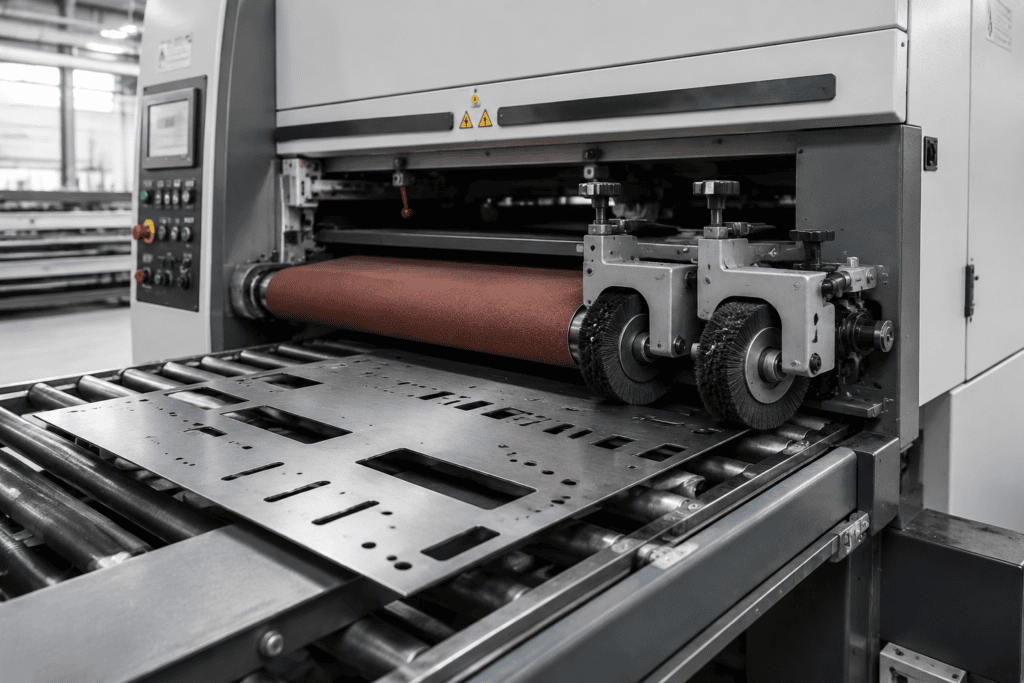
Wide-belt deburring machines feed flat parts through a series of contact heads on a conveyor: coarse abrasive belts grind off laser dross and die marks, followed by brush rollers that roll the edge into a radius. A two-head belt-plus-brush configuration produces a clean edge; a third cross-brush head produces a true rounded edge suitable for powder coating or handling safety. Cycle time is seconds per part. Any fabricator running more than a shift of laser cutting per day eventually justifies one.
Brush deburring machines in the narrower sense use rotating wire, abrasive-nylon or flap brushes against clamped or conveyed parts. They excel at edge blending and light burr removal where belts are too aggressive, and appear standalone, as CNC brush machines, and as finishing heads inside robotic cells—which is exactly how we use them at UBright.
The limitation of this family is geometry. Through-feed machines want flat parts of consistent thickness. Anything three-dimensional—housings, castings, machined blocks—needs a different approach.
In-CNC Deburring: Machine-Integrated Fourth-Axis Tools
A quietly growing option is to not buy a machine at all—use the machining center you already own. Chamfer mills, back-deburring tools that flip open behind a bore, and abrasive brushes can all run as tools in the tool changer, with a fourth-axis indexer presenting different part faces to the spindle.
The appeal is process consolidation: no second fixture, no transport between operations, no queue, and the deburring program lives in the same CAM file as the machining. For expensive parts in low to medium volumes, it is often the cheapest path.
Two cautions. First, you are spending spindle hours—often $60–120 per machine hour fully burdened—on work a dedicated machine or robot could do while your machining center cuts metal again. Second, in-machine tools face the same access limits as the cutting tools that created the burrs: deep cavities and intersection drillings remain out of reach. In practice it works best as a complement removing the easy edge burrs, with a dedicated system handling the rest.
Robotic Deburring Cells: Two Configurations That Change the Math
Now the category we know best. Robotic deburring uses a six- or five-axis industrial arm either to present parts to powered finishing stations or to carry finishing tools around fixtured parts. Both configurations fix the core weakness of every machine above: they combine the path flexibility of a human deburrer with the repeatability of a machine.
Configuration one: robot holds the part. A gripper on the robot wrist picks a machined part from a tray and presents it against an array of fixed powered stations—spindle-mounted cutters, brush wheels, belt heads, counter-rotating spindles for crossholes. The tools stay rigidly mounted (which preserves accuracy), and one cell routes the part through four to eight stations in a single cycle. Our 6-axis dual-station deburring equipment and 5-axis dual-station deburring equipment follow exactly this pattern, with a second loading position so the operator swaps trays while the robot keeps cutting.
Configuration two: robot holds the tool. When the part is a 40 kg gearbox housing, nobody moves the part to the tool—the tool goes to the part. The robot carries an electric spindle, brush or belt unit and traces programmed edge paths around a fixtured workpiece. This is the natural fit for castings, large housings and welded fabrications. Our robot-clamping-tool-type deburring equipment is built this way, and the same architecture underpins heavy work such as our brake caliper robotic grinding solution, where the arm follows casting parting lines under active force control.
Force control is what separates a robotic deburring cell from a robot waving a grinder. A rigid robot pushing a cutter into a part either skips the edge or gouges it, because casting flash varies, cutters wear, and parts sit in fixtures within tolerance, not at nominal. Production cells therefore run constant-force floating spindles or active compliance end effectors that maintain a set contact force—commonly 10–100 N for heavy gate and flash stock—independent of geometry variation and tool wear. That is what lets a robot hold a consistent 0.2 mm edge break across a part family, shift after shift. Add laser or vision part-location before the cycle and the cell self-corrects for loading position too.
The honest limitations: robots need fixtures, programming and process development before the first production part—an engineering investment mass finishing never demands. For very small parts in a single stable family, a vibratory bowl still beats a robot on cost. Where robots win decisively is the high-mix middle ground: medium to large parts, multiple located edge features, frequent changeovers handled by program calls rather than hardware, and edge quality specs manual labor cannot certify. A layout like our 6-axis robotic deburring cell typically runs one part family while the next program is prepared offline.
Deburring Machine Comparison Table
| Machine type | Part size / material | Best batch profile | Burr types handled | Cycle time | Investment tier |
|---|---|---|---|---|---|
| Tumble (barrel) | Small parts, most metals | Very high volume, one family | Outside edges, light rollover | Hours (batch) | Low |
| Vibratory bowl / trough | Small-medium parts | High volume, mixed parts | Outside edges, general finish | 15 min–2 h (batch) | Low–Mid |
| Centrifugal disc | Small precision parts | Medium volume | Fine burrs, edge refinement | Minutes (batch) | Mid |
| Thermal (TEM) | Small-medium, nearly all metals | High volume batches | Internal, cross-holes, threads | Seconds (batch) | High |
| Electrochemical (ECM) | Conductive metals, specific features | High volume, fixed family | Cross-drilled holes, valve bores | Seconds–minutes | High |
| High-pressure water | Castings, blocks, large parts | High volume | Internal galleries, chips | Seconds–minutes | High |
| Brush machine (standalone) | Medium parts | Low–medium volume | Edge blending, secondary | Seconds–minutes | Low–Mid |
| Wide-belt (sheet metal) | Flat blanks, any sheet | Continuous flow | Dross, punch burrs, edge radius | Seconds (through-feed) | Mid–High |
| In-CNC (4th axis) | Fits the machining center | Low–medium volume | Same edges the tools reach | Adds to cycle | Low (tooling) |
| Robotic cell | Small-medium (held) to very large (tool-held) | High mix, medium-high volume | All programmable edges, castings | 30 s–several min | Mid–High |
Realistic dollar ranges follow in the FAQ below.
Robotic Cell vs. Mass Finishing vs. Dedicated Machine: How to Decide
Strip away the brochures and the decision reduces to four questions.
How big are the parts and how many variants? Small parts in a few stable families point to mass finishing—lowest cost per part, proven for decades. Flat sheet metal points to wide-belt through-feed. Medium-to-large parts across many variants point to robotics, because the robot absorbs variant changes in software.
Where are the burrs? External edges: almost anything works—choose on volume and cost. Internal cross-holes and galleries: TEM, ECM or high-pressure water; no path tool reaches them, robot included. Program-reachable features on 3D parts: robotic cell.
What does the edge specification say? If the drawing just says “deburr,” the cheapest compliant process wins, and that is often vibratory. If it specifies an edge radius with tolerance, or the part feeds a sealing or high-pressure application, you need force or path control—brush machine, ECM or robot.
What is your labor reality? One shift of deburring with available labor justifies modest equipment. Three shifts, chronic vacancies or an aging deburring bench push the ROI hard toward automation.
Plenty of plants run a hybrid: a vibratory bowl for bulk small parts, a wide-belt for sheet work, and a robotic cell for machined castings that need certified edges. That layered picture is more common in real factories than any single-machine answer. Our five-axis deburring equipment, for example, exists precisely because some customers need robot precision at a lighter budget than a full dual-station cell.
Deburring Automation ROI: What You Actually Recover
Return on investment cases for deburring automation rest on three recoverable cost pools, and it is worth being sober about each.
Direct labor substitution. A dual-station robotic cell typically replaces one to two full-time deburring operators per shift, including the hidden second person who inspects or reworks after them. Multiply fully burdened labor cost by shifts and years, and this pool alone commonly funds the equipment over one to three years—but only if the cell actually runs those shifts. Automation that replaces one shift while the other two keep hand-finishing rarely pays back on labor alone.
Scrap, rework and claim reduction. This is the undercounted pool. Consistent machine-made edges reduce assembly-line rejects, warranty claims and 100% inspection burden. The magnitude varies by industry—in hydraulic and automotive supply it can exceed the labor savings; in general fabrication it may be modest. Base the case on your own rejection history, not vendor averages.
Throughput and responsiveness. A robot does not take lunch and deburrs the ten-thousandth part with the same edge as the first. That consistency lets quality plans relax, shortens quoted lead times, and removes the single-operator bottleneck from the routing.
Budget for the parts vendors’ ROI sheets forget: fixtures, program development, consumables, and integration with upstream machining. Turnkey cells cost more up front and dramatically shorten commissioning. When we scope a project, whether a standard cell from our full deburring equipment lineup or engineered work like the gearbox housing robotic grinding solution, the fixture and process development line is the one we refuse to leave vague—that is where projects succeed or stall.
Frequently Asked Questions About Deburring Machines
What is a deburring machine?
A deburring machine is any equipment that removes burrs—the sharp projections of metal left at cut, machined, punched or sheared edges—by mechanical, thermal, electrochemical or hydraulic means. The category spans tumblers, vibratory bowls, wide-belt machines, thermal and electrochemical systems, and robotic cells—one goal: a smooth, consistent, functionally safe edge.
How do I choose the right deburring machine?
Start from the burr, not the machine. Identify burr type, thickness and location; measure part size, material and mix; define the edge specification the customer actually requires; and be honest about volumes and labor. External burrs on small parts point to mass finishing, flat parts to wide-belt, internal burrs to TEM/ECM/waterjet, high-mix 3D parts to robotic cells. Send sample parts to two or three suppliers and compare process proposals, not brochures.
How much does a deburring machine cost?
Planning ranges, not quotes: hand tools and bench-top brushes run a few hundred to a few thousand dollars; industrial vibratory and tumble equipment roughly $5,000–50,000; wide-belt lines roughly $60,000–250,000; thermal, electrochemical and high-pressure water systems from the low hundreds of thousands up; turnkey robotic cells commonly $80,000–300,000+ depending on axes, stations, force control and fixtures. Real numbers move with part geometry, tooling and integration scope.
What industries use deburring machines?
Every industry that cuts metal: automotive powertrain and brake components, aerospace structures, hydraulics, medical devices, firearms, fasteners, electronics enclosures, gears and general machining. Fluid power and automotive suppliers face the tightest edge specifications, since a stray burr in a valve or brake circuit is a functional failure, not a cosmetic one.
Robotic vs. manual deburring—is the switch worth it?
If your volumes run beyond one shift and your parts have multiple located edge requirements, almost always: a robot holds a force-controlled, repeatable edge that hand finishing cannot certify, and it removes your hardest-to-staff position. If you deburr a few hundred small identical parts a week, manual work with good tooling—or a small vibratory bowl—remains the rational choice. Robots pay off on mix, volume and consistency, not novelty.
Conclusion: Match the Machine to the Burr, Not the Brochure
There is no best deburring machine—only the right process for a specific burr, part and volume. Mass finishing owns high-volume small parts, wide-belt lines own sheet metal, thermal and electrochemical systems own the burrs nothing else can reach, and in-CNC tools quietly absorb the easy edges. Robotic cells took the high-mix middle ground: medium to large parts, located edge requirements, and shops that can no longer staff a deburring bench at three shifts.
If your parts fall into that middle ground, the fastest path to a defensible decision is a sample part study. Send us your worst part—casting flash, crosshole burrs, mixed edge specs and all—and our engineers will propose a process, estimate cycle time, and tell you if a robot is the wrong tool for it. Browse the full product line to start the conversation.