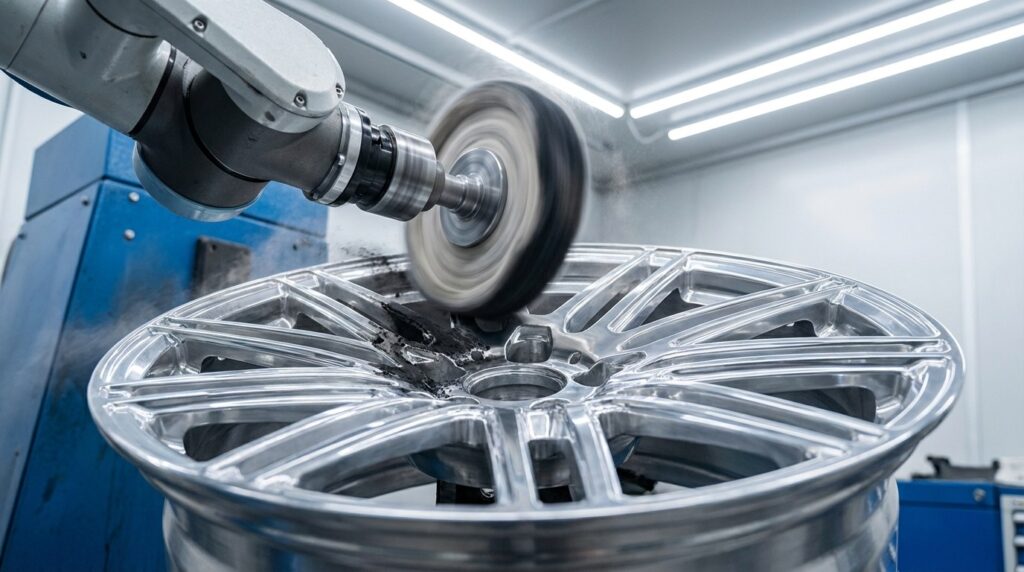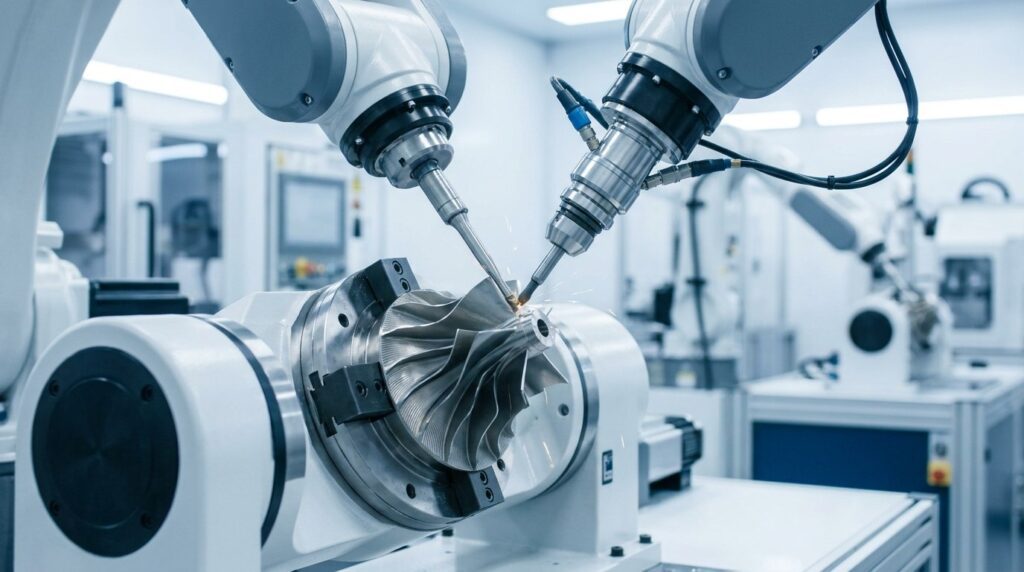
In aerospace manufacturing, turbine and compressor blades are among the most demanding components a finishing shop will ever see. As the core kinetic energy conversion components of jet engines and heavy-duty gas turbines, their surface quality directly influences the engine’s thrust-to-weight ratio, fuel efficiency, and flight safety. This article provides an in-depth analysis of the core challenge: deburring and precision polishing Titanium and Nickel-based Superalloy blades. We examine how automated robotic systems—equipped with active force control and Offline Programming (OLP) technologies—address the aerodynamic profile distortion and inconsistency risks of manual grinding, delivering stable micron-level precision.
什麼是航空渦輪葉片?
Aerospace turbine blades are installed in the compressor or turbine sections of jet engines. They operate under extreme physical environments: high-speed centrifugal forces of tens of thousands of RPMs, and gas temperatures that reach far beyond what most alloys can tolerate in the hot turbine section—where nickel-based superalloy blades dominate. In the cooler front compressor stages, titanium alloy blades are standard, and it is these titanium compressor blades, together with nickel-based turbine hardware, that set the agenda for finishing equipment.
渦輪葉片製造應用場景
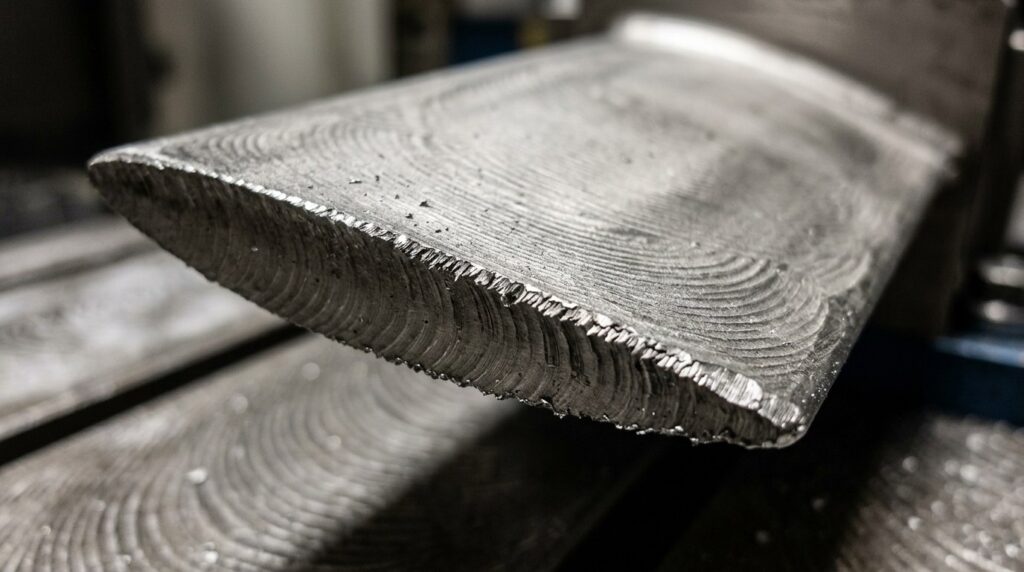
無論是商用客機引擎(如 LEAP 或 Trent 系列)或發電廠的重型燃氣渦輪機,這些葉片通常都是由極難加工的鈦合金或鎳基超合金(如 Inconel 或 Hastelloy)經由精密熔模鑄造或五軸 CNC 加工製成。.
After primary machining, the blade surfaces are left with distinct microscopic tool marks. Furthermore, sharp flash and burrs are generated around the complex root/dovetail sections, as well as along the highly delicate Leading Edge (LE) and Trailing Edge (TE). If these surface defects are not removed through extremely precise polishing, they can cause stress concentrations and accelerate fatigue cracking, with potentially catastrophic consequences in flight.
渦輪葉片的結構特性
渦輪葉片的幾何結構為表面處理帶來極大的挑戰:
- 高度複雜的空氣動力表面(翼面剖面): The pressure and suction sides of the blade are 3D free-form surfaces shaped by rigorous fluid-dynamics design. Even a minute alteration to their shape can trigger airflow separation and reduce engine efficiency.
- 微米薄邊:刀片的前緣和後緣都非常薄(有時僅幾分之一毫米)。最輕微的過度研磨都會破壞完美的「水滴形」斷面。.
- 難加工材料(超合金): Titanium and superalloys combine high strength with extremely poor thermal conductivity. They are highly susceptible to thermal burning or surface hardening layers during grinding.
渦輪葉片拋光的主要特性
主要特性:
- 絕對輪廓保真度:去毛刺和拋光過程絕對不能改變 5 軸 CNC 所建立的原始 3D 尺寸。材料去除量必須嚴格控制在微米級。.
- 極佳的表面粗糙度:通常要求精密度達到 Ra 0.2 - 0.4 μm,以最大程度降低空氣動力摩擦阻力。.
- 一致的殘餘壓應力:拋光製程不僅要使表面平滑,還要避免產生微裂縫。拋光通常與噴丸處理結合,以誘發有助益的壓應力層,增強抗疲勞性。.
刀片拋光技術參數
| 項目 | 參數範圍 | 注意事項 |
| 去除毛刺與刀痕 | 細砂陶瓷/氧化鋁帶 | 需要特定的鈦金屬冷卻耗材 |
| 機翼精密拋光 | 羊毛輪 / 特殊無紡布 | 與航太化合物一起使用,可去除所有微小刮痕 |
| 接觸力控制 | 2N - 15N(超高頻) | “輕觸式」混合,絕對保護纖薄邊緣 |
| 最終表面粗糙度 | Ra ≤ 0.4 μm | Finished to the OEM engine specification on the drawing |
| 輪廓公差控制 | ± 0.01 mm | 依靠 1000Hz 微米級的力控制和 3D 視覺 |
為何航空刀片必須使用機器人拋光?
傳統手動研磨的致命缺陷
過去,航太葉片的拋光主要仰賴擁有數十年經驗的工匠大師的 「感覺」。然而,鑒於現代航空製造業對良率和產能的嚴格要求,手工研磨已無法持續:
| 痛點 | 特定問題 | 影響 |
| Steep “Over-Cut” Scrap Costs | Superalloy blades are high-value parts. Manual grinding easily cuts tens of microns too deep on the trailing edge. | Scrapping one blade can mean losing thousands of dollars, and manual yields are difficult to hold at a consistently high level. |
| 資料一致性災難 | 一台引擎需要數百個葉片。如果由不同的工人打磨,每個葉片的實際空氣動力輪廓都會略有不同。. | 導致引擎組裝時出現嚴重的動態平衡問題,影響整體推力和燃油經濟性。. |
| 熱能燃燒與測量變化 | 鈦能快速儲存熱量。長時間的手動操作會造成局部高溫,破壞疲勞特性。. | 植物嚴重隱藏航空飛行的安全危害。. |
機器人自動化的優勢
Introducing a robotic precision deburring system equipped with micron-level active force control is a practical route for the aerospace engine supply chain to achieve stable quality control and fully traceable delivery. If you are new to the underlying technology, our primer on what robotic deburring actually does is a good starting point:
| 比較尺寸 | 手動研磨 | 機器人拋光 | 改進 |
| 檔案保真度 | 高誤差,容易改變氣動形態 | 毫克級精確切削、恆定力道 | Consistent contour accuracy across the blade set |
| 報廢率控制 | 一時疏忽造成毀壞 | 智慧型讓行與防撞監控 | Eliminates human over-cutting; scrap from grinding errors drops sharply |
| 資料可追蹤性 | 無保留資料 | 記錄每次切割的力道與座標 | Process data supports AS9100 audit requirements |
| 加工效率 | 緩慢、高度有限的輸出 | 多站高速協作 | Substantially higher capacity for high-volume deliveries |
核心優勢:
- 微米級主動式順應力控制: This is the anchor for aerospace blade machining and the core capability that separates force-controlled robotic polishing machines from position-only automation. The force control system monitors the contact force between the tool and the blade at 1000Hz. When the robot processes the razor-sharp and fragile trailing edge, it automatically drops the pressure to mere Newtons (N), brushing away micro-burrs without eating into the parent material—true “deburring without harming the profile.”
- 離線程式設計 (OLP) 與數位胞胎: Blade surfaces are highly complex. Engineers directly import high-precision 3D CAD models, and the software automatically recognizes the aerodynamic surfaces, generating Normal Vector polishing paths that conform to the geometry. This avoids the deviations inherent in manual teaching, keeping every step of the robot’s motion tied to the CAD model.
自動化渦輪葉片拋光製程工作流程
此程序利用 8 個核心步驟 將高端鈦壓縮機葉片從 「毛邊毛坯 」加工成 「高精度表面」。“
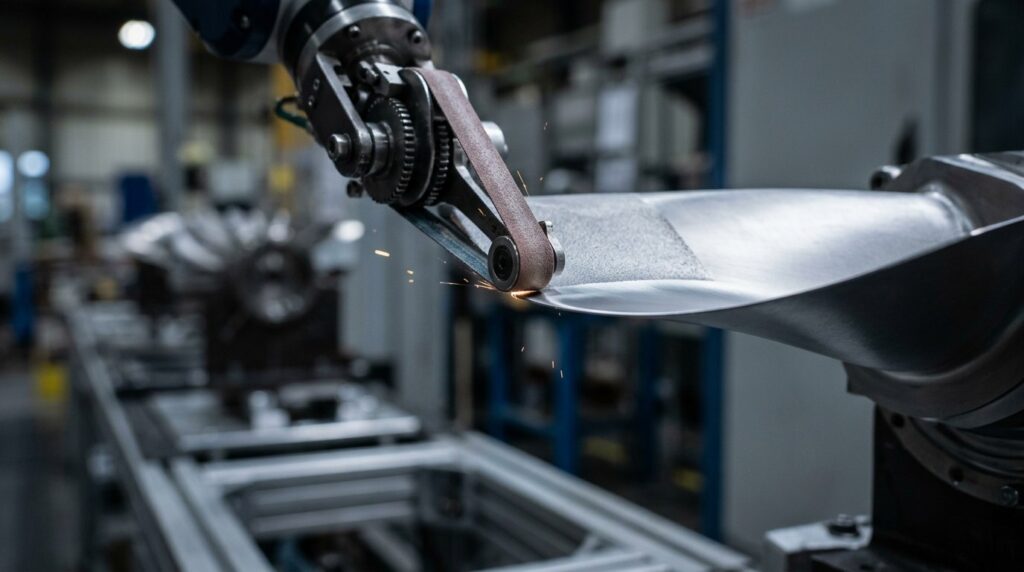
航空渦輪葉片機器人拋光與去毛刺完整製程流程
| 製程 | 製程名稱 | 設備 | 消耗品 | 時間 | 精度/用途 |
| 01 | 零應力高精度夾具夾具 | 氣壓式軟/冷凍治具 | - | 20s | 確保重複精度,不會造成夾持變形 |
| 02 | 根部燕尾槽去毛刺 | 機器人 + 高速主軸 | 微硬质合金毛刺 | 45s | 從複雜的杉樹根部精確碾磨出硬閃光 |
| 03 | 機翼 CNC 標記混合 | 機器人 + 兼容帶式砂光機 | 超細氧化鋁帶 | 120s | 依循空氣曲線,消除 5 軸銑削留下的微波 |
| 04 | LE / TE 精準混合 | 機器人 + 微型砂帶機 | Custom Aero Abrasive | 90s | 使用輕如羽毛的力道保留水滴形橫斷面 |
| 05 | 機翼精密拋光 | 機器人 + 羊毛拋光輪 | 航太級微膏 | 150s | Elevates surface finish to Ra < 0.4μm, reducing aero drag |
| 06 | 冷 MQL 冷卻 | MQL 噴塗系統 | 航空認證冷卻液 | Cont. | 嚴格控制接觸溫度,防止鈦金屬灼傷 |
| 07 | 自動超聲波清洗 | 多槽超聲波產線 | 非破壞性溶劑 | 180s | 徹底清除毛孔中的磨料和金屬殘渣 |
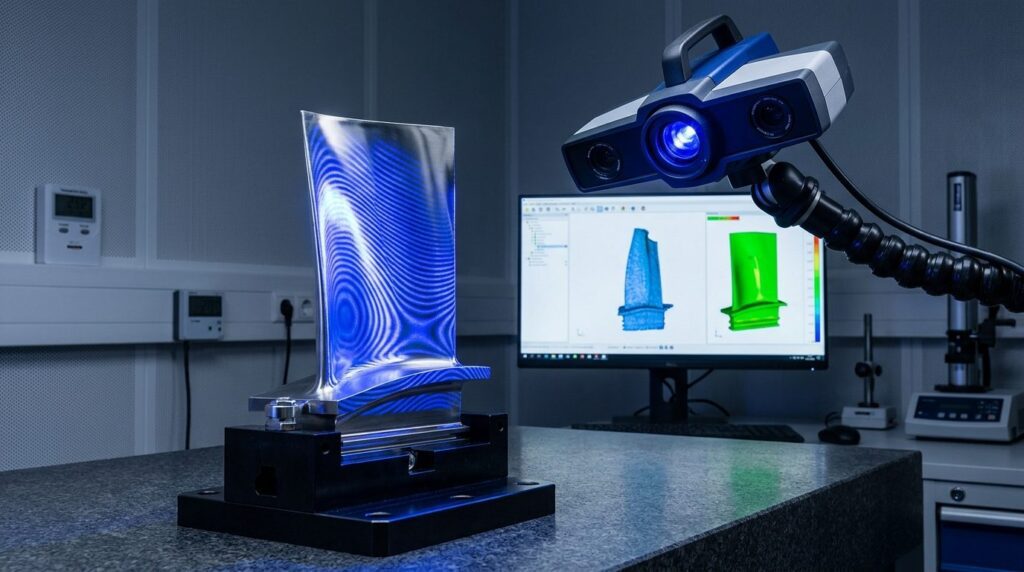
| 08 | 3D 藍光全面掃描 | 光學 3D 輪廓掃描器 | - | 60s | Generates full 3D deviation color maps for inspection records |
航空渦輪葉片機器人拋光與去毛刺製程說明
步驟 1:零應力夾緊
目的:抓取穩定,不會產生變形。.
重點:由於刀片極薄,傳統的硬質機械夾具會導致刀片本身彎曲。通常會使用客製化的保形聚氨酯軟夾具,或在最極端的高階應用中,使用冷凍夾持(使用液氮)來達到零應力的絕對剛性固定。.
步驟 2:根部燕尾槽去毛刺
目的:清除用於掛載到渦輪磁碟的複雜「fir-tree」根。.
重點: Leveraging the extreme 6-axis agility of the robot, it swaps to micro-tools to precisely dive into the complex gear-like grooves of the dovetail, clearing micro-flash without altering the critical assembly tolerances. Dovetail and fir-tree roots are among the most common geometries in industrial robotic deburring applications, and blade roots push the same tooling principles to their limit.
步驟 3 & 4: 機翼混合與邊緣修飾
目的:核心挑戰。擦除工具痕跡,同時保留空氣動力形狀。.
重點: This is where active force control matters most. Guided by OLP paths, the belt sander stays perpendicular (normal) to the free-form surface. The contact force drops automatically from 15N on the belly of the blade to under 2N the instant it reaches the razor-thin trailing edge.
步驟 5:機翼精密拋光
目的:降低表面粗糙度以提高疲勞壽命。.
重點:切換到極軟的羊毛輪搭配特定的拋光介質。它能沿著氣流方向輕柔地拋光表面,消除所有潛在的微觀應力集中點。.
步驟 8:3D 藍光全面掃描
目的: Full 3D inspection of every blade.
重點:高精度藍光掃描器可捕捉拋光刀片的數百萬個表面點雲數據點,並與原始 3D CAD 模型進行比較。任何超過 0.01mm 的過切或欠切都會在偏差顏色圖上觸發紅色警示。.
加工挑戰與解決方案
挑戰 1:超合金極難切割和瞬間燃燒
問題:
- 鈦和鎳基超合金(如 Inconel 718)特別用於噴射引擎,因為它們在高溫下仍能保持極高的強度和韌性。.
- 這意味著它們非常難以研磨。傳統的研磨方式很容易造成砂帶即時磨損、變鈍,產生大量的摩擦熱,立即燒焦表面、造成氧化變色,甚至破壞內部金相結構。.
解決方案:
- 冷切策略 + MQL 潤滑 + 智慧型磨損補償.
- 該系統採用極低的進給速度和恆定的輕壓力。在整個加工過程中,最小量潤滑 (MQL) 系統會精確噴灑潤滑液,立即將熱量帶離切割區。同時,力控制系統會即時感應消耗品的磨損情況,自動微調進給量,確保每次切割都保持在最佳的「冷切割」狀態。.
- 結果: The risk of thermal burning is effectively controlled, and metallographic and hardness testing of polished blade surfaces consistently confirms an undamaged structure.
挑戰 2:前導邊/後導邊的微米級脆弱度
問題:
- 刀片的尾部排氣邊緣通常厚度小於 0.5mm,非常鋒利且脆弱。.
- When grinding this area, applying even a few Newtons too much force, or if the robot path deviates by a mere 0.05mm, can directly flatten or snap the trailing edge—turning a blade worth thousands of dollars into scrap metal.
解決方案:
- 引進高頻混合力/位置控制架構.
- 在加工邊緣區域時,機器人並不完全依賴離線編程的精確坐標(位置);它會授予力感測器最優先的 「接管權」。當感測器偵測到阻力出現微小尖峰時(表示已接觸到脆弱邊緣),系統會自動執行「屈服」保護動作。.
- 結果: Reliable protection for ultra-thin edges. The ground leading and trailing edges maintain the design-mandated teardrop aerodynamic shapes, and over-cut scrap falls to a negligible level.
Application Scenario
Production Background
A typical deployment target for this type of cell is an aero-engine component supplier in Europe producing high-pressure compressor and turbine blades for commercial airliner engine programs. The finishing workshop is usually the bottleneck when blade output needs to scale up for a new engine generation.
技術挑戰
- Capacity expansion for a new generation of titanium alloy blades was being bottlenecked by the grinding workshop.
- Legacy manual grinding yields were unstable. Because titanium blades are high-value parts, scrap losses from manual over-cutting alone accumulated into a serious cost problem.
- The engine OEM required complete digital traceability of the manufacturing process for critical components, which traditional manual operations could not provide.
解決方案
| 項目 | 組態 |
| 工件 | Aero-Engine 鈦製高壓壓縮機刀片 |
| 材質 | Ti-6Al-4V 鈦合金鍛件 |
| 設備 | 高剛性 6 軸機器人 + 力控制微型砂光機 + MQL |
| 核心技術 | 1000Hz 主動式順應力控制 + 藍光 3D 掃描檢查 |
| 製程 | OLP Path Gen -> Root Flash Mill -> Cold Force Blend -> Edge Micro-Finish |
| 週期時間 | A few minutes for a comprehensive polish of a single complex blade |
實施結果
- Scrap Containment: Active force control plays the decisive role here. With the system in place, the scrap rate for high-pressure blades due to dimensional grinding errors typically falls from double digits to a low single-digit level, containing what used to be a major annual scrap cost.
- Consistent Profiles: Aerodynamic profile errors across the production batch concentrate within a narrow tolerance band, which improves dynamic balance consistency during final engine assembly.
- Digital Traceability: The system logs the pressure curves, RPM, and 3D coordinates during the grinding of every blade, automatically generating a digital process dossier. This documented evidence supports the audit requirements of the AS9100 aerospace quality system.
常見問題
Q1: 機械手臂磨削系統可以直接與我們的 CMM(三坐標測量機)數據連接嗎?
A: Yes. This is the core of closed-loop control in high-end aerospace manufacturing. Our system can ingest data from CMMs or 3D blue light scanners. If inspection reveals that the allowance left by the preceding CNC batch is abnormally large, the grinding software automatically parses this deviation data and dynamically generates an “adaptive” grinding toolpath for precise remedial compensation—closing the loop between inspection and production.
Q2: 鑒於鈦粉塵具有極高的易燃性和爆炸性,系統如何防止災難發生?
A: The aerospace industry works to some of the strictest explosion-protection standards in manufacturing (ATEX/NFPA). Our aerospace-grade grinding cells are built accordingly: fully enclosed micro-negative pressure explosion-proof doors, a complete suite of Ex-rated motors and sensors, and a dedicated Water Wash titanium dust extraction system. The moment dust is generated, it is drawn into water and passivated, removing the conditions a titanium dust explosion requires.
Q3: 從編寫新刀片的研磨程式到開始試產需要多久時間?
A: Leveraging advanced Offline Programming (OLP) digital twin technology, you do not waste time teaching on the physical robot. Engineers import the blade’s 3D CAD and desired contact force parameters on a computer, and the software automatically generates collision-free paths. For an entirely new, complex blade, moving from programming to physical proof-of-concept polishing typically takes about one working day.
問題 4:投資這種規模的航太級機械人系統時,如何計算投資報酬率 (ROI)?
A: Calculating ROI in the aerospace sector is different from standard industries. You cannot simply calculate “how many workers’ wages were saved.” The core return lies in the scrap costs recovered. A single titanium blade can be worth thousands of dollars, so cutting the scrap rate by even a modest percentage—combined with the capacity increase—adds up quickly. Based on our 專案評估與概念驗證服務, the payback period for these high-end systems is often shorter than buyers expect, with many projects recovering the investment within roughly a year.
總結
The precision grinding and polishing of aerospace turbine blades represent one of the highest technical barriers in manufacturing. Adopting an 整合微米級主動力控制和 OLP 離線路徑規劃的自動化機械手系統 addresses the profile distortion, scrap losses, and thermal burning hazards caused by manual grinding. It navigates razor-thin leading/trailing edges and complex free-form surfaces under constant force, keeping every blade’s aerodynamic shape within specification. For aero-engine component suppliers, this is a practical route to easing capacity constraints, stabilizing yields, and building the traceability that aviation quality systems require.
If your manufacturing plant is battling low yields in superalloy blade grinding, heavy scrap losses from manual over-cutting, and strict dimensional consistency requirements, contact our aerospace automation expert team to obtain a dedicated micron-level grinding technical assessment and machine trial solution.