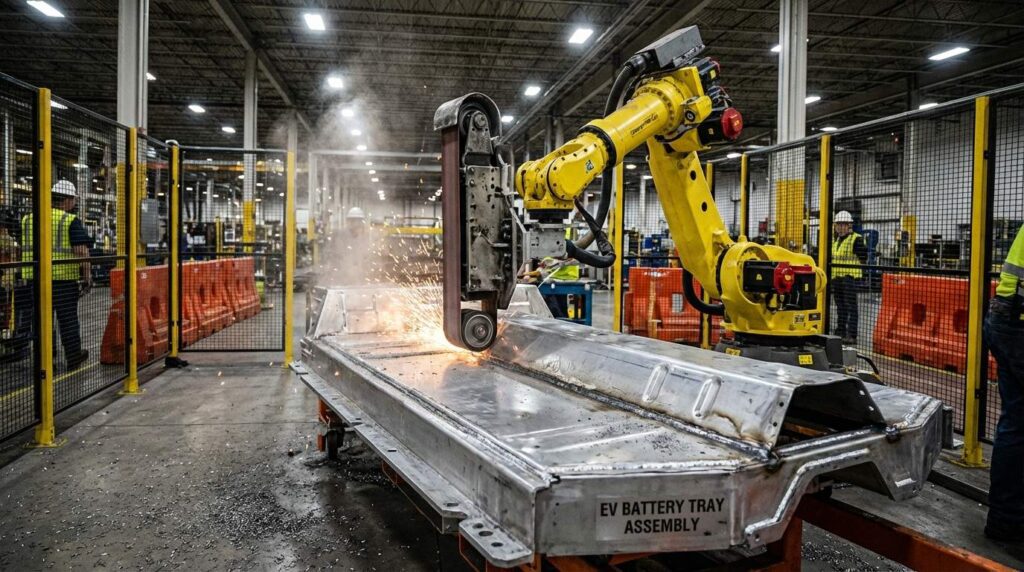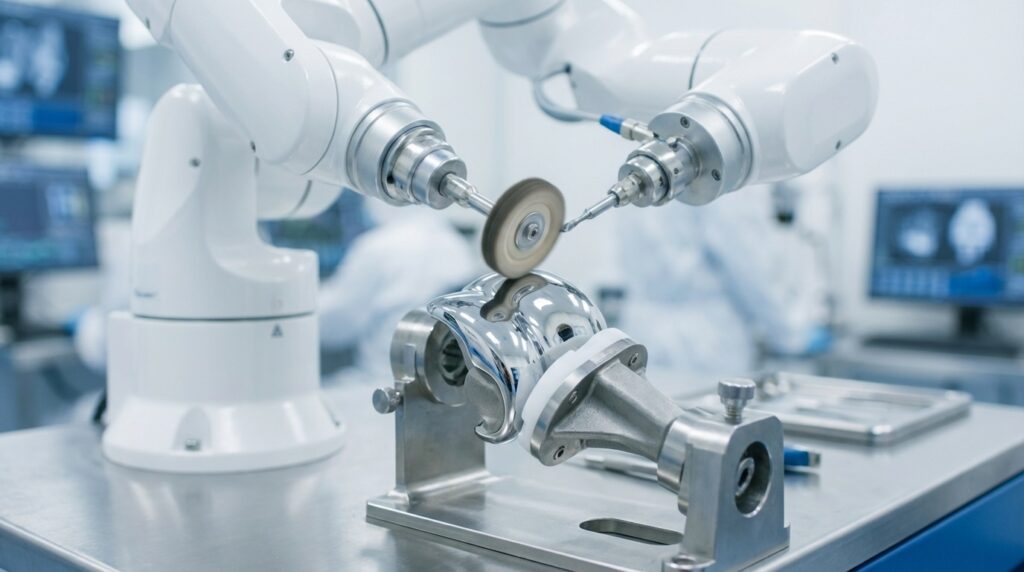
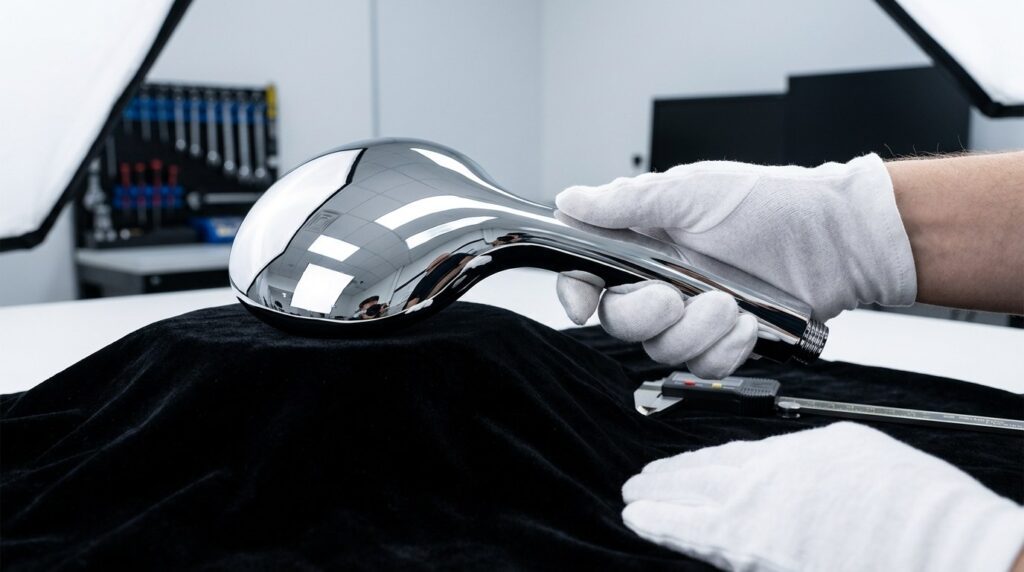
In the premium plumbing and hardware market, shower heads and hand-held units are core products that experience high-frequency tactile interaction with users. Whether the product is a teardrop-shaped rain shower body or an ergonomically designed hand-held unit, the defining feature of its appearance is continuous, full 3D free-form curvature.
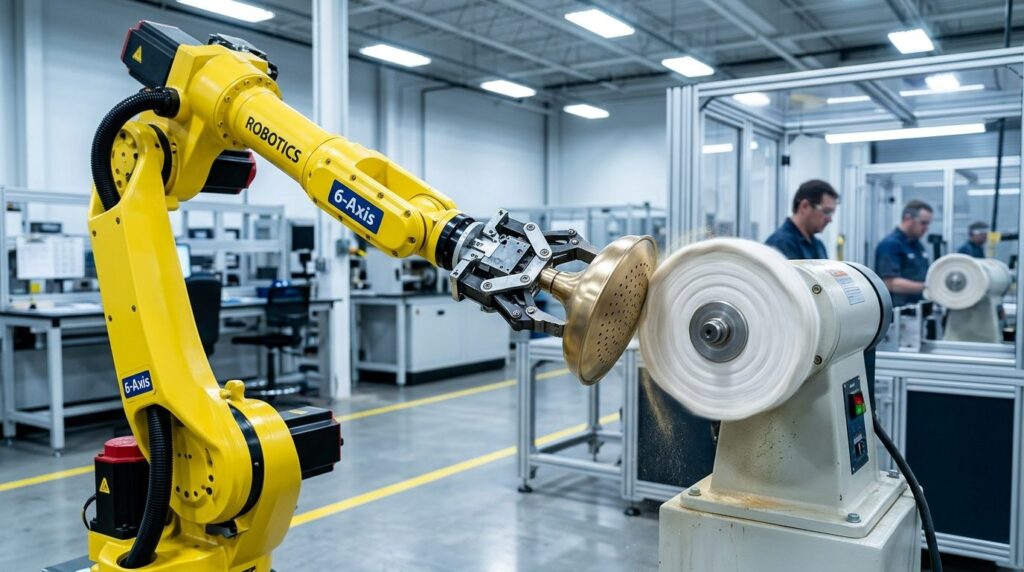
To maintain the dynamic curves envisioned by designers across millions of units and to ensure a premium mirror finish after electroplating, adopting an automated architecture—where a 6-axis industrial robot holds the workpiece against floor-mounted flexible abrasive belt machines, known as 機器人拋光—has become the standard process for top-tier global plumbing OEMs to say goodbye to manual “flat spots” and achieve a leap in yield rates.
What are Shower Head Castings?
High-end shower head bodies are typically integrally formed from premium brass via hot forging or gravity casting. Some models also use stainless steel or zinc alloy die-casting. Fresh out of the mold, the raw casting surface is not only covered in rough oxidation scale but also features distinct parting lines along its extremely complex bionic contours.
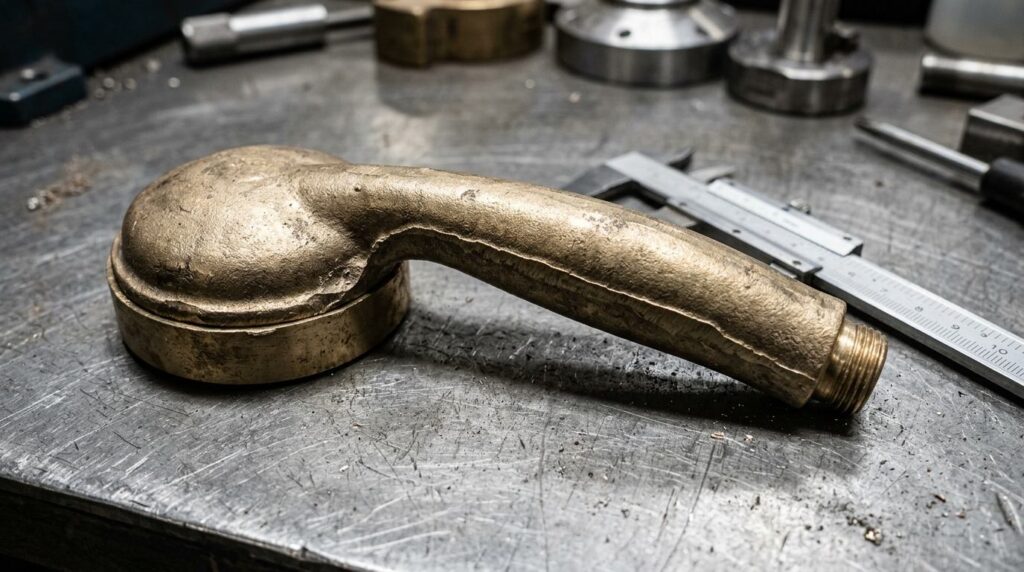
The “Curve-Killing” Effect of Traditional Manual Polishing
The defining characteristic of a shower head is that “there are almost no pure flat surfaces anywhere.” This extreme roundness poses three fatal pain points for traditional manual polishing:
- Unavoidable “Flat Spot” Defects: When a worker rotates a shower head against a sanding belt by hand, wrist force cannot be absolutely uniform. Lingering even slightly too long on a rounded curve (like the bell-shaped body or cylindrical handle) grinds out a microscopic flat area. After electroplating, this flat spot causes a break in the reflection, instantly destroying the product’s premium feel.
- Collapsed Edges Around Water Nozzles: The faceplate of a shower head is densely packed with water nozzles. Uncontrolled manual grinding easily rounds off or collapses the edges of these holes, leading to uneven gaps when assembling silicone nozzles later, or even causing leaks.
- Severe Dust Hazards: The massive amount of metal dust generated by brass polishing is not only a high occupational health hazard but also places modern factories under severe environmental and safety compliance pressures.
Technical Parameters for Shower Head Automation
| 項目 | 參數範圍 | 注意事項 |
| Parting Line Blending | Flexible Cloth-Backed Fine Belt | Rapidly removes flash without destroying original wall thickness |
| Bionic Curve Leveling | Floating Contact Wheel / Nylon | Conforms to teardrop or conical profiles for seamless transitions |
| Mirror Base Polishing | High-Density Cotton + Wax | Erases scratches and awakens clear metal luster for plating adhesion |
| Trajectory Continuity | Interpolation Precision ≤ 0.05 mm | Prevents stutter as the robot glides over multi-curvature surfaces |
| Constant Force Control | ±1N (High-Freq Adaptive) | “Floating touch” load control avoids flat spots from over-cutting |
Why Must Shower Heads Use the “Robot-Holding-Workpiece” Architecture?
Shower heads are moderate in size—typically 8 to 12 inches—but geometrically dense, and the cell layout reflects that: the 6-axis robot carries the head or its fixture and works it against a row of multi-station belt and polishing centers bolted to the floor. All the articulation sits on the part side, which free-form geometry demands.
This layout answers the specific problems of curved-surface finishing:
- 360° Posture Rotation: A 6-axis wrist out-articulates the human hand. Holding the head, the robot rolls, tilts and rotates continuously in front of a stationary belt, so the abrasive tracks through concave handle curves and convex body arcs alike—no blind spots left for a second setup.
- Real-Time Force Feedback: As the robot presses the head against the wheel, a wrist force sensor watches contact load. Where curvature changes sharply, downward pressure adjusts on the fly to keep removal uniform—the core mechanism that eliminates “flat spots” and “collapsed edges.”
- One-Grip Full Process: The same grip walks the head through coarse belts, fine belts, sisal and cloth wheels at successive floor stations. No second clamping step means no re-datuming error, and the cycle stays compact.
Automated Grinding and Polishing Process Workflow
| 步驟 | Stage | 設備與耗材 | 目的 |
| 01 | Auto Loading & Location | Robot + Pneumatic Gripper | Precisely grabs raw casting from tray, locking the coordinate system |
| 02 | Profile Parting Line Prep | Floor-Mounted Floating Belt Machine | Rapidly traces complex 3D contours to shear off forging flash |
| 03 | Streamlined Curve Transition | Floating Fine-Grit Abrasive Belt | Conforms to rounded profiles with constant force, unifying the surface arc |
| 04 | High-Gloss Mirror Buffing | Auto-Wax Multi-Station Cloth Center | Graded buffing brings brass to a mirror finish, ready for plating |
| 05 | Auto Unloading Handover | Transfer to dedicated racks/conveyors | Avoids collisions, transferring directly to ultrasonic cleaning lines |
Gripping Strategies for Free-Form Shower Bodies
A shower head is a closed, curved shape with no clamping flange and no hidden rear face worth sacrificing—so the grip has to live inside the part. The handle’s internal cavity and the water-inlet thread at its base are the standard locators: an expanding mandrel or form finger cage picks up the bore, seats against a machined shoulder, and leaves the entire outer surface open to the belts and wheels.
- Balancing grip force against buffing reaction: brass forgings are stiff, but the lever arm from grip to shower face is long; jaw pressure and support length are set so buffing loads cannot lever the part out of datum.
- Chatter control: vibration between part and wheel reads as wave in the reflection, so the fixture is designed stiff and the wheel run-out checked at changeover.
- Family tooling: handle sections across a brand’s range are deliberately standardized so one gripper body serves multiple models with insert swaps only.
Polishing Media for Multi-Curvature Brass Surfaces
Media for shower heads follow the curvature, not the other way round. Parting lines first give way to cloth-backed fine belts—flexible enough not to plough the profile—then floating contact wheels and nylon fair the free-form surfaces, and only then do sisal and cotton wheels with liquid compound bring the luster that plating will multiply. Skipping ahead in that ladder is what leaves orange peel under a bright plate. For equipment context, see our robotic polishing machine guide.
- Nozzle-field rules: the faceplate hole zone is finished with small-diameter, soft media at reduced pressure—material removal there is effectively cosmetic, never corrective.
- Compound discipline: liquid compound dosed on a timer keeps the wheel cutting cool and clean, and dissolves out again in ultrasonic dewaxing before plating.
- Wheel wear: as wheels shrink, TCP compensation keeps contact geometry—and therefore finish—constant through the batch. Wheel-machine formats for mirror work are compared in our wheel polishing machine guide.
Path Planning, Cycle Structure and Surface Checks
Path programs treat a shower head as a set of zones—handle barrel, body bell, transition shoulder, faceplate rim—each with its own sweep direction and speed. The robot follows surface normals at controlled contact angle, decelerates into tight transitions, and never doubles back within a zone, because back-passes show as cross-grain under chrome. Look-ahead control handles the speed changes inside the program, so the operator is not tuning feed by feel.
Cycle structure is station-paced: one robot services the belt row and the buffing centers in sequence, with part exchange overlapped so spindles stay loaded. Where a single model runs in volume, a second robot sharing the station row shortens takt without adding machine stations. The same architecture, applied to spout and body families, is described in our brass faucet robotic polishing solution.
Verification happens before plating, where mistakes are cheapest: zebra-light checks for reflection continuity across transitions, gloss sampling against the sealed golden part, and roughness checks on a statistical basis. Lots that pass are released with their cycle data attached—the traceability plumbing OEMs increasingly require.
Application Scenario: Forged Brass Shower Heads
A South China OEM polishing shower heads for a premium European plumbing brand illustrates the switch—representative of suppliers whose plating line sets the quality bar.
- Before: On a teardrop-shaped brass hand shower, the plating standard demanded uninterrupted reflections. Manual polishing pass rates hovered at unprofitable levels, rework caused frequent delivery delays, and the dust environment drew warnings from safety regulators.
- After: With robots holding the workpieces under active force control, the ideal 3D paths run the same way every cycle. Curve transitions come out smooth, the flat spots characteristic of hand grinding disappear, first-pass cosmetic yield climbs into the high nineties and holds, throughput rises on the same headcount, and the enclosed cells resolve the dust problem outright.
Shower Head Polishing FAQ
Q1: Shower head designs iterate incredibly fast with a massive variety of styles. Is robotic programming time-consuming for changeovers?
A: Not at all. Plumbing product cycles are short, so our cells rely on 3D Offline Programming (OLP): the engineer imports the new head’s 3D CAD model, and the software analyzes the free-form surfaces and generates collision-checked trajectories from it. With quick-change grippers, switching a line to a new style typically stays under 30 minutes of debug time. The same flexibility is what protects the thin nozzle areas discussed below.
Q2: The metal around the water nozzle area is usually quite thin. Will the robot warp the holes during polishing?
A: No. As with changeovers, this comes down to force and trajectory control. Around the faceplate edge and the densely packed nozzle field, the robot drops into a light-cut regime: flexible media, floating pressure, no dwelling. The surface finishes bright, while wall thickness and hole geometry stay as cast.
總結
In premium shower head production, flowing 3D curved reflections underwrite the brand’s pricing. An automated architecture—industrial robots holding workpieces against floor-mounted multi-station belt machines—breaks the manual bottlenecks of flat spots, collapsed edges and dust exposure, and gives plumbing OEMs a stable, repeatable finishing capability.
Every flat spot on a plated shower head is margin surrendered downstream. If curve-polishing yield has become the ceiling on your output, ask our team about a dedicated plumbing automation assessment and an enclosed, dust-free process: contact us.