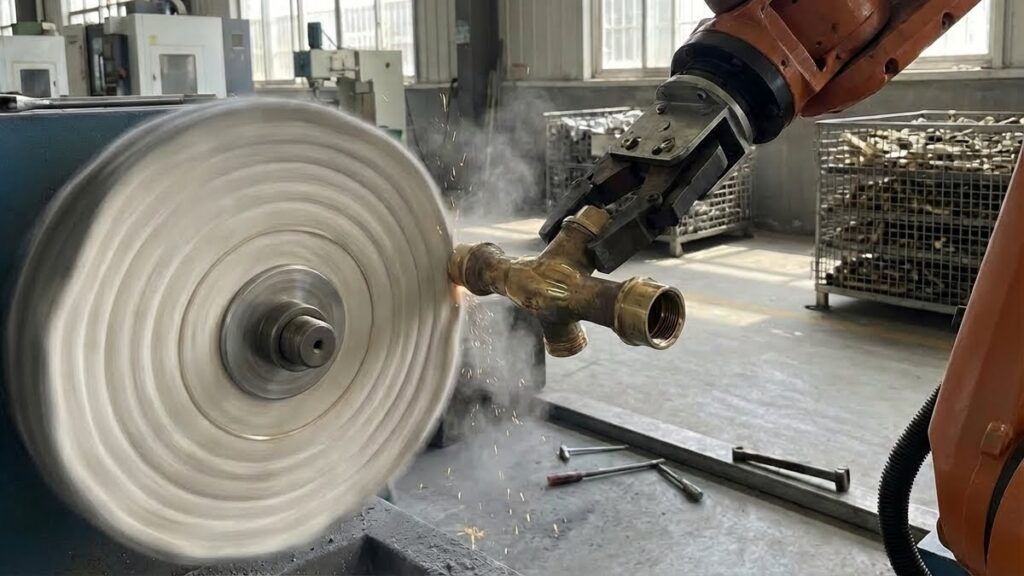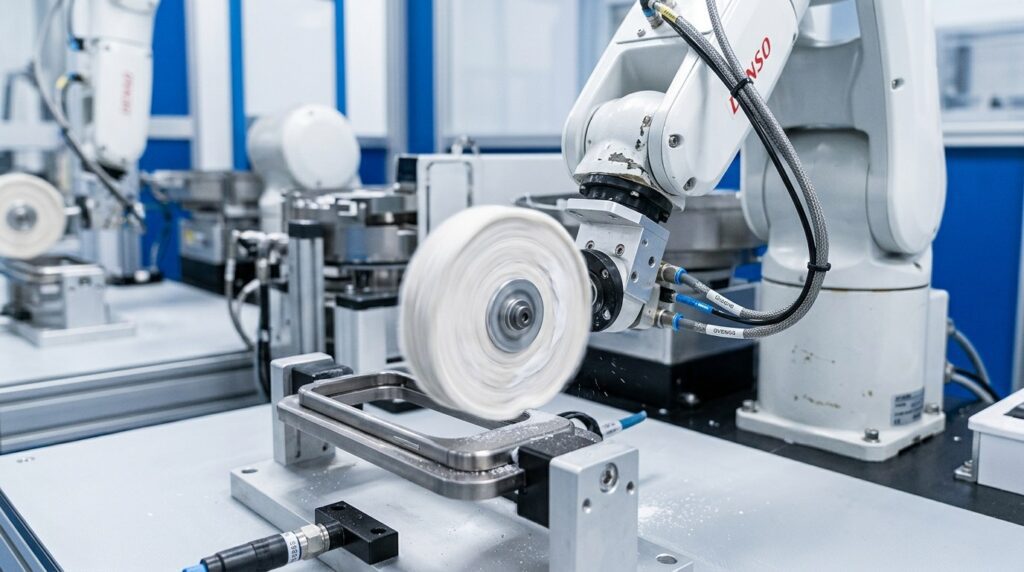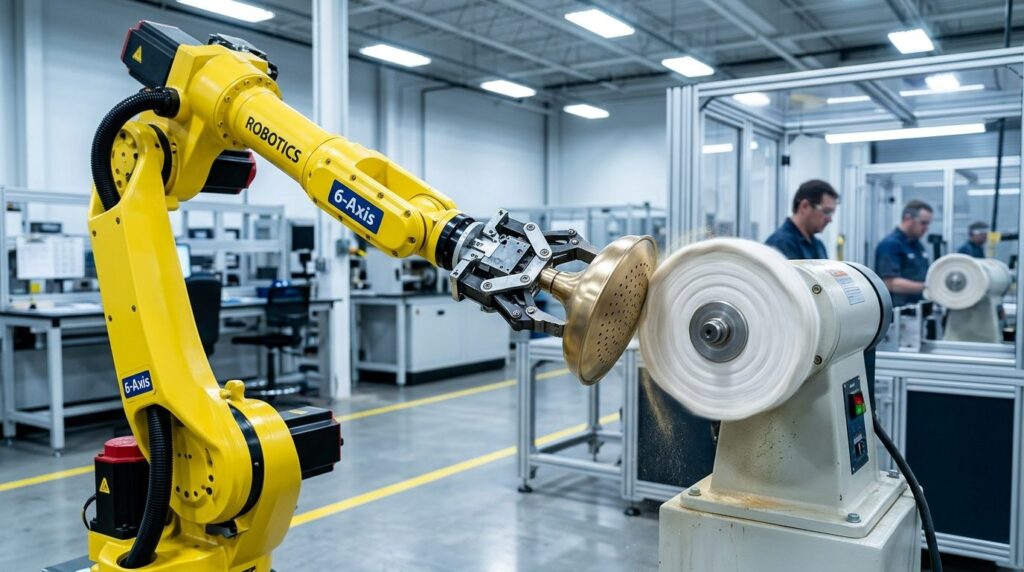
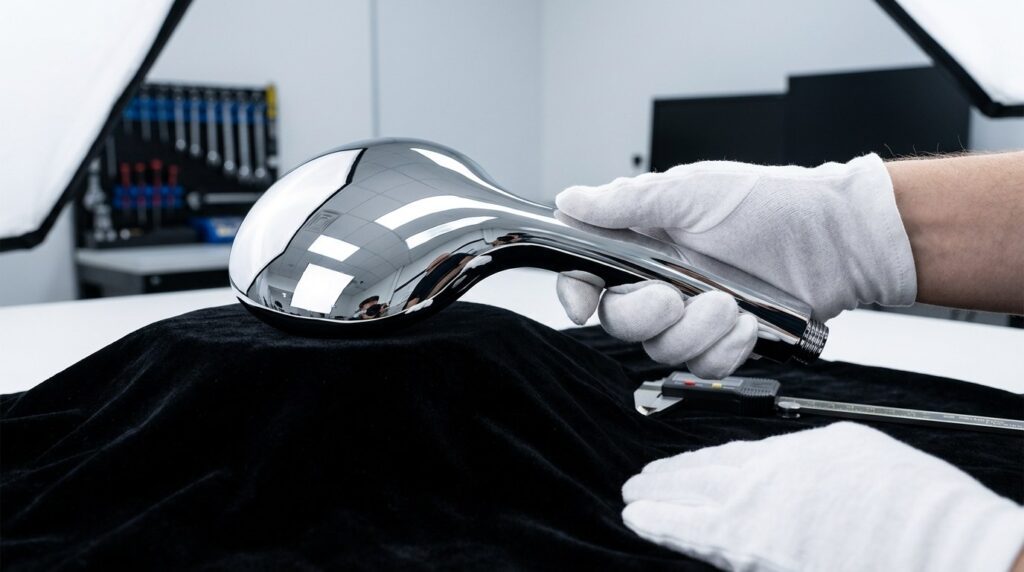
En la prima fontanería y ferretería market, shower heads and hand-held units are core products that experience high-frequency tactile interaction with users. Whether the product is a teardrop-shaped rain shower body or an ergonomically designed hand-held unit, the defining feature of its appearance is continuous, full 3D free-form curvature.
Para mantener las curvas dinámicas previstas por los diseñadores en millones de unidades y garantizar un acabado de espejo de primera calidad tras la galvanoplastia, la adopción de una arquitectura automatizada -en la que un robot industrial de 6 ejes sujeta la pieza contra máquinas de cinta abrasiva flexible montadas en el suelo, conocidas como pulido robotizado-se ha convertido en el proceso estándar para que los OEM de fontanería de primer nivel mundial digan adiós a los “puntos planos” manuales y logren un salto en los índices de rendimiento.
¿Qué son las piezas moldeadas para duchas?
Los cuerpos de las alcachofas de ducha de gama alta suelen estar fabricados íntegramente en latón de primera calidad mediante forja en caliente o fundición por gravedad. Algunos modelos también utilizan acero inoxidable o aleación de zinc fundido a presión. Recién sacada del molde, la superficie de fundición en bruto no solo está cubierta de una áspera capa de óxido, sino que también presenta líneas de separación distintivas a lo largo de sus contornos biónicos extremadamente complejos.
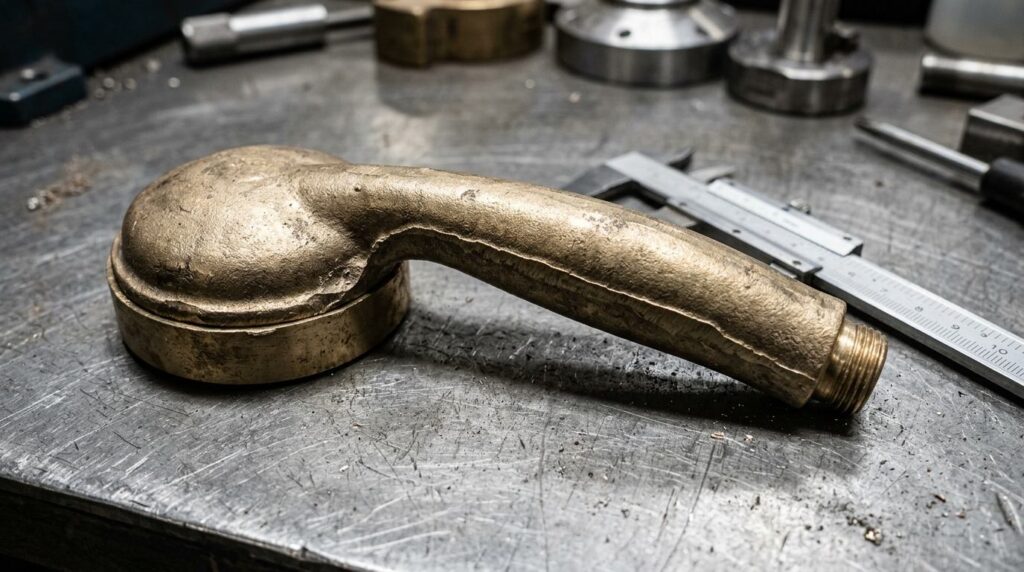
El efecto “matacurvas” del pulido manual tradicional
La característica que define a una alcachofa de ducha es que “casi no hay superficies planas puras en ninguna parte”.” Esta redondez extrema plantea tres puntos fatales para el pulido manual tradicional:
- Defectos “planos” inevitables: Cuando un trabajador hace girar a mano una regadera contra una banda de lijado, la fuerza de la muñeca no puede ser absolutamente uniforme. Permanecer incluso demasiado tiempo en una curva redondeada (como el cuerpo en forma de campana o el mango cilíndrico) hace que se muela una zona plana microscópica. Tras la galvanoplastia, este punto plano provoca una ruptura en el reflejo, destruyendo instantáneamente la sensación de calidad del producto.
- Bordes colapsados alrededor de las boquillas de agua: La placa frontal de una alcachofa de ducha está densamente poblada de boquillas de agua. El amolado manual incontrolado redondea o colapsa fácilmente los bordes de estos orificios, lo que provoca huecos desiguales al montar posteriormente las boquillas de silicona, o incluso provoca fugas.
- Riesgos graves por polvo: La enorme cantidad de polvo metálico que genera el pulido del latón no sólo supone un elevado riesgo para la salud laboral, sino que también somete a las fábricas modernas a fuertes presiones de cumplimiento de la normativa medioambiental y de seguridad.
Parámetros técnicos de la automatización del cabezal de ducha
| Artículo | Rango de parámetros | Notas |
| Mezcla de líneas de separación | Cinta fina flexible con soporte de tela | Elimina rápidamente las rebabas sin destruir el grosor original de la pared |
| Nivelación de curvas biónicas | Rueda de contacto flotante / Nylon | Se adapta a perfiles en forma de lágrima o cónicos para transiciones perfectas |
| Pulido Base Espejo | Algodón de alta densidad + cera | Borra los arañazos y despierta el brillo claro del metal para la adherencia del chapado |
| Continuidad de la trayectoria | Precisión de interpolación ≤ 0,05 mm | Prevents stutter as the robot glides over multi-curvature surfaces |
| Control de fuerza constante | ±1N (Adaptativo de alta frecuencia) | “Floating touch” load control avoids flat spots from over-cutting |
¿Por qué las alcachofas de ducha deben utilizar la arquitectura “Robot-Sujeta-Piezas”?
Shower heads are moderate in size—typically 8 to 12 inches—but geometrically dense, and the cell layout reflects that: the 6-axis robot carries the head or its fixture and works it against a row of multi-station belt and polishing centers bolted to the floor. All the articulation sits on the part side, which free-form geometry demands.
This layout answers the specific problems of curved-surface finishing:
- 360° Posture Rotation: A 6-axis wrist out-articulates the human hand. Holding the head, the robot rolls, tilts and rotates continuously in front of a stationary belt, so the abrasive tracks through concave handle curves and convex body arcs alike—no blind spots left for a second setup.
- Real-Time Force Feedback: As the robot presses the head against the wheel, a wrist force sensor watches contact load. Where curvature changes sharply, downward pressure adjusts on the fly to keep removal uniform—the core mechanism that eliminates “flat spots” and “collapsed edges.”
- One-Grip Full Process: The same grip walks the head through coarse belts, fine belts, sisal and cloth wheels at successive floor stations. No second clamping step means no re-datuming error, and the cycle stays compact.
Flujo de trabajo automatizado del proceso de esmerilado y pulido
| Paso | Stage | Equipos y consumibles | Propósito |
| 01 | Carga y localización automáticas | Robot + Pinza neumática | Toma con precisión la colada bruta de la bandeja, bloqueando el sistema de coordenadas |
| 02 | Preparación de la línea de separación de perfiles | Máquina de cinta flotante montada en el suelo | Trazado rápido de contornos 3D complejos para cortar la rebaba de forja |
| 03 | Transición de curvas racionalizada | Banda abrasiva flotante de grano fino | Se ajusta a los perfiles redondeados con una fuerza constante, unificando el arco de la superficie |
| 04 | Pulido espejo de alto brillo | Centro de paños Auto-Wax Multi-Station | Graded buffing brings brass to a mirror finish, ready for plating |
| 05 | Traspaso automático de descarga | Transferencia a estanterías/transportadores específicos | Evita colisiones, transfiriendo directamente a las líneas de limpieza por ultrasonidos |
Gripping Strategies for Free-Form Shower Bodies
A shower head is a closed, curved shape with no clamping flange and no hidden rear face worth sacrificing—so the grip has to live inside the part. The handle’s internal cavity and the water-inlet thread at its base are the standard locators: an expanding mandrel or form finger cage picks up the bore, seats against a machined shoulder, and leaves the entire outer surface open to the belts and wheels.
- Balancing grip force against buffing reaction: brass forgings are stiff, but the lever arm from grip to shower face is long; jaw pressure and support length are set so buffing loads cannot lever the part out of datum.
- Chatter control: vibration between part and wheel reads as wave in the reflection, so the fixture is designed stiff and the wheel run-out checked at changeover.
- Family tooling: handle sections across a brand’s range are deliberately standardized so one gripper body serves multiple models with insert swaps only.
Polishing Media for Multi-Curvature Brass Surfaces
Media for shower heads follow the curvature, not the other way round. Parting lines first give way to cloth-backed fine belts—flexible enough not to plough the profile—then floating contact wheels and nylon fair the free-form surfaces, and only then do sisal and cotton wheels with liquid compound bring the luster that plating will multiply. Skipping ahead in that ladder is what leaves orange peel under a bright plate. For equipment context, see our robotic polishing machine guide.
- Nozzle-field rules: the faceplate hole zone is finished with small-diameter, soft media at reduced pressure—material removal there is effectively cosmetic, never corrective.
- Compound discipline: liquid compound dosed on a timer keeps the wheel cutting cool and clean, and dissolves out again in ultrasonic dewaxing before plating.
- Wheel wear: as wheels shrink, TCP compensation keeps contact geometry—and therefore finish—constant through the batch. Wheel-machine formats for mirror work are compared in our wheel polishing machine guide.
Path Planning, Cycle Structure and Surface Checks
Path programs treat a shower head as a set of zones—handle barrel, body bell, transition shoulder, faceplate rim—each with its own sweep direction and speed. The robot follows surface normals at controlled contact angle, decelerates into tight transitions, and never doubles back within a zone, because back-passes show as cross-grain under chrome. Look-ahead control handles the speed changes inside the program, so the operator is not tuning feed by feel.
Cycle structure is station-paced: one robot services the belt row and the buffing centers in sequence, with part exchange overlapped so spindles stay loaded. Where a single model runs in volume, a second robot sharing the station row shortens takt without adding machine stations. The same architecture, applied to spout and body families, is described in our brass faucet robotic polishing solution.
Verification happens before plating, where mistakes are cheapest: zebra-light checks for reflection continuity across transitions, gloss sampling against the sealed golden part, and roughness checks on a statistical basis. Lots that pass are released with their cycle data attached—the traceability plumbing OEMs increasingly require.
Application Scenario: Forged Brass Shower Heads
A South China OEM polishing shower heads for a premium European plumbing brand illustrates the switch—representative of suppliers whose plating line sets the quality bar.
- Before: On a teardrop-shaped brass hand shower, the plating standard demanded uninterrupted reflections. Manual polishing pass rates hovered at unprofitable levels, rework caused frequent delivery delays, and the dust environment drew warnings from safety regulators.
- After: With robots holding the workpieces under active force control, the ideal 3D paths run the same way every cycle. Curve transitions come out smooth, the flat spots characteristic of hand grinding disappear, first-pass cosmetic yield climbs into the high nineties and holds, throughput rises on the same headcount, and the enclosed cells resolve the dust problem outright.
Preguntas frecuentes sobre el pulido de alcachofas de ducha
P1: Los diseños de alcachofas de ducha se repiten con una rapidez increíble y con una enorme variedad de estilos. Lleva mucho tiempo programar los cambios con robots?
A: Not at all. Plumbing product cycles are short, so our cells rely on 3D Offline Programming (OLP): the engineer imports the new head’s 3D CAD model, and the software analyzes the free-form surfaces and generates collision-checked trajectories from it. With quick-change grippers, switching a line to a new style typically stays under 30 minutes of debug time. The same flexibility is what protects the thin nozzle areas discussed below.
P2: El metal alrededor de la zona de la boquilla de agua suele ser bastante fino. Deformará el robot los orificios durante el pulido?
A: No. As with changeovers, this comes down to force and trajectory control. Around the faceplate edge and the densely packed nozzle field, the robot drops into a light-cut regime: flexible media, floating pressure, no dwelling. The surface finishes bright, while wall thickness and hole geometry stay as cast.
Conclusión
In premium shower head production, flowing 3D curved reflections underwrite the brand’s pricing. An automated architecture—industrial robots holding workpieces against floor-mounted multi-station belt machines—breaks the manual bottlenecks of flat spots, collapsed edges and dust exposure, and gives plumbing OEMs a stable, repeatable finishing capability.
Every flat spot on a plated shower head is margin surrendered downstream. If curve-polishing yield has become the ceiling on your output, ask our team about a dedicated plumbing automation assessment and an enclosed, dust-free process: Contacto.