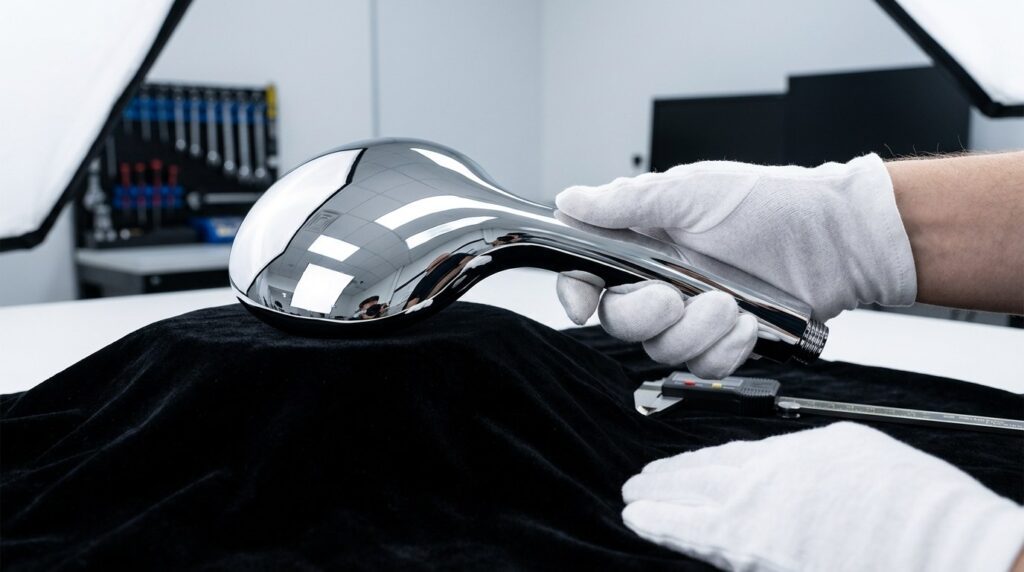
Na versão premium encanamento e ferragens market, shower heads and hand-held units are core products that experience high-frequency tactile interaction with users. Whether the product is a teardrop-shaped rain shower body or an ergonomically designed hand-held unit, the defining feature of its appearance is continuous, full 3D free-form curvature.
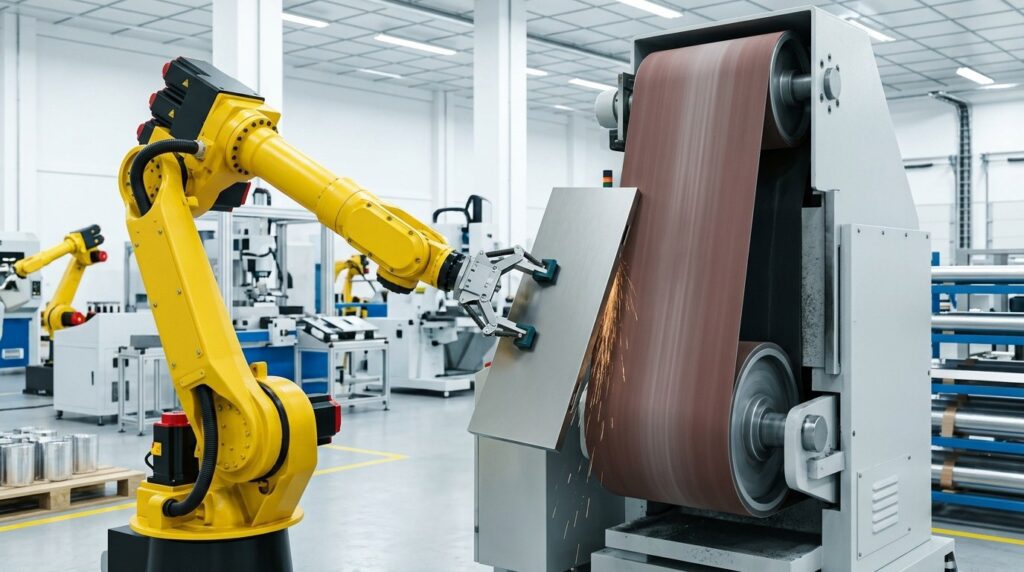
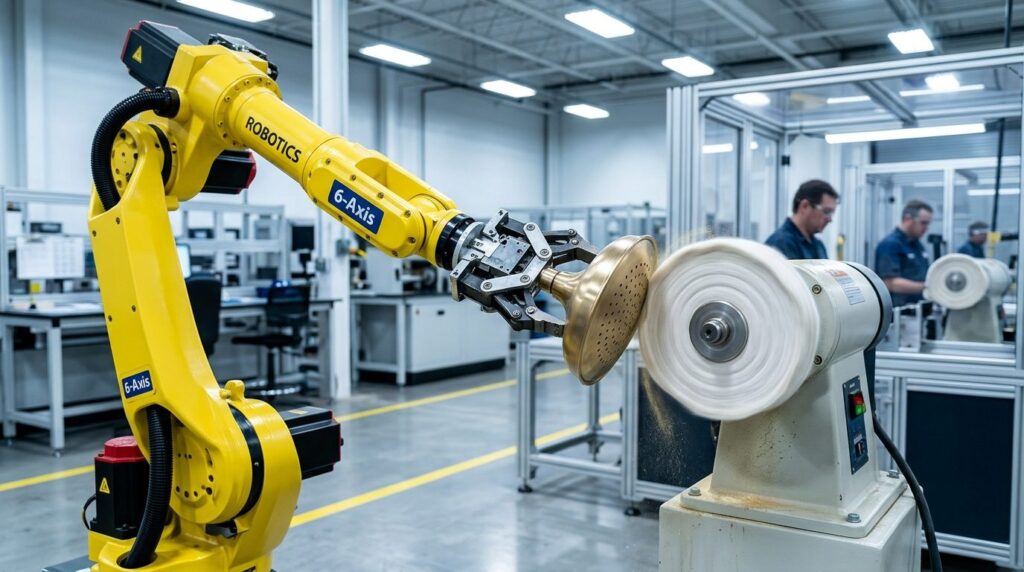
Para manter as curvas dinâmicas concebidas pelos designers em milhões de unidades e garantir um acabamento espelhado de alta qualidade após a galvanoplastia, adotou-se uma arquitetura automatizada — na qual um robô industrial de 6 eixos mantém a peça de trabalho contra máquinas com correias abrasivas flexíveis montadas no chão, conhecidas como polimento robótico—tornou-se o processo padrão para os principais fabricantes globais de equipamentos originais (OEMs) do setor de encanamento, permitindo que eles se livrem dos “pontos de estagnação” manuais e alcancem um salto nas taxas de rendimento.
O que são peças fundidas para chuveiros?
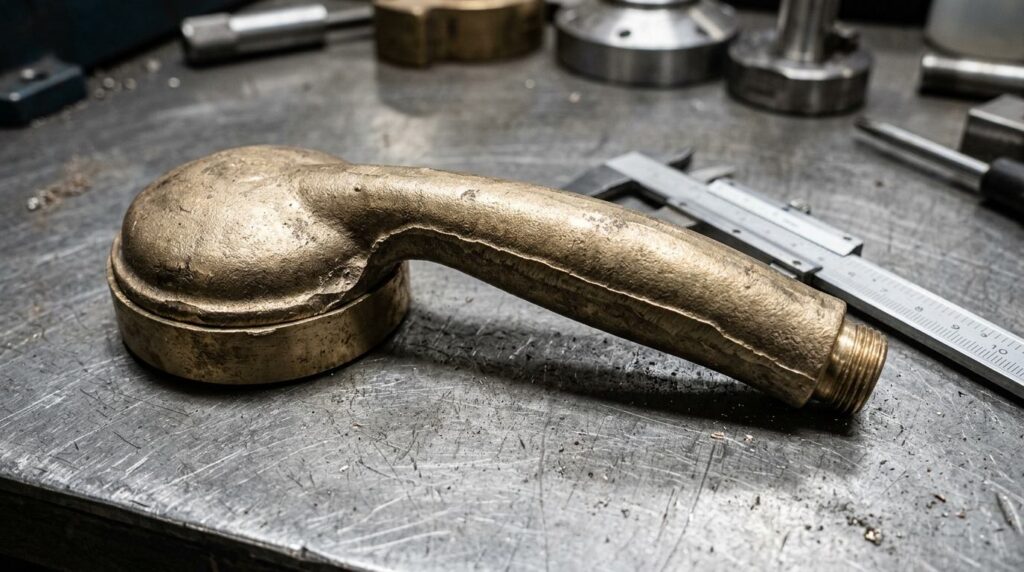
Os corpos dos chuveiros de alta qualidade são normalmente moldados de forma integral a partir de latão premium, por meio de forjamento a quente ou fundição por gravidade. Alguns modelos também utilizam aço inoxidável ou fundição sob pressão de liga de zinco. Recém-saída do molde, a superfície bruta da peça fundida não só está coberta por uma camada áspera de oxidação, como também apresenta linhas de separação distintas ao longo de seus contornos biônicos extremamente complexos.
O efeito “destruidor de curvas” do polimento manual tradicional
A característica que define um chuveiro é que “Não há praticamente nenhuma superfície totalmente plana em lugar algum.” Essa redondeza extrema apresenta três pontos críticos para o polimento manual tradicional:
- Defeitos inevitáveis do tipo “Flat Spot”: Quando um trabalhador gira manualmente o chuveiro contra uma cinta de lixa, a força exercida pelo pulso não pode ser absolutamente uniforme. Permanecer por um tempo, mesmo que ligeiramente, em uma curva arredondada (como o corpo em forma de sino ou a alça cilíndrica) acaba criando uma área plana microscópica. Após a galvanoplastia, esse ponto plano causa uma interrupção no reflexo, destruindo instantaneamente a sensação de alta qualidade do produto.
- Bordas colapsadas ao redor dos bicos de água: A placa frontal de um chuveiro possui uma grande densidade de bicos de água. O esmerilhamento manual descontrolado pode facilmente arredondar ou danificar as bordas desses orifícios, resultando em folgas irregulares na montagem posterior dos bicos de silicone ou até mesmo causando vazamentos.
- Riscos graves relacionados à poeira: A enorme quantidade de pó metálico gerada pelo polimento do latão não representa apenas um grande risco à saúde ocupacional, mas também submete as fábricas modernas a fortes pressões em termos de conformidade ambiental e de segurança.
Parâmetros técnicos para a automação de chuveiros
| Item | Faixa de parâmetros | Notas |
| Suavização da linha de divisão | Correia fina flexível com revestimento de tecido | Remove rapidamente o excesso de material sem comprometer a espessura original da parede |
| Nivelamento de Curvas Biônicas | Roda de contato flutuante / Nylon | Adequa-se a perfis em forma de lágrima ou cônicos para transições suaves |
| Polimento da base do espelho | Algodão de alta densidade + cera | Elimina arranhões e realça o brilho metálico para melhorar a aderência do revestimento |
| Continuidade da trajetória | Precisão de interpolação ≤ 0,05 mm | Prevents stutter as the robot glides over multi-curvature surfaces |
| Controle de Força Constante | ±1N (Adaptativo de alta frequência) | “Floating touch” load control avoids flat spots from over-cutting |
Por que os chuveiros devem adotar a arquitetura do tipo “robô segurando peça de trabalho”?
Shower heads are moderate in size—typically 8 to 12 inches—but geometrically dense, and the cell layout reflects that: the 6-axis robot carries the head or its fixture and works it against a row of multi-station belt and polishing centers bolted to the floor. All the articulation sits on the part side, which free-form geometry demands.
This layout answers the specific problems of curved-surface finishing:
- 360° Posture Rotation: A 6-axis wrist out-articulates the human hand. Holding the head, the robot rolls, tilts and rotates continuously in front of a stationary belt, so the abrasive tracks through concave handle curves and convex body arcs alike—no blind spots left for a second setup.
- Real-Time Force Feedback: As the robot presses the head against the wheel, a wrist force sensor watches contact load. Where curvature changes sharply, downward pressure adjusts on the fly to keep removal uniform—the core mechanism that eliminates “flat spots” and “collapsed edges.”
- One-Grip Full Process: The same grip walks the head through coarse belts, fine belts, sisal and cloth wheels at successive floor stations. No second clamping step means no re-datuming error, and the cycle stays compact.
Fluxo de trabalho automatizado do processo de lixamento e polimento
| Etapa | Stage | Equipamentos e consumíveis | Finalidade |
| 01 | Carregamento automático e localização | Robô + Pinça Pneumática | O sistema “Precisely” retira a peça fundida em bruto da bandeja, fixando o sistema de coordenadas |
| 02 | Preparação da linha de divisão do perfil | Máquina de correia flutuante montada no chão | Traça rapidamente contornos 3D complexos para remover as rebarbas da peça forjada |
| 03 | Transição de curva otimizada | Fita abrasiva flutuante de grão fino | Ajusta-se a perfis arredondados com força constante, unificando o arco da superfície |
| 04 | Polimento de espelho de alto brilho | Centro de Panos para Auto-Wax com Várias Estações | Graded buffing brings brass to a mirror finish, ready for plating |
| 05 | Entrega com descarregamento automático | Transferência para prateleiras/transportadores específicos | Evita colisões, transferindo diretamente para as linhas de limpeza por ultrassom |
Gripping Strategies for Free-Form Shower Bodies
A shower head is a closed, curved shape with no clamping flange and no hidden rear face worth sacrificing—so the grip has to live inside the part. The handle’s internal cavity and the water-inlet thread at its base are the standard locators: an expanding mandrel or form finger cage picks up the bore, seats against a machined shoulder, and leaves the entire outer surface open to the belts and wheels.
- Balancing grip force against buffing reaction: brass forgings are stiff, but the lever arm from grip to shower face is long; jaw pressure and support length are set so buffing loads cannot lever the part out of datum.
- Chatter control: vibration between part and wheel reads as wave in the reflection, so the fixture is designed stiff and the wheel run-out checked at changeover.
- Family tooling: handle sections across a brand’s range are deliberately standardized so one gripper body serves multiple models with insert swaps only.
Polishing Media for Multi-Curvature Brass Surfaces
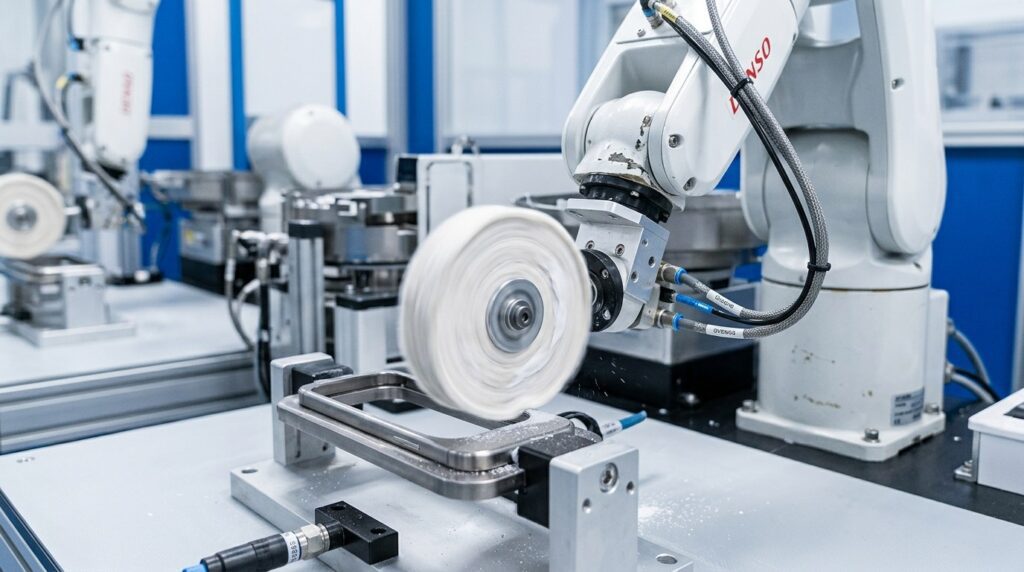
Media for shower heads follow the curvature, not the other way round. Parting lines first give way to cloth-backed fine belts—flexible enough not to plough the profile—then floating contact wheels and nylon fair the free-form surfaces, and only then do sisal and cotton wheels with liquid compound bring the luster that plating will multiply. Skipping ahead in that ladder is what leaves orange peel under a bright plate. For equipment context, see our robotic polishing machine guide.
- Nozzle-field rules: the faceplate hole zone is finished with small-diameter, soft media at reduced pressure—material removal there is effectively cosmetic, never corrective.
- Compound discipline: liquid compound dosed on a timer keeps the wheel cutting cool and clean, and dissolves out again in ultrasonic dewaxing before plating.
- Wheel wear: as wheels shrink, TCP compensation keeps contact geometry—and therefore finish—constant through the batch. Wheel-machine formats for mirror work are compared in our wheel polishing machine guide.
Path Planning, Cycle Structure and Surface Checks
Path programs treat a shower head as a set of zones—handle barrel, body bell, transition shoulder, faceplate rim—each with its own sweep direction and speed. The robot follows surface normals at controlled contact angle, decelerates into tight transitions, and never doubles back within a zone, because back-passes show as cross-grain under chrome. Look-ahead control handles the speed changes inside the program, so the operator is not tuning feed by feel.
Cycle structure is station-paced: one robot services the belt row and the buffing centers in sequence, with part exchange overlapped so spindles stay loaded. Where a single model runs in volume, a second robot sharing the station row shortens takt without adding machine stations. The same architecture, applied to spout and body families, is described in our brass faucet robotic polishing solution.
Verification happens before plating, where mistakes are cheapest: zebra-light checks for reflection continuity across transitions, gloss sampling against the sealed golden part, and roughness checks on a statistical basis. Lots that pass are released with their cycle data attached—the traceability plumbing OEMs increasingly require.
Application Scenario: Forged Brass Shower Heads
A South China OEM polishing shower heads for a premium European plumbing brand illustrates the switch—representative of suppliers whose plating line sets the quality bar.
- Before: On a teardrop-shaped brass hand shower, the plating standard demanded uninterrupted reflections. Manual polishing pass rates hovered at unprofitable levels, rework caused frequent delivery delays, and the dust environment drew warnings from safety regulators.
- After: With robots holding the workpieces under active force control, the ideal 3D paths run the same way every cycle. Curve transitions come out smooth, the flat spots characteristic of hand grinding disappear, first-pass cosmetic yield climbs into the high nineties and holds, throughput rises on the same headcount, and the enclosed cells resolve the dust problem outright.
Perguntas frequentes sobre o polimento de chuveiros
P1: Os designs de chuveiros evoluem a uma velocidade incrível, com uma enorme variedade de estilos. A programação robótica é demorada para essas mudanças?
A: Not at all. Plumbing product cycles are short, so our cells rely on 3D Offline Programming (OLP): the engineer imports the new head’s 3D CAD model, and the software analyzes the free-form surfaces and generates collision-checked trajectories from it. With quick-change grippers, switching a line to a new style typically stays under 30 minutes of debug time. The same flexibility is what protects the thin nozzle areas discussed below.
P2: O metal ao redor da área do bico de água costuma ser bem fino. O robô vai deformar os orifícios durante o polimento?
A: No. As with changeovers, this comes down to force and trajectory control. Around the faceplate edge and the densely packed nozzle field, the robot drops into a light-cut regime: flexible media, floating pressure, no dwelling. The surface finishes bright, while wall thickness and hole geometry stay as cast.
Conclusão
In premium shower head production, flowing 3D curved reflections underwrite the brand’s pricing. An automated architecture—industrial robots holding workpieces against floor-mounted multi-station belt machines—breaks the manual bottlenecks of flat spots, collapsed edges and dust exposure, and gives plumbing OEMs a stable, repeatable finishing capability.
Every flat spot on a plated shower head is margin surrendered downstream. If curve-polishing yield has become the ceiling on your output, ask our team about a dedicated plumbing automation assessment and an enclosed, dust-free process: Entre em contato conosco.