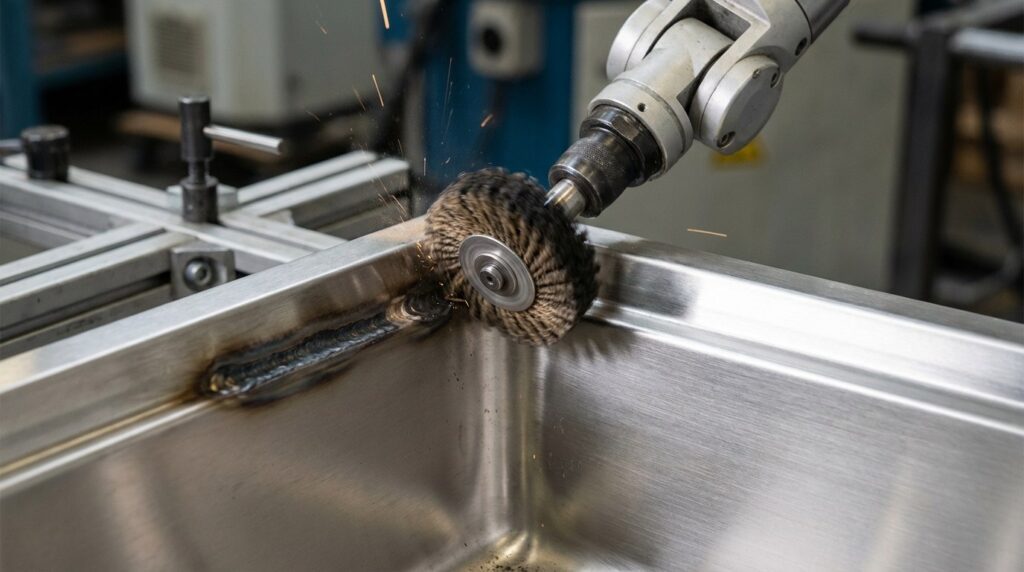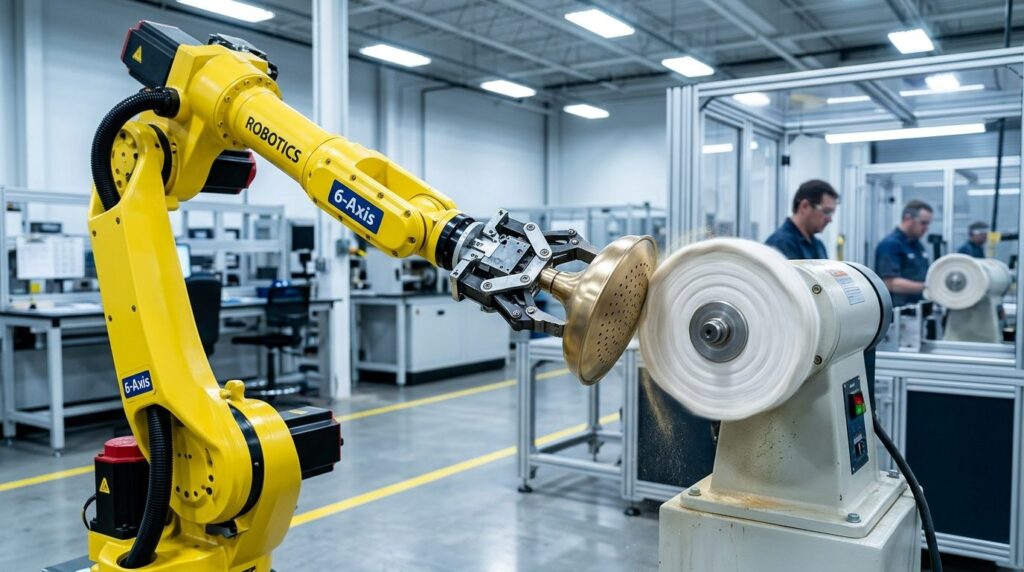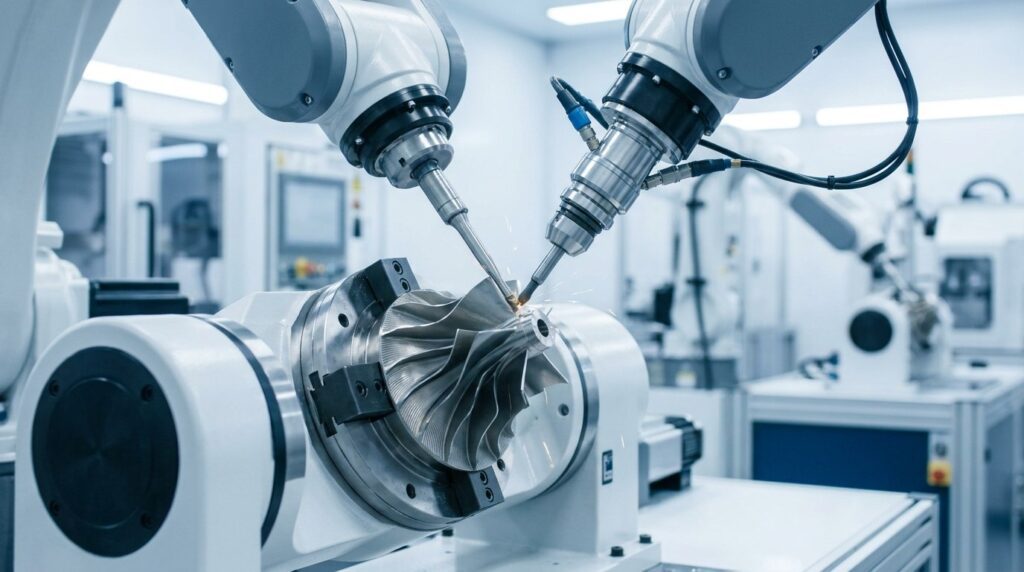
In aerospace manufacturing, turbine and compressor blades are among the most demanding components a finishing shop will ever see. As the core kinetic energy conversion components of jet engines and heavy-duty gas turbines, their surface quality directly influences the engine’s thrust-to-weight ratio, fuel efficiency, and flight safety. This article provides an in-depth analysis of the core challenge: deburring and precision polishing Titanium and Nickel-based Superalloy blades. We examine how automated robotic systems—equipped with active force control and Offline Programming (OLP) technologies—address the aerodynamic profile distortion and inconsistency risks of manual grinding, delivering stable micron-level precision.
Cánh tuabin hàng không vũ trụ là gì?
Aerospace turbine blades are installed in the compressor or turbine sections of jet engines. They operate under extreme physical environments: high-speed centrifugal forces of tens of thousands of RPMs, and gas temperatures that reach far beyond what most alloys can tolerate in the hot turbine section—where nickel-based superalloy blades dominate. In the cooler front compressor stages, titanium alloy blades are standard, and it is these titanium compressor blades, together with nickel-based turbine hardware, that set the agenda for finishing equipment.
Các tình huống ứng dụng trong sản xuất cánh tuabin
Dù là động cơ máy bay chở khách thương mại (như dòng LEAP hay Trent) hay tuabin khí công suất lớn dùng cho nhà máy điện, các cánh tuabin này thường được chế tạo từ các hợp kim Titan hoặc siêu hợp kim gốc Niken (như Inconel hoặc Hastelloy) – những vật liệu cực kỳ khó gia công – thông qua phương pháp đúc chính xác hoặc gia công CNC 5 trục.
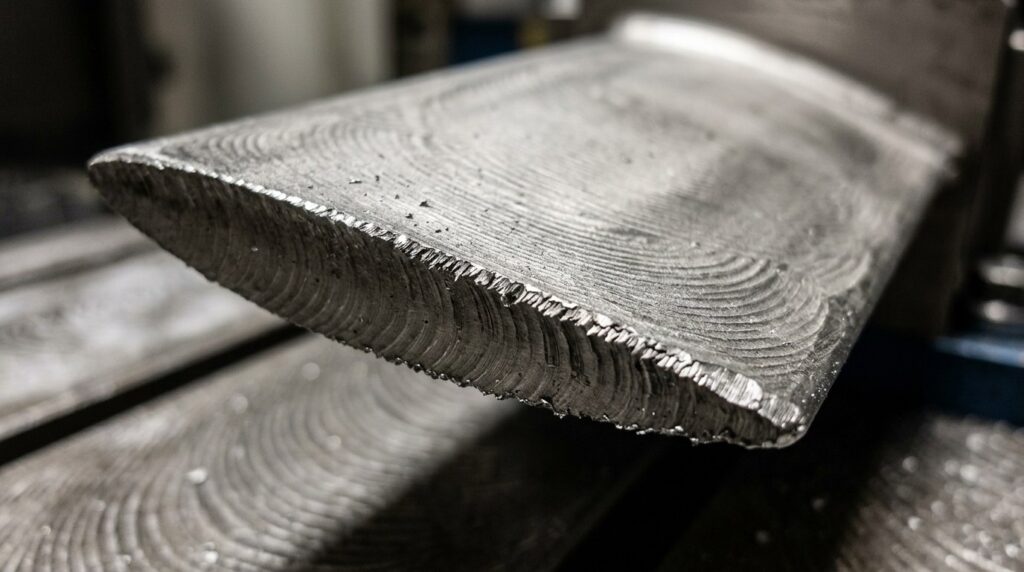
After primary machining, the blade surfaces are left with distinct microscopic tool marks. Furthermore, sharp flash and burrs are generated around the complex root/dovetail sections, as well as along the highly delicate Leading Edge (LE) and Trailing Edge (TE). If these surface defects are not removed through extremely precise polishing, they can cause stress concentrations and accelerate fatigue cracking, with potentially catastrophic consequences in flight.
Các đặc điểm cấu trúc của cánh tuabin
Cấu trúc hình học của các cánh tuabin đặt ra những thách thức cực kỳ lớn đối với quá trình xử lý bề mặt:
- Các bề mặt khí động học cực kỳ phức tạp (hình dạng cánh máy bay): The pressure and suction sides of the blade are 3D free-form surfaces shaped by rigorous fluid-dynamics design. Even a minute alteration to their shape can trigger airflow separation and reduce engine efficiency.
- Các cạnh mỏng chỉ vài micromet: Mép trước và mép sau của lưỡi dao mỏng như lưỡi dao cạo (đôi khi chỉ dày vài phần nghìn milimét). Chỉ cần mài quá tay một chút thôi cũng đủ làm hỏng hình dạng mặt cắt ngang hoàn hảo hình “giọt nước mắt”.
- Các vật liệu khó gia công (hợp kim siêu bền): Titanium and superalloys combine high strength with extremely poor thermal conductivity. They are highly susceptible to thermal burning or surface hardening layers during grinding.
Các đặc điểm chính của quá trình đánh bóng cánh tuabin
Các đặc điểm chính:
- Độ chính xác tuyệt đối của hồ sơ: Quá trình loại bỏ gờ và đánh bóng tuyệt đối không được làm thay đổi các kích thước 3D ban đầu do máy CNC 5 trục tạo ra. Việc loại bỏ vật liệu phải được kiểm soát chặt chẽ ở mức micron.
- Độ nhám bề mặt tuyệt vời: Thông thường, cần đạt mức độ chính xác Ra từ 0,2 đến 0,4 μm để giảm thiểu tối đa lực cản ma sát khí động học.
- Áp suất nén dư nhất quán: Quá trình đánh bóng không chỉ phải làm mịn bề mặt mà còn phải tránh tạo ra các vết nứt vi mô. Quá trình này thường được kết hợp với phương pháp bắn bi để tạo ra một lớp ứng suất nén có lợi, từ đó nâng cao khả năng chống mỏi.
Các thông số kỹ thuật về quá trình đánh bóng lưỡi dao
| Mặt hàng | Phạm vi tham số | Ghi chú |
| Loại bỏ vết xước và vết dụng cụ | Dây đai gốm/AlOx hạt mịn | Cần sử dụng các loại chất làm mát chuyên dụng dành cho titan |
| Chất đánh bóng chính xác cho cánh máy bay | Bánh xe len / Vải không dệt đặc biệt | Sử dụng cùng với hợp chất chuyên dụng cho ngành hàng không vũ trụ để loại bỏ tất cả các vết xước siêu nhỏ |
| Kiểm soát lực tiếp xúc | 2N – 15N (Tần số cực cao) | “Kỹ thuật pha trộn ”nhẹ như lông vũ”, bảo vệ tuyệt đối các đường viền mỏng |
| Độ nhám bề mặt cuối cùng | Ra ≤ 0,4 μm | Finished to the OEM engine specification on the drawing |
| Kiểm soát dung sai đường viền | ± 0,01 mm | Dựa trên công nghệ điều khiển lực ở mức micron với tần số 1000Hz và hệ thống thị giác 3D |
Tại sao các cánh quạt trong ngành hàng không vũ trụ phải sử dụng công nghệ đánh bóng bằng robot?
Những nhược điểm nghiêm trọng của phương pháp mài thủ công truyền thống
Trước đây, việc mài bóng các cánh quạt hàng không vũ trụ chủ yếu dựa vào “cảm nhận” của những bậc thầy thủ công có hàng chục năm kinh nghiệm. Tuy nhiên, trước những yêu cầu khắt khe về năng suất và công suất trong ngành sản xuất hàng không vũ trụ hiện đại, việc mài thủ công không còn là giải pháp bền vững nữa:
| Vấn đề nan giải | Vấn đề cụ thể | Tác động |
| Steep “Over-Cut” Scrap Costs | Superalloy blades are high-value parts. Manual grinding easily cuts tens of microns too deep on the trailing edge. | Scrapping one blade can mean losing thousands of dollars, and manual yields are difficult to hold at a consistently high level. |
| Những thảm họa về tính nhất quán trong hồ sơ | Một động cơ cần hàng trăm cánh quạt. Nếu được đánh bóng bởi các công nhân khác nhau, hình dạng khí động học thực tế của từng cánh quạt sẽ có sự khác biệt nhỏ. | Dẫn đến các vấn đề nghiêm trọng về cân bằng động trong quá trình lắp ráp động cơ, ảnh hưởng đến lực đẩy tổng thể và hiệu suất tiêu thụ nhiên liệu. |
| Cháy do nhiệt và những thay đổi về khí tượng | Titan tích trữ nhiệt rất nhanh. Việc tiếp xúc trực tiếp trong thời gian dài sẽ gây ra hiện tượng nhiệt độ cao cục bộ, làm suy giảm các tính chất chống mỏi. | Cây cối là những mối nguy hiểm nghiêm trọng và tiềm ẩn đối với an toàn bay. |
Những lợi ích của tự động hóa bằng robot
Introducing a robotic precision deburring system equipped with micron-level active force control is a practical route for the aerospace engine supply chain to achieve stable quality control and fully traceable delivery. If you are new to the underlying technology, our primer on what robotic deburring actually does is a good starting point:
| Tiêu chí so sánh | Mài thủ công | Đánh bóng bằng robot | Sự cải thiện |
| Thông tin chi tiết về Fidelity | Độ sai số cao, dễ làm thay đổi hình dạng khí động học | Cắt chính xác đến từng miligam, lực cắt ổn định | Consistent contour accuracy across the blade set |
| Kiểm soát tỷ lệ phế liệu | Chỉ cần một chút sơ ý là đã gây ra một vụ xô xát | Chức năng điều chỉnh tốc độ thông minh và giám sát chống va chạm | Eliminates human over-cutting; scrap from grinding errors drops sharply |
| Khả năng truy xuất nguồn gốc dữ liệu | Không có dữ liệu được lưu giữ | Ghi lại lực và tọa độ của mỗi lần cắt | Process data supports AS9100 audit requirements |
| Hiệu quả gia công | Tốc độ chậm, sản lượng rất hạn chế | Hợp tác tốc độ cao đa trạm | Substantially higher capacity for high-volume deliveries |
Những lợi thế cốt lõi:
- Kiểm soát lực tuân thủ chủ động ở cấp độ micromet: This is the anchor for aerospace blade machining and the core capability that separates force-controlled robotic polishing machines from position-only automation. The force control system monitors the contact force between the tool and the blade at 1000Hz. When the robot processes the razor-sharp and fragile trailing edge, it automatically drops the pressure to mere Newtons (N), brushing away micro-burrs without eating into the parent material—true “deburring without harming the profile.”
- Lập trình ngoại tuyến (OLP) & Bản sao kỹ thuật số: Blade surfaces are highly complex. Engineers directly import high-precision 3D CAD models, and the software automatically recognizes the aerodynamic surfaces, generating Normal Vector polishing paths that conform to the geometry. This avoids the deviations inherent in manual teaching, keeping every step of the robot’s motion tied to the CAD model.
Quy trình làm việc của quy trình đánh bóng cánh tuabin tự động
Quy trình này sử dụng 8 bước chính để gia công một cánh máy nén bằng titan cao cấp từ một “phôi có gờ” thành một “bề mặt có độ chính xác cao.”
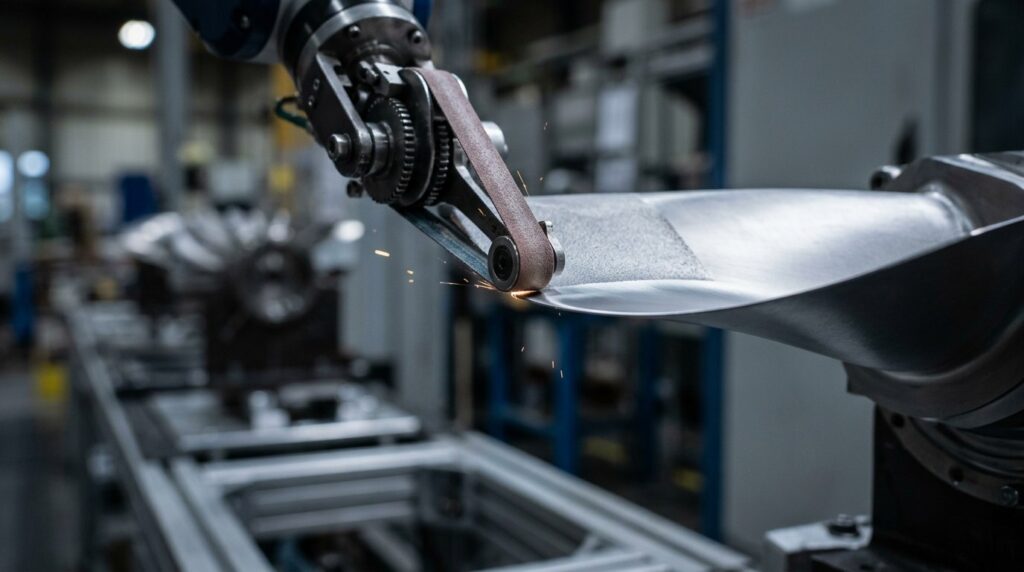
Quy trình hoàn chỉnh về đánh bóng và loại bỏ gờ bằng robot cho cánh tuabin hàng không vũ trụ
| Quy trình | Tên quy trình | Thiết bị | Vật tư tiêu hao | Thời gian | Độ chính xác / Mục đích |
| 01 | Kẹp không gây căng thẳng, độ chính xác cao | Dụng cụ định vị khí nén kiểu mềm/đông cứng | – | tuổi 20 | Đảm bảo độ chính xác lặp lại mà không gây ra biến dạng do kẹp |
| 02 | Loại bỏ gờ thừa ở khớp mộng gốc | Robot + Trục chính tốc độ cao | Mũi khoan cacbua siêu nhỏ | 45 giây | Cối xay mài chính xác những mảnh vụn cứng từ hệ rễ phức tạp của cây thông |
| 03 | Hiệu ứng chuyển màu trên cánh máy bay CNC | Robot + Máy chà nhám băng linh hoạt | Dây đai AlOx siêu mịn | 120 giây | Tuân theo các đường cong khí động học để loại bỏ các vết gợn nhỏ do quá trình phay 5 trục để lại |
| 04 | LE / TE – Trộn chính xác | Robot + Máy chà nhám đai siêu nhỏ | Aero Abrasive tùy chỉnh | thập niên 90 | Sử dụng lực nhẹ như lông vũ để giữ nguyên hình dạng mặt cắt hình giọt nước |
| 05 | Chất đánh bóng chính xác cho cánh máy bay | Robot + Đĩa đánh bóng bằng len | Hỗn hợp vi hạt cấp hàng không | những năm 150 | Elevates surface finish to Ra < 0.4μm, reducing aero drag |
| 06 | Làm mát MQL bằng phương pháp làm lạnh | Hệ thống phun MQL | Chất làm mát được chứng nhận theo tiêu chuẩn hàng không | Tiếp theo. | Kiểm soát chặt chẽ nhiệt độ tiếp xúc, ngăn ngừa bỏng do titan |
| 07 | Rửa tự động bằng sóng siêu âm | Dây chuyền siêu âm nhiều bể | Dung môi không phá hủy | những năm 180 | Loại bỏ triệt để các tạp chất mài mòn và cặn kim loại bám trong lỗ chân lông |
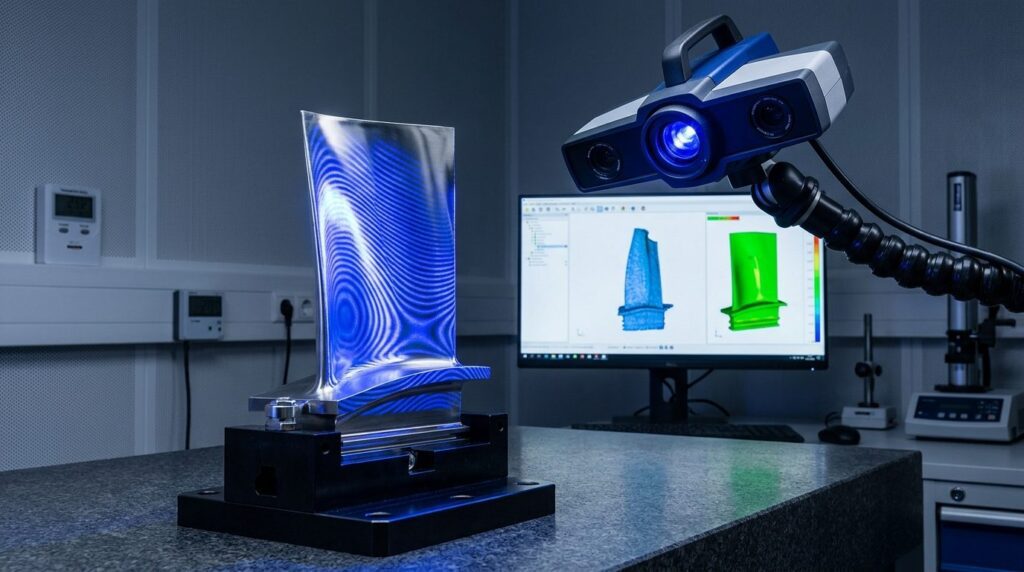
| 08 | Quét toàn diện bằng ánh sáng xanh 3D | Máy quét hình ảnh 3D quang học | – | thập niên 60 | Generates full 3D deviation color maps for inspection records |
Mô tả quy trình đánh bóng và loại bỏ gờ bằng robot cho cánh tuabin hàng không vũ trụ
Bước 1: Kẹp không gây căng thẳng
Mục đích: Kẹp chắc chắn mà không gây biến dạng.
Những điểm chính: Do các lưỡi dao cực kỳ mỏng, việc kẹp cơ học cứng truyền thống sẽ khiến chính lưỡi dao bị uốn cong. Thông thường, người ta sử dụng các giá kẹp mềm bằng polyurethane được thiết kế riêng theo hình dạng, hoặc trong những ứng dụng cao cấp nhất, người ta áp dụng phương pháp “Freeze Gripping” (sử dụng nitơ lỏng) để đạt được sự cố định cứng tuyệt đối mà không gây ra bất kỳ ứng suất nào.
Bước 2: Loại bỏ gờ cạnh trên rãnh ghép
Mục đích: Làm sạch phần rễ phức tạp hình “cây thông” được dùng để gắn vào đĩa tuabin.
Những điểm chính: Leveraging the extreme 6-axis agility of the robot, it swaps to micro-tools to precisely dive into the complex gear-like grooves of the dovetail, clearing micro-flash without altering the critical assembly tolerances. Dovetail and fir-tree roots are among the most common geometries in industrial robotic deburring applications, and blade roots push the same tooling principles to their limit.
Bước 3 và 4: Tạo độ mượt cho cánh máy bay và hoàn thiện các cạnh
Mục đích: Thách thức cốt lõi. Loại bỏ các vết do dụng cụ để lại đồng thời giữ nguyên hình dáng khí động học.
Những điểm chính: This is where active force control matters most. Guided by OLP paths, the belt sander stays perpendicular (normal) to the free-form surface. The contact force drops automatically from 15N on the belly of the blade to under 2N the instant it reaches the razor-thin trailing edge.
Bước 5: Đánh bóng chính xác cánh máy bay
Mục đích: Giảm độ nhám bề mặt để nâng cao tuổi thọ mỏi.
Những điểm chính: Sử dụng các đĩa len cực kỳ mềm kết hợp với các chất mài mòn chuyên dụng. Chúng nhẹ nhàng lướt trên bề mặt theo hướng luồng khí, loại bỏ hoàn toàn mọi điểm tập trung ứng suất vi mô tiềm ẩn.
Bước 8: Quét toàn diện bằng công nghệ ánh sáng xanh 3D
Mục đích: Full 3D inspection of every blade.
Những điểm chính: Một máy quét ánh sáng xanh có độ chính xác cao thu thập hàng triệu điểm dữ liệu đám mây điểm bề mặt từ lưỡi dao đã được đánh bóng, sau đó so sánh với mô hình CAD 3D gốc. Bất kỳ trường hợp cắt quá mức hoặc cắt thiếu nào vượt quá 0,01 mm sẽ kích hoạt cảnh báo màu đỏ trên bản đồ màu độ lệch.
Những thách thức và giải pháp trong gia công
Thách thức 1: Siêu hợp kim cực kỳ khó cắt và cháy ngay lập tức
Vấn đề:
- Các hợp kim siêu bền gốc titan và niken (như Inconel 718) được sử dụng trong động cơ phản lực chính là nhờ chúng duy trì được độ bền và độ dẻo dai cực cao ở nhiệt độ cao.
- Điều này có nghĩa là việc mài các vật liệu này cực kỳ khó khăn. Quá trình mài truyền thống dễ khiến các đai mài bị mòn và cùn ngay lập tức, tạo ra nhiệt ma sát cực lớn, dẫn đến việc bề mặt bị cháy ngay lập tức, gây biến màu do oxy hóa, hoặc thậm chí phá hủy cấu trúc kim loại bên trong.
Giải pháp:
- Chiến lược cắt lạnh + Bôi trơn MQL + Bù mòn thông minh.
- Hệ thống này sử dụng tốc độ tiến dao cực thấp kết hợp với áp lực nhẹ và ổn định. Trong suốt quá trình gia công, hệ thống bôi trơn lượng tối thiểu (MQL) phun chất lỏng một cách chính xác để tản nhiệt ngay lập tức khỏi vùng cắt. Đồng thời, hệ thống kiểm soát lực phát hiện sự mài mòn của vật tư tiêu hao theo thời gian thực, tự động điều chỉnh vi mô tốc độ tiến dao để đảm bảo mỗi đường cắt luôn duy trì ở trạng thái “cắt lạnh” tối ưu.
- Kết quả: The risk of thermal burning is effectively controlled, and metallographic and hardness testing of polished blade surfaces consistently confirms an undamaged structure.
Thách thức 2: Độ dễ vỡ ở cấp độ micron của các mép trước và mép sau
Vấn đề:
- Mép sau của cánh quạt thường có độ dày dưới 0,5 mm — cực kỳ sắc bén và dễ vỡ.
- When grinding this area, applying even a few Newtons too much force, or if the robot path deviates by a mere 0.05mm, can directly flatten or snap the trailing edge—turning a blade worth thousands of dollars into scrap metal.
Giải pháp:
- Giới thiệu kiến trúc điều khiển lai tần số cao kết hợp lực và vị trí.
- Khi gia công các vùng cạnh, robot không chỉ dựa vào các tọa độ chính xác (vị trí) được lập trình ngoại tuyến; nó trao “quyền can thiệp” ưu tiên cao nhất cho cảm biến lực. Ngay khi cảm biến phát hiện một sự tăng đột biến nhỏ về điện trở (nghĩa là đã chạm vào mép dễ vỡ), hệ thống sẽ tự động thực hiện một chuyển động bảo vệ “nhường bước”.
- Kết quả: Reliable protection for ultra-thin edges. The ground leading and trailing edges maintain the design-mandated teardrop aerodynamic shapes, and over-cut scrap falls to a negligible level.
Application Scenario
Production Background
A typical deployment target for this type of cell is an aero-engine component supplier in Europe producing high-pressure compressor and turbine blades for commercial airliner engine programs. The finishing workshop is usually the bottleneck when blade output needs to scale up for a new engine generation.
Những thách thức kỹ thuật
- Capacity expansion for a new generation of titanium alloy blades was being bottlenecked by the grinding workshop.
- Legacy manual grinding yields were unstable. Because titanium blades are high-value parts, scrap losses from manual over-cutting alone accumulated into a serious cost problem.
- The engine OEM required complete digital traceability of the manufacturing process for critical components, which traditional manual operations could not provide.
Giải pháp
| Mặt hàng | Cấu hình |
| Chi tiết gia công | Cánh quạt nén áp suất cao bằng titan cho động cơ hàng không |
| Chất liệu | Rèn hợp kim titan Ti-6Al-4V |
| Thiết bị | Robot 6 trục có độ cứng cao + Máy chà nhám vi mô điều khiển lực + Hệ thống bôi trơn MQL |
| Công nghệ cốt lõi | Điều khiển lực tuân thủ chủ động 1000Hz + Kiểm tra quét 3D bằng ánh sáng xanh |
| Quy trình | OLP Path Gen -> Máy nghiền Flash gốc -> Trộn ép lạnh -> Hoàn thiện vi mô cạnh |
| Thời gian chu kỳ | A few minutes for a comprehensive polish of a single complex blade |
Kết quả triển khai
- Scrap Containment: Active force control plays the decisive role here. With the system in place, the scrap rate for high-pressure blades due to dimensional grinding errors typically falls from double digits to a low single-digit level, containing what used to be a major annual scrap cost.
- Consistent Profiles: Aerodynamic profile errors across the production batch concentrate within a narrow tolerance band, which improves dynamic balance consistency during final engine assembly.
- Digital Traceability: The system logs the pressure curves, RPM, and 3D coordinates during the grinding of every blade, automatically generating a digital process dossier. This documented evidence supports the audit requirements of the AS9100 aerospace quality system.
Câu hỏi thường gặp
Câu hỏi 1: Hệ thống mài tự động có thể kết nối trực tiếp với dữ liệu từ máy đo tọa độ (CMM) của chúng tôi không?
A: Yes. This is the core of closed-loop control in high-end aerospace manufacturing. Our system can ingest data from CMMs or 3D blue light scanners. If inspection reveals that the allowance left by the preceding CNC batch is abnormally large, the grinding software automatically parses this deviation data and dynamically generates an “adaptive” grinding toolpath for precise remedial compensation—closing the loop between inspection and production.
Câu hỏi 2: Do bụi titan có tính dễ cháy và dễ nổ cực cao, vậy hệ thống này ngăn ngừa thảm họa như thế nào?
A: The aerospace industry works to some of the strictest explosion-protection standards in manufacturing (ATEX/NFPA). Our aerospace-grade grinding cells are built accordingly: fully enclosed micro-negative pressure explosion-proof doors, a complete suite of Ex-rated motors and sensors, and a dedicated Water Wash titanium dust extraction system. The moment dust is generated, it is drawn into water and passivated, removing the conditions a titanium dust explosion requires.
Câu hỏi 3: Mất bao lâu kể từ khi viết chương trình mài cho một lưỡi dao mới cho đến khi bắt đầu sản xuất thử nghiệm?
A: Leveraging advanced Offline Programming (OLP) digital twin technology, you do not waste time teaching on the physical robot. Engineers import the blade’s 3D CAD and desired contact force parameters on a computer, and the software automatically generates collision-free paths. For an entirely new, complex blade, moving from programming to physical proof-of-concept polishing typically takes about one working day.
Câu hỏi 4: Lợi tức đầu tư (ROI) được tính như thế nào khi đầu tư vào một hệ thống robot cấp hàng không vũ trụ có đẳng cấp như thế này?
A: Calculating ROI in the aerospace sector is different from standard industries. You cannot simply calculate “how many workers’ wages were saved.” The core return lies in the scrap costs recovered. A single titanium blade can be worth thousands of dollars, so cutting the scrap rate by even a modest percentage—combined with the capacity increase—adds up quickly. Based on our dịch vụ đánh giá dự án và chứng minh tính khả thi, the payback period for these high-end systems is often shorter than buyers expect, with many projects recovering the investment within roughly a year.
Kết luận
The precision grinding and polishing of aerospace turbine blades represent one of the highest technical barriers in manufacturing. Adopting an hệ thống robot tự động tích hợp khả năng điều khiển lực chủ động ở mức micromet và lập kế hoạch đường đi ngoại tuyến OLP addresses the profile distortion, scrap losses, and thermal burning hazards caused by manual grinding. It navigates razor-thin leading/trailing edges and complex free-form surfaces under constant force, keeping every blade’s aerodynamic shape within specification. For aero-engine component suppliers, this is a practical route to easing capacity constraints, stabilizing yields, and building the traceability that aviation quality systems require.
If your manufacturing plant is battling low yields in superalloy blade grinding, heavy scrap losses from manual over-cutting, and strict dimensional consistency requirements, contact our aerospace automation expert team to obtain a dedicated micron-level grinding technical assessment and machine trial solution.