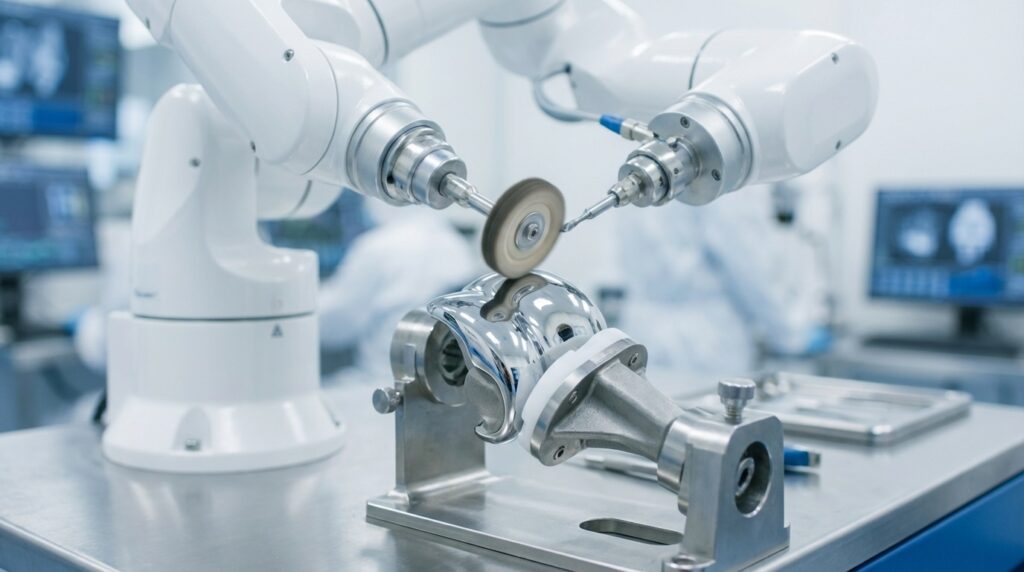
Độ nhám bề mặt và độ chính xác của đường viền trên các thiết bị cấy ghép chỉnh hình quyết định trực tiếp đến khả năng khớp nối với xương người, khả năng chống mài mòn và tuổi thọ sử dụng tối đa của chúng. Xuất phát từ những yêu cầu khắt khe của sản xuất thiết bị y tế, this article provides an in-depth analysis of the key technical challenges in automated polishing and grinding of titanium orthopedic implants. We cover medical-grade surface requirements, the limitations of manual grinding, and the application of robotic active force control and micron-level path control technologies. Through detailed technical data and equipment-level process control, we examine how robotic finishing systems are designed to support customer validation in regulated industries while improving surface quality and production consistency.
Thiết bị cấy ghép chỉnh hình là gì?
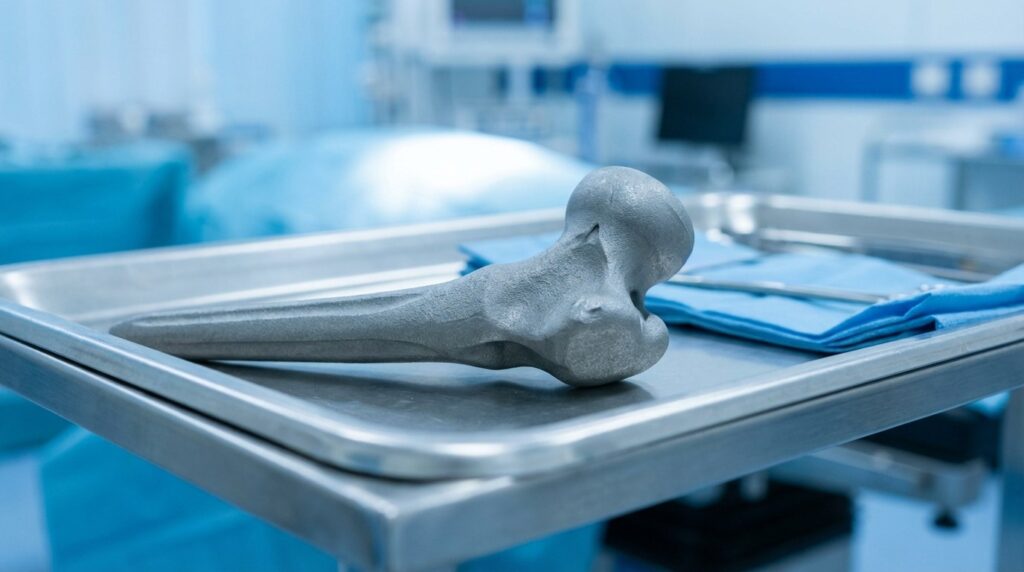
Các thiết bị cấy ghép chỉnh hình là những thiết bị y tế chính xác được sử dụng để thay thế, hỗ trợ hoặc phục hồi xương và khớp bị tổn thương trong cơ thể con người. Do phải tồn tại trong cơ thể con người trong thời gian dài hoặc vĩnh viễn, chúng chủ yếu được chế tạo từ các vật liệu có tính tương thích sinh học cao, chẳng hạn như hợp kim titan (Ti-6Al-4V) hoặc hợp kim coban-crom-molypden (CoCrMo).
Các tình huống ứng dụng của thiết bị cấy ghép chỉnh hình
Các thiết bị cấy ghép chỉnh hình được sử dụng rộng rãi trong các ca phẫu thuật thay khớp, phẫu thuật chỉnh hình cột sống và cố định gãy xương do chấn thương. Các lĩnh vực ứng dụng khác nhau đòi hỏi các phương pháp xử lý bề mặt rất khác nhau, đôi khi thậm chí trái ngược nhau:
- Khớp gối và khớp háng nhân tạo (Bề mặt khớp): Đây là những vùng chịu ma sát nơi các xương khớp nối với nhau. Các vùng này cần được đánh bóng đến độ nhẵn như gương (Ra < 0,05μm) để giảm thiểu mảnh vụn do mài mòn kim loại và ngăn ngừa hiện tượng lỏng lẻo của implant.
- Thân cấy ghép và bề mặt không khớp: Các bộ phận này cần phải kết dính chặt chẽ với mô xương (tích hợp xương) và thường đòi hỏi phải duy trì hoặc tạo ra các bề mặt nhám đặc biệt (ví dụ: lớp phủ xốp hoặc bề mặt được xử lý bằng phương pháp phun cát).
Điều này đòi hỏi thiết bị đánh bóng không chỉ phải đạt được độ hoàn thiện cực cao mà còn phải sở hữu kiểm soát quá trình đánh bóng cục bộ một cách chính xác, ensuring that areas meant to remain rough are left untouched. For a closer look at the mirror-finishing of spherical bearing surfaces such as femoral heads, see our dedicated article on artificial joint implant robotic polishing.
Đặc điểm cấu trúc của thiết bị cấy ghép chỉnh hình
Các thiết bị cấy ghép chỉnh hình có cấu trúc cực kỳ phức tạp:
- Các đường cong tự do phức tạp trong công nghệ sinh học: Hoàn toàn mô phỏng hình thái xương của con người, chúng có vô số phần nhô ra không đều, các rãnh và các bán kính chuyển tiếp nhỏ, hầu như không có hình dạng hình học chuẩn nào.
- Dung sai hình dạng nghiêm ngặt: Các bề mặt tiếp xúc của khớp nhân tạo phải khớp hoàn hảo với nhau. Những sai lệch về hình dạng ở mức độ micron có thể dẫn đến sự phân bố ứng suất không đồng đều và làm tăng tốc độ mài mòn.
- Đặc tính của vật liệu khó gia công: Hợp kim titan có độ cứng cao và độ dẫn nhiệt cực kỳ thấp. Trong quá trình mài và đánh bóng, chúng nhanh chóng sinh ra nhiệt lượng lớn, có thể gây cháy bề mặt, biến màu do oxy hóa hoặc thay đổi cấu trúc vi mô.
Các đặc điểm chính của các thiết bị cấy ghép chỉnh hình
Các đặc điểm chính:
- Độ nhám bề mặt đạt tiêu chuẩn y tế: Các bề mặt ma sát khớp phải đạt độ nhẵn siêu gương với giá trị Ra < 0,05μm.
- Độ chính xác về hình dạng ở cấp độ micromet: Quá trình đánh bóng tuyệt đối không được làm hỏng độ chính xác của đường viền sinh học đã được gia công bằng máy CNC.
- Full Quality Traceability and Consistency: Implant manufacturers operate under strict quality systems. The machining process for every implant must be stable and repeatable, with scrap controlled through process design rather than sorted out at final inspection.
Thông số kỹ thuật về đánh bóng implant
| Mặt hàng | Phạm vi tham số | Ghi chú |
| Hòa trộn vết dụng cụ | Dây đai linh hoạt / Bánh xe nylon | Cẩn thận loại bỏ các vết xước nhỏ do gia công CNC để lại |
| Tốc độ đánh bóng mịn | 1.500 – 3.000 vòng/phút | Sử dụng hợp chất chuyên dụng đạt tiêu chuẩn y tế và các miếng vải nhỏ |
| Dung sai tiếp xúc | < 0,01 mm | Dựa trên các hệ thống điều khiển lực chủ động tần số cao |
| Độ nhám bề mặt cuối cùng | Ra 0,02 – 0,05 μm | Typical target range for CoCrMo and Ti-6Al-4V bearing surfaces, per customer drawing |
| Môi trường sản xuất | Phòng sạch tiêu chuẩn ISO loại 7 hoặc 8 | Kiểm soát chặt chẽ bụi và ô nhiễm chéo |
Tại sao phương pháp đánh bóng bằng robot lại được ưa chuộng trong sản xuất các thiết bị cấy ghép chỉnh hình?
Những khó khăn khi đánh bóng thủ công truyền thống
Khi gia công các loại implant có độ chính xác cao như khớp nhân tạo bằng titan, phương pháp đánh bóng thủ công truyền thống gặp phải những trở ngại không thể khắc phục:
| Vấn đề nan giải | Vấn đề cụ thể | Tác động |
| Nguy cơ biến dạng đường viền nghiêm trọng | Titan rất khó đánh bóng. Công nhân thường ấn quá mạnh để tăng hiệu suất. | Gây ra tình trạng các bộ phận titan có giá thành rất cao phải bị loại bỏ do sai lệch kích thước; hiệu suất sản xuất khó vượt quá 85%. |
| Bỏng nhiệt thường xuyên | Titan có độ dẫn nhiệt kém. Việc đánh bóng bằng tay trong thời gian hơi lâu sẽ gây ra hiện tượng nóng cục bộ ở mức cao. | Dẫn đến hiện tượng đổi màu do oxy hóa bề mặt hoặc thậm chí làm suy giảm độ bền mỏi, gây ra những rủi ro y tế nghiêm trọng. |
| Không thể tiếp cận các vùng chết vi mô | Các khớp nhân tạo có những rãnh chuyển tiếp rất nhỏ. Bánh xe điều khiển bằng tay không thể lăn vào chính xác. | Để lại những vết đen chưa được đánh bóng, không đạt tiêu chuẩn kiểm định chất lượng y tế nghiêm ngặt. |
Những lợi ích của tự động hóa bằng robot
Medical-grade robotic polishing cells (combining high-precision vision with micro-feed force control) offer a practical way to break through titanium polishing bottlenecks:
| Tiêu chí so sánh | Đánh bóng thủ công | Đánh bóng bằng robot | Sự cải thiện |
| Độ chính xác đường viền | Dựa vào cảm nhận của người lao động, tỷ lệ sai sót cao | Follows bionic curves with constant contact force | Consistent contour accuracy from batch to batch |
| Hư hỏng do nhiệt | Thường xuyên | Áp suất/tốc độ ổn định, không tích tụ nhiệt | Largely prevents titanium surface burning |
| Tính nhất quán của sản phẩm | Sự chênh lệch lớn giữa các lô | Độ lặp lại ở cấp độ micromet | Process data logging supports customer quality audits |
| Vật tư tiêu hao & Môi trường | Ô nhiễm bụi mài nghiêm trọng | Tế bào kín với MQL | Compatible with cleanroom production environments |
Những lợi thế cốt lõi:
- Kiểm soát lực chủ động và tuân thủ: This is the core of processing orthopedic implants, and the same technology that distinguishes modern robotic polishing machines from rigid automation. The robot spindle is equipped with an ultra-sensitive 6-axis force sensor, allowing it to softly conform to the joint’s curves with extremely light, constant pressure (e.g., 2-5N), achieving “removing tool marks without harming the contour.”
- Xử lý chính xác theo vùng: Được trang bị hệ thống thay dao tự động (ATC) đa trạm, robot có thể tự động chuyển sang sử dụng các đầu mài có đường kính nhỏ để tiếp cận và gia công các vùng khuất phức tạp trong khung chậu nhân tạo hoặc khớp gối dựa trên các biến thể của đường cong.
- Chiến lược cắt lạnh ở nhiệt độ thấp: Bằng cách điều khiển chính xác tốc độ tiến dao của robot và phun sương chất lỏng đánh bóng, phương pháp này giúp tản nhiệt hiệu quả khỏi bề mặt titan, từ đó ngăn ngừa mọi sự thay đổi đối với cấu trúc kim loại.
Quy trình làm việc của quy trình đánh bóng tự động
Quy trình này sử dụng 8 bước để hoàn thiện bề mặt của khớp gối nhân tạo bằng titan. Do độ chính xác của quá trình gia công CNC trước đó đã rất cao, mục tiêu chính của quá trình đánh bóng là loại bỏ các vết xước siêu nhỏ do dụng cụ gây ra và đạt được bề mặt bóng như gương hoàn hảo. Cái Các quy trình cốt lõi là quá trình mài và đánh bóng bằng lực vi mô nhiều giai đoạn trong các bước 02-04.
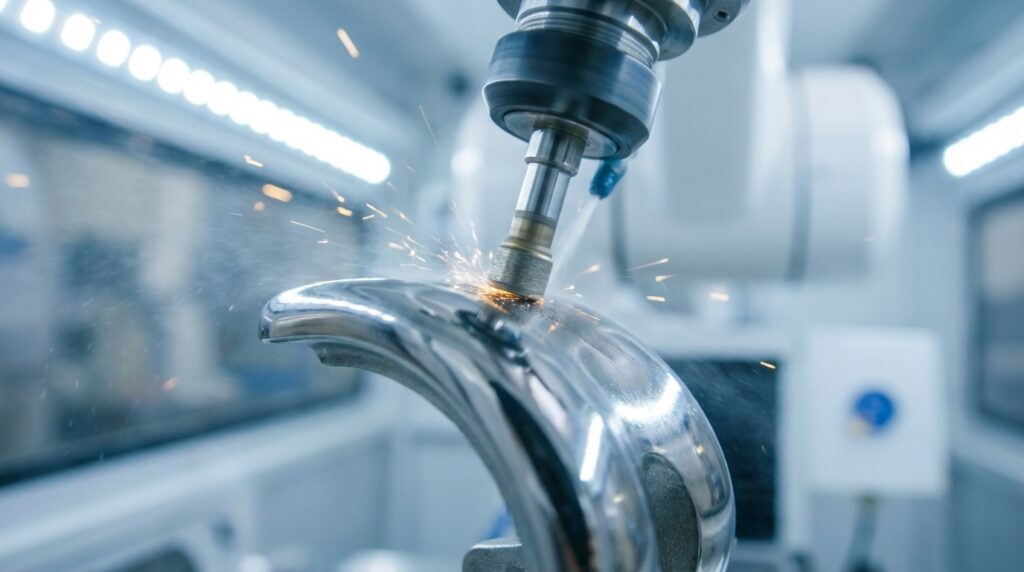
Quy trình hoàn chỉnh đánh bóng vật liệu cấy ghép chỉnh hình
| Quy trình | Tên quy trình | Thiết bị | Vật tư tiêu hao | Thời gian | Độ chính xác / Mục đích |
| 01 | Tải trọng không phá hủy | Bộ kẹp linh hoạt + Robot | Miếng bảo vệ bằng polyurethane | 15 giây | Đảm bảo có thể định vị lại mà không gây trầy xước |
| 02 | Kết hợp linh hoạt | Robot + Trục chính điều khiển lực | Bánh xe bằng nylon/len mịn | thập niên 90 | Loại bỏ các vết xước ở mức độ micron trên máy CNC 5 trục |
| 03 | Đánh bóng vi mô vùng mù | Robot + Trục chính tốc độ cao | Đầu mài vi mô gắn trên máy | những năm 75 | Xử lý các chuyển tiếp phức tạp như khớp gối |
| 04 | Đánh bóng gương | Robot + Máy đánh bóng | Vải bông mềm + Hợp chất y tế | 120 giây | Đạt được độ nhẵn gương tối ưu với Ra < 0,05 μm |
| 05 | Vệ sinh chuyên sâu | Dây chuyền siêu âm nhiều bể | Dung môi cấp y tế | những năm 300 | Loại bỏ triệt để cặn bám và các hạt siêu nhỏ |
| 06 | Rửa bằng nước cất | Buồng phun áp suất cao | Nước khử ion (DI) | thập niên 60 | Đảm bảo không để lại cặn ion trên bề mặt |
| 07 | Sấy khô trong phòng sạch | Lò sấy chân không | – | 120 giây | Sấy khô nhanh trong môi trường không bụi |
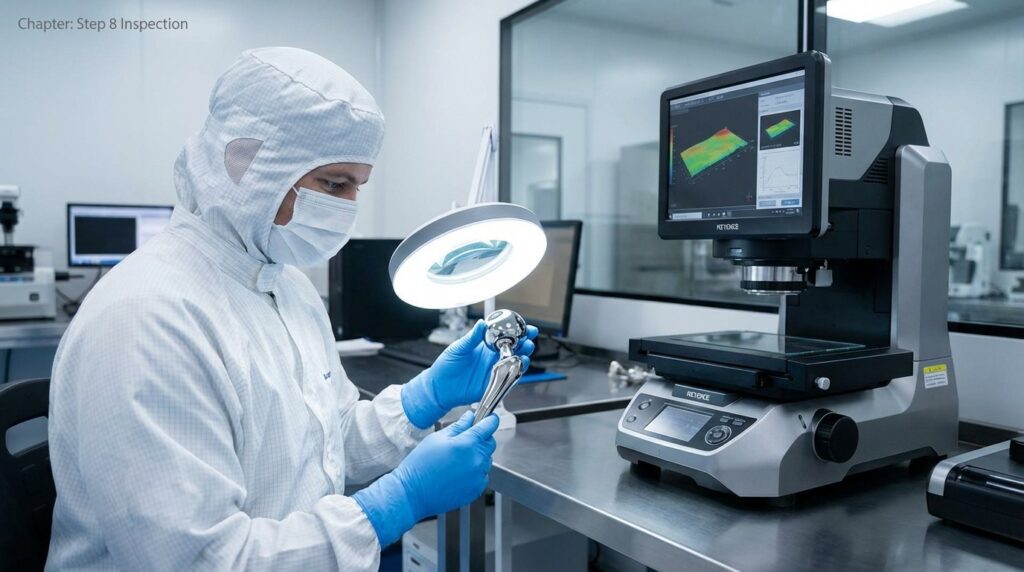
| 08 | Kiểm tra theo tiêu chuẩn y tế | Máy đo độ nhám bề mặt quang học 3D | – | 45 giây | Đo độ nhám bề mặt và dung sai hình học |
Mô tả quy trình đánh bóng vật liệu cấy ghép chỉnh hình
Bước 1: Tải trọng không phá hủy
Mục đích: Nắm chặt implant một cách chắc chắn mà không làm hỏng các bề mặt nhám đã được gia công sẵn (được thiết kế để tích hợp với xương).
Những điểm chính: Phụ kiện phải được bọc bằng polyurethane hoặc Teflon đạt tiêu chuẩn y tế để tránh các kẹp kim loại để lại vết lõm trên bề mặt titan.
Bước 2: Trộn linh hoạt
Mục đích: Loại bỏ nhẹ nhàng các vết xước nhỏ li ti hình lưới do quá trình phay CNC 5 trục để lại, tạo nền tảng cho quá trình đánh bóng gương.
Những điểm chính: Phải kích hoạt chế độ kiểm soát lực. Robot di chuyển đều đặn trên bề mặt khớp với lực tiếp xúc cực kỳ nhẹ (2–5 N) để tránh tạo ra các vết cắt.
Bước 3: Đánh bóng vi mô vùng khuất
Mục đích: Xử lý các đường cong lõm phức tạp (như khe giữa hai chỏm xương của khớp gối) mà các đĩa đánh bóng cỡ lớn không thể tiếp cận được.
Những điểm chính: Robot tự động chuyển sang sử dụng các đĩa mài gắn sẵn, có đường kính chỉ khoảng 10–20 mm, để thực hiện quá trình mài tinh với tốc độ cao và áp lực tối thiểu trong các không gian hẹp.
Bước 4: Đánh bóng gương
Mục đích: Mài bóng bề mặt khớp ma sát đến độ bóng như gương để giảm thiểu sự mài mòn sau khi cấy ghép vào cơ thể người.
Những điểm chính: Sử dụng các đĩa bông cực kỳ mềm kết hợp với dung dịch đánh bóng chuyên dụng, tương thích sinh học và đạt tiêu chuẩn y tế. Toàn bộ quy trình được kiểm soát nhiệt độ chặt chẽ để tránh làm cháy bề mặt.
Bước 5: Làm sạch bằng dung dịch tinh khiết
Mục đích: Thiết bị y tế không cho phép có bất kỳ cặn bẩn dạng hạt nào. Quá trình làm sạch bằng sóng siêu âm phải loại bỏ triệt để các chất lỏng đánh bóng và bột titan ẩn sâu trong các lỗ rỗng siêu nhỏ.
Bước 6: Rửa bằng nước cất
Mục đích: Rửa sạch các dung môi tẩy rửa bằng nước khử ion có độ tinh khiết cao, đảm bảo độ sạch sinh học của bề mặt vật cấy ghép.
Bước 7: Sấy khô trong phòng sạch
Mục đích: Làm khô hoàn toàn độ ẩm trong môi trường chân không hoặc môi trường được lọc bằng bộ lọc không khí hiệu suất cao (HEPA) để ngăn ngừa ô nhiễm thứ cấp.
Bước 8: Kiểm tra theo tiêu chuẩn y tế
Mục đích: Tạo các báo cáo kiểm tra độ nhám bề mặt và kích thước 3D đầy đủ bằng cách sử dụng các thiết bị cao cấp như máy đo độ nhám quang học 3D không tiếp xúc, đảm bảo khả năng truy xuất nguồn gốc chất lượng cho từng sản phẩm.
Những thách thức và giải pháp trong gia công
Thách thức 1: Titan rất dễ bị cháy do nhiệt và biến dạng
Vấn đề:
- Hợp kim titan có độ dẫn nhiệt cực thấp. Nhiệt sinh ra trong quá trình đánh bóng không thể tỏa đi nhanh chóng và tập trung tại bề mặt tiếp xúc.
- Nhiệt độ quá cao không chỉ khiến bề mặt bị oxy hóa và chuyển sang màu xanh (một khuyết tật thẩm mỹ nghiêm trọng) mà còn có thể giải phóng ứng suất bên trong các cấu trúc thành mỏng, gây ra biến dạng vi mô và làm mất độ chính xác của lắp ráp.
Giải pháp:
- Giới thiệu các chiến lược mài lạnh linh hoạt và bôi trơn với lượng tối thiểu (MQL). These are the same thermal-management principles covered in our general robotic grinding guide, applied here with tighter limits.
- Các chương trình đánh bóng bằng robot bị nghiêm cấm hoạt động trong cùng một khu vực trong thời gian dài. Chiến lược đường chạy dao “độ sâu cắt nhỏ, tần suất cao, tốc độ tiến dao nhanh” được áp dụng. Đồng thời, chất làm mát/dung dịch đánh bóng được phun sương chính xác giúp duy trì nhiệt độ tại điểm tiếp xúc luôn ở mức thấp hơn ngưỡng chuyển pha của vật liệu.
- Kết quả: Scrap caused by localized overheating is largely eliminated, and metallographic inspection of finished surfaces consistently confirms an undisturbed base structure.
Thách thức 2: Khả năng tiếp cận dụng cụ cực kỳ hạn chế trong các vùng không thể đánh bóng
Vấn đề:
- Các thiết bị cấy ghép chỉnh hình (chẳng hạn như các bộ phận xương chậu nhân tạo) có nhiều bán kính rất nhỏ và các rãnh sâu mà các đĩa đánh bóng tiêu chuẩn đơn giản là không thể tiếp cận được.
Giải pháp:
- Hợp tác đa trạm và hệ thống thay dao tự động (ATC).
- Tổ máy này được trang bị các dụng cụ đánh bóng với nhiều kích cỡ và hình dạng khác nhau. Thông qua quá trình mô phỏng chính xác bằng phần mềm Lập trình ngoại tuyến (OLP), robot, giống như một nha sĩ, có thể tự động chọn các mũi khoan hình cầu hoặc hình nón siêu mịn và tiếp cận các vùng khuất ở các góc cụ thể để thực hiện công đoạn hoàn thiện tinh xảo.
- Kết quả: Full-surface polishing coverage with no dead zones, helping finished parts meet strict visual inspection requirements.
Application Scenario
Production Background
A typical application for this type of cell is the finishing line of an orthopedic implant manufacturer producing artificial hip and knee components. The workpiece in this scenario is the CoCrMo femoral component of a knee joint—a small, highly curved part where the articular surface must be brought to a mirror finish while the surrounding geometry stays untouched.
Những thách thức kỹ thuật
- Bộ phận khớp gối nhân tạo ở phần khớp gối đùi được làm từ hợp kim Coban-Crom-Molypden (CoCrMo) – một loại vật liệu cực kỳ khó gia công – với các đường cong vô cùng phức tạp.
- The drawing calls for a mirror finish in the Ra 0.02 μm class on the articular surface, with geometric contour deviations held within a few microns.
- The finishing process needs complete data recording and traceability to support the manufacturer’s quality audits and process validation documentation.
Giải pháp
| Mặt hàng | Cấu hình |
| Chi tiết gia công | CoCrMo Artificial Knee Joint (Femoral Condyle) |
| Chất liệu | CoCrMo Alloy |
| Thiết bị | Medical-Grade 6-Axis Robot + 6D Force Control + Cleanroom-Compatible Enclosure |
| Công nghệ cốt lõi | High-Frequency Active Force Control + OLP + Full-Process Data Monitoring |
| Quy trình | Flexible Blending -> Blind Zone Micro-Grinding -> Soft Cloth Mirror Polish |
| Thời gian chu kỳ | Several minutes per piece at high precision |
Kết quả triển khai
- Precision Performance: With the high-precision force control system, contour deviations are held within a few microns of the CAD model, and surface roughness stabilizes in the Ra 0.02-0.05 μm range, meeting the drawing requirements.
- Process Traceability: The system records the underlying parameters—pressure, speed, coordinates—for every joint machined. This documented process evidence supports the manufacturer’s quality audits and process validation activities.
- Clean Production: The cell integrates high-level dust filtration and micro-negative pressure systems, making it compatible with ISO Class 7/8 cleanroom surroundings and reducing cross-contamination risks.
Câu hỏi thường gặp
Q1: Can robotic polishing truly guarantee not to destroy the high-precision contours milled by CNC?
A: Yes, when an active force control system is used. If a traditional rigid robot deviates by 0.1mm, it severely gouges the workpiece. However, a robot equipped with a force sensor acts like a spring; even if it encounters a 0.5mm or 1mm curve error, it automatically yields, always maintaining a constant, gentle pressure of, say, 3N. This “soft contact” removes the micron-level roughness peaks and valleys without altering the macroscopic geometric contour.
Q2: Is it easy to change over the robot for low-volume, high-mix orthopedic implants (like custom joints)?
A: Very easy. Orthopedic implants indeed come in numerous specifications. Our solution deeply integrates OLP (Offline Programming) software. When introducing a new joint specification, engineers simply import the 3D model into the software, which automatically generates smooth polishing paths and performs interference checks. On the shop floor, the operator only needs to load the corresponding program and swap the quick-change fixture. The entire changeover typically takes less than 10 minutes.
Q3: Titanium dust generated during polishing poses an explosion risk. How does the system prevent this?
A: Titanium and aluminum dust fires are a serious, well-documented hazard, and the cell is engineered around it. Our medical-grade polishing cells come standard with a high level of safety protection: ATEX-rated explosion-proof dust extraction, wet-type vacuum designs that rapidly cool and settle the dust, and MQL spray measures within the fully enclosed cell, so the polishing process can be operated safely within a documented fire-protection concept.
Q4: How does the ROI (Return on Investment) for medical device polishing compare to the general hardware industry?
A: While the initial investment for a customized force-controlled robotic cell for medical devices is higher than standard polishing equipment, the payback is often faster than in general hardware polishing. The reason is simple: implant workpieces carry a high unit value and a very low tolerance for scrap. A system that cuts the scrap rate of titanium joints by even a few percentage points typically recovers its investment in one to two years, in addition to the savings in high-skilled labor costs.
Kết luận
The surface treatment of titanium orthopedic implants using an automated robotic polishing system with micron-level active force control is a proven route to meeting the precision, traceability, and process-validation requirements of modern implant manufacturing. It addresses the contour distortion and thermal damage issues typical of manual grinding, and it raises the quality ceiling of scalable medical product manufacturing.
If you are seeking to improve the polishing yield of artificial joints, solve complex curve machining challenges, or wish to strengthen the process documentation behind your finishing line, contact our advanced manufacturing engineering team for professional project assessment and proof-of-concept testing services.