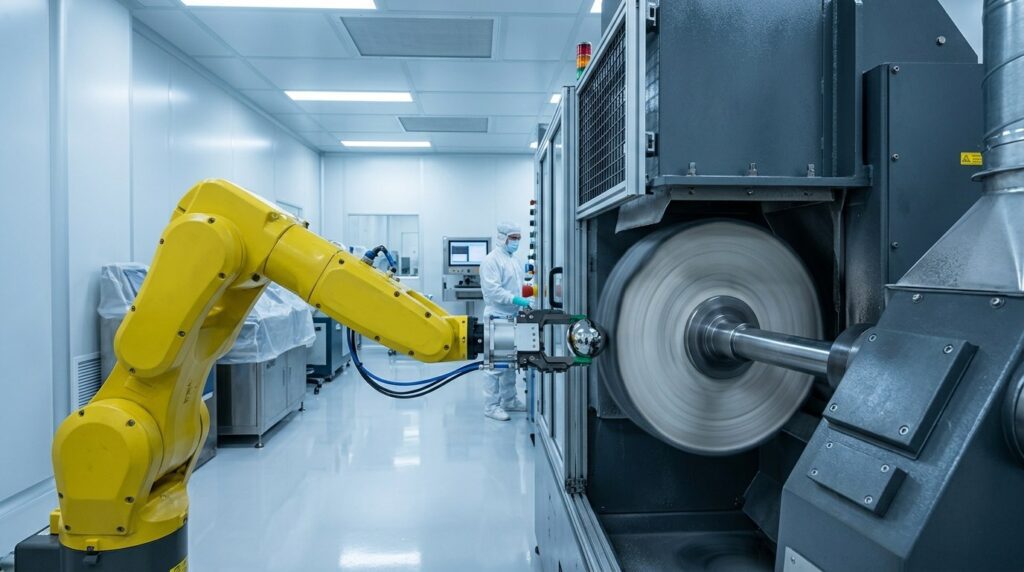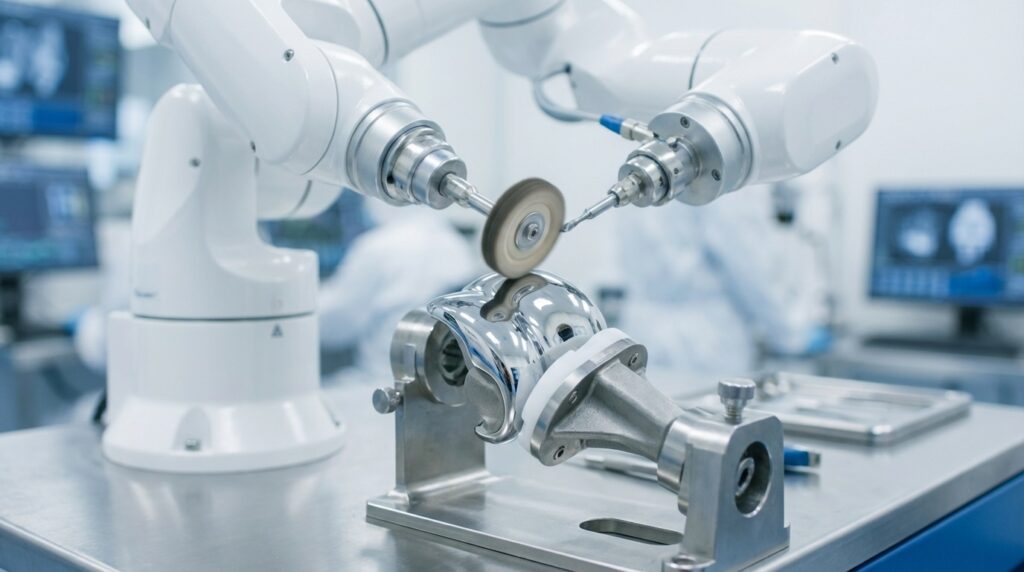
The surface roughness and contour precision of orthopedic implants directly determine their fit with human bones, wear resistance, and ultimate service life. Starting from the extreme requirements of medical device manufacturing, this article provides an in-depth analysis of the key technical challenges in automated polishing and grinding of titanium orthopedic implants. We cover medical-grade surface requirements, the limitations of manual grinding, and the application of robotic active force control and micron-level path control technologies. Through detailed technical data and equipment-level process control, we examine how robotic finishing systems are designed to support customer validation in regulated industries while improving surface quality and production consistency.
What are Orthopedic Implants?
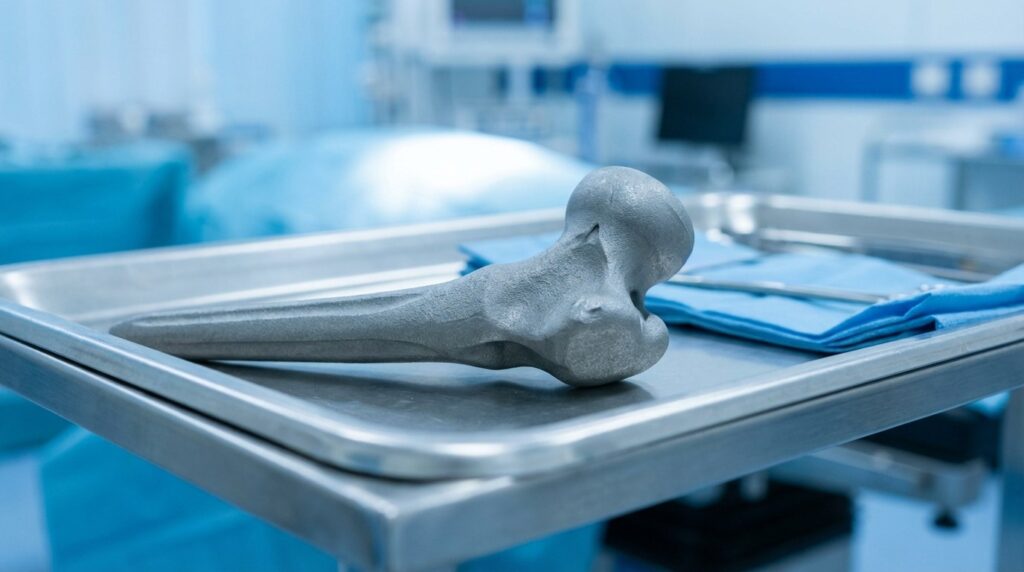
Orthopedic implants are precision medical devices used to replace, support, or repair damaged bones and joints in the human body. Because they must remain in the human body for extended periods or permanently, they are primarily made of highly biocompatible materials, such as Titanium alloys (Ti-6Al-4V) or Cobalt-Chromium-Molybdenum alloys (CoCrMo).
Application Scenarios For Orthopedic Implant
Orthopedic implants are widely used in various joint replacement, spinal repair, and trauma fracture fixation surgeries. Different application areas demand vastly different, sometimes contradictory, surface treatments:
- Artificial Knee and Hip Joints (Articular Surfaces): These are the friction-bearing areas where bones articulate. They require ultimate mirror polishing (Ra < 0.05μm) to minimize metallic wear debris and prevent implant loosening.
- Implant Stems and Non-Articular Surfaces: These parts need to bond tightly with bone tissue (osseointegration) and typically require retaining or creating specific rough textures (e.g., porous coatings or sandblasted finishes).
This dictates that polishing equipment must not only achieve extremely high finishes but also possess precise localized polishing control, ensuring that areas meant to remain rough are left untouched. For a closer look at the mirror-finishing of spherical bearing surfaces such as femoral heads, see our dedicated article on artificial joint implant robotic polishing.
Structural Characteristics For Orthopedic Implant
Orthopedic implants feature extremely complex structures:
- Complex Bionic Free-form Curves: Completely mimicking human bone morphology, they contain numerous irregular protrusions, grooves, and tiny transitional radii, with almost no standard geometric shapes.
- Stringent Contour Tolerances: The contact surfaces of artificial joints must match perfectly. Micron-level shape errors can lead to uneven stress distribution and accelerated wear.
- Difficult-to-Machine Material Properties: Titanium alloys possess high hardness and extremely poor thermal conductivity. During grinding and polishing, they generate intense heat quickly, which can cause surface burning, oxidative discoloration, or microstructural changes.
Key Characteristics of Orthopedic Implants
Key Characteristics:
- Medical-Grade Surface Roughness: Articular friction surfaces must achieve a super-mirror finish of Ra < 0.05μm.
- Micron-Level Shape Fidelity: The polishing process must absolutely not destroy the bionic contour precision machined by the CNC.
- Full Quality Traceability and Consistency: Implant manufacturers operate under strict quality systems. The machining process for every implant must be stable and repeatable, with scrap controlled through process design rather than sorted out at final inspection.
Technical Parameters for Implant Polishing
| Item | Parameter Range | Notes |
| Tool Mark Blending | Flexible Belt / Nylon Wheel | Gently remove micro-marks left by CNC machining |
| Fine Polishing Speed | 1500 – 3000 rpm | Uses specific medical-grade compound & small cloth wheels |
| Contact Tolerances | < 0.01 mm | Relies on high-frequency active force control systems |
| Final Surface Roughness | Ra 0.02 – 0.05 μm | Typical target range for CoCrMo and Ti-6Al-4V bearing surfaces, per customer drawing |
| Production Environment | ISO Class 7 or 8 Cleanroom | Strict control over dust and cross-contamination |
Why is Robotic Polishing Preferred for Orthopedic Implants?
Conventional Manual Polishing Pain Points
When processing high-precision implants like titanium artificial joints, traditional manual polishing faces insurmountable bottlenecks:
| Pain Point | Specific Issue | Impact |
| Severe Risk of Contour Distortion | Titanium is hard to polish. Workers often press too hard to increase efficiency. | Causes highly expensive titanium parts to be scrapped due to dimensional errors; yields struggle to exceed 85%. |
| Frequent Thermal Burning | Titanium has poor thermal conductivity. Slightly prolonged manual polishing causes high localized heat. | Leads to surface oxidative discoloration or even alters fatigue strength, posing severe medical risks. |
| Inability to Reach Micro Dead Zones | Artificial joints have tiny transitional grooves. Manual wheels cannot enter precisely. | Leaves unpolished dark spots, failing strict medical quality inspections. |
Advantages of Robotic Automation
Medical-grade robotic polishing cells (combining high-precision vision with micro-feed force control) offer a practical way to break through titanium polishing bottlenecks:
| Comparison Dimension | Manual Polishing | Robotic Polishing | Improvement |
| Contour Fidelity | Relies on worker feel, high error | Follows bionic curves with constant contact force | Consistent contour accuracy from batch to batch |
| Thermal Damage | Frequent | Constant pressure/speed, no heat buildup | Largely prevents titanium surface burning |
| Product Consistency | High batch-to-batch variation | Micron-level repeatability | Process data logging supports customer quality audits |
| Consumables & Environment | Severe polishing dust pollution | Enclosed cell with MQL | Compatible with cleanroom production environments |
Core Advantages:
- Active Compliant Force Control: This is the core of processing orthopedic implants, and the same technology that distinguishes modern robotic polishing machines from rigid automation. The robot spindle is equipped with an ultra-sensitive 6-axis force sensor, allowing it to softly conform to the joint’s curves with extremely light, constant pressure (e.g., 2-5N), achieving “removing tool marks without harming the contour.”
- Precision Localized Processing: Equipped with a multi-station Automatic Tool Changer (ATC), the robot can automatically switch to tiny diameter polishing burrs to penetrate and process complex blind zones in artificial pelvises or knee joints based on curve variations.
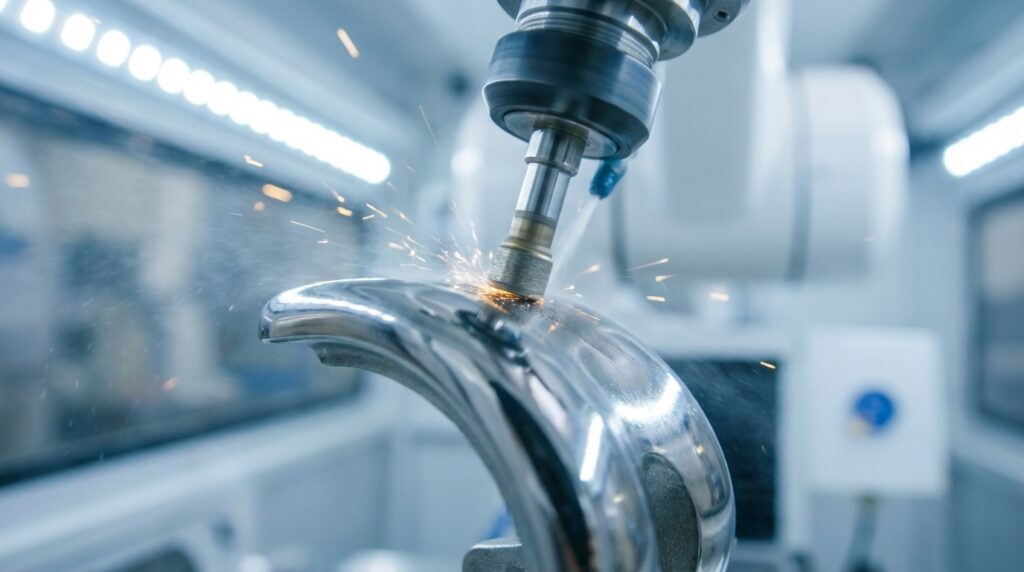
- Low-Temperature Cold Cutting Strategy: By precisely controlling the robot’s feed rate and micro-spraying polishing fluids, it effectively dissipates cutting heat from the titanium surface, preventing any alteration to the metallographic structure.
Automated Polishing Process Workflow
This process uses 8 steps to complete the surface treatment of a titanium artificial knee joint. Because the preceding CNC machining precision is already very high, the main goal of polishing is to eliminate microscopic tool marks and achieve an ultimate mirror finish. The core processes are the multi-stage micro-force grinding and polishing in steps 02-04.
Orthopedic Implant Polishing Complete Process Flow
| Process | Process Name | Equipment | Consumable | Time | Precision / Purpose |
| 01 | Non-Destructive Loading | Flexible Gripper + Robot | Polyurethane Protectors | 15s | Ensures repeat positioning without scratching |
| 02 | Flexible Blending | Robot + Force Control Spindle | Fine Nylon/Wool Wheel | 90s | Eliminates micron-level marks from 5-axis CNC |
| 03 | Blind Zone Micro-Polishing | Robot + High-Speed Spindle | Mounted Micro Burr | 75s | Processes complex transitions like the femoral condyle |
| 04 | Mirror Buffing | Robot + Polisher | Soft Cotton Cloth + Medical Compound | 120s | Achieves ultimate mirror finish Ra < 0.05μm |
| 05 | Purified Cleaning | Multi-Tank Ultrasonic Line | Medical-Grade Solvent | 300s | Thoroughly strips compound residue and micro-particles |
| 06 | DI Water Rinse | High-Pressure Spray Cabin | Deionized (DI) Water | 60s | Ensures no ionic residue on the surface |
| 07 | Cleanroom Drying | Vacuum Drying Oven | – | 120s | Rapid drying in a dust-free environment |
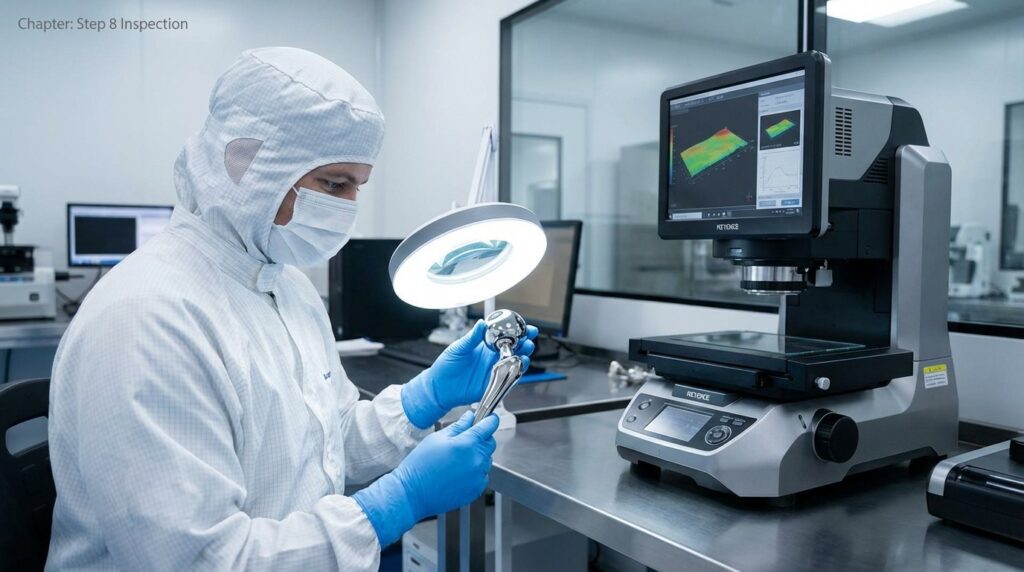
| 08 | Medical-Grade Inspection | 3D Optical Profilometer | – | 45s | Measures surface roughness and geometric tolerances |
Orthopedic Implant Polishing Process Descriptions
Step 1: Non-Destructive Loading
Purpose: Securely grip the implant without damaging the already-machined rough surfaces (designed for bone integration).
Key Points: The fixture must be wrapped in medical-grade polyurethane or Teflon to prevent metal grippers from leaving indentations on the titanium surface.
Step 2: Flexible Blending
Purpose: Gently eliminate the microscopic grid-like tool marks left by 5-axis CNC milling, laying the foundation for mirror polishing.
Key Points: Force control mode MUST be engaged. The robot glides evenly over the articular surface with extremely light contact force (2-5N) to prevent creating any cutting steps.
Step 3: Blind Zone Micro-Polishing
Purpose: Process complex concave curves (like the intercondylar notch of a knee joint) that large polishing wheels cannot reach.
Key Points: The robot automatically changes to mounted burrs, perhaps only 10mm-20mm in diameter, performing high-speed, minimal-pressure fine grinding in tight spaces.
Step 4: Mirror Buffing
Purpose: Polish the friction articular surface to an ultra-mirror finish to minimize wear after implantation in the human body.
Key Points: Uses extremely soft cotton wheels combined with specialized, biocompatible medical-grade polishing liquids. The entire process strictly controls temperature to avoid surface burning.
Step 5: Purified Cleaning
Purpose: Medical devices have zero tolerance for particulate residue. Ultrasonic cleaning must thoroughly strip polishing liquids and titanium powder hidden deep within micro-pores.
Step 6: DI Water Rinse
Purpose: Wash away cleaning solvents using high-purity Deionized water, ensuring the biological cleanliness of the implant surface.
Step 7: Cleanroom Drying
Purpose: Thoroughly dry the moisture in a vacuum or High-Efficiency Particulate Air (HEPA) filtered environment to prevent secondary contamination.
Step 8: Medical-Grade Inspection
Purpose: Generate complete surface roughness and 3D dimensional inspection reports using high-end equipment like non-contact 3D optical profilometers, achieving quality traceability for every product.
Machining Challenges & Solutions
Challenge 1: Titanium is Highly Prone to Thermal Burning and Deformation
Problem:
- Titanium alloys have extremely low thermal conductivity. Heat generated during polishing cannot dissipate quickly and concentrates on the contact surface.
- Excessive temperature not only causes the surface to oxidize and turn blue (a severe cosmetic defect) but can also release internal stress in thin-walled structures, causing micro-deformation and destroying assembly precision.
Solution:
- Introduce Cold Flexible Grinding Strategies and Minimum Quantity Lubrication (MQL). These are the same thermal-management principles covered in our general robotic grinding guide, applied here with tighter limits.
- Robot polishing programs are strictly prohibited from dwelling in the same area for long. A toolpath strategy of “small depth of cut, high frequency, fast feed” is adopted. Concurrently, precisely sprayed atomized coolant/polishing fluid keeps the contact point temperature strictly below the material’s phase transformation threshold.
- Result: Scrap caused by localized overheating is largely eliminated, and metallographic inspection of finished surfaces consistently confirms an undisturbed base structure.
Challenge 2: Extremely Poor Tool Accessibility in Polishing Dead Zones
Problem:
- Orthopedic implants (such as artificial pelvic components) feature many tiny radii and deep grooves that standard polishing wheels simply cannot enter.
Solution:
- Multi-Station Collaboration and Automatic Tool Changer (ATC).
- The cell is equipped with polishing tools of various sizes and shapes. Through precise simulation using Offline Programming (OLP) software, the robot, much like a dentist, can automatically pick up ultra-fine ball-nose or conical burrs and reach into blind zones at specific angles for fine finishing.
- Result: Full-surface polishing coverage with no dead zones, helping finished parts meet strict visual inspection requirements.
Application Scenario
Production Background
A typical application for this type of cell is the finishing line of an orthopedic implant manufacturer producing artificial hip and knee components. The workpiece in this scenario is the CoCrMo femoral component of a knee joint—a small, highly curved part where the articular surface must be brought to a mirror finish while the surrounding geometry stays untouched.
Technical Challenges
- The femoral condyle component of the artificial knee joint is made of extremely difficult-to-machine Cobalt-Chromium-Molybdenum (CoCrMo) alloy, with highly complex curves.
- The drawing calls for a mirror finish in the Ra 0.02 μm class on the articular surface, with geometric contour deviations held within a few microns.
- The finishing process needs complete data recording and traceability to support the manufacturer’s quality audits and process validation documentation.
The Solution
| Item | Configuration |
| Workpiece | CoCrMo Artificial Knee Joint (Femoral Condyle) |
| Material | CoCrMo Alloy |
| Equipment | Medical-Grade 6-Axis Robot + 6D Force Control + Cleanroom-Compatible Enclosure |
| Core Tech | High-Frequency Active Force Control + OLP + Full-Process Data Monitoring |
| Process | Flexible Blending -> Blind Zone Micro-Grinding -> Soft Cloth Mirror Polish |
| Cycle Time | Several minutes per piece at high precision |
Implementation Results
- Precision Performance: With the high-precision force control system, contour deviations are held within a few microns of the CAD model, and surface roughness stabilizes in the Ra 0.02-0.05 μm range, meeting the drawing requirements.
- Process Traceability: The system records the underlying parameters—pressure, speed, coordinates—for every joint machined. This documented process evidence supports the manufacturer’s quality audits and process validation activities.
- Clean Production: The cell integrates high-level dust filtration and micro-negative pressure systems, making it compatible with ISO Class 7/8 cleanroom surroundings and reducing cross-contamination risks.
FAQ
Q1: Can robotic polishing truly guarantee not to destroy the high-precision contours milled by CNC?
A: Yes, when an active force control system is used. If a traditional rigid robot deviates by 0.1mm, it severely gouges the workpiece. However, a robot equipped with a force sensor acts like a spring; even if it encounters a 0.5mm or 1mm curve error, it automatically yields, always maintaining a constant, gentle pressure of, say, 3N. This “soft contact” removes the micron-level roughness peaks and valleys without altering the macroscopic geometric contour.
Q2: Is it easy to change over the robot for low-volume, high-mix orthopedic implants (like custom joints)?
A: Very easy. Orthopedic implants indeed come in numerous specifications. Our solution deeply integrates OLP (Offline Programming) software. When introducing a new joint specification, engineers simply import the 3D model into the software, which automatically generates smooth polishing paths and performs interference checks. On the shop floor, the operator only needs to load the corresponding program and swap the quick-change fixture. The entire changeover typically takes less than 10 minutes.
Q3: Titanium dust generated during polishing poses an explosion risk. How does the system prevent this?
A: Titanium and aluminum dust fires are a serious, well-documented hazard, and the cell is engineered around it. Our medical-grade polishing cells come standard with a high level of safety protection: ATEX-rated explosion-proof dust extraction, wet-type vacuum designs that rapidly cool and settle the dust, and MQL spray measures within the fully enclosed cell, so the polishing process can be operated safely within a documented fire-protection concept.
Q4: How does the ROI (Return on Investment) for medical device polishing compare to the general hardware industry?
A: While the initial investment for a customized force-controlled robotic cell for medical devices is higher than standard polishing equipment, the payback is often faster than in general hardware polishing. The reason is simple: implant workpieces carry a high unit value and a very low tolerance for scrap. A system that cuts the scrap rate of titanium joints by even a few percentage points typically recovers its investment in one to two years, in addition to the savings in high-skilled labor costs.
Conclusion
The surface treatment of titanium orthopedic implants using an automated robotic polishing system with micron-level active force control is a proven route to meeting the precision, traceability, and process-validation requirements of modern implant manufacturing. It addresses the contour distortion and thermal damage issues typical of manual grinding, and it raises the quality ceiling of scalable medical product manufacturing.
If you are seeking to improve the polishing yield of artificial joints, solve complex curve machining challenges, or wish to strengthen the process documentation behind your finishing line, contact our advanced manufacturing engineering team for professional project assessment and proof-of-concept testing services.