整形外科用インプラントの表面粗さと輪郭精度は、人骨との適合性、耐摩耗性、最終的な耐用年数を直接決定します。の極端な要件から出発しています。 医療機器製造, this article provides an in-depth analysis of the key technical challenges in automated polishing and grinding of titanium orthopedic implants. We cover medical-grade surface requirements, the limitations of manual grinding, and the application of robotic active force control and micron-level path control technologies. Through detailed technical data and equipment-level process control, we examine how robotic finishing systems are designed to support customer validation in regulated industries while improving surface quality and production consistency.
整形外科用インプラントとは?
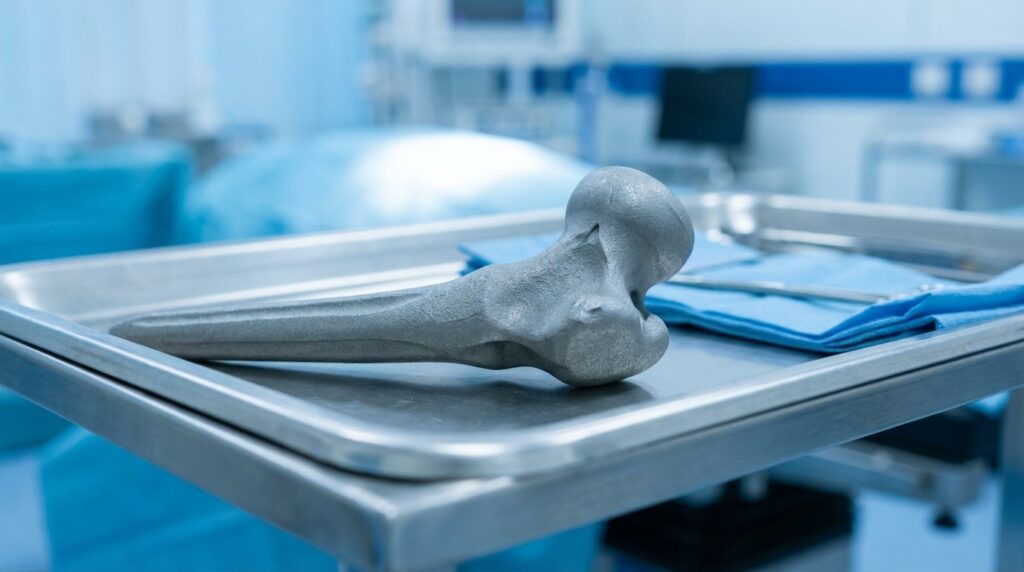
整形外科用インプラントは、人体の損傷した骨や関節を置換、支持、修復するために使用される精密医療機器です。インプラントは、長期間または永久的に人体に留置される必要があるため、主にチタン合金(Ti-6Al-4V)やコバルト-クロム-モリブデン合金(CoCrMo)などの生体適合性の高い材料で作られています。.
整形外科インプラントの応用シナリオ
整形外科用インプラントは、様々な人工関節置換術、脊椎修復術、外傷骨折固定術に広く使用されています。用途が異なれば、求められる表面処理も大きく異なり、時には相反することもあります:
- 人工膝関節と人工股関節(関節面):骨が連結する摩擦を受ける部分です。金属摩耗粉を最小限に抑え、インプラントのゆるみを防ぐため、究極の鏡面研磨(Ra < 0.05μm)が必要です。.
- インプラントの茎と非関節面:これらの部品は骨組織と強固に結合する必要があり(オッセオインテグレーション)、通常、特定の粗いテクスチャー(多孔質コーティングやサンドブラスト仕上げなど)を保持または作成する必要がある。.
このため、研磨装置には極めて高い仕上げが要求されるだけでなく、次のような特性も求められます。 精密な局所研磨制御, ensuring that areas meant to remain rough are left untouched. For a closer look at the mirror-finishing of spherical bearing surfaces such as femoral heads, see our dedicated article on artificial joint implant robotic polishing.
整形外科用インプラントの構造特性
整形外科用インプラントは非常に複雑な構造をしている:
- 複雑なバイオニック・フリーフォーム・カーブ:人間の骨の形態を完全に模倣し、多数の不規則な突起、溝、微小な移行半径を含み、標準的な幾何学的形状はほとんどない。.
- 厳しい輪郭公差:人工関節の接触面は完全に一致しなければなりません。ミクロン単位の形状誤差は、不均一な応力分布や摩耗の加速につながります。.
- 難削材の特性:チタン合金は高い硬度と極めて低い熱伝導性を持っています。研削や研磨の際、チタン合金は短時間で高熱を発生し、表面の焼け、酸化変色、微細構造の変化を引き起こす可能性があります。.
整形外科インプラントの主な特徴
主な特徴:
- 医療グレードの表面粗さ:関節摩擦面は、Ra < 0.05μmのスーパーミラー仕上げでなければならない。.
- ミクロンレベルの形状忠実度:研磨工程は、CNCによって加工されたバイオニックな輪郭の精度を絶対に壊してはならない。.
- Full Quality Traceability and Consistency: Implant manufacturers operate under strict quality systems. The machining process for every implant must be stable and repeatable, with scrap controlled through process design rather than sorted out at final inspection.
インプラント研磨の技術的パラメーター
| 項目 | パラメータ範囲 | 備考 |
| ツールマークのブレンド | フレキシブルベルト/ナイロンホイール | CNC加工で残ったマイクロマークを優しく取り除く |
| 精密研磨速度 | 1500 - 3000 rpm | 特定の医療グレードのコンパウンドと小さな布製ホイールを使用 |
| 接触公差 | < 0.01 mm | 高周波アクティブ・フォース・コントロール・システムに頼る |
| 最終表面粗さ | Ra 0.02 - 0.05 μm | Typical target range for CoCrMo and Ti-6Al-4V bearing surfaces, per customer drawing |
| 生産環境 | ISOクラス7または8のクリーンルーム | 粉塵や二次汚染を厳しく管理 |
なぜ整形外科用インプラントにロボット研磨が望ましいのですか?
従来の手作業による研磨の問題点
チタン製人工関節のような高精度のインプラントを加工する場合、従来の手作業による研磨では克服できないボトルネックに直面します:
| ペイン・ポイント | 特定の問題 | インパクト |
| 輪郭歪みの重大なリスク | チタンは磨きにくい。作業効率を上げるために、作業者はしばしば強く押しすぎる。. | 寸法誤差のために非常に高価なチタン部品が廃棄される。. |
| 頻繁な火傷 | チタンは熱伝導率が低い。手作業による研磨がやや長引くと、局所的に高い熱が発生します。. | 表面の酸化変色や疲労強度の変化を引き起こし、深刻な医療リスクをもたらす。. |
| マイクロ・デッドゾーンに到達できない | 人工関節には小さな溝がある。手動の車輪は正確に入ることができない。. | 磨ききれない黒い斑点が残り、厳しい医療品質検査に不合格となる。. |
ロボット・オートメーションの利点
Medical-grade robotic polishing cells (combining high-precision vision with micro-feed force control) offer a practical way to break through titanium polishing bottlenecks:
| 比較寸法 | 手動研磨 | ロボット研磨 | 改善 |
| 輪郭の忠実度 | 作業員の感覚に頼る、誤差が大きい | Follows bionic curves with constant contact force | Consistent contour accuracy from batch to batch |
| 熱損傷 | 頻繁 | 圧力/速度が一定で、熱がこもらない | Largely prevents titanium surface burning |
| 製品の一貫性 | 高いバッチ間ばらつき | ミクロンレベルの再現性 | Process data logging supports customer quality audits |
| 消耗品と環境 | 深刻な研磨粉塵汚染 | MQL付き密閉セル | Compatible with cleanroom production environments |
コアの利点:
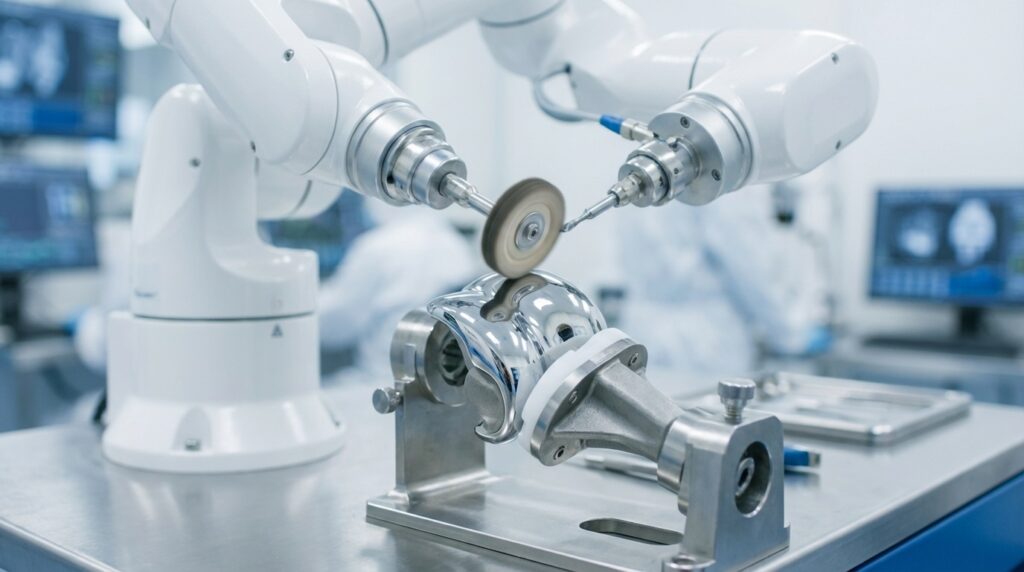
- アクティブ・コンプライアント・フォース・コントロール: This is the core of processing orthopedic implants, and the same technology that distinguishes modern robotic polishing machines from rigid automation. The robot spindle is equipped with an ultra-sensitive 6-axis force sensor, allowing it to softly conform to the joint’s curves with extremely light, constant pressure (e.g., 2-5N), achieving “removing tool marks without harming the contour.”
- 精密な局所処理:マルチステーションATC(Automatic Tool Changer:自動工具交換装置)を搭載しているため、ロボットは自動的に小径の研磨バリに切り替わり、人工骨盤や人工膝関節の複雑な不感帯をカーブの変化に基づいて貫通し、加工することができる。.
- 低温冷間切断戦略:ロボットの送り速度を精密に制御し、研磨液をマイクロスプレーすることで、チタン表面から切削熱を効果的に放散させ、金属組織の変化を防ぎます。.
自動化された研磨工程のワークフロー
このプロセスでは 8ステップ チタン製人工膝関節の表面処理を完了させるためである。先行するCNC加工の精度はすでに非常に高いため、研磨の主な目的は以下のとおりです。 微細なツールマークを除去し、究極の鏡面仕上げを実現. .その 核となる工程は、ステップ02-04の多段マイクロフォース研削と研磨である。.
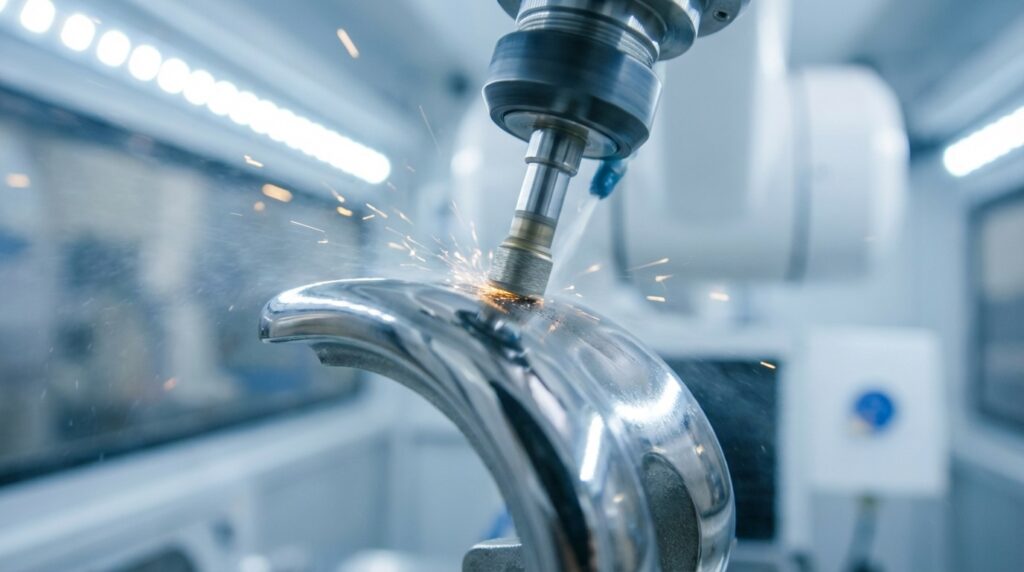
整形外科インプラント研磨の全工程の流れ
| プロセス | プロセス名 | 設備 | 消耗品 | 時間 | 精度/目的 |
| 01 | 非破壊負荷 | フレキシブル・グリッパー+ロボット | ポリウレタンプロテクター | 15s | 傷をつけずに繰り返し位置決めができる |
| 02 | 柔軟なブレンド | ロボット+力制御スピンドル | ファイン・ナイロン/ウール・ホイール | 90s | 5軸CNCからミクロンレベルのマークを除去 |
| 03 | ブラインド・ゾーン・マイクロ研磨 | ロボット+高速スピンドル | マイクロバリ | 75s | 大腿骨顆のような複雑な移行部を処理する |
| 04 | ミラーバフ | ロボット+ポリッシャー | 柔らかい綿布+医療用コンパウンド | 120s | 究極の鏡面仕上げRa < 0.05μmを達成 |
| 05 | 浄化洗浄 | 多槽式超音波ライン | 医療グレード溶剤 | 300s | コンパウンドの残留物や微粒子を徹底的に除去 |
| 06 | 純水リンス | 高圧スプレーキャビン | 脱イオン(DI)水 | 60s | 表面にイオンが残らないようにする。 |
| 07 | クリーンルーム乾燥 | 真空乾燥炉 | - | 120s | 埃のない環境での迅速な乾燥 |
| 08 | 医療グレードの検査 | 3D光学式プロフィロメーター | - | 45s | 表面粗さと幾何公差の測定 |
整形外科インプラント研磨工程の説明
ステップ1:非破壊負荷
目的:既に加工された粗面(骨との一体化のために設計された)を傷つけることなく、インプラントを確実に把持します。.
キーポイント:金属製のグリッパーがチタンの表面にくぼみを残すのを防ぐため、固定具は医療グレードのポリウレタンかテフロンで包まれなければなりません。.
ステップ2:柔軟なブレンド
目的:5軸CNCフライス加工で残る微細な格子状の工具痕を優しく除去し、鏡面研磨の土台を作ります。.
キーポイント:力制御モードは必ず作動させてください。ロボットは極めて軽い接触力(2-5N)で関節面上を均一に滑走し、切断段差を生じさせない。.
ステップ3:ブラインドゾーンのマイクロ研磨
目的:大きな砥石では届かない複雑な凹曲線(膝関節の顆間ノッチのような)を加工します。.
キーポイント:直径10mm~20mm程度のバリを自動で交換し、狭いスペースでも高速・低圧で微粉砕を行う。.
ステップ4:ミラーバフ
目的:摩擦関節面を超鏡面仕上げに研磨し、人体移植後の摩耗を最小限に抑える。.
キーポイント:非常に柔らかいコットンホイールと、生体適合性に優れた医療用研磨液を使用。全工程で温度を厳密に管理し、表面の火傷を防ぎます。.
ステップ5:浄化洗浄
目的:医療機器は微粒子の残留が許されません。超音波洗浄は、微細孔の奥深くに隠れた研磨液やチタン粉を徹底的に剥離しなければなりません。.
ステップ6:純水リンス
目的:高純度の脱イオン水を使用して洗浄溶剤を洗い流し、インプラント表面の生物学的清浄度を確保する。.
ステップ7:クリーンルーム乾燥
目的:二次汚染を防ぐため、真空またはHEPA(High-Efficiency Particulate Air)フィルターを使用した環境で水分を十分に乾燥させてください。.
ステップ8:医療グレードの検査
目的:非接触3D光学式プロフィロメーターのようなハイエンド機器を使用して、完全な表面粗さと3D寸法検査レポートを作成し、すべての製品の品質トレーサビリティを実現します。.
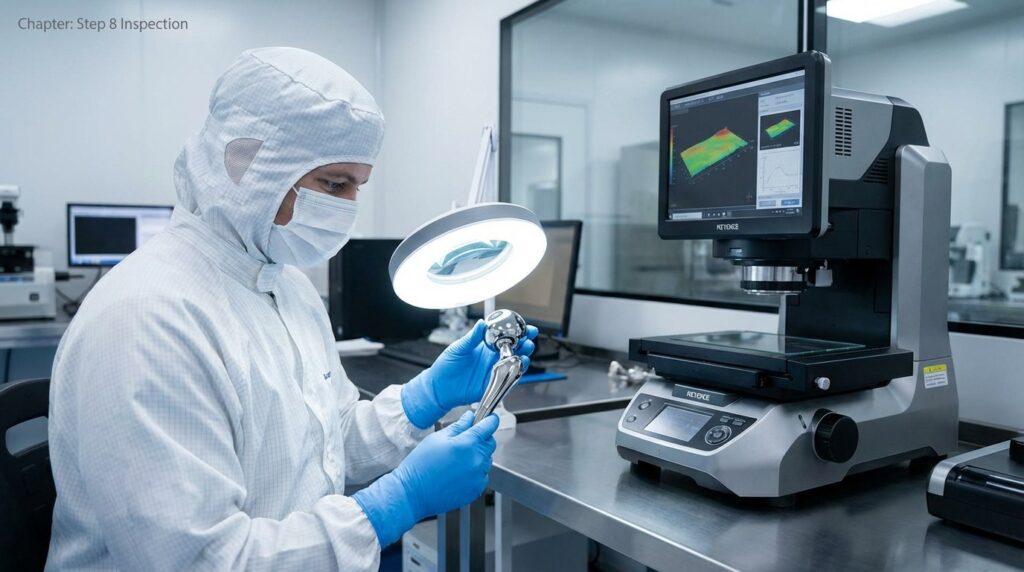
機械加工の課題と解決策
課題1:チタンは熱による燃焼や変形を起こしやすい
問題点:
- チタン合金は熱伝導率が極めて低い。研磨中に発生した熱はすぐに放散することができず、接触面に集中します。.
- 過度の温度は、表面を酸化させて青く変色させる(外観上の重大な欠陥)だけでなく、薄肉構造の内部応力を解放して微小変形を引き起こし、組立精度を破壊する可能性がある。.
ソリューション:
- 冷間フレキシブル研磨戦略と最小量潤滑(MQL)の導入. These are the same thermal-management principles covered in our general robotic grinding guide, applied here with tighter limits.
- ロボットの研磨プログラムは、同じエリアに長く留まることは厳禁である。小切込み、高周波、高速送り」のツールパス戦略を採用。同時に、精密に噴霧されたクーラント/研磨液により、接触点の温度は材料の相変態閾値以下に厳密に保たれます。.
- 結果: Scrap caused by localized overheating is largely eliminated, and metallographic inspection of finished surfaces consistently confirms an undisturbed base structure.
課題2:デッドゾーンの研磨における工具の使い勝手の悪さ
問題点:
- 整形外科用インプラント(人工骨盤部品など)には、標準的な研磨砥石では入り込めないような小さな半径や深い溝が数多くあります。.
ソリューション:
- マルチステーション・コラボレーションとオートマチック・ツール・チェンジャー(ATC).
- このセルには、さまざまなサイズと形状の研磨ツールが搭載されています。オフライン・プログラミング(OLP)ソフトウェアを使用した精密なシミュレーションにより、ロボットは歯医者のように、極細のボールノーズや円錐形のバリを自動的に拾い上げ、特定の角度で不感帯に到達して微細な仕上げを行うことができます。.
- 結果: Full-surface polishing coverage with no dead zones, helping finished parts meet strict visual inspection requirements.
Application Scenario
Production Background
A typical application for this type of cell is the finishing line of an orthopedic implant manufacturer producing artificial hip and knee components. The workpiece in this scenario is the CoCrMo femoral component of a knee joint—a small, highly curved part where the articular surface must be brought to a mirror finish while the surrounding geometry stays untouched.
技術的課題
- 人工膝関節の大腿骨顆部コンポーネントは、非常に複雑なカーブを持つ、加工が極めて困難なコバルト・クロム・モリブデン(CoCrMo)合金でできている。.
- The drawing calls for a mirror finish in the Ra 0.02 μm class on the articular surface, with geometric contour deviations held within a few microns.
- The finishing process needs complete data recording and traceability to support the manufacturer’s quality audits and process validation documentation.
ソリューション
| 項目 | 構成 |
| ワークピース | CoCrMo人工膝関節(大腿骨顆) |
| 素材 | CoCrMo合金 |
| 設備 | Medical-Grade 6-Axis Robot + 6D Force Control + Cleanroom-Compatible Enclosure |
| コア・テック | 高周波アクティブフォースコントロール+OLP+フルプロセスデータモニタリング |
| プロセス | フレキシブル・ブレンディング -> ブラインドゾーン・ミクロ研磨 -> ソフトクロス・ミラー・ポリッシュ |
| サイクルタイム | Several minutes per piece at high precision |
実施結果
- Precision Performance: With the high-precision force control system, contour deviations are held within a few microns of the CAD model, and surface roughness stabilizes in the Ra 0.02-0.05 μm range, meeting the drawing requirements.
- Process Traceability: The system records the underlying parameters—pressure, speed, coordinates—for every joint machined. This documented process evidence supports the manufacturer’s quality audits and process validation activities.
- クリーン生産: The cell integrates high-level dust filtration and micro-negative pressure systems, making it compatible with ISO Class 7/8 cleanroom surroundings and reducing cross-contamination risks.
よくあるご質問
Q1:ロボット研磨は、CNCで削り出した高精度の輪郭を壊さないことを本当に保証できますか?
A: Yes, when an active force control system is used. If a traditional rigid robot deviates by 0.1mm, it severely gouges the workpiece. However, a robot equipped with a force sensor acts like a spring; even if it encounters a 0.5mm or 1mm curve error, it automatically yields, always maintaining a constant, gentle pressure of, say, 3N. This “soft contact” removes the micron-level roughness peaks and valleys without altering the macroscopic geometric contour.
Q2: 少量多品種の整形外科用インプラント(カスタム・ジョイントなど)のロボットへの切り替えは簡単ですか?
A:とても簡単です。整形外科用インプラントには実に多くの仕様があります。当社のソリューションは、OLP(オフライン・プログラミング)ソフトウェアを深く統合しています。新しい関節仕様を導入する際、エンジニアは3Dモデルをソフトウェアにインポートするだけで、スムーズな研磨経路が自動的に生成され、干渉チェックが実行されます。現場では、オペレーターは対応するプログラムをロードし、クイックチェンジ治具を交換するだけです。交換に要する時間は通常10分以内です。.
Q3: 研磨時に発生するチタン粉塵は爆発の危険があります。どのように防ぐのですか?
A: Titanium and aluminum dust fires are a serious, well-documented hazard, and the cell is engineered around it. Our medical-grade polishing cells come standard with a high level of safety protection: ATEX-rated explosion-proof dust extraction, wet-type vacuum designs that rapidly cool and settle the dust, and MQL spray measures within the fully enclosed cell, so the polishing process can be operated safely within a documented fire-protection concept.
Q4: 医療機器研磨のROI(投資利益率)は、一般的なハードウェア業界と比べてどうですか?
A: While the initial investment for a customized force-controlled robotic cell for medical devices is higher than standard polishing equipment, the payback is often faster than in general hardware polishing. The reason is simple: implant workpieces carry a high unit value and a very low tolerance for scrap. A system that cuts the scrap rate of titanium joints by even a few percentage points typically recovers its investment in one to two years, in addition to the savings in high-skilled labor costs.
結論
を用いたチタン製整形外科インプラントの表面処理 ミクロンレベルのアクティブフォース制御による自動ロボット研磨システム is a proven route to meeting the precision, traceability, and process-validation requirements of modern implant manufacturing. It addresses the contour distortion and thermal damage issues typical of manual grinding, and it raises the quality ceiling of scalable medical product manufacturing.
If you are seeking to improve the polishing yield of artificial joints, solve complex curve machining challenges, or wish to strengthen the process documentation behind your finishing line, コンタクト 当社の高度製造エンジニアリングチームが、専門的なプロジェクト評価と概念実証試験サービスを提供します。.