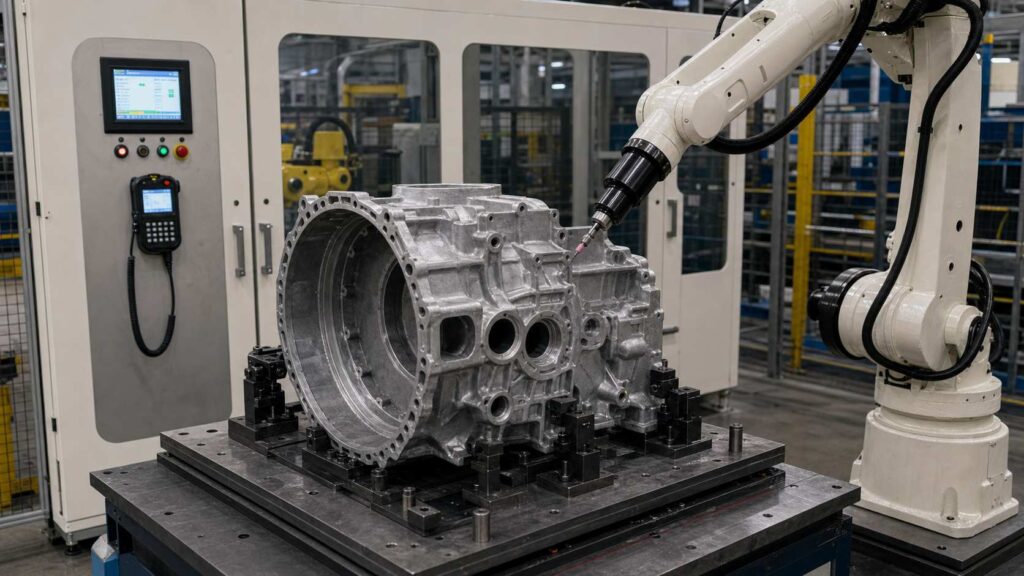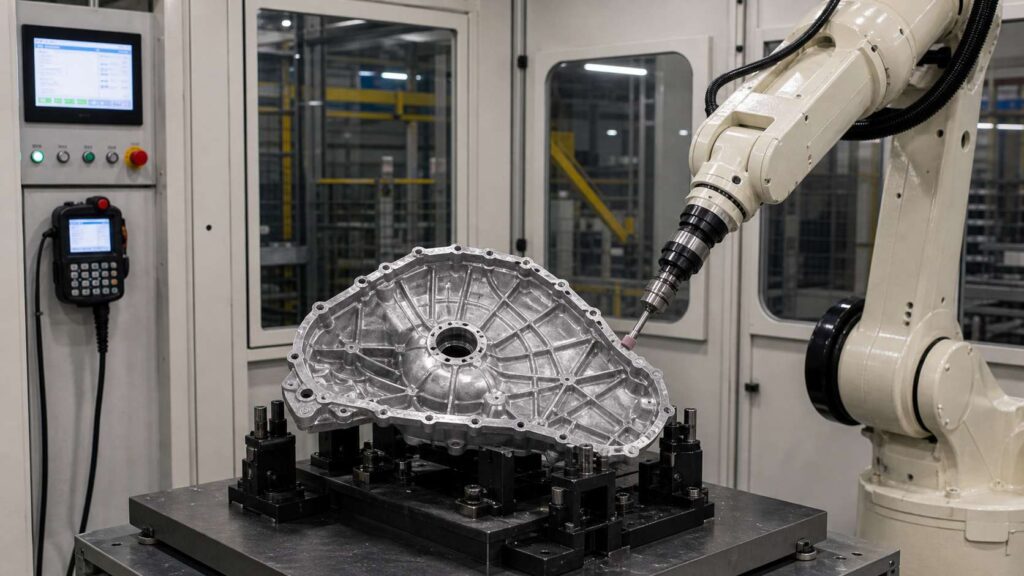
Aluminum alloy CVT transmission side covers are thin-wall die casting components used in continuously variable transmission systems. Based on typical CVT side cover workpieces, this part includes a wide cover body, sealing flange, mounting holes, reinforced ribs, local oil passage areas, boss features and irregular outer contours. After die casting, trimming and machining, burrs, flash, sharp edges and local residues may remain around the flange perimeter, hole edges, rib transitions and outer contour areas.
This robotic deburring solution is designed for aluminum alloy CVT transmission side covers used in automotive transmission systems. It helps remove burrs and sharp edges from sealing flanges, mounting holes, outer contours, rib edges, local oil passage boundaries and gate-cut areas while improving finishing consistency and reducing manual deburring workload.
What Is an Aluminum Alloy CVT Transmission Side Cover?
An aluminum alloy CVT transmission side cover is a die casting part used to close, protect and support the side area of a continuously variable transmission. It is usually assembled onto the transmission main housing and works together with sealing gaskets, bolts and internal transmission components. Compared with a CVT transmission main housing, the side cover is usually flatter, thinner and more cover-like, but it still includes many functional edges that require controlled deburring.
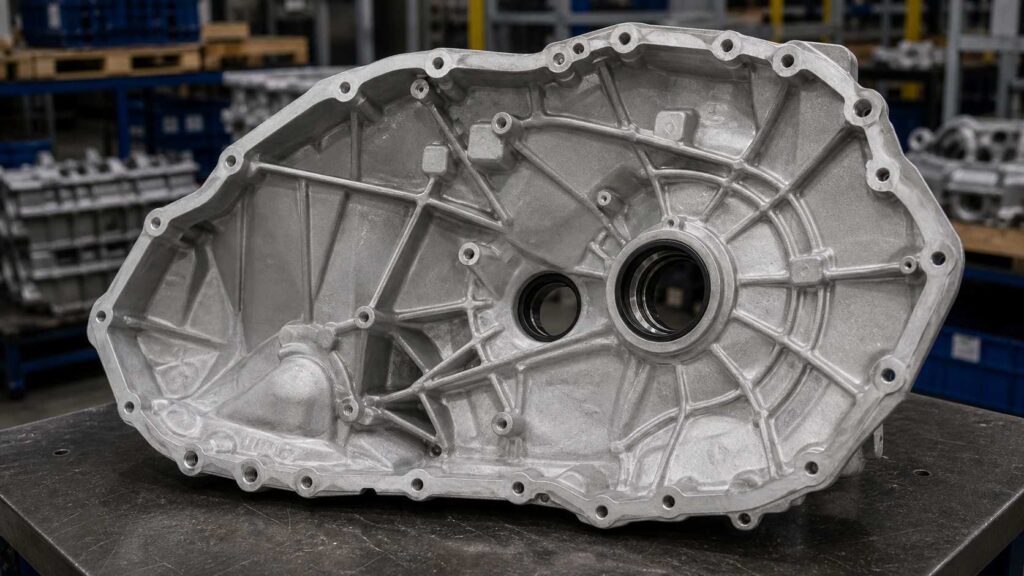
Based on typical CVT side cover structures, this workpiece has a thin-wall cover body, continuous sealing flange, multiple mounting holes, reinforced ribs, local bosses, oil passage-related features and irregular external contours. Burrs can appear around the flange edge, bolt holes, machined openings, casting parting lines, trimming edges and rib intersections. Since the part is related to transmission sealing and assembly, the finishing process must remove burrs without damaging sealing faces, machined hole surfaces or gasket contact areas.
For this type of workpiece, the main finishing requirement is robotic deburring, edge cleanup and controlled burr removal rather than heavy grinding or decorative polishing.
| Artículo | Detalles |
|---|---|
| Nombre de la pieza | Aluminum Alloy CVT Transmission Side Cover |
| Nombre en chino | 铝合金 CVT 变速箱侧盖 |
| Alternative Name | CVT Side Cover / Transmission Side Cover / CVT Cover Plate |
| Tamaño habitual | Around 250–600 mm in length, depending on transmission model |
| Material | Aluminum Alloy Die Casting |
| Proceso principal | Desbarbado robotizado |
| Procesos asistidos | Edge Rounding, Flash Removal, Hole Edge Deburring, Local Residue Cleanup |
| Áreas clave de procesamiento | Sealing flange, mounting holes, outer contour, reinforced ribs, local bosses, oil passage edges, gate-cut areas |
| Áreas protegidas | Sealing surfaces, machined mounting faces, precision holes, gasket contact areas, internal functional surfaces |
| Gol de la victoria | Remove burrs, flash and sharp edges while protecting sealing and assembly surfaces |
Typical Finishing Challenges of Aluminum Alloy CVT Transmission Side Cover
An aluminum alloy CVT transmission side cover is not a simple flat plate. Although it is thinner than a main transmission housing, it contains many functional edges, holes, ribs and sealing-related areas. The continuous sealing flange must remain dimensionally stable, while the mounting holes and local bosses require clean edges for assembly.
Manual deburring can be inconsistent because operators must process a long flange path, many repeated holes and several small rib transitions. Some areas may be under-processed, leaving sharp burrs near holes or corners. Other areas may be over-processed, especially around sealing flanges or machined surfaces. For transmission covers, this is a risk because sealing quality and assembly reliability depend on stable edge conditions.
| Problema habitual | Área específica | Impacto |
|---|---|---|
| Flash de fundición | Outer contour, flange perimeter, parting line areas | Affects appearance, handling and assembly |
| Rebabas en los bordes de los orificios | Mounting holes, bolt holes, local openings | May affect bolt assembly and gasket installation |
| Bordes afilados | Flange edge, cover boundary, trimming areas | Creates handling risk and inconsistent edge quality |
| Rib Transition Burrs | Reinforced ribs, boss boundaries, local corners | Difficult to remove manually with stable quality |
| Variación manual | Repeated holes and long flange paths | Causes inconsistent deburring results between operators |
| Sensitive Sealing Areas | Gasket faces, machined surfaces, flange contact areas | Risk of sealing surface damage during manual processing |
Robotic Deburring Process for Aluminum Alloy CVT Transmission Side Cover
A robotic deburring cell for aluminum alloy CVT transmission side covers should be designed around stable part positioning, controlled edge contact and protection of sealing surfaces. The robot must process the flange perimeter, mounting holes, outer contour, rib transitions and local casting residues while avoiding direct contact with gasket faces, machined mounting surfaces and precision holes.
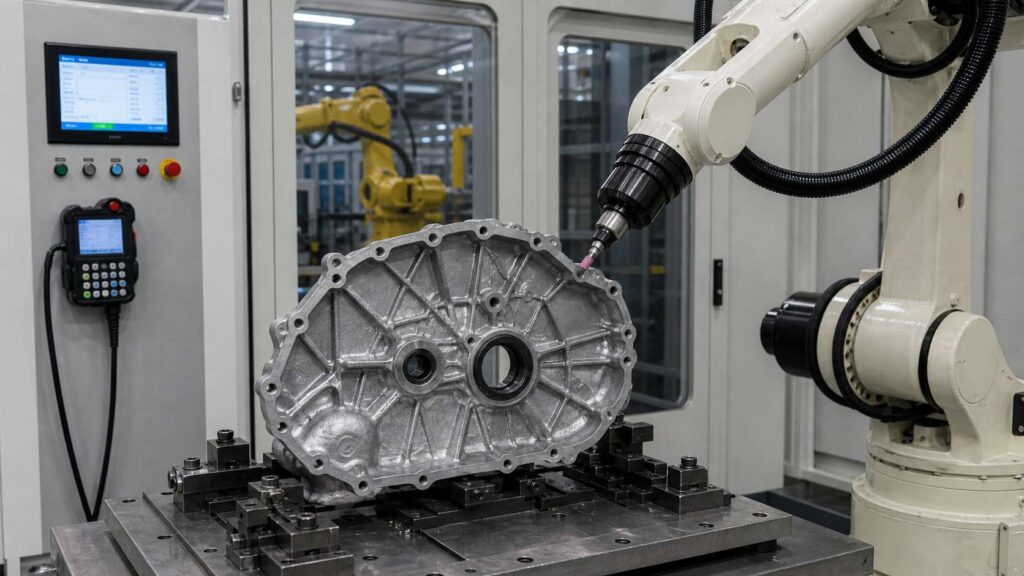
For CVT side cover parts, the process usually includes loading, positioning, program selection, flange edge deburring, outer contour cleanup, mounting hole deburring, rib and boss edge treatment, protected surface inspection, chip removal and unloading. Depending on the burr condition, the system can use flexible deburring tools, rotary brushes, chamfering tools, compliant spindles or small abrasive tools for local areas.
| Paso | Proceso | Propósito | Herramienta / Sistema |
|---|---|---|---|
| 1 | Carga y posicionamiento | Secure the CVT side cover for stable processing | Accesorio específico |
| 2 | Selección de programas | Match the correct cover model and robot path | Interfaz hombre-máquina / Programa de robot |
| 3 | Confirmación del área protegida | Define sealing faces and precision no-contact zones | Fixture reference / Program setting |
| 4 | Outer Contour Deburring | Remove flash and sharp edges from the external boundary | Herramienta de desbarbado flexible |
| 5 | Sealing Flange Edge Cleanup | Deburr flange edges without damaging gasket surfaces | Herramienta de desbarbado conforme a la normativa |
| 6 | Mounting Hole Deburring | Remove burrs from bolt holes and local openings | Herramienta de biselado / Eje de desbarbado |
| 7 | Rib and Boss Edge Treatment | Clean burrs around ribs, bosses and local transitions | Pequeña herramienta para desbarbar |
| 8 | Local Residue Cleanup | Treat small gate-cut or trimming residues if needed | Light abrasive tool |
| 9 | Control de calidad | Check burr removal and protected surfaces | Inspección manual o visual |
| 10 | Descarga y limpieza | Remove chips and transfer the finished cover | Soplado de aire / Limpieza con aspiradora |
Paso 1: Carga y colocación
The aluminum alloy CVT transmission side cover is loaded into a dedicated fixture. Because the workpiece is a thin-wall die casting, fixture support should prevent vibration and deformation during robotic deburring.
The fixture should support the cover from stable non-critical areas and expose the sealing flange, outer contour, mounting holes, ribs and local bosses. Repeatable positioning is important because the robot must follow long edge paths while avoiding protected sealing surfaces.
Paso 2: Selección del programa
After the part is fixed, the operator selects the correct robot program through the HMI. CVT side covers may vary by model, hole layout, flange contour, rib position and local boss design.
The selected program defines the deburring path, tool posture, spindle speed, feed rate, contact force and protected zones. Saved programs help maintain consistent results across repeated production batches and reduce dependence on manual operator experience.
Paso 3: Confirmación del área protegida
Before deburring starts, the robot program confirms the protected areas of the side cover. These usually include gasket contact faces, machined mounting surfaces, precision holes, internal functional areas and oil passage surfaces.
This step is important because burr-prone edges are often close to sealing and assembly surfaces. The robot should remove burrs from edge boundaries while keeping the tool away from functional faces that affect sealing performance.
Step 4: Outer Contour Deburring
The robot first processes the external contour of the CVT transmission side cover. This area may contain trimming burrs, parting line flash, local sharp edges or small casting residues.
A flexible deburring tool can follow the irregular external boundary and remove burrs with controlled pressure. Compared with manual processing, robotic path control helps keep the edge condition more stable around the full cover perimeter.
Step 5: Sealing Flange Edge Cleanup
The sealing flange is one of the most important areas on a CVT side cover. Burrs around the flange edge can affect assembly cleanliness, gasket installation and handling safety, but the sealing face itself must be protected.
A compliant deburring tool can clean the flange edge while avoiding excessive material removal. The goal is to remove sharp edges and loose burrs from the flange boundary without scratching or rounding the gasket contact surface.
Step 6: Mounting Hole Deburring
CVT side covers usually include many mounting holes and bolt holes distributed around the cover body. Burrs around these holes can affect bolt insertion, assembly fit and cleanliness.
A chamfering tool or deburring spindle can process each hole with repeatable depth and angle. The robot can repeat the same routine across multiple holes, improving consistency and reducing missed burrs compared with manual deburring.
Step 7: Rib and Boss Edge Treatment
Reinforced ribs and boss features can create small burrs at transitions, corners and casting boundaries. These areas are often difficult for manual operators to process evenly because they require frequent tool angle changes.
The robot can use a small deburring tool to clean rib edges, boss boundaries and local corner transitions. Controlled posture and programmed access help reduce residual burrs in narrow or irregular areas.
Step 8: Local Residue Cleanup
Some CVT side covers may have small gate-cut residues, trimming marks or local casting defects on non-functional areas. These areas may require light cleanup after the main deburring process.
A small abrasive tool or compliant deburring head can be used for limited local treatment. The process should avoid heavy grinding because the side cover is a thin-wall component and excessive material removal may affect appearance, strength or assembly accuracy.
Paso 9: Control de calidad
After robotic deburring, operators inspect the sealing flange, mounting holes, outer contour, ribs, bosses and local oil passage edges. The inspection confirms that burrs and sharp edges have been removed and that protected sealing surfaces remain undamaged.
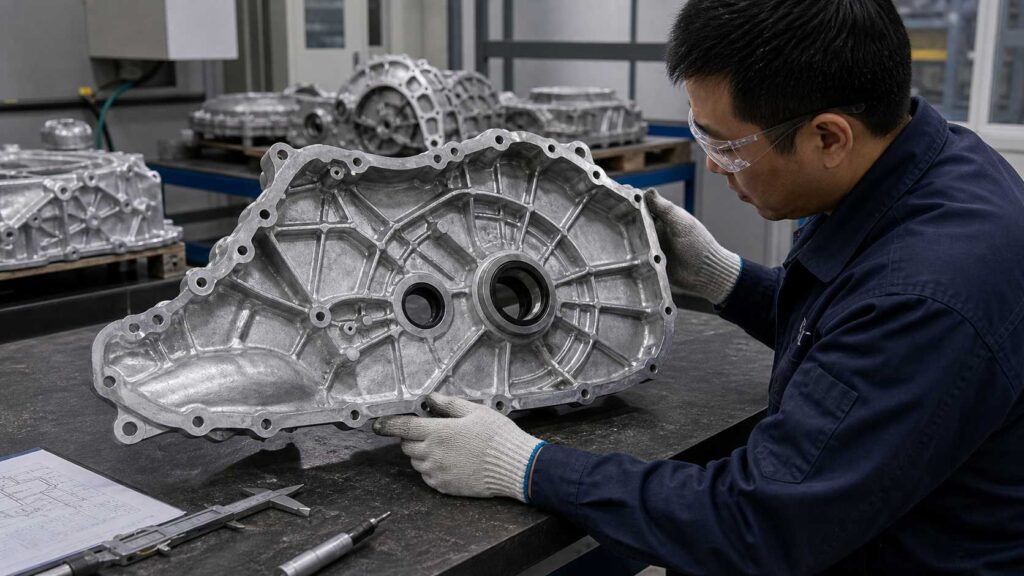
Inspection can include visual checks, manual touch checks, sample gauges or camera-based inspection depending on production requirements. Feedback from inspection can also help optimize tool life, contact pressure and robot path accuracy.
Paso 10: Descarga y limpieza
After inspection, the finished CVT side cover is unloaded and transferred to the next production process. Aluminum chips and fine particles should be removed from holes, ribs, oil passage edges and flange areas.
An enclosed robotic deburring cell with aluminum chip collection is recommended for CVT side cover production. It helps improve workshop cleanliness, reduce manual deburring intensity and provide a more stable finishing environment.
Dificultades en el mecanizado y sus soluciones
| Reto | Causa | Solución robótica |
|---|---|---|
| Thin-Wall Cover Stability | Side cover may vibrate or deform during processing | Dedicated fixture with stable support |
| Long Sealing Flange Path | Flange edge requires continuous and consistent deburring | Programmed flange-edge path with compliant tool |
| Repeated Hole Burrs | Many mounting holes require consistent edge cleanup | Chamfering routine with repeatable depth and angle |
| Rib and Boss Burrs | Reinforced structures create small hidden burrs | Small tool access with divided local paths |
| Protección funcional de superficies | Sealing faces and machined areas must not be damaged | Protected-zone programming and accurate fixture reference |
| Manual Quality Variation | Long edge paths and repeated holes are difficult to process by hand | Saved robot programs and controlled contact force |
Difficulty 1: Thin-Wall Side Cover Support
A CVT transmission side cover is thinner than a main transmission housing. If the fixture support is not stable, the part may vibrate during deburring, especially when the robot processes long outer edges or flange areas.
The solution is to use a dedicated support fixture designed for the cover geometry. The fixture should hold the part securely while avoiding contact with sealing surfaces and machined faces. Stable support helps the robot maintain consistent contact pressure and edge quality.
Difficulty 2: Sealing Flange Deburring Without Surface Damage
The sealing flange edge often needs burr removal, but the gasket contact face must remain clean and undamaged. Manual deburring may scratch the sealing face or create inconsistent edge rounding.
The solution is to define the sealing face as a protected zone and use a controlled deburring path along the flange boundary. A compliant tool can remove burrs from the edge while limiting tool pressure near the functional sealing surface.
Difficulty 3: Consistent Deburring Around Multiple Mounting Holes
CVT side covers usually have many bolt holes and mounting holes. Manual operators may miss small burrs or create inconsistent chamfers across repeated holes.
The solution is to use a robot program with repeatable hole-edge routines. A chamfering tool or deburring spindle can process each hole with controlled depth, angle and speed, improving consistency across the full part.
Difficulty 4: Burr Removal Around Ribs and Bosses
Ribs and bosses increase structural strength, but they also create local corners where burrs can remain after casting or trimming. These areas may be narrow, irregular or difficult to reach with manual tools.
The solution is to divide rib and boss areas into small processing zones. The robot can use a compact deburring tool and optimized posture to remove burrs from local transitions without over-processing nearby surfaces.
Difficulty 5: Avoiding Excessive Material Removal
Since the CVT side cover is a thin-wall die casting, heavy grinding is usually not suitable. Excessive material removal may affect local thickness, flange geometry or assembly quality.
The solution is to use robotic deburring as the main process and only apply light local cleanup where necessary. Tool selection, feed rate and contact force should be controlled according to burr size and part thickness.
Caso de fabricación
Antecedentes del cliente
An automotive transmission component manufacturer produces aluminum alloy CVT transmission side covers for continuously variable transmission assemblies. Before automation, operators manually removed burrs and sharp edges from outer contours, sealing flanges, mounting holes, ribs, boss areas and local trimming edges.
As production volume increased, manual deburring became difficult to standardize. Long flange edges required repeated manual work, and hole-edge burrs sometimes remained after processing. The customer wanted to improve deburring consistency, reduce manual workload and better protect sealing surfaces.
Retos técnicos
The workpiece had a thin-wall cover body, continuous sealing flange, multiple mounting holes, reinforced ribs, local bosses and irregular outer contours. Burrs were distributed around both exposed external edges and functional assembly areas.
The main challenge was removing burrs from the flange perimeter and repeated holes while protecting gasket faces, machined surfaces and precision openings. Because the cover structure was relatively thin, the process also needed to avoid excessive contact pressure and unnecessary grinding.
Solución
The proposed solution used a six-axis industrial robot, a dedicated CVT side cover fixture and a flexible deburring system. The robot used a compliant deburring tool for the outer contour and sealing flange, a chamfering tool for mounting holes, and a small deburring head for rib transitions and boss boundaries.
Protected sealing faces, machined mounting areas and precision holes were defined in the robot program. The fixture supported the side cover from stable non-critical positions, allowing the robot to process the required edges while maintaining safe clearance from functional surfaces.
| Artículo | Configuración |
|---|---|
| Pieza de trabajo | Aluminum Alloy CVT Transmission Side Cover |
| Nombre en chino | 铝合金 CVT 变速箱侧盖 |
| Tamaño habitual | Around 250–600 mm in length, depending on model |
| Proceso principal | Desbarbado robotizado |
| Proceso asistido | Edge Rounding, Hole Edge Deburring, Flash Removal, Local Residue Cleanup |
| Robot | Robot industrial de seis ejes |
| Herramientas | Flexible deburring tool, chamfering tool, deburring spindle, compliant finishing head |
| Calendario | Dedicated CVT Transmission Side Cover Fixture |
| Estrategia de protección | Protected sealing faces, machined surfaces, precision holes and gasket contact areas |
| Chip Control | Enclosed Cell with Aluminum Chip Collection |
Resultados de la aplicación
The robotic cell took over repetitive deburring work on the CVT side cover outer contour, sealing flange, mounting holes, ribs and local boss areas. Operators mainly handled loading, unloading, inspection and tool maintenance instead of continuous manual deburring.
The controlled process improved consistency around long flange paths and repeated mounting holes. It also reduced the risk of manual over-processing near sealing faces and machined surfaces.
| Área de resultados | Mejora |
|---|---|
| Outer Contour Quality | More stable burr removal around irregular cover edges |
| Sealing Flange Deburring | Consistent edge cleanup while protecting gasket surfaces |
| Mounting Hole Treatment | Repeatable hole-edge deburring across multiple holes |
| Rib and Boss Cleanup | Reduced residual burrs in local transitions |
| Protección funcional de superficies | Lower risk of damage to sealing and machined faces |
| Reducción de la mano de obra | Reducción de la carga de trabajo relacionada con el desbarbado manual repetitivo |
| Estabilidad de la producción | Saved programs for repeated CVT side cover batches |
| Entorno del taller | Cleaner finishing area with enclosed chip collection |
Comentarios de los clientes
The customer reported that the robotic deburring cell made CVT transmission side cover finishing more stable and reduced manual effort around flange edges, mounting holes and rib transitions. Operators could focus more on part loading, inspection and process monitoring instead of continuous manual deburring.
Information Needed for a Robotic Deburring Proposal
To recommend a suitable robotic deburring cell for your aluminum alloy CVT transmission side cover, we usually need the part drawing, material grade, casting weight, photos of burrs and flash, required processing areas, protected sealing surfaces, current manual cycle time and annual production volume.
These details help our engineering team evaluate fixture design, robot reach, tool selection, path planning and chip collection layout. For CVT side covers, it is especially important to identify which flange edges, mounting holes, rib transitions and outer contours require burr removal, and which sealing faces, machined pads and precision holes must be protected during robotic deburring.
PREGUNTAS FRECUENTES
Q1: Is a CVT transmission side cover the same as a CVT transmission main housing?
No. A CVT transmission side cover is usually a cover-like component mounted on the side of the transmission, while the CVT main housing is the main structural body that supports internal transmission components. The side cover is generally thinner and focuses more on flange, hole and cover-edge deburring.
Q2: Why is robotic deburring suitable for CVT transmission side covers?
Robotic deburring is suitable because CVT side covers have long sealing flanges, many mounting holes, irregular outer contours and repeated burr locations. A robot can follow programmed paths with controlled contact force, improving consistency compared with manual deburring.
Q3: What areas can the robot process on a CVT side cover?
The robot can process the outer contour, sealing flange edges, mounting holes, bolt holes, rib transitions, local bosses, oil passage edges and small gate-cut residues. The exact processing range should be confirmed according to the part drawing and actual burr distribution.
Q4: Does a CVT transmission side cover require robotic grinding?
In most cases, heavy robotic grinding is not required. The main process is robotic deburring, edge cleanup and light local residue removal. If the part has obvious gate-cut residues or thick parting line defects, light local grinding can be added.
Q5: How are sealing surfaces protected during deburring?
Sealing surfaces are protected through fixture positioning, robot path planning and no-contact zones. The robot processes only the edge boundary while keeping the deburring tool away from gasket faces and machined sealing areas.
Q6: Can one robotic cell handle different CVT side cover models?
Yes. One robotic cell can often handle different CVT side cover models if the fixture, robot reach and tooling are designed for part variation. Different robot programs can be saved for different cover shapes, hole patterns and flange layouts.
Conclusión
Aluminum alloy CVT transmission side covers have thin-wall cover bodies, continuous sealing flanges, multiple mounting holes, reinforced ribs and irregular outer contours. These features make manual deburring repetitive and difficult to standardize, especially around long flange paths and repeated hole edges.
A robotic deburring solution helps manufacturers remove burrs, flash and sharp edges from CVT transmission side covers while improving finishing consistency, reducing manual workload and protecting sealing surfaces. If your CVT side cover production still relies on manual flange deburring, mounting hole cleanup or outer contour finishing, Contacte con nosotros para una solución robótica a medida. También puedes explorar nuestra Automoción y VE solicitudes y Equipamiento para obtener más información sobre nuestros sistemas de acabado robotizados.