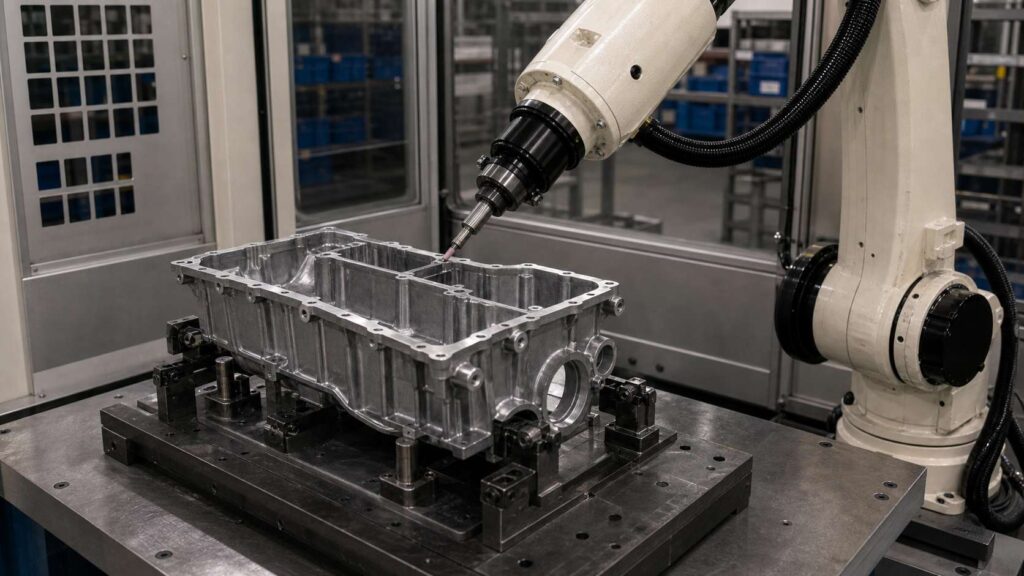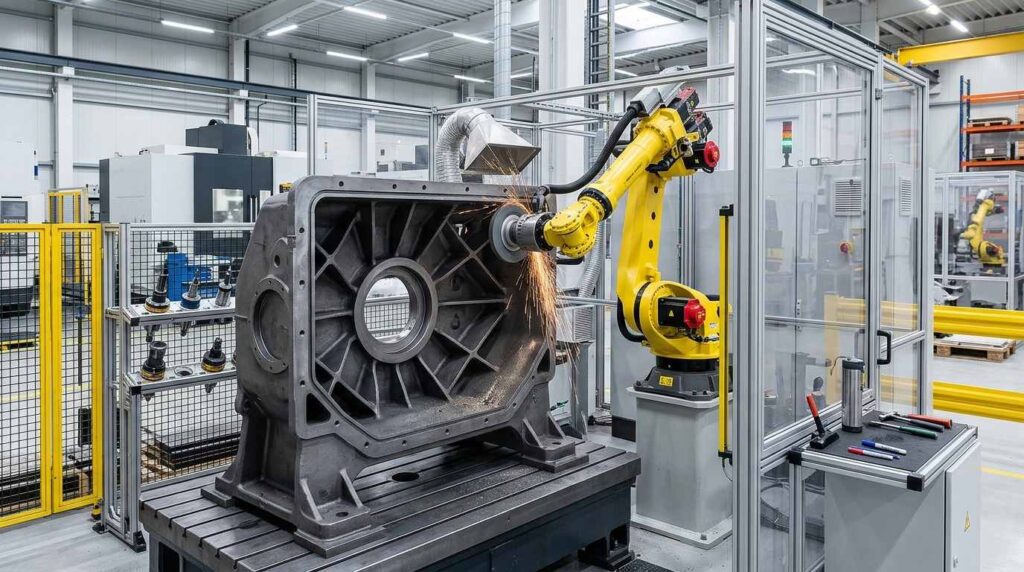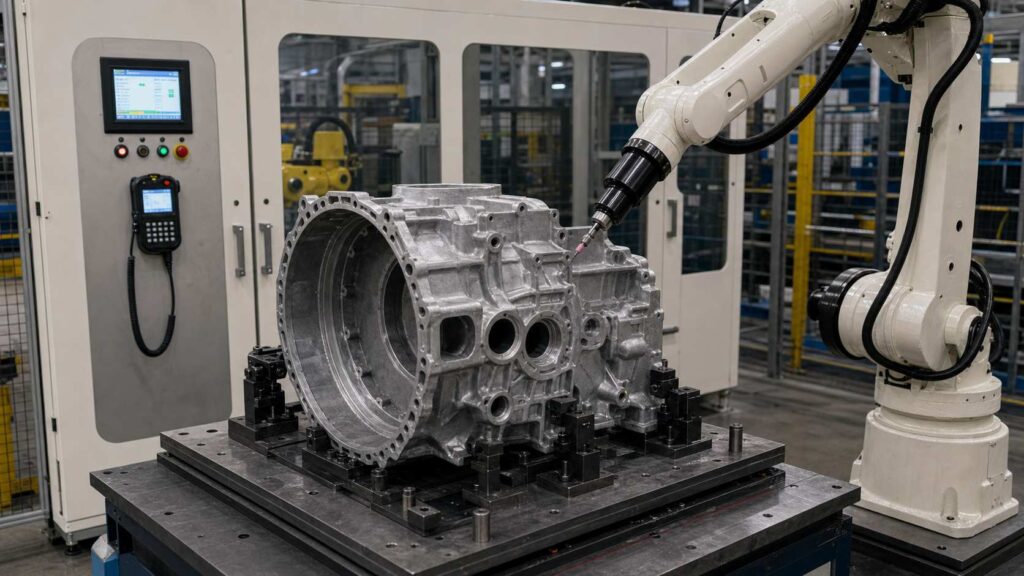
Large aluminum alloy engine gear housings are structural casting components used in automotive engine timing and gear transmission systems. As a class, these castings feature a large cavity opening, gear chamber areas, shaft holes, mounting holes, sealing flanges, reinforced ribs, thick wall sections and irregular outer contours, making post-casting deburring and local grinding more complex than on simple aluminum castings.
This robotic deburring and grinding solution is designed for large aluminum alloy engine gear housings with typical dimensions around 400–750 mm in length, depending on the engine model. It helps remove burrs, flash, parting line residues, sharp edges and local gate marks from cavity openings, shaft holes, mounting holes, sealing flanges, rib transitions and outer contours while improving finishing consistency and reducing manual grinding workload.
What Is a Large Aluminum Alloy Engine Gear Housing?
A large aluminum alloy engine gear housing is a structural casting used to enclose and protect engine gear transmission systems. It is commonly mounted at the front or side of the engine block and houses timing gears, drive gears, bearing supports and related transmission components. Compared with an engine cylinder head or cylinder block, the gear housing focuses on gear chamber protection, shaft alignment and sealing rather than combustion or fluid passage functions.
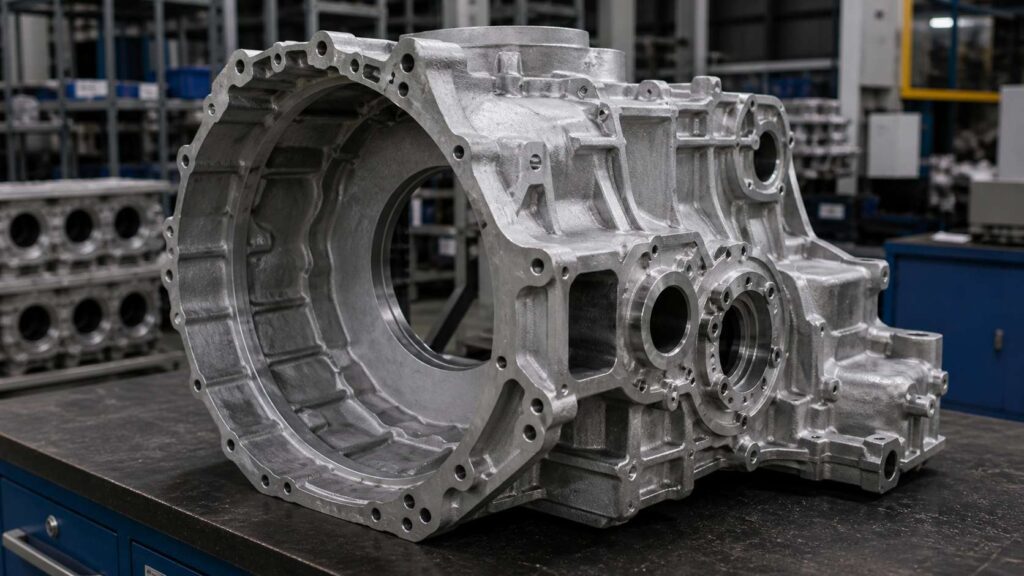
The defining feature is the large cavity opening for gear access, multiple shaft holes for gear shafts, bolt holes for mounting, continuous sealing flanges, reinforced ribs for structural strength, thick wall sections and local boss features. After casting, trimming and rough machining, burrs, flash, parting lines, gate residues or sharp edges may remain around cavity boundaries, shaft hole edges, mounting holes, flange edges, rib intersections and outer contours.
What this housing needs from finishing is deburring, controlled local grinding and edge cleanup, not a decorative surface.
| Artículo | Detalles |
|---|---|
| Nombre de la pieza | Large Aluminum Alloy Engine Gear Housing |
| Alternative Name | Timing Gear Housing / Engine Gear Cover |
| Tamaño habitual | Around 400–750 × 300–500 × 150–350 mm, depending on model |
| Material | Fundición de aleaciones de aluminio |
| Proceso principal | Robotic Deburring and Grinding |
| Procesos asistidos | Cavity Edge Deburring, Shaft Hole Treatment, Flash Removal, Local Surface Cleanup |
| Áreas clave de procesamiento | Large cavity opening, shaft holes, mounting holes, sealing flanges, reinforced ribs, thick wall sections, outer contours, gate-cut areas |
| Áreas protegidas | Bearing holes, sealing surfaces, machined mounting faces, precision shaft holes, gear chamber functional surfaces |
| Gol de la victoria | Remove burrs, flash, sharp edges and local residues while protecting precision gear-related functional surfaces |
Typical Finishing Challenges of Large Aluminum Alloy Engine Gear Housing
A large aluminum alloy engine gear housing is difficult to finish because it combines a large cavity structure with multiple precision holes, sealing flanges and reinforced ribs. Burrs may appear around cavity openings, shaft hole boundaries, mounting holes, flange edges, rib roots and thick wall transitions. These areas require different tool angles and different levels of material removal.
Manual deburring and grinding can be unstable because operators must reach into large cavity areas, work around multiple shaft holes and follow long sealing flange paths. Some burrs inside cavity corners or rib intersections may be missed, while exposed flange edges may be over-ground. Since the gear housing includes precision bearing holes and sealing surfaces, uncontrolled manual grinding may damage shaft hole surfaces, sealing faces or mounting interfaces.
| Problema habitual | Área específica | Impacto |
|---|---|---|
| Casting Flash / Parting Lines | Outer contour, sealing flange, cavity opening edges | Affects edge consistency and sealing preparation |
| Residuos de la compuerta | Gate-cut areas on thick wall sections or boss areas | Requires controlled local grinding |
| Bordes afilados | Cavity opening, shaft holes, mounting holes | Genera riesgos en la manipulación y el montaje |
| Rebabas residuales | Rib intersections, boss boundaries, local transitions | Causes unstable finishing quality and inspection issues |
| Variación manual | Repeated holes, cavity edges and flange paths | Esto da lugar a resultados inconsistentes entre los distintos operadores |
| Áreas funcionales sensibles | Bearing holes, sealing surfaces, machined mounting faces | Risk of damage during manual deburring or grinding |
Robotic Deburring and Grinding Process for Large Aluminum Alloy Engine Gear Housing
A robotic deburring and grinding cell for large aluminum alloy engine gear housings should be designed around part stability, cavity accessibility, controlled material removal and protected-surface management, and 6-axis deburring equipment is what makes the deep cavity and flange edges reachable. The process must remove burrs, flash and local residues from the housing body, cavity edges, holes and flanges while avoiding contact with bearing holes, sealing surfaces and machined mounting faces.
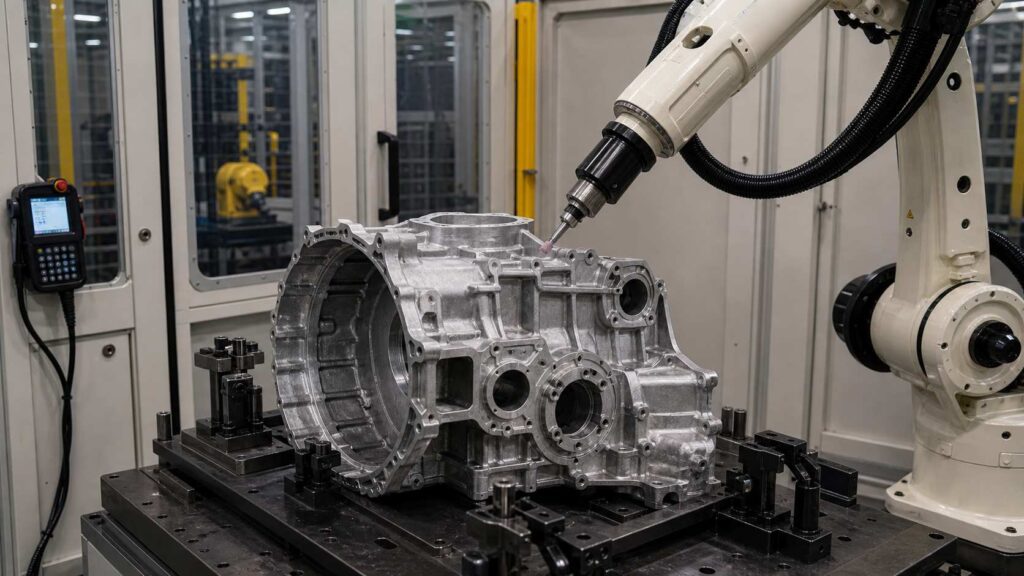
For large engine gear housings with typical dimensions around 400–750 mm in length, the process usually includes loading, program selection, protected-area confirmation, outer contour grinding, cavity opening deburring, shaft hole treatment, sealing flange cleanup, rib transition finishing, inspection and unloading. Different tools can be used for different areas, including abrasive grinding tools, flexible deburring tools, chamfering tools and small finishing heads.
| Paso | Proceso | Propósito | Herramienta / Sistema |
|---|---|---|---|
| 1 | Carga y posicionamiento | Secure the gear housing for stable multi-side access | Accesorio específico |
| 2 | Selección de programas | Match the correct housing model and robot path | Interfaz hombre-máquina / Programa de robot |
| 3 | Confirmación del área protegida | Define bearing, sealing and precision no-grind zones | Lógica de programación / Configuración del programa |
| 4 | Outer Contour and Parting Line Grinding | Remove flash and residues from external casting edges | Herramienta de rectificado abrasiva |
| 5 | Large Cavity Opening Deburring | Remove burrs and sharp edges from cavity boundaries | Herramienta de desbarbado flexible |
| 6 | Shaft Hole Edge Treatment | Deburr shaft holes and bearing-related openings | Herramienta de biselado / Eje de desbarbado |
| 7 | Sealing Flange Edge Cleanup | Clean burrs from continuous sealing flange edges | Herramienta de desbarbado flexible |
| 8 | Rib and Boss Transition Finishing | Process rib roots, boss boundaries and local transitions | Cabezal de rectificado pequeño / Herramienta adaptable |
| 9 | Control de calidad | Check burr removal and protected functional areas | Inspección manual o visual |
| 10 | Descarga y limpieza | Remove chips and transfer the gear housing | Soplado de aire / Limpieza con aspiradora |
Paso 1: Carga y colocación
The large aluminum alloy engine gear housing is loaded into a dedicated fixture that supports the casting from stable non-critical areas. Because the workpiece has a large cavity structure and multiple precision holes, fixture rigidity is important for stable robotic grinding and deburring.
The fixture should allow the robot to access the outer contour, cavity opening, shaft holes, sealing flange, ribs and mounting holes. Stable positioning also helps maintain safe clearance from protected bearing holes, sealing surfaces and machined mounting faces.
Paso 2: Selección del programa
After the gear housing is fixed, the operator selects the correct robot program through the HMI. This is important because gear housing models may vary in cavity shape, shaft hole positions, flange layout, rib structure and mounting hole patterns.
Sequence, tools, postures, feed rate, contact force and protected zones are all fixed in the program. Because the same program is recalled batch after batch, deburring and grinding results stay consistent.
Paso 3: Confirmación del área protegida
Before processing begins, the system confirms the protected areas of the gear housing. These usually include bearing holes, shaft hole surfaces, sealing faces, machined mounting surfaces, precision holes and gear chamber functional surfaces.
This step is critical because many burr-prone edges are close to precision features. The robot should remove burrs from edge boundaries and casting transitions while keeping abrasive tools away from surfaces that affect gear alignment, sealing and dimensional accuracy.
Step 4: Outer Contour and Parting Line Grinding
Work starts on the outside of the casting. Side walls, outer flanges, corner transitions, mounting bosses and gate-cut sections are the spots where flash, parting line residues, trimming marks and local defects cling, and the abrasive tool clears them one segment at a time.
An abrasive grinding tool can remove raised defects with controlled feed speed and contact pressure. For aluminum alloy gear housings, the process should avoid excessive pressure that may create deep tool marks or remove too much base material from the casting.
Step 5: Large Cavity Opening Deburring
The large cavity opening is a key feature of the gear housing. Burrs or sharp edges around cavity boundaries may appear after casting, trimming or rough machining, but the cavity surface itself must be protected.
A flexible deburring tool can clean the cavity edge with controlled pressure and a programmed path. The robot should treat only the edge boundary and avoid contact with precision gear chamber surfaces or machined functional areas.
Step 6: Shaft Hole Edge Treatment
Shaft holes are critical features that support gear shafts and bearings. Burrs around these hole edges can affect shaft insertion, bearing seating or assembly alignment.
A chamfering tool or deburring spindle can process each shaft hole with repeatable depth and angle. The robot repeats the same routine across hole groups, improving hole-edge consistency and reducing manual variation.
Step 7: Sealing Flange Edge Cleanup
The sealing flange is a continuous edge feature that requires consistent burr removal for proper gasket sealing. Light flash and sharp edges may remain around the flange after casting or trimming.
With a flexible tool tracking the flange perimeter at set contact pressure, sharp edges and loose burrs come off while the sealing surface and flange geometry stay exactly as designed.
Step 8: Rib and Boss Transition Finishing
Reinforced ribs, raised bosses and local transitions may retain small burrs after casting. These areas are often difficult to reach manually because they require frequent tool angle changes.
A small grinding head or compliant deburring tool can be used for these local features. The robot can divide the rib and boss structure into several finishing zones and process each transition with stable posture, reducing residual burrs in hidden or recessed areas.
Paso 9: Control de calidad
After robotic deburring and grinding, operators inspect the outer contours, cavity opening, shaft holes, sealing flange, mounting holes, rib transitions and gate-cut areas. The inspection verifies that every listed edge is clean and that protected surfaces came through untouched.
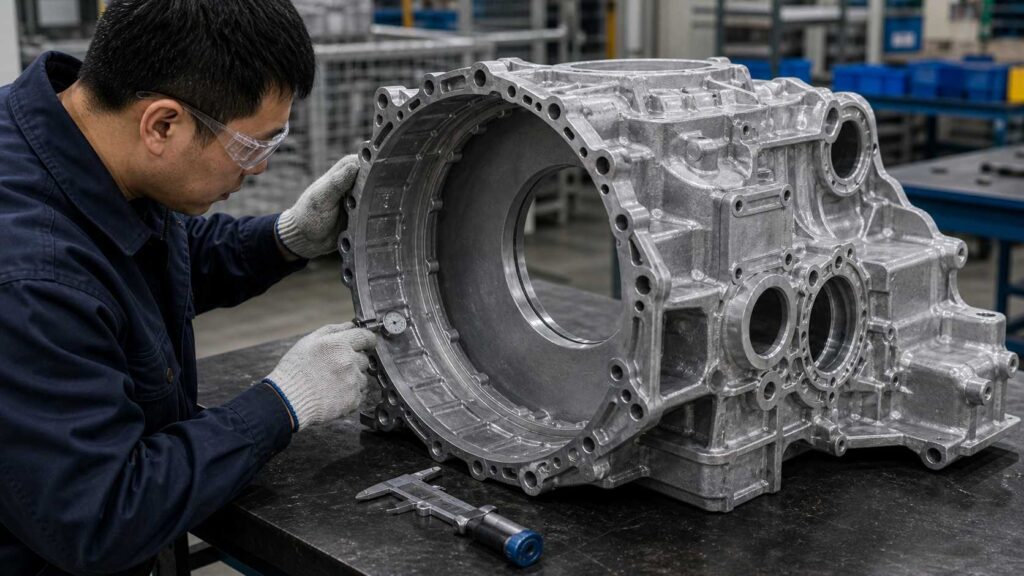
Visual checks, touch checks, gauges or camera verification can be mixed and matched to what the line needs. What the inspection finds feeds back into tool wear compensation, local path corrections and maintenance planning.
Paso 10: Descarga y limpieza
After inspection, the gear housing is unloaded and transferred to the next production process. Aluminum chips and fine particles should be removed from cavity areas, shaft holes, sealing flanges and mounting holes.
An enclosed robotic cell with aluminum chip and dust collection is recommended for gear housing deburring and grinding. It helps improve cleanliness, reduce operator exposure and create a more controlled finishing environment than open manual grinding.
Dificultades en el mecanizado y sus soluciones
| Reto | Causa | Solución robótica |
|---|---|---|
| Large Cavity Handling | Gear housing has large open cavity requiring multi-angle access | Dedicated fixture and stable robotic positioning |
| Cavity Edge Burrs | Large cavity boundaries require edge cleanup but chamber surfaces must be protected | Controlled deburring path with no-grind chamber zones |
| Shaft Hole Burrs | Multiple shaft holes retain burrs and require consistent treatment | Chamfering or deburring routine with repeatable depth |
| Sealing Flange Consistency | La brida continua crea tramos largos cerca de las zonas de las juntas | Trayectoria programada para el desbarbado del borde de la brida |
| Rib and Boss Burrs | Reinforced features create hidden burr locations | Small tool access with divided local finishing zones |
| Protección funcional de superficies | Bearing holes and sealing faces must not be damaged | Protected-zone programming and accurate fixture reference |
Difficulty 1: Large Gear Housing Positioning and Cavity Access
A large engine gear housing is a three-dimensional casting with a large cavity opening and multiple external features. The robot must reach outer contours, cavity edges, shaft holes, sealing flanges and ribs without losing tool stability.
The solution is to use a dedicated gear housing fixture with stable support and repeatable positioning. This allows the robot to approach different processing areas with predictable posture while reducing vibration during grinding and deburring.
Difficulty 2: Cavity Opening Edge Deburring Without Chamber Damage
The large cavity opening may have burrs or sharp edges around the boundary, but the gear chamber surface itself is a precision functional area. Manual deburring can be risky if the tool slips or cuts into the chamber surface.
The solution is to use a controlled deburring path with defined no-grind zones. The robot removes burrs from the cavity edge while keeping the tool away from the precision chamber wall and related machined surfaces.
Difficulty 3: Multiple Shaft Hole Edge Treatment
Shaft holes are often distributed across different surfaces of the gear housing. These holes may retain burrs that are difficult to remove consistently by hand.
The solution is to use a chamfering tool or deburring spindle with local routines for each hole. The robot processes each shaft hole edge with repeatable angle and depth, reducing missed burrs and improving inspection consistency.
Difficulty 4: Sealing Flange Edge Consistency
The sealing flange is a continuous edge feature that requires uniform burr removal for proper gasket sealing. Manual operators may create inconsistent edge conditions along the long flange path.
Here the fix is a programmed flange-edge path: the robot walks the contour under controlled pressure so burrs come off without the tool ever landing on the sealing face itself.
Difficulty 5: Protecting Bearing Holes and Mounting Interfaces
Gear housings include bearing holes, sealing faces, precision holes and machined mounting surfaces. These surfaces are close to burr-prone edges but must not be scratched or over-ground.
The solution is to define all precision features as protected zones in the robot program. The robot processes only the required burr locations and keeps abrasive tools away from functional interfaces that affect gear alignment and assembly accuracy.
Application Scenario
Scenario Background
Large timing and gear transmission housings are heavy, high-feature-count castings: before automation, every one of them needs burrs, flash, local residues and sharp edges removed by hand from outer contours, cavity openings, shaft holes, sealing flanges, ribs and mounting holes.
Manual finishing cannot hold a standard on parts this complex. Cavity corners and rib intersections come out under-processed, exposed flange edges get over-ground, and the cycle repeats every batch. A robotic deburring and grinding cell addresses all three at once: consistency, workload and protection of gear-related surfaces.
Retos técnicos
The housing geometry stacks a large cavity opening, multiple shaft holes, sealing flanges, mounting holes, bosses, ribs and substantial outer contours into one part. Burr locations span external edges and internal cavity boundaries alike, each calling for its own tool and posture.
Striking the removal-versus-protection balance is the central problem. Gate cuts and parting line residues demand local grinding on one side of the part while bearing holes, sealing faces and machined mounting surfaces on the other must remain untouched.
Solución
One way to equip the cell for this casting is a six-axis industrial robot, a dedicated housing support fixture and four tool stations: an abrasive grinding tool for outer contour flash and gate residues, a flexible deburring tool for cavity and flange edges, a chamfering tool for shaft and mounting holes, and a small grinding head for rib and boss transitions.
The program carries a full protected-surface list covering bearing holes, sealing faces, machined pads and precision holes. Its fixture holds the housing firm yet leaves every side reachable for the robot, and the enclosed cell pulls aluminum chips and dust out of the air as the tools work.
| Artículo | Configuración |
|---|---|
| Pieza de trabajo | Large Aluminum Alloy Engine Gear Housing |
| Tamaño habitual | Around 400–750 × 300–500 × 150–350 mm, depending on model |
| Proceso principal | Robotic Deburring and Grinding |
| Proceso asistido | Cavity Edge Deburring, Shaft Hole Treatment, Flash Removal, Local Surface Cleanup |
| Robot | Robot industrial de seis ejes |
| Herramientas | Abrasive grinding tool, flexible deburring tool, chamfering tool, deburring spindle, compliant finishing tool |
| Calendario | Dedicated Engine Gear Housing Support Fixture |
| Estrategia de protección | Protected bearing holes, sealing faces, machined surfaces and precision holes |
| Control del polvo | Cámara cerrada con sistema de recogida de virutas y polvo de aluminio |
Resultados de la aplicación
The robotic cell took over repetitive deburring and grinding work on outer contours, cavity opening, shaft holes, sealing flanges, mounting holes, rib transitions and local gate-cut areas. With the robot doing the finishing, personnel cover loading, unloading, inspection and tool maintenance only, and batch quality stops wandering between operators.
The controlled process also improved protection for precision gear-related surfaces. Instead of relying only on manual tool control, the robot followed saved paths with defined protected zones, reducing the risk of accidental contact near bearing holes, sealing faces and mounting surfaces.
| Área de resultados | Mejora |
|---|---|
| Outer Contour Quality | More stable cleanup along casting edges and side-wall contours |
| Cavity Edge Deburring | Controlled burr removal around large cavity boundaries |
| Shaft Hole Treatment | Repeatable deburring around shaft and bearing holes |
| Sealing Flange Cleanup | Consistent edge condition along continuous flange path |
| Rib and Boss Finishing | Reduced missed burrs in rib roots and boss transitions |
| Gate / Parting Line Cleanup | Dedicated local paths for thicker casting residues |
| Protección funcional de superficies | Lower risk of damage to bearing holes and sealing faces |
| Reducción de la mano de obra | Reduced repetitive manual deburring and grinding workload |
| Estabilidad de la producción | Saved programs for repeated gear housing batches |
| Entorno del taller | Zona de acabado más limpia con un sistema cerrado de recogida de virutas de aluminio |
Información necesaria para una propuesta de rectificado robotizado
To recommend a suitable robotic deburring and grinding cell for your large aluminum alloy engine gear housing, we usually need the part drawing, material grade, casting weight, photos of burrs, flash, cavity residues or gate-cut areas, required processing areas, protected bearing or sealing surfaces, current manual cycle time and annual production volume.
Fixture design, robot reach, tool selection, chip collection layout and feasibility can all be judged from these details. For large aluminum alloy engine gear housings, it is especially important to identify which cavity edges, shaft holes, flange boundaries and outer contours require burr removal, and which bearing holes, sealing faces and precision holes must be protected during robotic finishing.
PREGUNTAS FRECUENTES
Q1: Is an engine gear housing the same as an engine cylinder head or cylinder block?
All three are distinct. An engine gear housing is a transmission-related casting that encloses timing gears and drive gears. An engine cylinder head includes combustion chamber and port features, while a cylinder block is the main engine body with cylinder bores. All three are different components with different functions and deburring requirements; for a transmission main case in the same family, see our CVT transmission main housing deburring and grinding solution.
Q2: Why is robotic deburring and grinding suitable for engine gear housings?
Robotic deburring and grinding are suitable because gear housings have large cavity openings, multiple shaft holes, continuous sealing flanges and reinforced ribs. A robot can follow programmed paths with controlled contact force, improving consistency compared with manual finishing.
Q3: What areas can the robot process on an engine gear housing?
The robot can process outer contours, cavity opening edges, shaft holes, sealing flanges, mounting holes, boss boundaries, rib transitions, parting line areas and local gate residues. Drawing review and a burr survey on sample castings define exactly where the robot may cut.
Q4: Does this part require decorative polishing?
Engine gear housings carry no decorative-polishing requirement in normal applications. The work is deburring, local grinding, flash removal, cavity edge cleanup and edge rounding. If finer surface work is needed elsewhere on your line, our robotic polishing machine guide covers that equipment separately.
Q5: How are bearing holes and sealing surfaces protected during grinding?
Bearing holes, sealing faces and precision holes are protected through fixture positioning, robot path planning and no-grind zones. The abrasive only ever touches the specific edge or residue area it was sent to; bearing holes, sealing faces and other critical surfaces are off-limits in the path plan.
Q6: Can one robotic cell handle different gear housing models?
Yes. One robotic cell can often handle different aluminum alloy engine gear housing models if the fixture, robot reach and tooling are designed for part variation. Different robot programs can be saved for different cavity shapes, shaft hole patterns or part numbers.
Conclusión
Large aluminum alloy engine gear housings have large cavity openings, multiple shaft holes, sealing flanges, mounting holes, ribs and substantial outer contours, making manual deburring and grinding difficult to standardize. A robotic deburring and grinding solution helps manufacturers remove burrs, flash, sharp edges and local residues while improving consistency and protecting critical gear-related functional surfaces.
If your engine gear housing production still relies on manual cavity edge deburring, shaft hole treatment, sealing flange cleanup or local casting residue grinding, Contacte con nosotros for a customized robotic solution. Broader context is in our Automoción y VE applications; for machine dimensions and tool options see Equipamiento.